Shakespeariana – XXXV

Beauty and kindness

Franz Schubert (1797 - 1828): An Silvia, Lied for voice and piano op. 106 n. 4, D 891 (1826); lyrics by William Shakespeare (from The Two Gentlemen of Verona, act 4, scene 2), German translation by Eduard von Bauernfeld. Fritz Wunderlich, tenor; Hubert Giesen, piano.

Was ist Silvia, saget an,
Dass sie die weite Flur preist?
Schön und zart seh’ ich sie nah’n,
Auf Himmels Gunst und Spur weist,
Dass ihr alles untertan.

Ist sie schön und gut dazu?
Reiz labt wie milde Kindheit;
Ihrem Aug’ eilt Amor zu,
Dort heilt er seine Blindheit,
Und verweilt in süsser Ruh’.

Darum Silvia, tön’, o Sang,
Der holden Silvia Ehren;
Jeden Reiz besiegt sie lang,
Den Erde kann gewähren:
Kränze ihr und Saitenklang!

Who is Silvia? what is she,
That all our swains commend her?
Holy, fair, and wise is she;
The heaven such grace did lend her,
That she might admirèd be.

Is she kind as she is fair?
For beauty lives with kindness.
Love doth to her eyes repair,
To help him of his blindness;
And, being helped, inhabits there.

Then to Silvia let us sing,
That Silvia is excelling;
She excels each mortal thing
Upon the dull earth dwelling;
To her let us garlands bring

Nicht diese Küsse

Ludwig van Beethoven (c16 dicembre 1770 - 1827): Der Kuß (Il bacio), arietta per voce e pianoforte op. 128 (1822) su testo di Christian Felix Weisse. Fritz Wunderlich, tenore; Hubert Giesen, pianoforte (in concerto, Festival di Salisburgo 1965).

Ich war bei Chloen ganz allein,
Und küssen wollt’ ich sie;
Jedoch sie sprach,
Sie würde schrein:
Es sei vergebne Müh’.

Ich wagt’ es doch und küßte sie,
Trotz ihrer Gegenwehr.
Und schrie sie nicht?
Jawohl, sie schrie,
Doch lange hinterher.

(Ero tutto solo con Cloe e volevo baciarla; ma lei disse che avrebbe gridato: fatica sprecata.
Osai ugualmente e la baciai, nonostante la sua riluttanza. E non gridò? Ma certo, gridò, però molto tempo dopo.)

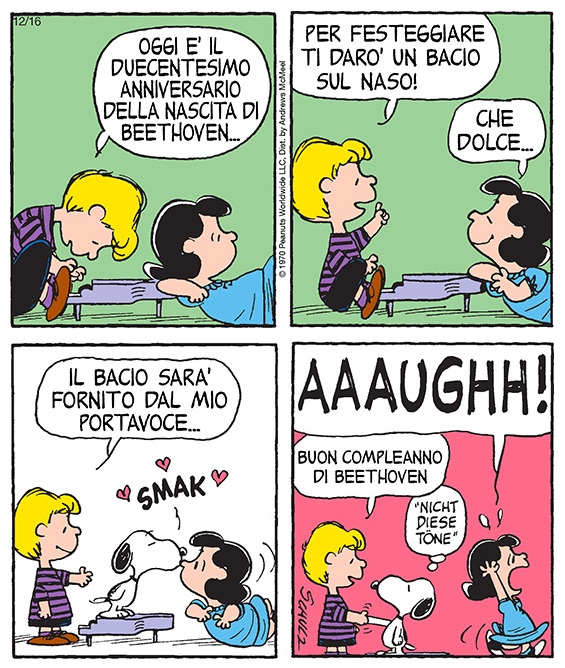
Peanuts di Charles M. Schulz,
16 dicembre 1970