The woods so wild

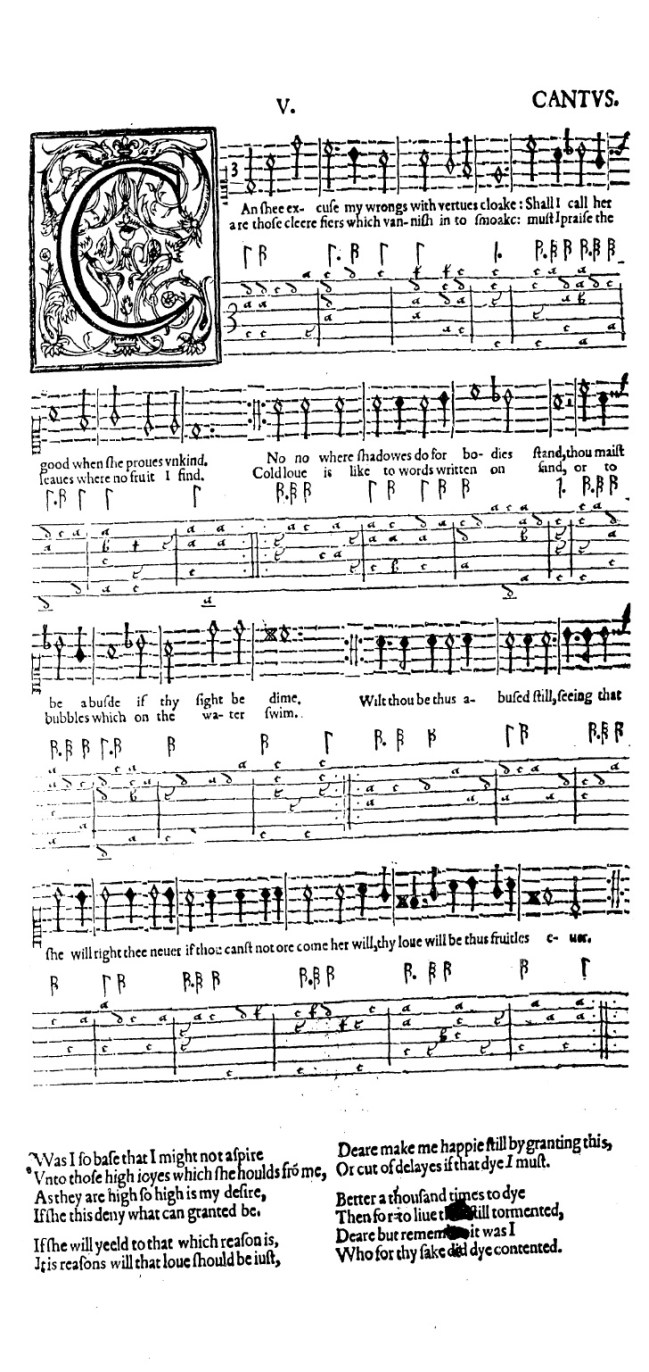
John Dowland (1563 - 1626): Can she excuse my wrongs, ayre, dal First Booke of Songes or Ayres (1597). Emma Kirkby, soprano; Anthony Rooley, liuto.

Can she excuse my wrongs with Virtue’s cloak?
Shall I call her good when she proves unkind?
Are those clear fires which vanish into smoke?
Must I praise the leaves where no fruit I find?
 No, no; where shadows do for bodies stand,
 That may’st be abus’d if thy sight be dim.
 Cold love is like to words written on sand,
 Or to bubbles which on the water swim.
Wilt thou be thus abused still,
Seeing that she will right thee never?
If thou canst not o’ercome her will,
Thy love will be thus fruitless ever.

Was I so base, that I might not aspire
Unto those high joys which she holds from me?
As they are high, so high is my desire,
If she this deny, what can granted be?
 If she will yield to that which reason is,
 It is reason’s will that love should be just.
 Dear, make me happy still by granting this,
 Or cut off delays if that I die must.
Better a thousand times to die
Than for to live thus still tormented:
Dear, but remember it was I
Who for thy sake did die contented.

Il testo – adattato a un tema di gagliarda: in qualche fonte, la versione strumentale del brano (qui) reca il titolo The Earl of Essexhis ] Galliard – fa forse riferimento alle vicende di Robert Devereux, 2° conte di Essex (1566-1601), che potrebbe essere l’autore dei versi. È probabile che sia da collegarsi a Robert Devereux la citazione della melodia tradizionale The woods so wild, da Dowland inserita nel terzo periodo, affidata a una voce intermedia (tenore; testo: Wilt thou be thus abused still ecc.): farebbe riferimento al fatto che il conte di Essex soleva ritirarsi in una casa di sua proprietà, sita nei boschi a nord-est di Londra.
The woods so wild è un ballad assai diffuso in epoca Tudor: pare che fosse par­ti­co­lar­mente caro a Enrico VIII. Variazioni sulla melodia si devono a William Byrd (riportate dal Fitzwilliam Virginal Book e dal My Lady Nevell’s Book) e a Orlando Gibbons.


William Byrd (c1540 - 1623): The Woods so Wilde, variazioni. Michael Maxwell Steer, clavicembalo.


Orlando Gibbons (1583 - 1625): The Woods so Wild, variazioni. Michael Maxwell Steer, clavicembalo.


Un’altra interpretazione del brano di Dowland, ove la parte che comprende la citazione della melodia tradizionale è eseguita con un flauto dolce. Karin Gyllenhammar, soprano; Mirjam-Luise Münzel, flauto; David Leeuwarden, liuto; Alina Rotaru, clavicembalo.
Dowland - Can she

Six Songs

Denis ApIvor (14 aprile 1916 - 2004): Six Songs per voce e pianoforte. Moira Harris, soprano; Wills Morgan, tenore; Richard Black, pianoforte.

  1. A hert tae break (testo: anonimo scozzese, 1946)
  2. As the holly groweth green (Enrico VIII; 1936) [2:35]
  3. Flos Lunae (Ernest Christopher Dowson; 1939) [4:15]
  4. Maw Bonnie Lad (anonimo scozzese; 1974-75) [7:49]
  5. Spleen (Dowson; 1939) [9:23]
  6. Villanelle (Dowson; 1939) [13:52]

Shakespeariana – XXXIII

English translation: please click here.

Il suon d’argento


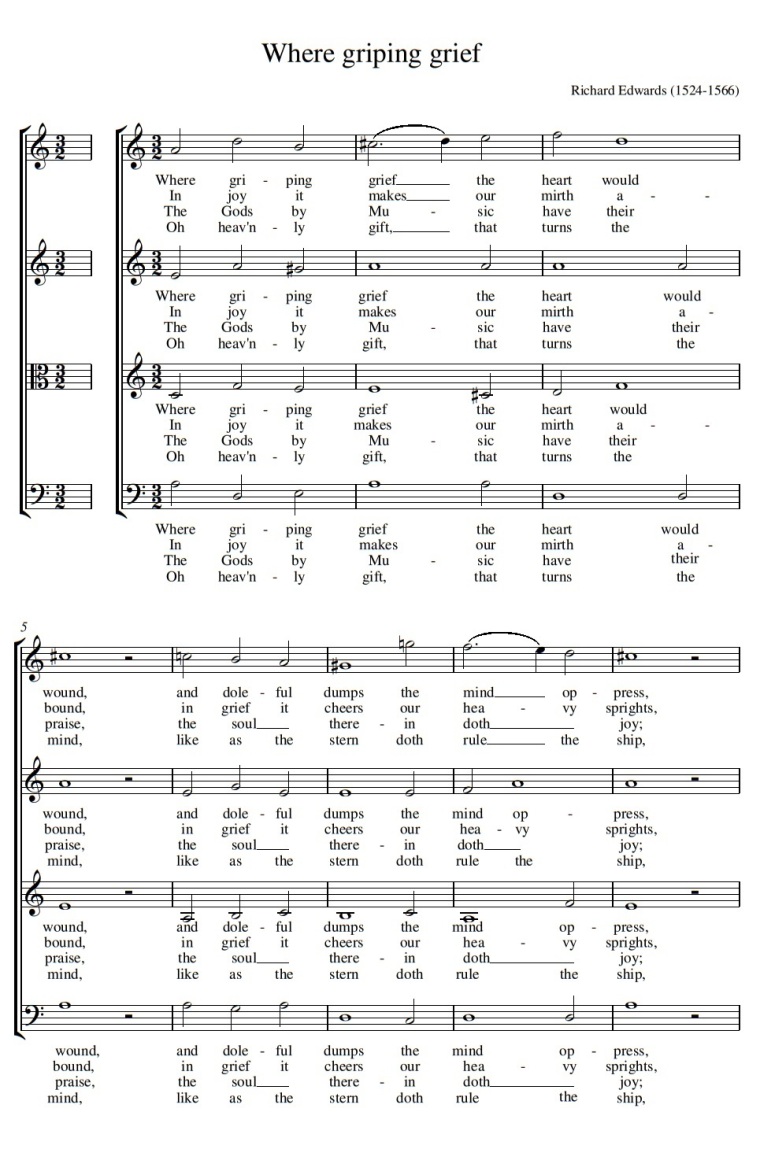
Anonimo (probabilmente Richard Edwardes, 1525 - 1566): Where griping grief. Versione per voce (soprano) e liuto: Emma Kirkby e Anthony Rooley. Versione a 4 voci: Deller Consort.

Where griping grief the heart would wound
 And doleful dumps the mind oppress,
There music with her silver sound
 Is wont with speed to give redress
Of troubled minds, for ev’ry sore,
 Sweet music hath a salve in store.

In joy it makes our mirth abound,
 In grief it cheers our heavy sprites,
The careful head relief hath found,
 By music’s pleasant sweet delights;
Our senses, what should I say more,
 Are subject unto Music’s law.

The gods by music have their praise,
 The soul therein doth joy;
For as the Roman poets say,
 In seas whom pirates would destroy,
A dolphin saved from death most sharp,
 Arion playing on his harp.

O heavenly gift, that turns the mind,
 Like as the stern doth rule the ship,
Of music whom the gods assigned,
 To comfort man whom cares would nip,
Since thou both man and beast doth move,
 What wise man then will thee reprove.


Forse figlio illegittimo di Enrico VIII, Richard Edwardes fu poeta, autore drammatico, gen­tiluo­mo della Chapel Royal e maestro del coro di voci bianche della medesima istituzione sotto le regine Maria e Elisabetta I. Nei suoi ultimi anni compilò un’ampia silloge di testi poetici di autori diversi, cui aggiunse, firmandoli, alcuni componimenti propri, e fra questi appunto Where gripyng grief, con il titolo In commendation of Musick. La raccolta, intitolata The Paradise of Dainty Devices, fu pubbli­cata postuma nel 1576, a cura di Henry Disle; dei molti volumi mi­scel­la­nei dati alle stampe in quel periodo fu il più fortunato, tant’è vero che fu ristampato nove volte nei successivi trent’anni.
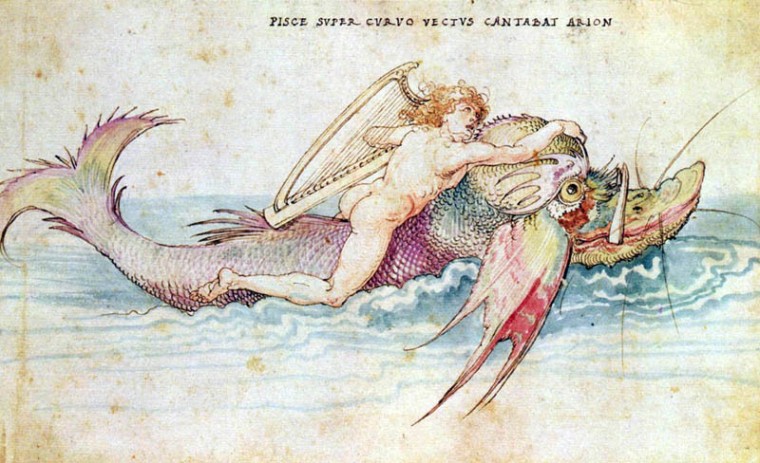
Del testo si trovano, anche nel web, numerose varianti, quasi tutte di poco conto, a cominciare da «When… Then…» invece di «Where… There…» nella prima strofa; ma è chiaramente un errore l’«Anon» che non di rado sostituisce «Arion» all’inizio dell’ultimo verso della terza strofa: Edwardes fa infatti riferimento a Arione di Métimna, l’antico citaredo che secondo Erodoto inventò il ditirambo e che, racconta il mito, si salvò da sicura morte in mare lasciandosi portare a riva da un delfino che aveva ammaliato con il canto.

Dürer: Arion (c1514)
Albrecht Dürer: Arion (c1514)

Le due fonti manoscritte che ci hanno tramandato la musica di Where griping grief (il Mulliner Book, raccolta di composizioni per strumento a tastiera databile fra il 1550 e il 1585 circa; e il Brogyntyn Lute Book, c1595) non riportano né il testo né il nome dell’autore: si ritiene probabile che anche la musica sia dello stesso Edwardes. La melodia è finemente cesellata; pur procedendo prevalentemente per gradi congiunti, presenta non pochi intervalli più ampi, fra cui un’insolita (per l’epoca) ottava diminuita — sulle parole «dumps the» nel secondo verso della prima strofa.

Il brano doveva essere abbastanza noto all’epoca di Shakespeare, perché questi lo cita in una scena di Romeo e Giulietta. Alla fine del IV atto, dopo che la Nutrice ha rinvenuto il corpo esanime della giovane Capuleti e un cupo inatteso dolore strazia i suoi familiari, alcuni musicisti, che erano stati convocati per allietare la festa delle nozze di Giulietta con il conte Paride, ripongono mestamente gli strumenti e stanno per andarsene quando sopraggiunge Pietro (servitore della Nutrice) e chiede ai musici di suonare per lui; gli altri rispondono che non è il momento adatto per far musica, sicché Pietro inizia a battibeccare con loro e infine, citando Where griping grief, trova il modo di insolentirli. La scena consiste in una lunga serie di giochi di parole a sfondo musicale, da alcuni critici considerati di bassa lega — tanto che qualche traduttore italiano ha pensato bene di omettere l’intero passo. Ma secondo me la scena non è affatto priva di interesse, ragion per cui la riporto qui di seguito: a sinistra l’originale inglese, a destra non esattamente una traduzione, ma piuttosto una reinterpretazione, con alcune esplicite allusioni a musiche famose ai tempi del Bardo e già note ai frequentatori di questo blog.

PETER
Musicians, O musicians, Heart’s Ease, Heart’s Ease. O, an you will have me live, play Heart’s Ease.
PIETRO
Musici, o musici, Chi passa, Chi passa. Se volete ch’io viva, suonate Chi passa.
FIRST MUSICIAN
Why Heart’s ease?
1° MUSICO
Perché Chi passa?
PETER
O musicians, because my heart itself plays My Heart is Full. O, play me some merry dump to comfort me.
PIETRO
O musici, perché il mio cuore sta danzando un passamezzo che non passa. Prego, suonate qualche allegro lamento per confortarmi.
FIRST MUSICIAN
Not a dump, we. ‘Tis no time to play now.
1° MUSICO
No, niente lamenti. Non è il momento di suonare.
PETER
You will not then?
PIETRO
Non volete suonare?
FIRST MUSICIAN
No.
1° MUSICO
No.
PETER
I will then give it you soundly.
PIETRO
Allora ve le suonerò io, sentirete.
FIRST MUSICIAN
What will you give us?
1° MUSICO
Che cosa sentiremo?
PETER
No money, on my faith, but the gleek. I will give you the minstrel.
PIETRO
Oh, non un tintinnar di monete, ve l’assicuro, ma piuttosto una canzon…atura. Ecco, vi tratterò da menestrelli.
FIRST MUSICIAN
Then I will give you the serving creature.
1° MUSICO
E allora noi ti tratteremo da giullare.
PETER
Then will I lay the serving creature’s dagger on your pate. I will carry no crotchets. I’ll re you, I’ll fa you. Do you note me?
PIETRO
E allora riceverete la sonagliera del giullare sulla zucca. Vi avevo chiesto lamenti e mi date capricci. Così ve le suonerò: prendete nota.
FIRST MUSICIAN
An you re us and fa us, you note us.
1° MUSICO
Se ce le suoni, prenderemo davvero le tue note.
SECOND MUSICIAN
Pray you, put up your dagger and put out your wit.
2° MUSICO
Per favore, riponi la tua sonagliera e va’ adagio.
PETER
Then have at you with my wit. I will dry-beat you with an iron wit and put up my iron dagger. Answer me like men.
(sings)
 When griping grief the heart doth wound
 And doleful dumps the mind oppress,
 Then Music with her silver sound—
Why «silver sound»? Why «Music with her silver sound»? What say you, Simon Catling?
PIETRO
Andrò a mio agio e vi metterò a disagio. I miei adagi non sono meno pesanti della sonagliera. Rispondete dunque, da uomini, ai miei colpi.
(canta)
 Quando ferisce il cuore arduo tormento
 E la mente grava penoso tedio,
 Allora Musica dal suon d’argento…
Perché «suon d’argento»? Perché dice «Musica dal suon d’argento»? Tu che ne dici, Simon Cantino?
FIRST MUSICIAN
Marry, sir, because silver hath a sweet sound.
1° MUSICO
Diamine, signore, perché l’argento ha un dolce suono.
PETER
Prates. What say you, Hugh Rebeck?
PIETRO
Ciance. E tu che dici, Ugo Ribeca?
SECOND MUSICIAN
I say, «silver sound» because musicians sound for silver.
2° MUSICO
Dico: «suon d’argento» perché i musicisti suonano per guadagnarsi dell’argento.
PETER
Prates too. What say you, James Soundpost?
PIETRO
Ciance anche queste. E tu, Giaco Bischero?
THIRD MUSICIAN
Faith, I know not what to say.
3° MUSICO
In fede mia, non so che dire.
PETER
Oh, I cry you mercy, you are the singer. I will say for you. It is «Music with her silver sound» because musicians have no gold for sounding.
(sings)
 Then Music with her silver sound
 With speedy help doth lend redress.
(exit)
PIETRO
Oh, ti chiedo scusa: tu sei quello che canta. Be’, risponderò io per te: dice «Musica col suon d’argento» perché i musicisti non hanno mai oro da far risonare.
(canta)
 Allora Musica dal suon d’argento
 Con lesto soccorso pone rimedio.
(esce)
FIRST MUSICIAN
What a pestilent knave is this same!
1° MUSICO
Che pestifero furfante è costui!
SECOND MUSICIAN
Hang him, Jack! Come, we’ll in here, tarry for the mourners and stay dinner.
(exeunt)
2° MUSICO
Lascialo perdere! Venite, entriamo: aspette­remo quelli che verranno per il funerale e ci fermeremo a pranzo.
(escono)

Shakespeariana – XXXIII

Her silver sound


Anonymous (probably Richard Edwardes, 1525 - 1566): Where griping grief. Two versions:
– as a song for 1 voice (soprano) and lute: Emma Kirkby and Anthony Rooley.
– as a partsong for 4 voices: the Deller Consort.

Where griping grief the heart would wound
 And doleful dumps the mind oppress,
There music with her silver sound
 Is wont with speed to give redress
Of troubled minds, for ev’ry sore,
 Sweet music hath a salve in store.

In joy it makes our mirth abound,
 In grief it cheers our heavy sprites,
The careful head relief hath found,
 By music’s pleasant sweet delights;
Our senses, what should I say more,
 Are subject unto Music’s law.

The gods by music have their praise,
 The soul therein doth joy;
For as the Roman poets say,
 In seas whom pirates would destroy,
A dolphin saved from death most sharp,
 Arion playing on his harp.

O heavenly gift, that turns the mind,
 Like as the stern doth rule the ship,
Of music whom the gods assigned,
 To comfort man whom cares would nip,
Since thou both man and beast doth move,
 What wise man then will thee reprove.


Richard Edwardes, possibly an illegitimate son of Henry VIII, was a poet, playwright, gentleman of the Chapel Royal and choirmaster of the same institution in the reigns of Mary and Elizabeth I. In his later years he compiled an extensive anthology of poems by various authors, adding his own, including Where griping grief (under the title In commendation of Musick). The anthology, titled The Paradise of Dainty Devices, appeared posthumously in 1576, edited by Henry Disle; it was the most successful of the numerous miscellaneous books printed at the end of the sixteenth century: it was in fact reprinted nine times in the following thirty years.

There are, even on the Internet, many variants of Where griping grief, almost all of little importance, such as for example «When… Then…» instead of «Where… There…» in the first line; but the «Anon» which often replaces «Arion» at the beginning of the last line of the third stanza is clearly a mistake: Edwardes in fact refers to Arion of Methymna, a kitharode in ancient Greece credited with inventing the dithyramb: according to the myth, Arion was saved from certain death at sea by being carried ashore by a dolphin that he had enchanted with his own singing.

Dürer: Arion (c1514)
Albrecht Dürer: Arion (c1514)

The two manuscript sources that have handed down the music of Where griping grief (the Mulliner Book, a collection of pieces for keyboard instrument dating between about 1550 and 1585; and the Brogyntyn Lute Book, c1595) do not bear neither the text nor the name of the composer: the music is thought to be probably by Edwardes himself. Where griping grief has a finely chiseled tune; though proceeding mainly in joint degrees, it has several larger intervals, including an unusual (at that time) diminished octave — to the words «dumps the» in the second line of the first stanza.

Where griping grief must have been quite well known in Shakespeare’s time, so much so that its first stanza is quoted in a scene from Romeo and Juliet, at the end of the fourth act, after the Nurse has found the lifeless body of the young Capulet and a gloomy unexpected pain torments his relatives; the news also saddens some musicians, who had been summoned to cheer Juliet’s wedding party: they are putting away their instruments before leaving when Peter (the Nurse’s servant) asks them to play for him; since the musicians have no intention of pleasing him, Peter begins to argue with them and finally, quoting Where griping grief, finds a way to insult them.

PETER

Answer me like men.
(sings)
 When griping grief the heart doth wound
 And doleful dumps the mind oppress,
 Then Music with her silver sound—
Why «silver sound»? Why «Music with her silver sound»? What say you, Simon Catling?

FIRST MUSICIAN

Marry, sir, because silver hath a sweet sound.

PETER

Prates. What say you, Hugh Rebeck?

SECOND MUSICIAN

I say, «silver sound» because musicians sound for silver.

PETER

Prates too. What say you, James Soundpost?

THIRD MUSICIAN

Faith, I know not what to say.

PETER

Oh, I cry you mercy, you are the singer. I will say for you. It is «Music with her silver sound» because musicians have no gold for sounding.
(sings)
 Then Music with her silver sound
 With speedy help doth lend redress.
(exit)

Musica di sua maestà: Enrico VIII d’Inghilterra – II

Alcune diverse interpretazioni di Tander naken, brano composto dal re Enrico VIII d’Inghilterra sulla melodia della canzone renana quattrocentesca Tandernaken («A Andernach»).

  1. Aldo Bova e Ernst Stolz
  2. Purcell Consort Of Voices, dir. Grayston Burgess, e Musica Reservata, dir. Michael Morrow
  3. Ensemble Quintessential

Tander naken

Musica di sua maestà: Enrico VIII d’Inghilterra – I

Enrico VIII d’Inghilterra (1491 - 1547): Pastime with good company, partsong a 3 voci. The King’s Singers.

Testo (in inglese moderno):

Pastime with good company
I love and shall until I die.
Grudge who likes, but none deny,
So God be pleased, thus live will I.
   For my pastance:
   Hunt, sing, and dance.
   My heart is set!
   All goodly sport
   For my comfort.
   Who shall me let?

Youth must have some dalliance,
Of good or ill some pastance.
Company I think then best –
All thoughts and fantasies to digest.
   For idleness
   Is chief mistress
   Of vices all.
   Then who can say
   But mirth and play
   Is best of all?

Company with honesty
Is virtue – vices to flee.
Company is good and ill,
But every man has his free will.
   The best ensue,
   The worst eschew,
   My mind shall be.
   Virtue to use,
   Vice to refuse,
   Thus shall I use me!

Uomo di vasta cultura, il secondo re della dinastia Tudor si cimentò anche nella creazione di brani musicali. Pastime with good company è la più famosa fra le sue composizioni.
Enrico VIII è anche tradizionalmente considerato l’estensore del testo di Greensleeves, che sarebbe stato scritto per Anna Bolena. L’attribuzione appare tuttavia assai poco attendibile, in quanto i più antichi documenti relativi a Greensleeves risalgono agli ultimi anni del Cinquecento, quando il presunto autore era morto da decenni. D’altra parte, è davvero curioso che al sovrano siano stati attribuiti i versi e non anche la melodia, considerato che le non irrilevanti qualità del sovrano in ambito musicale erano ben note.

Il lamento di Lady Carey

Anonimo: My Lady Carey’s Dompe (c1530). Ernst Stolz, spinetta.
Secondo alcuni studiosi, il termine dompe trarrebbe origine dall’irlandese dump, che significa lamento. My Lady Carey’s Dompe — tramandato senza il nome del suo autore dal manoscritto Roy. App. 58 della British Library, redatto verso il 1530 — potrebbe essere opera di Hugh Aston, insigne musicista da annoverarsi fra i più originali e innovativi compositori dell’epoca Tudor.
« My Lady Carey » è assai probabilmente Maria Bolena, sorella di Anna: nata intorno all’anno 1500, sposò sir William Carey, uno dei favoriti di Enrico VIII, nel 1520 e ne rimase vedova otto anni dopo. Dal 1522 al 1525 fu una delle amanti del re, il quale fu forse il vero padre dei suoi due figli. Morendo, sir Carey lasciò in eredità molti debiti alla vedova, che per sopravvivere fu perfino costretta a dare in pegno i propri gioielli, prima che Anna, nel frattempo divenuta moglie di Enrico, riuscisse a farle ottenere una pensione. Nel 1534 Maria sposò segretamente William Stafford, un militare di buona famiglia ma di scarse risorse; questo matrimonio le alienò i favori del sovrano e di Anna: fu allontanata dalla corte e visse gli ultimi anni nell’ombra. Morì nel 1543.