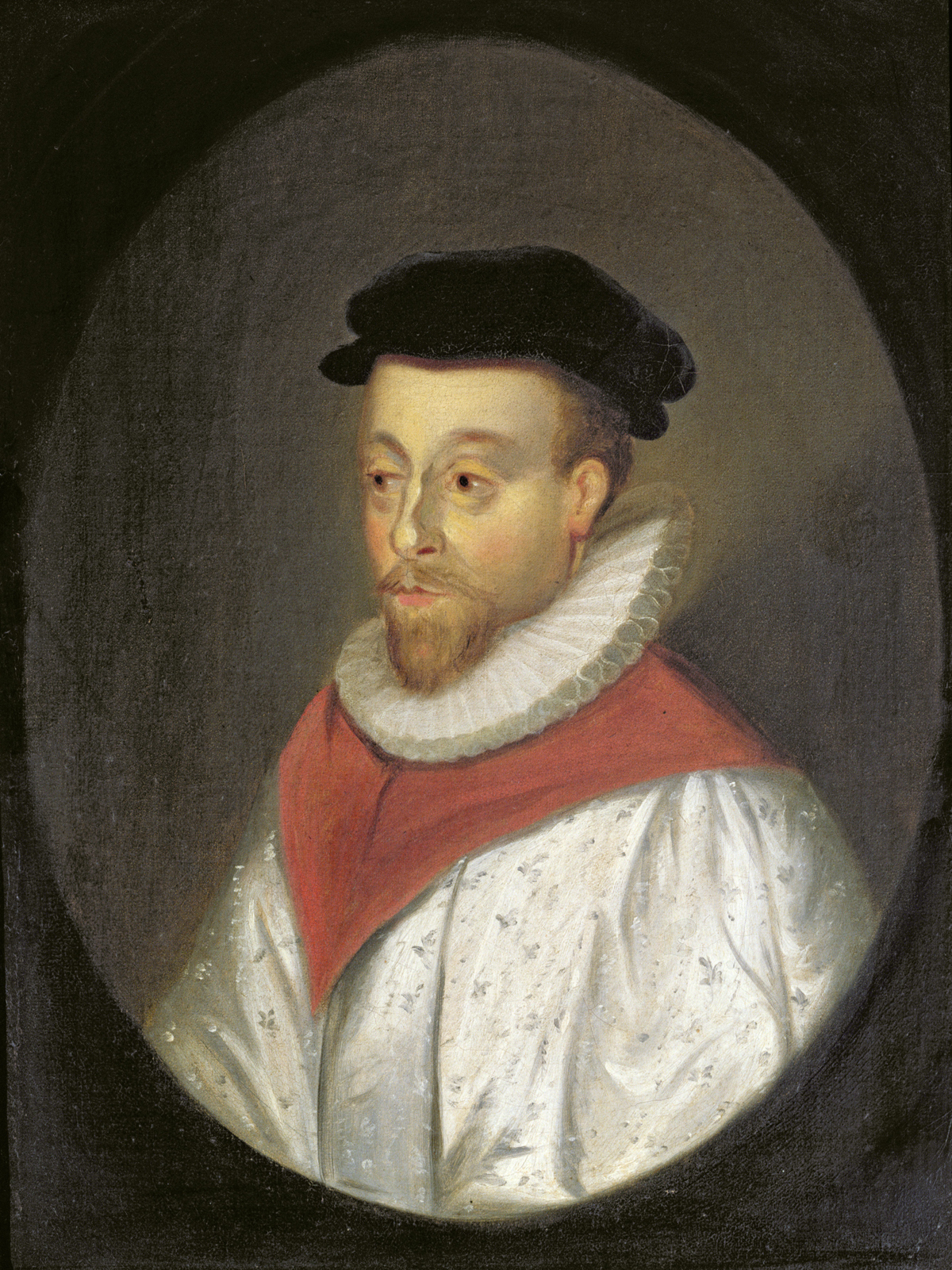
Who’s the fool, now?

Thomas Ravenscroft (c1582 - c1633): Martin said to his man, partsong a 4 voci (da Deuteromelia, 1609, n. 16). Pro Cantione Antiqua.

  1. Martin said to his man
      (fie, man, fie!),
     Martin said to his man
      (who’s the foole, now?),
     Martin said to his man:
    Fill thou the cup and I the can.
     Thou hast well drunken, man!
     Who’s the foole, now?

  2. I see a sheep shearing corn
    And a couckold blow his horn.

  3. I see a man in the Moone,
    Clowting of Saint Peters shoone.

  4. I see a hare chase a hound,
    Twenty mile aboue the ground.

  5. I see a goose ring a hog.
    And a snayle that did bite a dog.

  6. I see a mouse catch the cat,
    And the cheese to eate the rat.

Quando la musica è puro spasso: un partsong fra i meglio riusciti di Ravenscroft magistralmente interpretato dal complesso vocale diretto da Mark Brown. Alcuni allegri ubriaconi, fra un boccale e l’altro, si divertono a spararle sempre più grosse, fino a quando uno non eccede; da ammirarsi l’arte con cui gli interpreti variano continuamente l’intonazione del testo. L’ultima fanfaronata è totalmente inverosimile: il suo autore lo sa benissimo, perciò è un po’ imbarazzato e parla/canta sottovoce: segue un attimo di silenzio che ben rappresenta lo sconcerto generale, poi l’allegra e rapida conclusione. Bravissimi tutti.

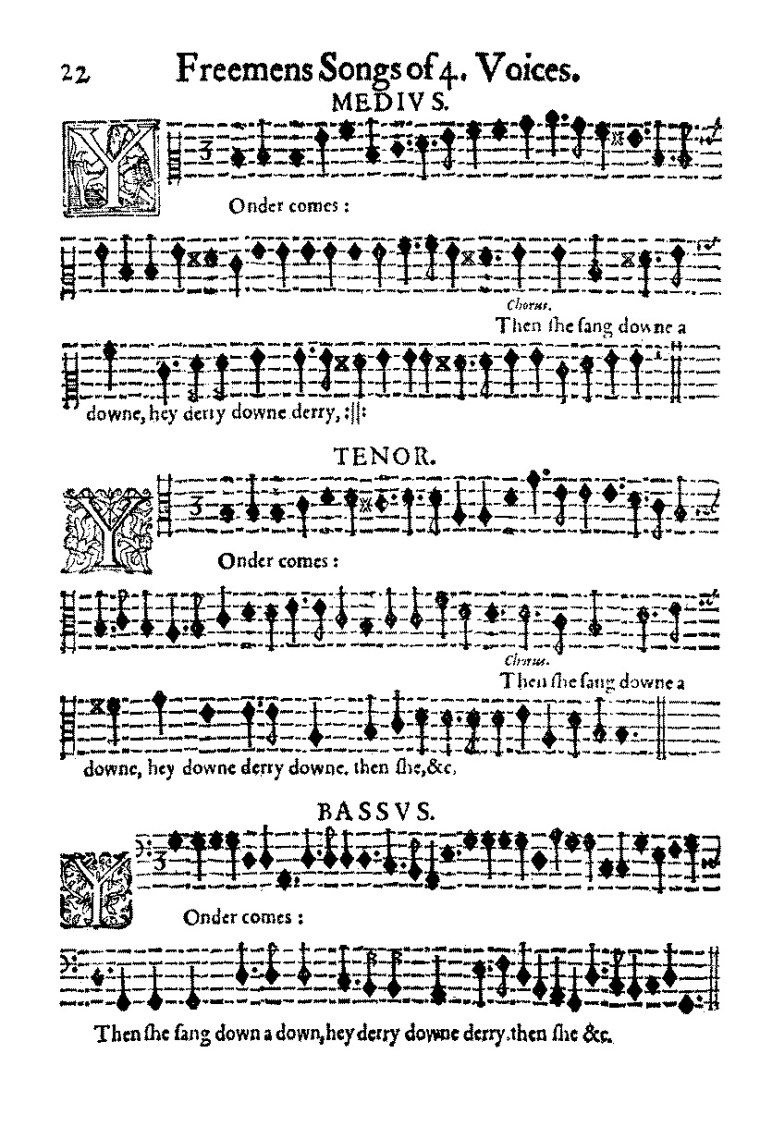
Folk songs: 19. Yonder comes a courteous knight

 
Thomas Ravenscroft (c1582 - c1633): Yonder comes a courteous knight, partsong a 4 (pubblicato in Deuteromelia, 1609, n. 22). Pro Cantione Antiqua.

Notevoli il testo, che presenta alla fine una «morale» davvero curiosa 🙂 , e l’armonizzazione, severa e moderna allo stesso tempo, nonché l’interpretazione dell’ensemble Pro Cantione Antiqua.

Yonder comes a courteous knight,
Lustely raking over the lay;
He was well ware of a bonny lasse,
As she came wand’ring over the way.
  Then she sang downe a downe, hey downe derry.

Jove you speed, fayre ladye, he said,
Among the leaves that be so greene;
If I were a king, and wore a crowne,
Full soone, fair lady, shouldst thou be a queen.

Also Jove save you, faire lady,
Among the roses that be so red;
If I have not my will of you,
Full soone, faire lady, shall I be dead.

[Then he lookt east, then hee lookt west,
He lookt north, so did he south;
He could not finde a privy place,
For all lay in the divel’s mouth.
]

If you will carry me, gentle sir,
A mayde unto my father’s hall,
Then shall you have your will of me,
Under purple and under paule.

[He set her up upon a steed,
And him selfe upon another,
And all the day he rode her by,
As though they had been sister and brother.
]

When she came to her father’s hall,
It was well walled round about;
She rode in at the wicket-gate,
And shut the foure-ear’d foole without.

You had me, quoth she, abroad in the field,
Among the corne, amidst the hay,
Where you might had your will of mee,
For, in good faith, sir, I never said nay.

[Ye had me also amid the field,
Among the rushes that were so browne,
Where you might had your will of me,
But you had not the face to lay me downe.
]

He pulled out his nut-browne sword,
And wipt the rust off with his sleeve,
And said: Jove’s curse come to his heart,
That any woman would beleeve!

When you have your owne true-love
A mile or twaine out of the towne,
Spare not for her gay clothing,
But lay her body flat on the ground.

Folk songs: 13. A wooing song of a yeoman of Kent’s son

Thomas Ravenscroft (c1582 - c1633): A wooing song of a yeoman of Kent’s son, partsong a 1-4 voci (da Melismata, 1611, n. 22). Pro Cantione Antiqua.

I have house and land in Kent,
And if you’ll love me, love me now;
Twopence-halfpenny is my rent,
I cannot come every day to woo.
  Twopence-halfpenny is his rent,
  And he cannot come every day to woo.

Ich am my vather’s eldest zonne,
My mother eke doth love me well,
For ich can bravely clout my shoone,
And ich full well can ring a bell.
  For he can bravely clout his shoone,
  And he full well can ring a bell.

My vather he gave me a hog,
My mouther she gave me a zow;
I have a God-vather dwels thereby,
And he on me bestowed a plow.
  He has a God-vather dwells thereby,
  And he on him bestowed a plough.

One time I gave thee a paper of pins,
Another time a tawdry-lace;
And if thou wilt not grant me love,
In truth ich die bevore thy face.
  And if thou wilt not grant his love,
  In truth he’ll die bevore thy vace.

Ich have been twice our Whitson-lord,
Ich have had ladies many vair,
And eke thou hast my heart in hold
And in my mind zeems passing rare.
  And eke thou hast his heart in hold
  And in his mind seems passing rare.

Ich will put on my best white slops
And ich will wear my yellow hose,
And on my head a good grey hat,
And in’t ich stick a lovely rose.
  And on his head a good grey hat,
  And in’t he’ll stick a lovely rose.

Wherefore cease off, make no delay,
And if you’ll love me, love me now;
Or else ich zeek zome oderwhere,
For I cannot come every day to woo.
  Or else he’ll zeek zome oderwhere,
  For he cannot come every day to woo.

La melodia è, nella parte iniziale, molto simile a quella di The Three Ravens, i versi portano a tutt’altro contesto. Anche in questo caso Ravenscroft dimostra di essere un musicista di vaglia, la sua armonizzazione è elegante e moderna, e la bravura degli interpreti fa il resto.

Power & Gibbons

Leonel Power (fra il 1370 e il 1385 - 5 giugno 1445): Gloria a 5 voci. Pro Cantione Antiqua.


Orlando Gibbons (1583 - 5 giugno 1625): Almighty and everlasting God, anthem a 4 voci. Coro del St John’s College di Cambridge.

Almighty and everlasting God,
mercifully look upon our infirmities,
and in all our dangers and necessities
stretch forth thy right hand to help and defend us,
through Christ our Lord. Amen.