The woods so wild

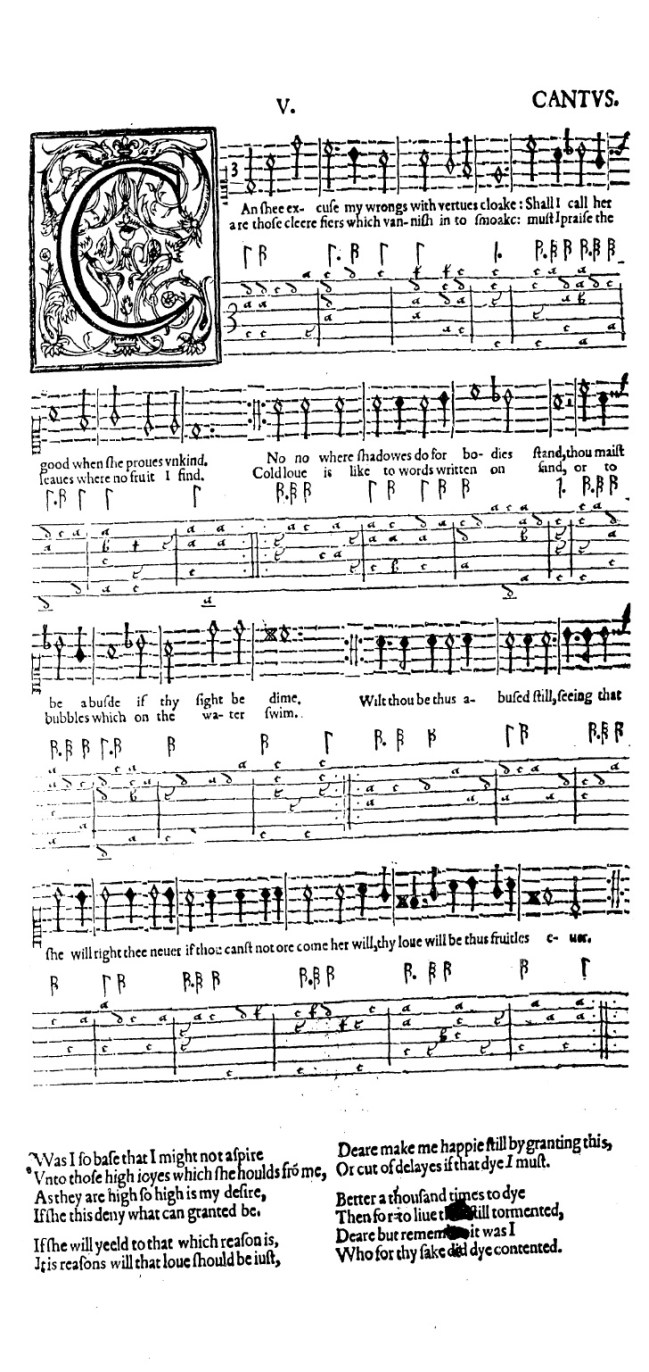
John Dowland (1563 - 1626): Can she excuse my wrongs, ayre, dal First Booke of Songes or Ayres (1597). Emma Kirkby, soprano; Anthony Rooley, liuto.

Can she excuse my wrongs with Virtue’s cloak?
Shall I call her good when she proves unkind?
Are those clear fires which vanish into smoke?
Must I praise the leaves where no fruit I find?
 No, no; where shadows do for bodies stand,
 That may’st be abus’d if thy sight be dim.
 Cold love is like to words written on sand,
 Or to bubbles which on the water swim.
Wilt thou be thus abused still,
Seeing that she will right thee never?
If thou canst not o’ercome her will,
Thy love will be thus fruitless ever.

Was I so base, that I might not aspire
Unto those high joys which she holds from me?
As they are high, so high is my desire,
If she this deny, what can granted be?
 If she will yield to that which reason is,
 It is reason’s will that love should be just.
 Dear, make me happy still by granting this,
 Or cut off delays if that I die must.
Better a thousand times to die
Than for to live thus still tormented:
Dear, but remember it was I
Who for thy sake did die contented.

Il testo – adattato a un tema di gagliarda: in qualche fonte, la versione strumentale del brano (qui) reca il titolo The Earl of Essexhis ] Galliard – fa forse riferimento alle vicende di Robert Devereux, 2° conte di Essex (1566-1601), che potrebbe essere l’autore dei versi. È probabile che sia da collegarsi a Robert Devereux la citazione della melodia tradizionale The woods so wild, da Dowland inserita nel terzo periodo, affidata a una voce intermedia (tenore; testo: Wilt thou be thus abused still ecc.): farebbe riferimento al fatto che il conte di Essex soleva ritirarsi in una casa di sua proprietà, sita nei boschi a nord-est di Londra.
The woods so wild è un ballad assai diffuso in epoca Tudor: pare che fosse par­ti­co­lar­mente caro a Enrico VIII. Variazioni sulla melodia si devono a William Byrd (riportate dal Fitzwilliam Virginal Book e dal My Lady Nevell’s Book) e a Orlando Gibbons.


William Byrd (c1540 - 1623): The Woods so Wilde, variazioni. Michael Maxwell Steer, clavicembalo.


Orlando Gibbons (1583 - 1625): The Woods so Wild, variazioni. Michael Maxwell Steer, clavicembalo.


Un’altra interpretazione del brano di Dowland, ove la parte che comprende la citazione della melodia tradizionale è eseguita con un flauto dolce. Karin Gyllenhammar, soprano; Mirjam-Luise Münzel, flauto; David Leeuwarden, liuto; Alina Rotaru, clavicembalo.
Dowland - Can she

A Musicall Banquet: VIII. In a grove most rich of shade

Guillaume Tessier (sec. XVI): In a grove most rich of shade, ayre su testo di Philip Sidney (da Astrophel and Stella). Versione per 1 voce e liuto: Emily van Evera e Paul O’Dette; versione per 2 voci e liuto: Emma Kirkby, soprano; David Thomas, basso; Anthony Rooley, liuto.

In a grove most rich of shade
where birds wanton music made,
May then in his pied weeds showing,
new perfumes with flowers fresh growing.

Astrophel with Stella sweet
did for mutual comfort meet
both within themselves oppressed,
but each in the other blessed.

Him great harms had taught much care,
Her fair neck a foul yoke bare;
But her sight his cares did banish,
In his sight her yoke did vanish.

Wept they had, alas the while,
But now tears themselves did smile,
While their eyes, by love directed,
Interchangeably reflected.

Sigh they did, but now betwixt
Sighs of woe were glad sighs mixt;
With arms crossed, yet testifying
Restless rest, and living dying.

Their ears hungry of each word
Which the dear tongue would afford;
But their tongues restrained from walking,
Till their hearts had ended talking.

But when their tongues could not speak,
Love itself did silence break:
Love did set his lips asunder,
Thus to speak in love and wonder.

Therewithal away she went,
Leaving him so passion, rent
With what she had done and spoken,
That therewith my song is broken.

In a grove most rich of shade è l’ottava canzone di Astrophel and Stella: il testo è stato adattato a una composizione che il francese Guillaume Tessier aveva inserito nel proprio Premier Livre d’Airs tant en François, Italien qu’Espaignol…, edito a Parigi nel 1582 con una dedica (in italiano) «alla Sereniss. e Sacratiss. Regina d’Inghilterra»; è probabile che Sidney conoscesse personalmente Tessier.
Il brano venne poi ripubblicato da Robert Dowland (1591 - 1641) nella raccolta A Musicall Banquet (Londra 1610, n. VII), antologia dedicata a sir Robert Sidney, fratello di Philip e padrino del curatore.

A Musicall Banquet: V. Go, my flock

Anonimo (sec. XVI-XVII): Go, my flock, go get you hence, ayre su testo di Philip Sidney (1554 - 1586) tratto da Astrophel and Stella. Nigel Rogers, tenore; Anthony Bailes, liuto.

Go, my flock, go get you hence,
Seek some other place of feeding;
Where you may have some defence
From the storms in my breast breeding
And showers from mine eyes proceeding.

Leave a wretch in whom all woe
Can abide to keep no measure:
Merry flock! such one forego,
Unto whom mirth is displeasure:
Only rich in mischief’s treasure.

Stella! fayrest shepherdess!
Fayrest but yet cruelst ever!
Stella! whom the heav’ns still bless!
Though against me she persever;
Though I bliss inherit never.

Stella hath refusèd me!
Astrophel that so well servèd,
In this pleasant spring, must see,
While in pride flowers be preservèd
Himself only winter-starvèd.

Why, alas, then doth she swear
That she loveth me so dearly?
Seeing me so long to bear
Coals of love that burn so clearly:
And yet leave me hopeless merely?

No, she hates me, well away!
Fayning love, somewhat to please me:
Knowing, if she should display
All her hate, Death would soon seize me,
And of hideous torments ease me.

Then my dear flock now adieu!
But, alas, if in your straying,
Heavenly Stella meet with you,
Tell her, in your piteous blaying,
Her poor slave’s unjust decaying.

Personalità di spicco nell’Inghilterra elisabettiana, sir Philip Sidney è noto fra l’altro quale autore di una raccolta di versi (108 sonetti e 11 canzoni) in stile petrarchesco, pubblicata postuma nel 1591 con il titolo Astrophel and Stella: vi si celebra l’amore del poeta per Penelope Devereux (1563 - 1607).
Sorella maggiore del più noto Robert, 2° conte di Essex e favorito di Elisabetta I, quando aveva 13 anni Penelope fu promessa in sposa a Sidney; per ragioni non del tutto chiarite, il progetto andò a monte e, all’inizio del 1581, Penelope sposò controvoglia Robert Rich, in seguito 1° conte di Warwick (1559 - 1619), dal quale ebbe sette figli; nei versi di Sidney ricorre sovente il termine rich, evidente allusione al nome assunto dall’amata con questo matrimonio. Nel 1595 Penelope divenne amante di Charles Blount, 8° barone Mountjoy (1563 - 1606), il quale le diede altri tre figli; ottenuto il divorzio nel 1605, alla fine di quell’anno Penelope sposò Blount.
L’ayre composto da autore ignoto sul testo di Go, my flock, nona canzone di Astrophel and Stella, venne pubblicato da Robert Dowland nella raccolta A Musicall Banquet (Londra 1610, n. IIII) — questa antologia è dedicata a sir Robert Sidney, fratello di Philip e padrino del curatore.