The bryghtest myrrour

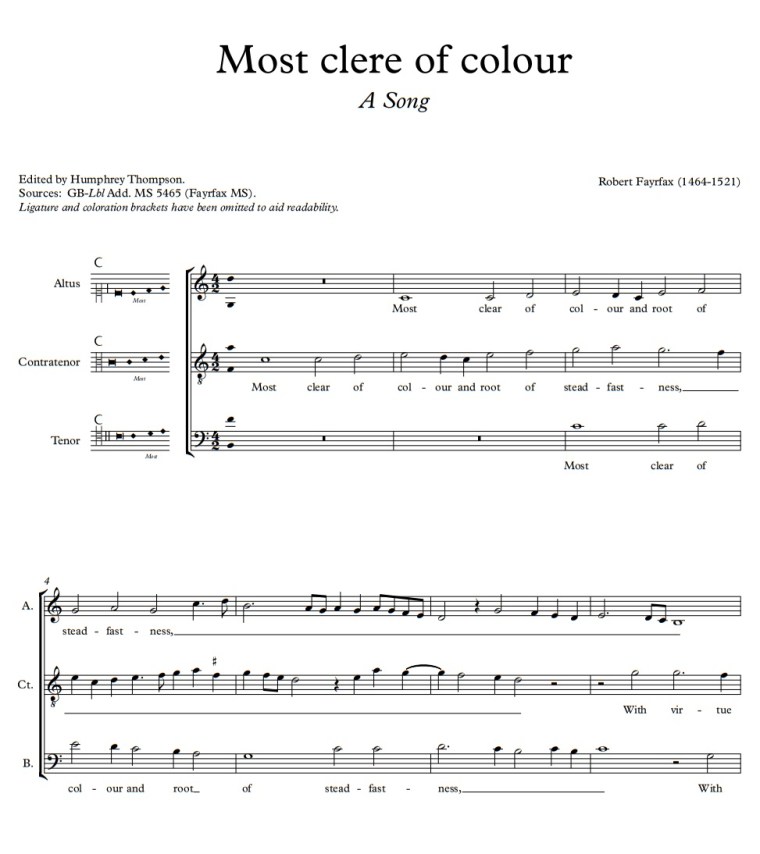
Robert Fayrfax (23 aprile 1464 - 1521): Most clere of colour per 3 voci a cappella. The Hilliard Ensemble.

Most clere of colour and rote of stedfastness,
With vertu connyng her maner is lede,
Which that passyth my mynde for to express
Of her bounte, beaute and womanhode;
The bryghtest myrrour and floure of goodlyhed,
Which that all men knowith, both more and less;
Thes vertues byn pryntyd in her doutless.
Thatt was my woe

Robert Fayrfax (23 aprile 1464 - 1521): Thatt was my woe a 2 voci a cappella. The Cardinall’s Musick.

Thatt was my woe is nowe my most gladness,
Thatt was my payne is nowe my joyus chaunce;
Thatt was my ffere is nowe my sykyrness;
Thatt was my greffe is nowe my allegeaunce.
Thus hath nowe grace enrychyd my plesaunce,
Wherfor I am and shal be tyll I dye
your trew servaunt with thought, hart and body.

Due Magnificat di Robert Fayrfax

Robert Fayrfax (23 aprile 1464 - 1521): Magnificat «O bone Ihesu» a 3-5 voci (trascritto nel Lambeth Choirbook, n. 15). Ensemble The Cardinall’s Musick, dir. Andrew Carwood.


Robert Fayrfax: Magnificat «regale» a 5 voci (trascritto nell’Eton Choirbook, n. 75). Stessi interpreti.
Non è ben chiaro perché il brano abbia questo titolo; si suppone che il Magnificat sia stato composto per il King’s College di Cambridge e che da questo (in latino «Collegium regale») abbia preso nome.
Il Lambeth Choirbook e l’Eton Choirbook sono due degli unici tre libri corali inglesi (il terzo è il Caius Choirbook) dell’epoca precedente la Riforma anglicana pervenuti fino a noi. L’Eton Choirbook fu redatto fra il 1490 e il 1500 e ulteriormente ampliato presumibilmente fra il 1510 e il 1515. Il Lambeth (o Arundel) Choirbook e il Caius Choirbook vennero ultimati verso la fine degli anni 1520.

Fayrfax, Magnificat Regale