Arcadelt & Petrarca

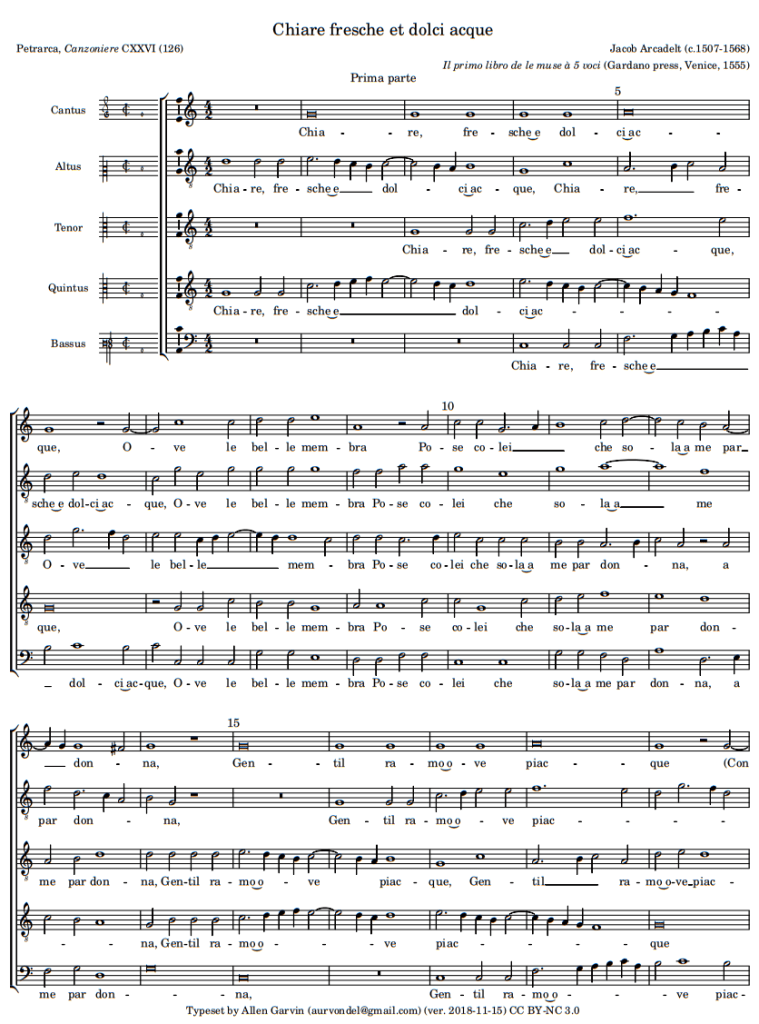
Jacques Arcadelt (1507 - 14 ottobre 1568): Chiare, fresche e dolci acque, madrigale a 5 voci (pubblicato nella raccolta Il primo libro de le Muse a cinque voci composto da diversi eccellentissimi musici, 1555, n. 1); testo di Francesco Petrarca (Canzoniere CXXVI, 1-3). The Consort of Musicke, dir. Anthony Rooley.

1ª parte :

Chiare, fresche e dolci acque,
ove le belle membra
pose colei che sola a me par donna;
gentil ramo ove piacque
(con sospir’ mi rimembra)
a lei di fare al bel fiancho colonna;
herba et fior’ che la gonna
leggiadra ricoverse
co l’angelico seno;
aere sacro, sereno,
ove Amor co’ begli occhi il cor m’aperse:
date udïenza insieme
a le dolenti mie parole extreme.

2ª parte :

S’egli è pur mio destino
e ’l cielo in ciò s’adopra,
ch’Amor quest’occhi lagrimando chiuda,
qualche gratia il meschino
corpo fra voi ricopra,
et torni l’alma al proprio albergo ignuda.
La morte fia men cruda
se questa spene porto
a quel dubbioso passo:
ché lo spirito lasso
non poria mai in piú riposato porto
né in piú tranquilla fossa
fuggir la carne travagliata et l’ossa.

3ª parte :

Tempo verrà anchor forse
ch’a l’usato soggiorno
torni la fera bella et mansüeta,
et là ’v’ella mi scorse
nel benedetto giorno,
volga la vista disïosa et lieta,
cercandomi; et, o pietà!,
già terra in fra le pietre
vedendo, Amor l’inspiri
in guisa che sospiri
sí dolcemente che mercé m’impetre,
et faccia forza al cielo,
asciugandosi gli occhi col bel velo.
Moro beato


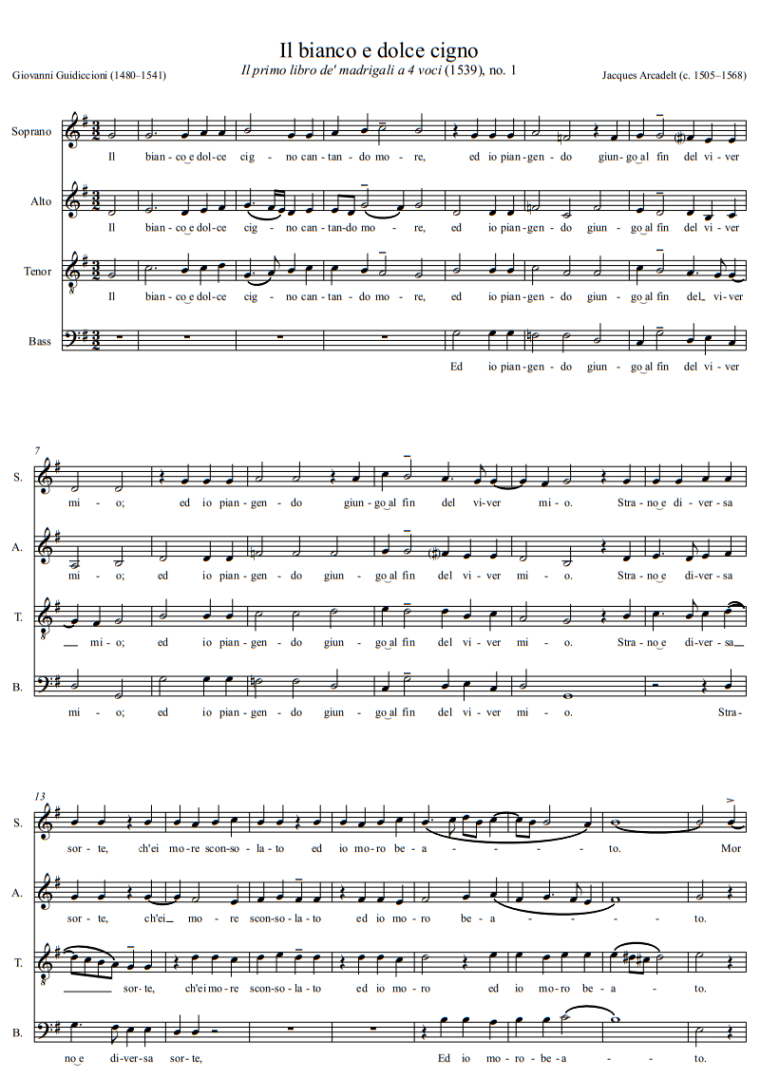
Jacques Arcadelt (1507 - 14 ottobre 1568): Il bianco e dolce cigno, madrigale a 4 voci (pubblicato nel Primo Libro de’ madrigali a 4 voci, 1539, n. 1); testo di Giovanni Guidiccioni rielaborato da Alfonso d’Avalos. The King’s Singers (sopra) e The Consort of Musicke.

Il bianco e dolce cigno
cantando more, ed io
piangendo giung’al fin del viver mio.
Stran’e diversa sorte,
ch’ei more sconsolato
ed io moro beato.
Morte che nel morire
m’empie di gioia tutto e di desire.
Se nel morir, altro dolor non sento,
di mille mort’il dì sarei contento.


Ed ecco una lectio magistralis di Francesco Di Fortunato:


La pietate e’l desire

Leone Leoni (c1560 - 24 giugno 1627): Cor mio, deh, non languire, madrigale a 5 voci (pubblicato in Bell’Alba: quinto libro de madrigali a cinque voci, 1602, n. 9) su testo di Battista Guarini. The Consort of Musicke, dir. Anthony Rooley.

Cor mio, deh, non languire,
Che fai teco languir l’anima mia.
Odi i caldi sospiri: a te gl’invia,
La pietate e’l desire.
S’i’ ti potessi dar morendo aita,
Morrei per darti vita.
Ma vivi ohimé, ch’ingiustamente more,
Chi vivo tien ne l’altrui petto il core.

Lamento della Ninfa

Claudio Monteverdi (1567 - 1643): Lamento della Ninfa, da Madrigali guerrieri et amorosi (VIII Libro di madrigali, 1638, n. 22), su testo di Ottavio Rinuccini. Emma Kirkby, soprano; Paul Agnew e Andrew King, tenori; Alan Ewing, basso; The Consort of Musicke, dir. Anthony Rooley.
Lo stesso testo messo in musica da Antonio Brunelli, ma Monteverdi ne dà un’interpretazione completamente diversa.

Non havea Febo ancora
recato al mondo il dì,
che del suo albergo fuora
una donzella uscì.

  Miserella, ah più no, no,
  tanto gel soffrir non può.

Sul pallidetto volto
scorgeasi il suo dolor,
spesso gli venia sciolto
un gran sospir dal cor.

Si calpestando i fiori
errava hor qua, hor là,
e i suoi perduti amori
così piangendo va.

Amor, dicea, e il pie’
mirando il ciel fermò,
dove, dov’ è la fe’
che ‘l traditor giurò?

Se il ciglio ha più sereno
colei che ‘l mio non è,
già non gli alberga in seno
amor si nobil fè.

Fa’ ch’ei ritorni mio
Amor com’ei pur fu,
o tu m’ancidi, ch’io
non mi tormenti più.

Né mai più dolci baci
da quella bocca havrà,
né più soavi, ah taci,
taci, che troppo il sa.

Poiché di lui mi struggo,
dove stima non fa,
che sì, che sì ch’io ‘l fuggo
ch’ancor mi pregherà?

Sì tra sdegnosi pianti
sfogava il suo dolor;
sì dei gentili amanti
misto è col gelo amor.

Monteverdi

Ambo siam sassi

Heinrich Schütz (8 ottobre 1585 - 1672): Di marmo siete voi SWV 17, madrigale a 5 voci (n. 17 del Primo libro de madrigali, 1611) su testo di Giambattista Marino. The Consort of Musicke, dir. Anthony Rooley.

Di marmo siete voi,
donna, a colpi d’amore,
al pianto mio,
e di marmo son io
alle vostr’ire e agli strali suoi
per natura,
per amor io costante
e voi dura.
Ambo siam sassi
e l’un e l’altro è scoglio,
io di fé e voi d’orgoglio.

A Musicall Banquet – XIV. Vous que le bonheur rappelle

Pierre Guédron (c1565 - c1621): Vous que le bonheur rappelle, air de cour (pubblicato a cura di Robert Dowland in A Musicall Banquet, Londra 1610, n. XIII). The Consort of Musicke, dir. Anthony Rooley.

Vous que le bonheur rappelle
à un servage ancien,
mourez aux pieds de la belle
qui vous daigne faire sien.

Glorieuse en votre perte,
honorez votre vainqueur,
qui vous a la porte ouverte
de la prison de son coeur.

Heureux venez vous donc rendre
à celle qui vous a pris;
c’est honneur de se voir prendre
à qui tient tout à mépris.

L’honneur d’un brave adversaire
honore votre trépas,
heureux qu’en mourant peut faire
que son nom ne meure pas.

A Musicall Banquet: VIII. In a grove most rich of shade

Guillaume Tessier (sec. XVI): In a grove most rich of shade, ayre su testo di Philip Sidney (da Astrophel and Stella). Versione per 1 voce e liuto: Emily van Evera e Paul O’Dette; versione per 2 voci e liuto: Emma Kirkby, soprano; David Thomas, basso; Anthony Rooley, liuto.

In a grove most rich of shade
where birds wanton music made,
May then in his pied weeds showing,
new perfumes with flowers fresh growing.

Astrophel with Stella sweet
did for mutual comfort meet
both within themselves oppressed,
but each in the other blessed.

Him great harms had taught much care,
Her fair neck a foul yoke bare;
But her sight his cares did banish,
In his sight her yoke did vanish.

Wept they had, alas the while,
But now tears themselves did smile,
While their eyes, by love directed,
Interchangeably reflected.

Sigh they did, but now betwixt
Sighs of woe were glad sighs mixt;
With arms crossed, yet testifying
Restless rest, and living dying.

Their ears hungry of each word
Which the dear tongue would afford;
But their tongues restrained from walking,
Till their hearts had ended talking.

But when their tongues could not speak,
Love itself did silence break:
Love did set his lips asunder,
Thus to speak in love and wonder.

Therewithal away she went,
Leaving him so passion, rent
With what she had done and spoken,
That therewith my song is broken.

In a grove most rich of shade è l’ottava canzone di Astrophel and Stella: il testo è stato adattato a una composizione che il francese Guillaume Tessier aveva inserito nel proprio Premier Livre d’Airs tant en François, Italien qu’Espaignol…, edito a Parigi nel 1582 con una dedica (in italiano) «alla Sereniss. e Sacratiss. Regina d’Inghilterra»; è probabile che Sidney conoscesse personalmente Tessier.
Il brano venne poi ripubblicato da Robert Dowland (1591 - 1641) nella raccolta A Musicall Banquet (Londra 1610, n. VII), antologia dedicata a sir Robert Sidney, fratello di Philip e padrino del curatore.

A Musicall Banquet – VI. O dear life

 
Anonimo (XVI-XVII secolo): O dear life, when shall it be, ayre su testo di Philip Sidney (1554 - 1586) tratto da Astrophel and Stella (Tenth Song). Emma Kirkby, soprano; David Thomas, basso; The Consort of Musicke, dir. Anthony Rooley.

O dear life, when shall it be
That mine eyes thine eyes may see;
And in them thy mind discover,
Whether absence hath had force,
Thy remembrance to divorce
From the image of thy lover?

Or if I myself find not,
After [Though my] parting aught forgot:
Nor debarr’d from Beauty’s treasure,
Let no tongue aspire to tell
In what high joys I shall dwell,
Only Thought aims at the pleasure.

Thought, therefore, I will send thee
To take up the place for me:
Long I will not after tarry:
There, unseen, thou may’st be bold,
Those fair wonders to behold,
Which in them my hopes do carry.

Thought, see thou no place forbear,
Enter bravely everywhere;
Seize on all to her belonging:
But, if thou wouldst guarded be,
Fearing her beams, take with thee
Strength of liking, rage of longing.

O my thought! my thoughts surcease,
Thy delights my woes increase;
My life fleets with too much thinking:
Think no more, but die in me,
Till thou shalt revived be,
At her lips my nectar drinking.

È di autore ignoto anche il secondo brano su testo di Philip Sydney inserito da Robert Dowland nella raccolta A Musicall Banquet (Londra 1610, n. V).

la 10ª canzone di Astrophel and Stella ispirò anche William Byrd (c1540 - 1623), che sui versi di Sidney compose un partsong a 5 voci (pubblicato in Songs of sundrie natures, 1589, n. 33). L’ascoltiamo qui nella interpretazione a voce sola con ac­com­pa­gna­mento strumentale dei Musicians of Swanne Alley, solista il soprano Emily van Evera:


Lilies on the river’s side


John Dowland (1563 - 1626): Come away, come, sweet love, ayre (pubblicato nel First Booke of Songes or Ayres, 1597, n. 11):
– versione a 4 voci con accompagnamento di liuto: The Consort of Musicke, dir. Anthony Rooley;
– versione a 1 voce con accompagnamento di liuto: Alfred Deller. controtenore; Robert Spencer, liuto.

Come away, come, sweet love,
the golden morning breaks.
All the earth, all the air
of love and pleasure speaks:
teach thine arms then to embrace
and sweet rosy lips to kiss,
and mix our souls in mutual bliss.
Eyes were made for beauty’s grace,
viewing, rueing love’s long pain
procur’d by beauty’s rude disdain.

Come away, come, sweet love,
the golden morning wastes,
while the sun from his sphere
his fiery arrows casts:
making all the shadows fly,
playing, staying in the grove,
to entertain the stealth of love.
Thither sweet love let us hie,
flying, dying in desire,
wing’d with sweet hopes and heav’nly fire.

Come away, come, sweet love,
do not in vain adorn
beauty’s grace, that should rise
like to the naked morn:
lilies on the river’s side,
and fair Cyprian flow’rs new-blown,
desire no beauties but their own.
Ornament is nurse of pride,
pleasure, measure love’s delight:
haste then sweet love our wishèd flight.