Anonimo (sec. XVI-XVII): Passava Amor, su arco desarmado, romance su testo di Jorge de Montemayor (da Los siete libros de la Diana, 1559). Olga Pitarch, soprano; ensemble Faenza, dir. Marco Horvat.
Passava Amor, su arco desarmado,
los ojos baxos, blando y muy modesto:
dexávame ya atrás muy descuydado.
¡Quán poco espacio pude gozar esto!
Fortuna, de embidiosa, dixo luego:
– ¡Teneos, Amor! ¿Por qué vais [passáis] tan presto?
Bolvió de presto a mí el niño ciego,
muy enojado en verse reprehendido,
que no hay reprehensión do está su fuego.
Ay, prados, bosques, selvas que criastes
tan libre coraçón como era el mío:
¿Por qué tan grave mal no le estorvastes?
Passava Amor è il primo dei tre romances su testo spagnolo inclusi da Robert Dowland nella raccolta A Musicall Banquet (Londra 1610, n. XIV)
Pierre Guédron (c1565 - c1621): Vous que le bonheur rappelle, air de cour (pubblicato a cura di Robert Dowland in A Musicall Banquet, Londra 1610, n. XIII). The Consort of Musicke, dir. Anthony Rooley.
Vous que le bonheur rappelle
à un servage ancien,
mourez aux pieds de la belle
qui vous daigne faire sien.
Glorieuse en votre perte,
honorez votre vainqueur,
qui vous a la porte ouverte
de la prison de son coeur.
Heureux venez vous donc rendre
à celle qui vous a pris;
c’est honneur de se voir prendre
à qui tient tout à mépris.
L’honneur d’un brave adversaire
honore votre trépas,
heureux qu’en mourant peut faire
que son nom ne meure pas.
Pierre Guédron (c1565 - c1621): Si le parler et le silence, air de cour (pubblicato in Airs de différents auteurs mis en tablature de luth par Gabriel Bataille, Parigi 1608; poi a cura di Robert Dowland in A Musicall Banquet, Londra 1610, n. XII). Nigel Rogers, tenore; Anthony Bailes, liuto.
Ce penser qui sans fin tirannise ma vie
se montre tellement contre moi conjuré,
que tant plus jé m’efforce à dompter son ennuie
at tant moins à mon bien je le vois préparé.
J’ai quitté la beauté dont il a pris naissance,
espérant par l’oublie ses charmes décevoir
mais je trouve à la fin que la venue et l’absence
sont tous deux différents, et d’un même pouvoir.
J’ay maintefois juré du change faire espreuve
Pour faire qu’un dessein fust par l’autre deffait,
Mais à toutes les fois, aussi tost je me treuve
Infidelle en parole, & fidelle en effect.
J’ay des plus fiers dedains la puissance empruntée
Pour repousser le trait dont j’ay le coeur attaint,
Mais plus je recognois par par leur force domptée
Ma douleur veritable & mon remede feint.
Ainsi donc combatant le mal qui me possede
Sans voir par ces moyens ses tempestes calmer,
Je me vay consommant dans mon propre remede
Comme un Vaisseau qui brusle au milieu de la Mer.
Voilà comme en vivant en toute servitude
Je nourris un penser dont l’impiteux effort,
Se montre en mon endroit si plain d’ingratitude
Qu’en luy donnant la vie il me donne la mort.
Pierre Guédron (c1565 - c1621): Si le parler et le silence, air de cour. Catherine King, soprano; Jacob Heringman, liuto.
Si le parler et le silence
nuit à notre heur également,
parlons donc, ma chère espérance,
du coeur et des yeux seulement;
Amour ce petit dieu volage
nous apprend ce muet langage.
Que le regard vole et revole,
messager des nos passions,
et serve au lieu de la parole
pour dire nos intentions.
Amour ce petit dieu volage
nous apprend ce muet langage.
Mais si quelque âme est offencée
de nous voir discourir des yeux,
nous parlérons de la pensée,
comme les anges dans les cieux.
Amour ce petit dieu volage
nous apprend ce muet langage.
Ainsi par un doux artifice
nous trompérons les courtisans,
et nous rirons de la malice
de mille fâcheux médisans,
qui n’en sauront pas d’avantage
ignorant, ce muet langage.
Si le parler è il primo dei tre airs de cour di Pierre Guédron inclusi da Robert Dowland nella raccolta A Musicall Banquet (Londra 1610, n. XI).
Air de cour è in sostanza il nome dato alla chanson francese d’autore nel periodo compreso tra la fine del Cinquecento e il quarto decennio del secolo successivo (corrisponde dunque grosso modo all’età aurea dell’ayre inglese). Fra i principali esponenti di questo genere, oltre a Guédron spiccano Antoine Boësset e Étienne Moulinié: nomi che ricorreranno con una certa frequenza in questo blog.
John Dowland (1563 - 1626): In darkness let me dwell, ayre. Ellen Hargis, soprano; Jacob Heringman, liuto; Mary Springfels, viol.
In darkness let me dwell; the ground shall sorrow be,
The roof despair, to bar all cheerful light from me;
The walls of marble black, that moist’ned still shall weep;
My music, hellish jarring sounds, to banish friendly sleep.
Thus, wedded to my woes, and bedded in my tomb,
O let me living die, till death doth come, till death doth come.
Capolavoro di Dowland, il brano fu pubblicato dal figlio del compositore, Robert (1591 - 1641), nell’antologia A Musicall Banquet (Londra 1610, n. X). In darkness let me dwell è l’ultima delle composizioni vocali su testo inglese della raccolta: fanno seguito tre airs de cour francesi (tutti e tre di Pierre Guédron, il cui nome non è tuttavia menzionato nella pubblicazione), due romances spagnoli e cinque arie su testo italiano.
John Dowland (1563 - 1626): Lady if you so spight me, ayre. Martyn Hill, tenore; Anthony Rooley, liuto; Trevor Jones, viol.
Lady if you so spight me,
Wherfore do you so oft kisse and delight mee?
Sure that my hart opprest and overcloyed,
May breake thus overjoyde,
If you seeke to spill mee,
Come kisse me sweet and kill mee,
So shal your hart be eased,
And I shall rest content and dye well pleased.
Il brano fu pubblicato dal figlio del compositore, Robert (1591 - 1641), nella raccolta A Musicall Banquet (Londra 1610, n. IX).
John Dowland (1563 - 1626): Lady if you so spight me, ayre « for one voice only to sing » su testo di sir Henry Lee of Ditchley (1533 - 1611). Emma Kirkby, soprano; Anthony Rooley, liuto.
Far from triumphing Court and wonted glory
He dwelt in shady unfrequented places,
Time’s prisoner now, he made his pastime story;
Glady forgets Court’s erst-afforded graces.
That goddess whom he served to heaven is gone,
And he on earth in darkness left to moan.
But lo, a glorious light from his dark rest
Shone from the place where erst this goddess dwelt;
A light whose beams the world with fruit hath blest;
Blest was the knight while he that light beheld.
Since then a star fixed on his head hath shined,
And a saint’s image in his heart is shrined.
Ravished with joy, so graced by such a saint,
He quite forgat his cell and self denaid;
He thought it shame in thankfulness to faint,
Debts due to princes must be duly paid;
Nothing so hateful to a noble mind
As finding kindness for to prove unkind.
But ah! poor knight, though thus in dream he ranged,
Hoping to serve this saint in sort most meet,
Time with his golden locks to silver changed
Hath with age-fetters bound him hands and feet.
Ay me! he cries, goddess, my limbs grow faint,
Though I Time’s prisoner be, be you my saint.
Il brano fu pubblicato dal figlio del compositore, Robert (1591 - 1641), nella raccolta A Musicall Banquet (Londra 1610, n. VIII).
Guillaume Tessier (sec. XVI): In a grove most rich of shade, ayre su testo di Philip Sidney (da Astrophel and Stella). Versione per 1 voce e liuto: Emily van Evera e Paul O’Dette; versione per 2 voci e liuto: Emma Kirkby, soprano; David Thomas, basso; Anthony Rooley, liuto.
In a grove most rich of shade
where birds wanton music made,
May then in his pied weeds showing,
new perfumes with flowers fresh growing.
Astrophel with Stella sweet
did for mutual comfort meet
both within themselves oppressed,
but each in the other blessed.
Him great harms had taught much care,
Her fair neck a foul yoke bare;
But her sight his cares did banish,
In his sight her yoke did vanish.
Wept they had, alas the while,
But now tears themselves did smile,
While their eyes, by love directed,
Interchangeably reflected.
Sigh they did, but now betwixt
Sighs of woe were glad sighs mixt;
With arms crossed, yet testifying
Restless rest, and living dying.
Their ears hungry of each word
Which the dear tongue would afford;
But their tongues restrained from walking,
Till their hearts had ended talking.
But when their tongues could not speak,
Love itself did silence break:
Love did set his lips asunder,
Thus to speak in love and wonder.
Therewithal away she went,
Leaving him so passion, rent
With what she had done and spoken,
That therewith my song is broken.
In a grove most rich of shade è l’ottava canzone di Astrophel and Stella: il testo è stato adattato a una composizione che il francese Guillaume Tessier aveva inserito nel proprio Premier Livre d’Airs tant en François, Italien qu’Espaignol…, edito a Parigi nel 1582 con una dedica (in italiano) «alla Sereniss. e Sacratiss. Regina d’Inghilterra»; è probabile che Sidney conoscesse personalmente Tessier.
Il brano venne poi ripubblicato da Robert Dowland (1591 - 1641) nella raccolta A Musicall Banquet (Londra 1610, n. VII), antologia dedicata a sir Robert Sidney, fratello di Philip e padrino del curatore.
Daniel Bacheler (1572 - 1618 o 1619): Change thy mind since she doth change, ayre su testo di Robert Devereux, II conte di Essex (1567 - 1601). Nigel Rogers, tenore; Anthony Bailes, liuto.
To plead my faith, where faith hath no reward;
to move remorse, where favour is not borne;
to heap complaints, where she doth not regard,
were fruitless, bootless, vain and yield but scorn.
I loved her whom all the world admir’d.
I was refus’d of her that can love none;
and my vain hope, which far too high aspir’d,
is dead and buried and for ever gone.
Forget my name, since you have scorn’d my love,
and womanlike do not too late lament;
since for your sake I do all mischief prove,
I none accuse nor nothing do repent.
I was as fond as ever she was fair,
yet lov’d I not more than I now despair.
Nella raccolta A Musicall Banquet, pubblicata a Londra nel 1610 a cura di Robert Dowland, il secondo brano composto su testo di Robert Devereux è opera di Daniel Bacheler, liutista e compositore che fu dapprima al servizio di sir Francis Walsingham, potente ministro di Elisabetta I; in seguito attivo presso lo stesso conte di Essex. venne infine nominato groom of the privy chamber della regina consorte Anna di Danimarca.
Anonimo (sec. XVI-XVII): Go, my flock, go get you hence, ayre su testo di Philip Sidney (1554 - 1586) tratto da Astrophel and Stella. Nigel Rogers, tenore; Anthony Bailes, liuto.
Go, my flock, go get you hence,
Seek some other place of feeding;
Where you may have some defence
From the storms in my breast breeding
And showers from mine eyes proceeding.
Leave a wretch in whom all woe
Can abide to keep no measure:
Merry flock! such one forego,
Unto whom mirth is displeasure:
Only rich in mischief’s treasure.
Stella! fayrest shepherdess!
Fayrest but yet cruelst ever! Stella! whom the heav’ns still bless!
Though against me she persever;
Though I bliss inherit never.
Stella hath refusèd me! Astrophel that so well servèd,
In this pleasant spring, must see,
While in pride flowers be preservèd
Himself only winter-starvèd.
Why, alas, then doth she swear
That she loveth me so dearly?
Seeing me so long to bear
Coals of love that burn so clearly:
And yet leave me hopeless merely?
No, she hates me, well away!
Fayning love, somewhat to please me:
Knowing, if she should display
All her hate, Death would soon seize me,
And of hideous torments ease me.
Then my dear flock now adieu!
But, alas, if in your straying,
Heavenly Stella meet with you,
Tell her, in your piteous blaying,
Her poor slave’s unjust decaying.
Personalità di spicco nell’Inghilterra elisabettiana, sir Philip Sidney è noto fra l’altro quale autore di una raccolta di versi (108 sonetti e 11 canzoni) in stile petrarchesco, pubblicata postuma nel 1591 con il titolo Astrophel and Stella: vi si celebra l’amore del poeta per Penelope Devereux (1563 - 1607).
Sorella maggiore del più noto Robert, 2° conte di Essex e favorito di Elisabetta I, quando aveva 13 anni Penelope fu promessa in sposa a Sidney; per ragioni non del tutto chiarite, il progetto andò a monte e, all’inizio del 1581, Penelope sposò controvoglia Robert Rich, in seguito 1° conte di Warwick (1559 - 1619), dal quale ebbe sette figli; nei versi di Sidney ricorre sovente il termine rich, evidente allusione al nome assunto dall’amata con questo matrimonio. Nel 1595 Penelope divenne amante di Charles Blount, 8° barone Mountjoy (1563 - 1606), il quale le diede altri tre figli; ottenuto il divorzio nel 1605, alla fine di quell’anno Penelope sposò Blount.
L’ayre composto da autore ignoto sul testo di Go, my flock, nona canzone di Astrophel and Stella, venne pubblicato da Robert Dowland nella raccolta A Musicall Banquet (Londra 1610, n. IIII) — questa antologia è dedicata a sir Robert Sidney, fratello di Philip e padrino del curatore.
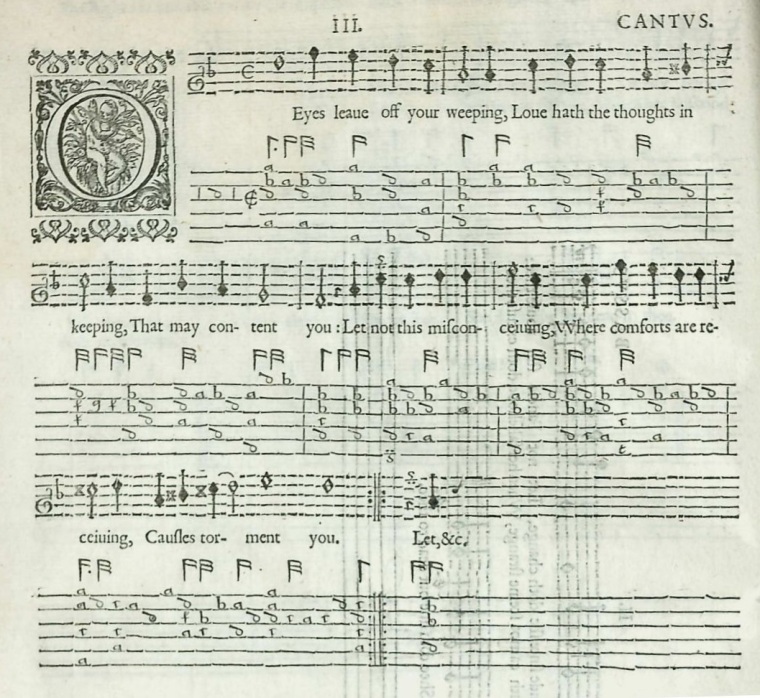
Robert Hales (attivo 1583 - 1616): O eyes, leave off your weeping, ayre su testo di autore anonimo (talvolta erroneamente attribuito a Nicholas Breton, 1542 - 1626). Emma Kirkby, soprano; Anthony Rooley, liuto.
O eyes, leave off your weeping,
love hath the thoughts in keeping
that may content you.
Let not this misconceiving,
where comforts are receiving,
causeless torment you.
Clouds threaten but a shower;
hope hath his happy hour,
though long in lasting.
Time needs must be attended
Love must not be offended
with too much hasting.
But O the painful pleasure,
where Love attends the leisure
of life’s wretchedness:
where Hope is but illusion,
and Fear is but confusion
of Love’s happiness.
But happy Hope, that seeth
how Hope and Hap agreeth,
of life deprive me;
or let me be assured
when life hath death endured
Love will revive me.
Di Robert Hales sappiamo che fu al servizio di Elisabetta I, apprezzato dalla sovrana in particolare quale cantante, e poi di Anna di Danimarca, consorte di Giacomo I; O eyes, leave off your weeping, pubblicato da Robert Dowland nella raccolta A Musicall Banquet (Londra 1610, n. 4), è l’unica sua composizione nota.
Richard Martin (XVI-XVII secolo): Change thy mind since she doth change, ayre su testo (risalente al 1597) di Robert Devereux, II conte di Essex (1567 - 1601). Nigel Rogers, tenore; Anthony Bailes, liuto.
Change thy mind since she doth change,
Let not fancy still abuse thee.
Thy untruth cannot seem strange
When her falsehood doth excuse thee.
Love is dead and thou art free;
She doth live, but dead to thee.
Whilst she lov’d thee best awhile,
See how she hath still delay’d thee,
Using shows for to beguile
Those vain hopes that have deceiv’d thee.
Now, thou see’st although too late
Love loves truth, which women hate.
Love no more since she is gone;
She is gone and loves another.
Being once deceiv’d by one,
Leave her love, but love none other.
She was false, bid her adieu;
She was best, but yet; untrue.
Love, farewell, more dear to me
Than my life which thou preservest.
Life, all joys are gone from thee,
Others have what thou deservest.
O my death doth spring from hence;
I must die for her offence.
[Die, but yet before thou die,
Make her know what she hath gotten.
She in whom my hopes did lie
Now is chang’d, I quite forgotten.
She is chang’d, but changed base,
Baser in so vile a place.]
Presente nella raccolta A Musicall Banquet, pubblicata a Londra nel 1610 a cura di Robert Dowland, Change thy mind è l’unica composizione pervenutaci di Richard Martin, musicista del quale si ignora pressoché tutto.
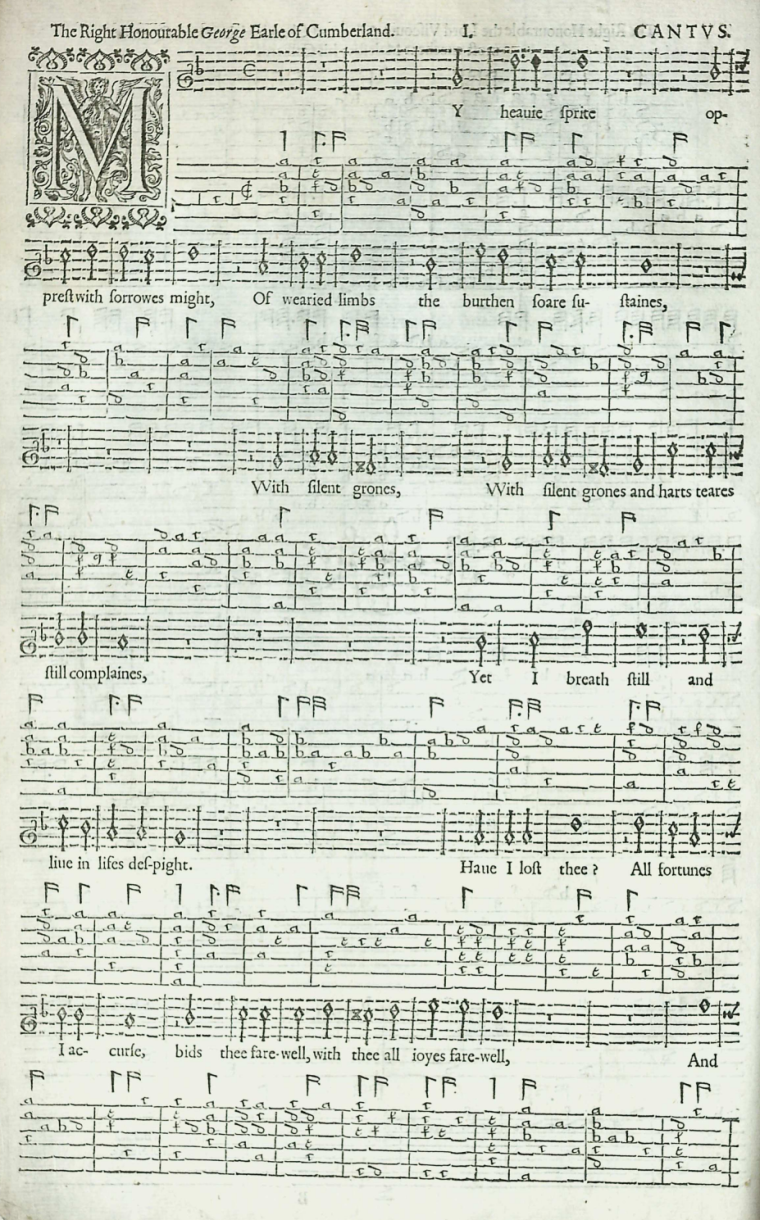
Anthony Holborne (c1545 - 1602): My heavy sprite, oppress’d with sorrow’s might, ayre su testo di George Clifford, III conte di Cumberland (1558 - 1606). Emma Kirkby, soprano; Anthony Rooley, liuto.
My heavy sprite, oppress’d with sorrow’s might,
of wearied limbs the burden sore sustains,
with silent groans and heart’s tears still complains,
yet I breathe still and live in life’s despite.
Have I lost thee? All fortunes I accurse
bids, thee farewell, with thee all joys farewell,
and for thy sake this world becomes my hell.
My heavy sprite di Anthony Holborne è il primo brano vocale della raccolta A Musicall Banquet, pubblicata a Londra nel 1610 a cura di Robert Dowland (1591 - 1641).
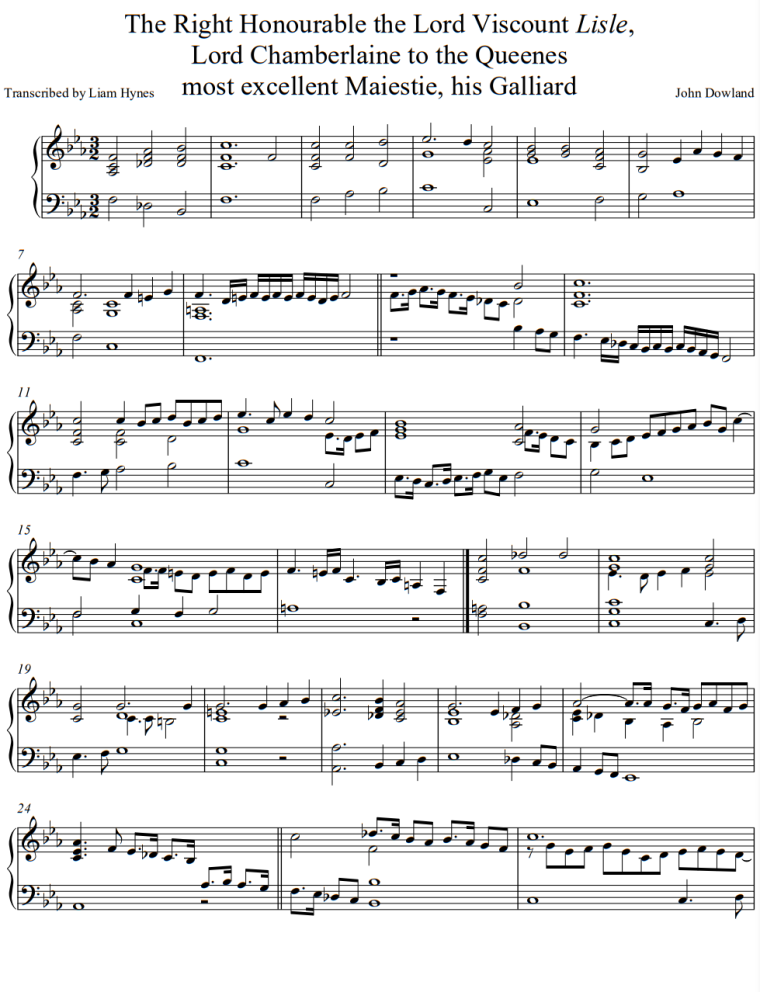
John Dowland (1563 - 1626): The Right Honourable the Lord Viscount Lisle, Lord Chamberlaine to the Queenes most excellent Maiestie, his Galliard. Nigel North, liuto.
A Musicall Banquet. Furnished with a varietie of delicious Ayres, Collected out of the best Authors in English, French, Spanish and Italian è il titolo di una raccolta di composizioni di diversi autori, curata e pubblicata a Londra nel 1610 da Robert Dowland (1591 - 1641), figlio di John, e dedicata a Robert Sidney (1563 - 1626), statista al servizio di Elisabetta I e Giacomo I. La silloge si apre con questa gagliarda dal titolo chilometrico, uno dei più celebri brani liutistici di Dowland: la composizione è espressamente intitolata a Sidney, che era stato creato visconte Lisle nel 1605 — e che più tardi, nel 1618, divenne il primo conte di Leicester.
Francesco Canova, detto Francesco da Milano, Francesco del Liuto e il Divino (18 agosto 1497 - 1543): composizioni per liuto. Caius Hera.
Le composizioni di Francesco da Milano che ci sono pervenute sono state pubblicate in edizione critica dal musicologo statunitense Arthur J. Ness nel 1970; oggi, per distinguerle si usa far riferimento alla numerazione assegnata loro dal prof. Ness.
Fantasia (Ness 67)
Fantasia (Ness 41) [1:35]
Fantasia (Ness 31) [2:10]
Ricercar (Ness 52) [2:50]
Ricercar (Ness 4) [4:24]
Fantasia (Ness 81) [5:08]
Ricercar (Ness 84) [5:52]
Ricercar (Ness 16) [6:38]
Fantasia (Ness 40) [7:36]
Ricercar (Ness 10) [8:30]
De mon triste desplaisir (trascrizione dell’omonima chanson di Jean Richafort) [10:03]
Fantasia de mon triste (sulla medesima chanson) [11:46]
Nicolas Chédeville (1705 - 6 agosto 1782): Sonata in sol minore per oboe e continuo, n. 6 della raccolta Il pastor fido (pubblicata nel 1737 come op. 13 di Antonio Vivaldi). Paul Goodwin, oboe; Nigel North, arciliuto e chitarra barocca; Susan Sheppard, violoncello; Frances Eustace, fagotto; John Toll, clavicembalo e organo.
Anonimo: She Moved through the Fair, canzone tradizionale irlandese. Alfred Deller, controtenore; Desmond Dupré, liuto.
My young love said to me: My mother won’t mind,
And my father won’t slight you for your lack of kine.
And she stepped away from me and this she did say:
It will not be long, love, ‘til our wedding day.
She stepped away from me and she moved through the fair,
And fondly I watched her move here and move there,
And then she went homeward with one star awake,
As the swan in the evening moves over the lake.
Last night she came to me, she came softly in.
So softly she came that her feet made no din,
And she laid her hand on me, and this she did say:
It will not be long, love, ‘til our wedding day.
La melodia, diffusa in Irlanda e in Scozia, risale probabilmente al basso Medioevo. Il testo è stato pubblicato per la prima volta nella raccolta Irish Country Songs (1909), curata da Herbert Hughes.
Anonimo: Bushes and Briars, canto tradizionale inglese. Alfred Deller, controtenore; Desmond Dupré, liuto.
La «scoperta» di questo brano si deve a Ralph Vaughan Williams, che l’udì cantare da un pastore nell’Essex e ne pubblicò un arrangiamento per coro maschile a 4 voci a cappella nel 1908.
Through bushes and through briars,
I lately took my way;
All for to hear the small birds sing,
And the lambs to skip and play.
I overheard my own true love,
Her voice it was so clear;
Long time I have been waiting
For the coming of my dear.
Sometimes I am uneasy
And troubled in my mind;
Sometimes I think I’ll go to my love
And tell to him my mind.
And if I should go to my love,
My love he will say «Nay»;
If I show to him my boldness,
He’ll ne’er love me again.
L’arrangiamento di Vaughan Williams eseguito da The Gentlemen of St. John’s.
Anonimo: The Water is Wide ovvero Waly, waly, canto di origine scozzese che risale probabilmente all’inizio del XVIII secolo; la versione pubblicata da Cecil Sharp nel volume Folk Songs From Somerset (1906) è quella più frequentemente eseguita. Gli interpreti sono Alfred Deller (controtenore) e Desmond Dupré (liuto).
The water is wide, I cannot get o’er
And neither have I wings to fly,
O give me a boat that will carry two
And both can row, my love and I.
O down in the meadows the other day
A-gathering flow’rs, both fine and gay,
A-gathering flow’rs, both red and blue,
I little thought what love can do.
I lean’d my back up against some oak,
Thinking that he was a trusty tree.
But first he bended and then he broke,
And so did my false love to me.
A ship there is and she sails the sea,
She’s loaded deep as deep can be,
But not so deep as the love I’m in.
I know not if I sink or swim.
O love is handsome and love is fine,
And love’s a jewel while it is new;
But when it is old it groweth cold
And fades away like morning dew.
Thomas Campion (o Campian; 1567 - 1620): Shall I come, sweet Love, to thee, ayre (pubblicato nel Third Booke of Ayres, 1617, n. 8). Alfred Deller, controtenore; Robert Spencer, liuto.
Deller morì a Bologna il 16 luglio 1979.
Shall I come, sweet Love, to thee
When the evening beams are set?
Shall I not excluded be,
Will you find no feigned let?
Let me not, for pity, more
Tell the long hours at your door.
Who can tell what thief or foe,
In the covert of the night,
For his prey will work my woe,
Or through wicked foul despite?
So may I die unredressed
Ere my long love be possesed.
But to let such dangers pass,
Which a lover’s thoughts disdain,
’Tis enough in such a place
To attend love’s joys in vain:
Do not mock me in thy bed,
While these cold nights freeze me dead.
« J’aime beaucoup mieux ce qui me touche que ce qui me surprend » (François Couperin le Grand).
Antoine Forqueray (1672 - 1745): La Couperin, n. 6 della Suite in re minore per viola da gamba e continuo (Pièces de viole, pubblicate postume dal figlio Jean-Baptiste nel 1747). Il Giardino Armonico: Vittorio Ghielmi, viola da gamba; Luca Pianca, liuto attiorbato.
François Couperin le Grand (1668 - 1733): La superbe, ou La Forqueray, n. 1 dell’Ordre XVII (Pièces de clavecin III, 1722). Gustav Leonhardt, clavicembalo.
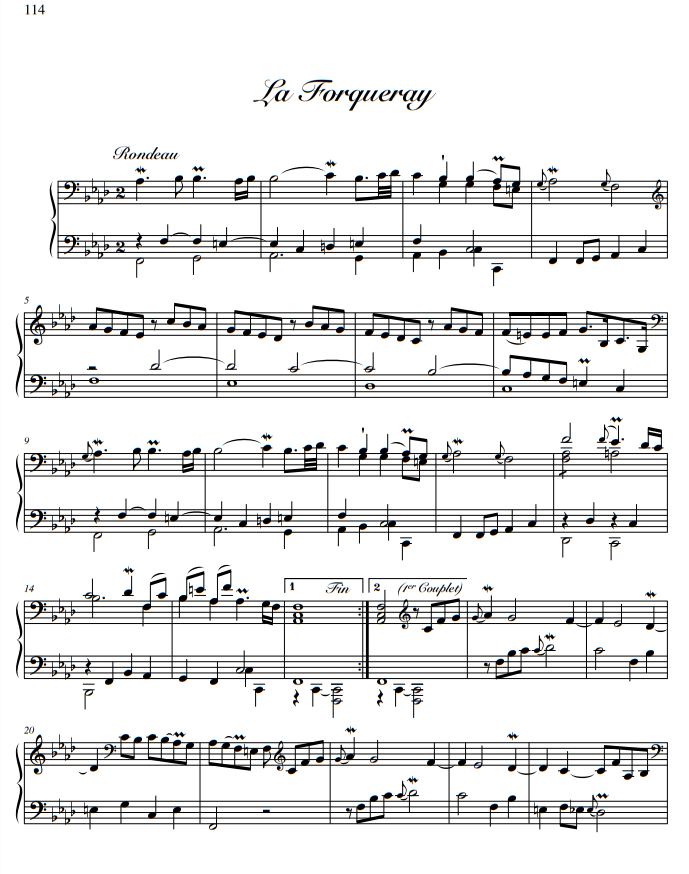
Jacques Duphly (1715 - 15 luglio 1789): La Forqueray, rondeau in fa minore (dal Troisième Livre de Pièces de Clavecin, 1756). Gustav Leonhardt, clavicembalo.
Herbert Hughes (1882 - 1937): Down by the Salley Gardens, melodia tradizionale irlandese (Maids of Mourne Shore) adattata a un testo di William Butler Yeats (da The Wanderings of Oisin and Other Poems, 1889). Alfred Deller, controtenore; Desmond Dupré, liuto.
Down by the salley gardens my love and I did meet;
She passed the salley gardens with little snow-white feet.
She bid me take love easy, as the leaves grow on the tree;
But I, being young and foolish, with her would not agree.
In a field by the river my love and I did stand,
And on my leaning shoulder she laid her snow-white hand.
She bid me take life easy, as the grass grows on the weirs;
But I was young and foolish, and now am full of tears.
Cataldo Amodei (1649 - 13 luglio 1693): Tra l’herbette il pie sciogliea, cantata per voce e basso continuo (1685). Emma Kirkby, soprano; Jakob Lindberg, liuto; Lars Ulrik Mortensen, clavicembalo.
Aria
Tra l’herbette il piè sciogliea
Strepitoso un fiumicello
Al cui sen l’onde accrescea
Col suo pianto un pastorello.
Recitativo
Tacquero in aria i venti
Si dolsero le selve,
E ‘l suon de’ suoi lamenti
Con rauchi gridi accompagnar le belve.
Ond’ei con queste voci
Poiché gl’occhi turbati al ciel affisse,
De’ suoi tormenti atroci
Fè preludio un sospiro, e così disse:
Aria
Cristalli fugaci
Ch’all’umide sponde
Stampate con l’onde
Vestigi di baci.
Se con rauco mormorio
Voi sciogliete il piede errante
Per pietà d’un mesto Amante
Raccogliete il pianto mio.
E con l’onde correnti
De’ vostri molli argenti
Anche le stille amare
Delle lagrime mie portate al mare.
Recitativo
Fermate omai fermate
Il precipizio vostro acque tranquille
E se per questa riva
Stampasse orme remote il piè di Fille
Voi con lingua d’argento
Alla beltà ch’adoro
Sussurrando narrate il mio lamento.
Aria
Voi con suon dolente e basso
Ammollite un cor di pietra,
Che percosso alfin si spetra
Al giocciolar dell’onde ancora un sasso.
Recitativo
Lasso, ma che deliro?
Folle, ma che vaneggio?
A chi narro i miei pianti?
Alle piante insensate al sordo Fiume;
E con flebili accenti
Scongiuro ai sassi, e mi querelo ai venti.
Aria
Aurette veloci
Foriere del dì
Al suon di mie voci
Fermatevi qui
Se Filli mi sprezza
Di me che sarà?
Se un’empia bellezza
D’un cor che l’adora
Tiranna si fa
Date morte a quest’alma o libertà.
Con questi amari accenti
Quando il vecchio Silen dal bosco udillo,
Su la sponda d’un rio pianse Mirtillo.
Anonimo (secolo XVI): The oak and the ash, ovvero The Northern Lasse’s Lamentation. Alfred Deller, controtenore; Desmond Dupré, liuto.
A North Country maid up to London had strayed
Although with her nature it did not agree,
She wept, and she sighed, and she bitterly cried:
I wish once again in the North I could be.
Oh the oak and the ash and the bonnie ivy tree,
They flourish at home in my own country.
While sadly I roam, I regret my dear home
Where lads and young lasses are making the hay,
The merry bells ring and the birds sweetly sing,
And maidens and meadows are pleasant and gay.
Oh the oak and the ash and the bonnie ivy tree,
They flourish at home in my own country.
No doubt, did I please, I could marry with ease,
Where maidens are fair many lovers will come.
But he whom I wed must be North Country bred,
And carry me back to my North Country home.
Oh the oak and the ash and the bonny ivy tree,
They flourish at home in my own country.
Una serie di variazioni sulla melodia di The Oak and the Ash, opera di Giles Farnaby (c1563 - 1640), si trova con il titolo Quodlings Delight nel Fitzwilliam Virginal Book (n. [CXIV]). Qui la composizione di Farnaby è interpretata al clavicembalo da Pieter-Jan Belder:
La medesima melodia ha inoltre dato origine a diverse danze popolari, fra cui una contraddanza pubblicata con il numero 52 nella fortunata raccolta The English Dancing Master (16511) di John Playford: il brano reca il suggestivo titolo di Goddesses, probabilmente ispirato da quello di un masque, The Vision of the Twelve Goddesses, scritto da Samuel Daniel e rappresentato nel 1604. Ecco Goddesses in un arrangiamento di Bernard Thomas interpretato dal bravissimo Nicolas Fendt, che suona chitarra rinascimentale, liuto-chitarra, flauto dolce soprano, contralto, tenore e basso, e percussioni:
Anonimo del XVI secolo: Mignonne, allons (pubblicato nel Recueil des plus belles et excellentes chansons en forme de voix de ville, 1576) di Jean Chardevoine; testo di Pierre de Ronsard (ode À Cassandre, 1545). Duo Mignarda: Donna Stewart, voce; Ron Andrico, liuto.
Mignonne, allons voir si la rose
Qui ce matin avait déclose
Sa robe de pourpre au Soleil,
A point perdu cette vesprée,
Les plis de sa robe pourprée,
Et son teint au vôtre pareil.
Las! voyez comme en peu d’espace,
Mignonne, elle a dessus la place
Hélas! ses beautés laissé choir!
Ô vraiment marâtre Nature,
Puis qu’une telle fleur ne dure
Que du matin jusques au soir!
Donc, si vous me croyez, mignonne,
Tandis que vôtre âge fleuronne
En sa plus verte nouveauté,
Cueillez, cueillez votre jeunesse:
Comme à cette fleur la vieillesse
Fera ternir votre beauté.
La Cassandre cui è dedicata l’ode di Ronsard, fra i più celebri componimenti del poeta francese, è Cassandra Salviati, figlia del banchiere fiorentino Bernardo.
Pierre de Ronsard e Cassandra Salviati nel frontespizio della prima edizione degli Amours (Parigi 1552).
Un sentito ringraziamento a Luisa Zambrotta, il cui interessantissimo blog ha richiamato alla mia mente questa struggente chanson.
Thomas Ravenscroft (c1582 - c1635): The three ravens. Versione per 1 voce e liuto: Alfred Deller e Desmond Dupré; versione per 4 voci e viol consort: Theatre of Voices diretto da Paul Hillier (voce solista Else Torp) e Fretwork.
Nell’interpretazione di Deller, le strofe sono accorpate a due a due.
There were three ravens sat on a tree,
down a down, hay down, hay down,
There were three ravens sat on a tree,
with a down,
There were three ravens sat on a tree,
They were as black as black could be,
with a down, derry, derry, derry, down, down.
And one of them said to his mate:
Where shall we our breakfast take?
Down, [down] in yonder green field,
There lies a knight slain with his shield.
His hounds they lie down at his feet,
So well they their master keep.
His hawks they fly so eagerly,
There’s no fowl dare him come nie.
Down there comes a fallow doe,
As great with young as she might go.
She lift up his bloody head,
And kissed his wounds that were so red.
She got him up upon her back,
And carried him to earthen lake.
She buried him before the prime.
She was dead herself ere even-song time.
God send every gentleman
Such hawks, such hounds, and such a leman.
Non si hanno molte notizie su Ravenscroft, che però fu molto ammirato e stimato dai musicisti suoi contemporanei. Più che per le sue composizioni originali, è noto per un cospicuo numero di raffinati arrangiamenti di melodie tradizionali — qual è appunto The three ravens — che Ravenscroft pubblicò in tre diverse raccolte: Pammelia (1609), Deuteromelia: or The Second part of Musicks melodie (1609) e Melismata (1611).
Il nome di Ravenscroft comparirà spesso in questo blog 😉
Edward Frederick Brewtnall (1846-1902): The Three Ravens, acquerello su carta, c1883
Anonimo (sec. XVI) Greensleeves, ballad (versione per voce e liuto); gli interpreti sono Donna Stewart e Ron Andrico, ossia il duo Mignarda, che ritroveremo più volte in un prossimo futuro. Buone emozioni a tutti 🙂
Alas, my love, you do me wrong
To cast me off discourteously,
And I have loved you so long,
Delighting in your company.
Greensleeves was all my joy,
Greensleeves was my delight,
Greensleeves was my heart of gold,
And who but my lady Greensleeves.
I have been ready at your hand,
To grant whatever you would crave;
I have both waged life and land,
Your love and good-will for to have.
I bought thee petticoats of the best,
The cloth so fine as fine might be:
I gave thee jewels for thy chest;
And all this cost I spent on thee.
Thy crimson stockings all of silk,
With gold all wrought above the knee,
Thy pumps as white as was the milk,
And yet thou wouldst not love me.
Well! I will pray to God on high,
That thou my constancy mayst see,
And that, yet once before I die,
Thou wilt vouchsafe to love me!




 Julian Bream




 Pierre de Ronsard e Cassandra Salviati nel frontespizio della prima edizione degli Amours (Parigi 1552).
 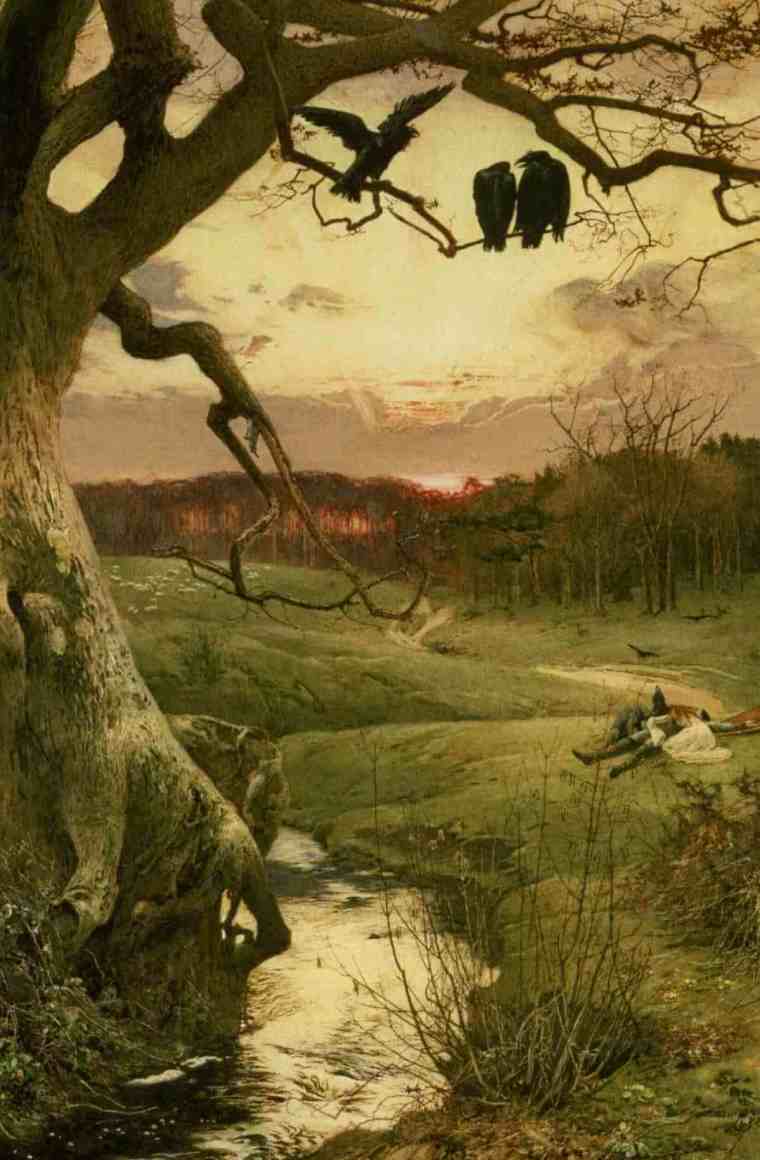 Edward Frederick Brewtnall (1846-1902): The Three Ravens, acquerello su carta, c1883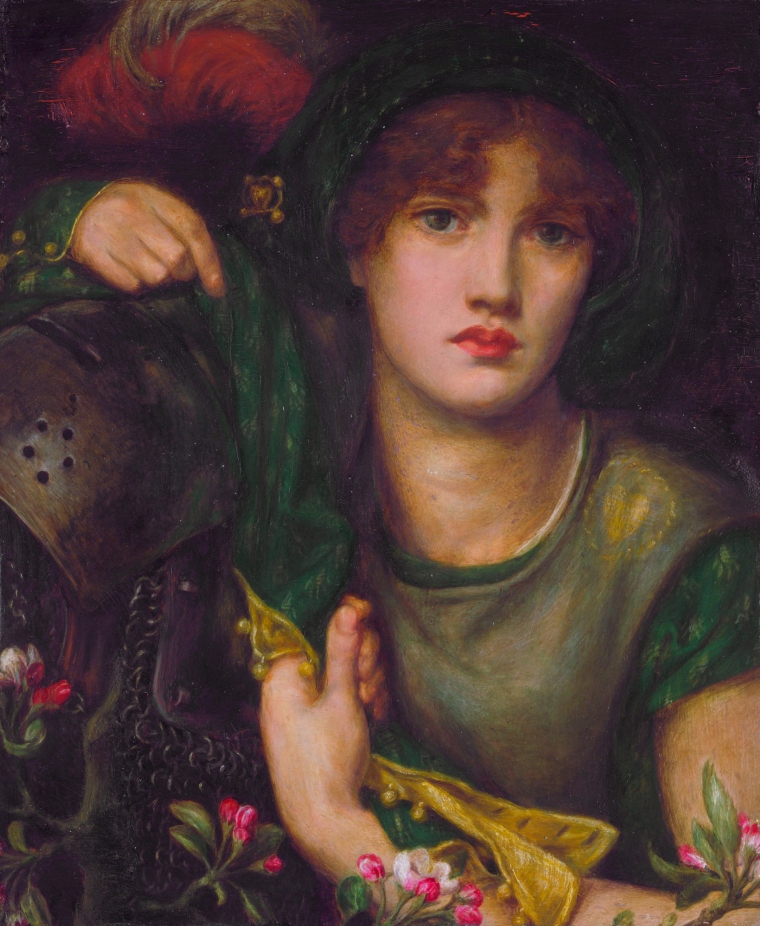
 la regina gioiosa