Anonimo (XVII secolo): Woodycock, tratto dalla raccolta The English Dancing Master (1651, n. 15) di John Playford. Folger Consort.
Anonimo (XVII secolo): Divisions (variazioni) on Woodycock. Latitude 37 (Julia Fredersdorff, violino barocco; Laura Vaughan, viol; Donald Nicolson, clavicembalo) e Genevieve Lacey, flauto dolce.
Giles Farnaby (c1563 - 1640): Wooddy-Cock (variazioni), dal Fitzwilliam Virginal Book (n. [CXLI]). Zsuzsa Pertis, clavicembalo.
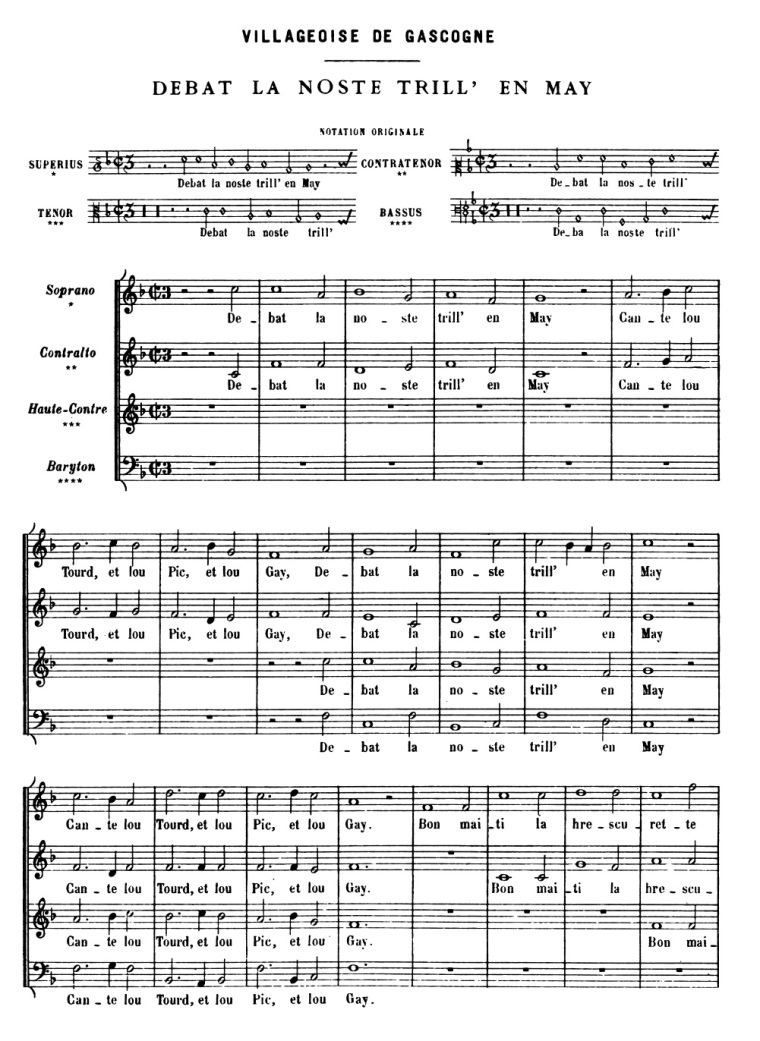
Claude Le Jeune (c1530 - 1600): Debat la noste trill’ en may, chanson a 4 voci e 4 viole (1585). Ensemble «Clément Janequin», Ensemble Les Eléments.
Testo originale in dialetto guascone
Traduzione in francese moderno
Debat la noste trill’ en May
Cante lou Tourd, et lou Pic, et lou Gay.
Bon maiti la hrescurette jou m’leué
Jou troubé la mi’ amourette sueu graüe,
Aqui n’agoum’ quauques moutetz,
Et puchens dus ou trés poutétz.
Debat la noste trill’ en May
Cante lou Tourd, et lou Pic, et lou Gay.
La betzere courroussa de Deü baisa,
Dichouc se ce hous pensa de bet temps a.
Non m’a gousse muchat jamès
Qu’ere de ta hrem com’ames.
Debat la noste trill’ en May
Cante lou Tourd, et lou Pic, et lou Gay,
Com’ duchouc jou la mia bere
Vist que lou ceü non capere tau beautat
Que m’bouilles ta reguerguement
Ma peiche de péne et torment
Debat la noste trill’ en May
Cante lou Tourd, et lou Pic, et lou Gay.
Sous notre treille en mai
Chantent la grive et le pic et le geai.
De bon matin, à la fraîche je me levai
Je rencontrai mon amoureuse sur la grève,
Là nous eûmes quelques mots doux,
Et ensuite deux ou trois baisers.
Sous notre treille en mai
Chantent la grive et le pic et le geai.
Alors elle, courroucée de ces baisers,
Dit que si elle avait pris garde, autrefois,
Elle ne m’aurait jamais montré
Que son amour pour moi était aussi fort.
Sous notre treille en mai
Chantent la grive et le pic et le geai.
Où, lui dis-je, ma belle, a-t-on vu
Que le ciel n’abrite pas de beauté qui te vaille,
Pour que tu me veuilles avec tant de rudesse
Repaître de peine et de tourment!
Sous notre treille en mai
Chantent la grive et le pic et le geai.
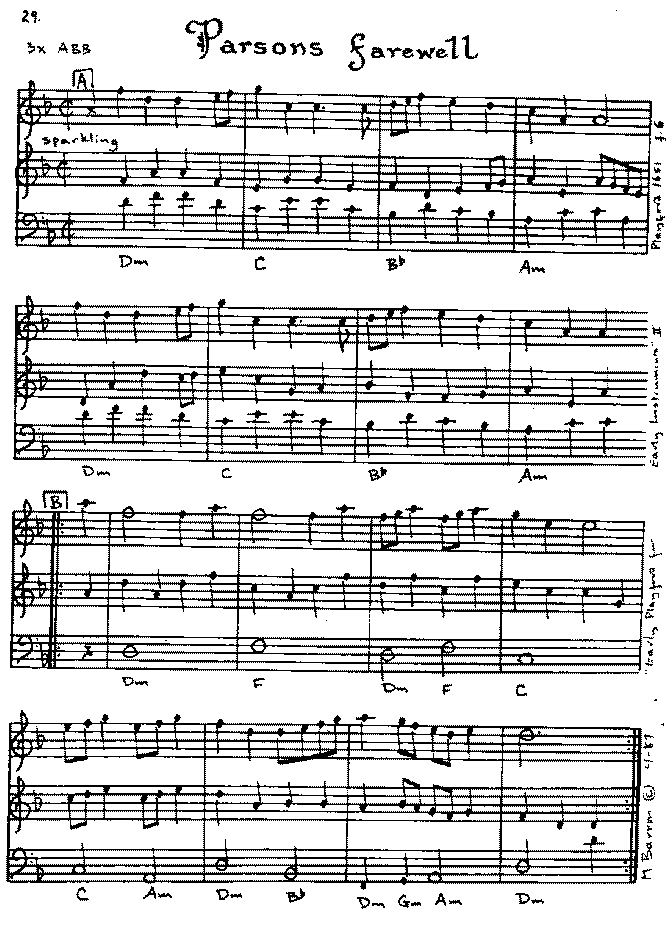
Anonimo (XVII secolo): Parson’s Farewell, dalla raccolta The English Dancing Master di John Playford (Londra 16511), n. 6. Ernst Stolz, pardessus de viole, flauto dolce, clavicembalo, chitarra rinascimentale e violone.
Anonimo (XVII secolo): Bourée d’Avignonez, da Recueil de plusieurs vieux Airs faits aux Sacres, Couronnements, Mariages di André Danican Philidor l’Aîné (manoscritto datato 1690), n. XXII. Le Concert des Nations, dir. Jordi Savall.
Con il suo ensemble, The Broadside Band, Jeremy Barlow ha lavorato a lungo e proficuamente sulle musiche utilizzate da Johann Christoph Pepusch nell’Opera del mendicante (The Beggar’s Opera, 1728) di John Gay: la quale è l’unica ballad opera di cui si parli ancora ai nostri giorni, grazie anche al rifacimento brechtiano del 1928, Die Dreigroschenoper, che adotta però musiche originali composte da Kurt Weill. Per l’Opera del mendicante invece, com’è noto, Pepusch adattò i testi di Gay a melodie che all’epoca avevano una certa notorietà, prendendole a prestito da broadside ballads, arie d’opera, inni religiosi e canti di tradizione popolare.
Oltre a produrre un’edizione completa del lavoro di Gay e Pepusch, Barlow e la sua band hanno inciso (per Harmonia Mundi, 1982) anche un’antologia degli airs più famosi (in tutto nove brani), di ciascuno dei quali proponendo non solo la versione dell’Opera del mendicante ma anche la composizione originale e eventuali altre sue trasformazioni, varianti e parodie.
L’ultima sezione dell’antologia, che qui sottopongo alla vostra attenzione, è dedicato a Greensleeves. Comprende, nell’ordine:
una improvvisazione sul passamezzo antico, eseguita al liuto da George Weigand
Greensleeves, la più antica versione nota della melodia (dal William Ballet’s Lute Book, c1590-1603) con la più antica versione nota del testo (da A Handful of Pleasant Delights, 1584), cantata da Paul Elliott accompagnato al liuto da Weigand [1:13]
Alas, my love, you do me wrong,
To cast me off discourteously.
And I have loved you so long,
Delighting in your company.
Greensleeves was all my joy,
Greensleeves was my delight,
Greensleeves was my heart of gold,
And who but my Lady Greensleeves.
I have been ready at your hand,
To grant whatever you wouldst crave,
I have both waged life and land,
Your love and goodwill for to have.
Well I will pray to God on high
That thou my constancy mayst see,
And that yet once before I die,
Thou wilt vouchsafe to love me.
Greensleeves, now farewell, adieu,
God I pray to prosper thee,
For I am still thy lover true,
Come once again and love me.
Greensleeves, la versione più diffusa all’inizio del Seicento, secondo William Cobbold (1560 - 1639) e altri autori, con improvvisazioni eseguite da Weigand alla chitarra barocca e da Rosemary Thorndycraft al bass viol [4:07]
la versione dell’Opera del mendicanteche già conosciamo, interpretata ancora da Elliott a solo [5:27]
un misto di tre jigs irlandesi eseguito da Barlow al flauto e da Alastair McLachlan al violino [6:03]:
– A Basket of Oysters (da Moore’s Irish Melodies, 1834)
– A Basket of Oysters or Paddythe Weaver (Aird’s selection, 1788)
– Greensleeves (versione raccolta a Limerick nel 1852)
With his ensemble, The Broadside Band, Jeremy Barlow worked extensively and profitably on the music used by Johann Christoph Pepusch in John Gay’s The Beggar’s Opera (1728): it is the only ballad opera still being talked about in our days, thanks also to Bertolt Brecht’s 1928 remake, Die Dreigroschenoper, which however has original music composed by Kurt Weill. It is not the same for The Beggar’s Opera: Gay’s lyrics were in fact adapted by Pepusch to melodies that at the time already had a certain notoriety, borrowing them from broadside ballads, opera arias, religious hymns and folk songs.
Barlow and his band have recorded a complete edition of Gay and Pepusch’s work, as well as an anthology of its most famous airs (nine pieces in all), of each of which they presented not only The Beggar’s Opera version, but also the original composition and some of its variants and parodies.
The last track of the anthology, the one I submit to your attention here, is dedicated to Greensleeves. It includes, in order:
Greensleeves, earliest version of melody (from William Ballet’s Lute Book, c1590-1603) with earliest surviving words (A Handful of Pleasant Delights, 1584), sung by Paul Elliott accompanied on lute by Weigand [1:13]
Alas, my love, you do me wrong,
To cast me off discourteously.
And I have loved you so long,
Delighting in your company.
Greensleeves was all my joy,
Greensleeves was my delight,
Greensleeves was my heart of gold,
And who but my Lady Greensleeves.
I have been ready at your hand,
To grant whatever you wouldst crave,
I have both waged life and land,
Your love and goodwill for to have.
Well I will pray to God on high
That thou my constancy mayst see,
And that yet once before I die,
Thou wilt vouchsafe to love me.
Greensleeves, now farewell, adieu,
God I pray to prosper thee,
For I am still thy lover true,
Come once again and love me.
Greensleeves, the most widespread version at the beginning of the seventeenth century, according to William Cobbold (1560 - 1639) and other authors, with improvisations performed by Weigand on baroque guitar and by Rosemary Thorndycraft on bass viol [4:07]
The Beggar’s Opera version (we already know it) sung by Elliott a solo [5:27]
a medley of three Irish jigs performed by Barlow on flute and Alastair McLachlan on violin [6:03]:
– A Basket of Oysters (da Moore’s Irish Melodies, 1834)
– A Basket of Oysters or Paddythe Weaver (Aird’s selection, 1788)
– Greensleeves (collected Limerick 1852).
Anonimo: John, come kiss me, now. Ernst Stolz, viol e chitarra rinascimentali.
William Byrd (c1540 - 4 luglio 1623): Jhon come kisse me now (sic!), 16 variazioni per strumento a tastiera (dal Fitzwilliam Virginal Book, n. X). Rosemary Thomas, clavicembalo.
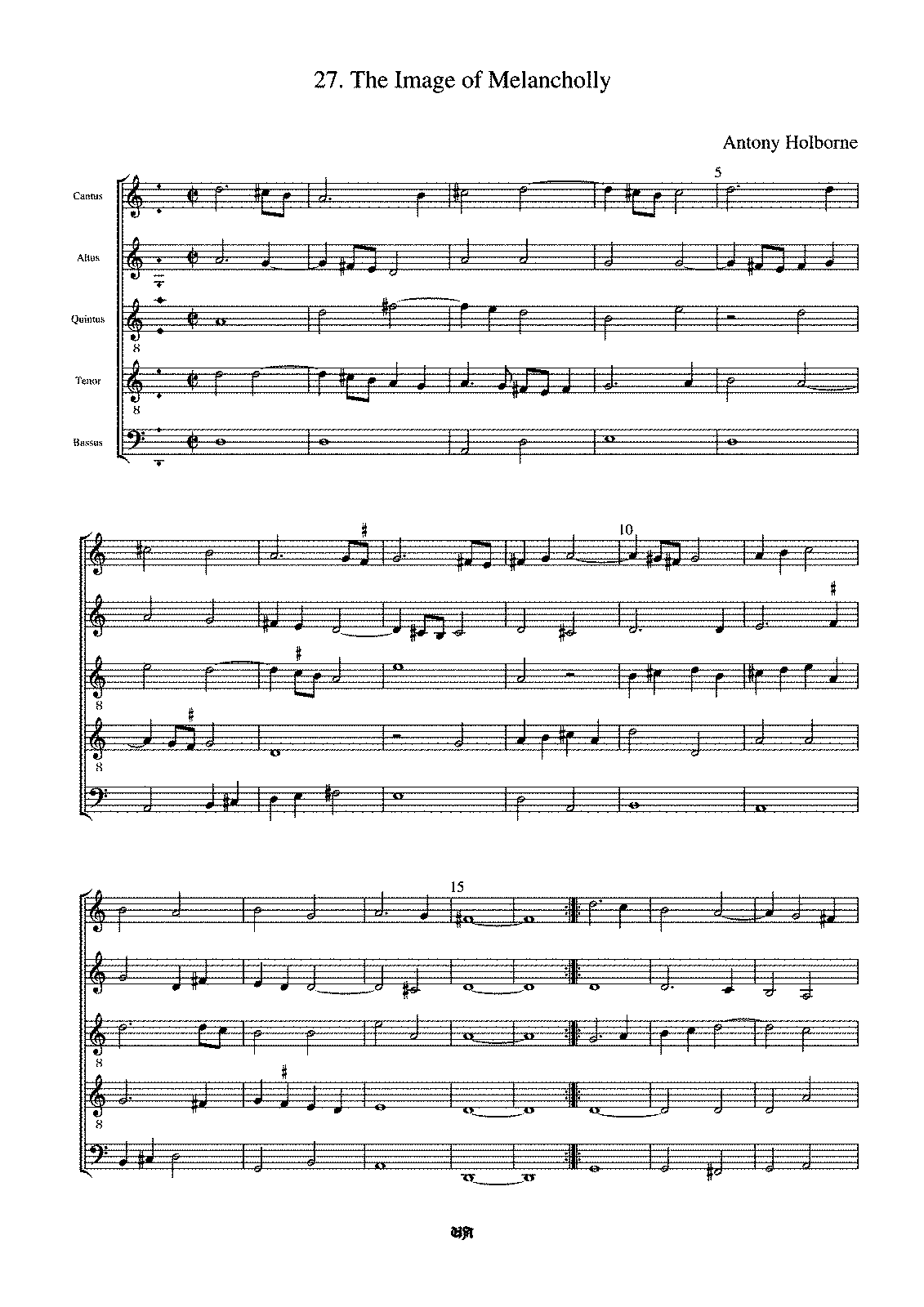
Anthony Holborne (c1545 - 29 novembre 1602): The Image of Melancholy, pavana a 5 parti strumentali (pubblicata in Pavans, Galliards, Almains and other Short Aeirs, 1599, n. 27). Ensemble Masques: Sophie Gent e Tuomo Suni, violini; Margaret Little e Mélisande Corriveau, bass viols; Benoît van den Bemden, violone; Olivier Fortin, clavicembalo.
John Dowland (1563 - 1626): In darkness let me dwell, ayre. Ellen Hargis, soprano; Jacob Heringman, liuto; Mary Springfels, viol.
In darkness let me dwell; the ground shall sorrow be,
The roof despair, to bar all cheerful light from me;
The walls of marble black, that moist’ned still shall weep;
My music, hellish jarring sounds, to banish friendly sleep.
Thus, wedded to my woes, and bedded in my tomb,
O let me living die, till death doth come, till death doth come.
Capolavoro di Dowland, il brano fu pubblicato dal figlio del compositore, Robert (1591 - 1641), nell’antologia A Musicall Banquet (Londra 1610, n. X). In darkness let me dwell è l’ultima delle composizioni vocali su testo inglese della raccolta: fanno seguito tre airs de cour francesi (tutti e tre di Pierre Guédron, il cui nome non è tuttavia menzionato nella pubblicazione), due romances spagnoli e cinque arie su testo italiano.
John Dowland (1563 - 1626): Lady if you so spight me, ayre. Martyn Hill, tenore; Anthony Rooley, liuto; Trevor Jones, viol.
Lady if you so spight me,
Wherfore do you so oft kisse and delight mee?
Sure that my hart opprest and overcloyed,
May breake thus overjoyde,
If you seeke to spill mee,
Come kisse me sweet and kill mee,
So shal your hart be eased,
And I shall rest content and dye well pleased.
Il brano fu pubblicato dal figlio del compositore, Robert (1591 - 1641), nella raccolta A Musicall Banquet (Londra 1610, n. IX).
John Dowland (1563 - 1626): Lady if you so spight me, ayre « for one voice only to sing » su testo di sir Henry Lee of Ditchley (1533 - 1611). Emma Kirkby, soprano; Anthony Rooley, liuto.
Far from triumphing Court and wonted glory
He dwelt in shady unfrequented places,
Time’s prisoner now, he made his pastime story;
Glady forgets Court’s erst-afforded graces.
That goddess whom he served to heaven is gone,
And he on earth in darkness left to moan.
But lo, a glorious light from his dark rest
Shone from the place where erst this goddess dwelt;
A light whose beams the world with fruit hath blest;
Blest was the knight while he that light beheld.
Since then a star fixed on his head hath shined,
And a saint’s image in his heart is shrined.
Ravished with joy, so graced by such a saint,
He quite forgat his cell and self denaid;
He thought it shame in thankfulness to faint,
Debts due to princes must be duly paid;
Nothing so hateful to a noble mind
As finding kindness for to prove unkind.
But ah! poor knight, though thus in dream he ranged,
Hoping to serve this saint in sort most meet,
Time with his golden locks to silver changed
Hath with age-fetters bound him hands and feet.
Ay me! he cries, goddess, my limbs grow faint,
Though I Time’s prisoner be, be you my saint.
Il brano fu pubblicato dal figlio del compositore, Robert (1591 - 1641), nella raccolta A Musicall Banquet (Londra 1610, n. VIII).






 la regina gioiosa