Jean Barraqué (1928 - 17 agosto 1973): Sonata per pianoforte (1950-52). Roger Woodward (registrazione del 1972 realizzata in presenza dell’autore).
La Sonata di Barraqué, unanimemente considerata un capolavoro del serialismo, si evolve in un unico movimento, suddiviso in due sezioni: la seconda, Lent, ha inizio a 19:16.
Jean Barraqué (1928 - 17 agosto 1973): Chant après chant per voce, 6 percussionisti e pianoforte (1965-66), testi di Barraqué e Hermann Broch. Jamie Jordan, soprano; University of South Florida Percussion Ensemble: Jacob Dike, Armando Ayala, Kevin Cross, Beran Harp, Amanda Dezee e Christopher Herman; Corey Merenda, pianoforte; dir. Robert McCormick.
Samuel Coleridge-Taylor (15 agosto 1875 - 1912): Ouverture per The Song of Hiawatha, trilogia corale op. 30 (1901) su testi di Henry Wadsworth Longfellow. RTÉ Concert Orchestra, dir. Adrian Leaper.
Agli interessati YouTube offre la possibilità di ascoltare l’intera trilogia. Nato a Holborn, Londra, da padre creolo originario della Sierra Leone e madre inglese, Samuel Coleridge-Taylor fu così chiamato in onore del poeta Samuel Taylor Coleridge. Affermatosi quale compositore e direttore d’orchestra, nei primi anni del ‘900 si recò in tournée negli Stati Uniti, ottenendo un grandissimo successo; l’appellativo di «Mahler africano» gli fu assegnato dai membri (bianchi) di un’orchestra newyorkese da lui diretta nel 1910. Morì a 37 anni di polmonite.
Samuel Sebastian Wesley (14 agosto 1810 - 1876): Larghetto in fa diesis minore per organo (da Three Pieces for chamber organ, set 2, 1843, n. 2). Iddo van der Giessen.
Salomon Jadassohn (13 agosto 1831 - 1902): Sestetto in sol maggiore per pianoforte a 4 mani, 2 violini, viola e violoncello op. 100 (1888). Bracha Eden e Alexander Tamir, pianoforte; membri del quartetto d’archi non identificati.
Sostenuto – Allegro ma non troppo vivace
Adagio serioso [10:39]
Finale: Allegretto grazioso, ma un poco vivo – Più mosso [16:44]
Jacopo Peri detto Zazzerino (20 agosto 1561 - 12 agosto 1633): Tu dormi, e ‘l dolce sonno. Ellen Hargis, soprano; Paul O’Dette, chitarrone; Andrew Lawrence-King, arpa; Hille Perl, lirone.
Tu dormi, e’l dolce sonno
Ti lusinga con l’ali, aura volante,
Né mov’ombra già mai tacite piante.
Io, che non ho riposo,
Se non quando da’ lumi
Verso torrenti e fiumi,
Esc’al notturno sol a me gioioso.
Tu lo splendor degl’argentati rai
Non rimiri, e tu stai
Sord’al duol che m’accora;
Io sent’e veggio ogn’hor l’aura e l’aurora.
Tu dormi, e non ascolti
Me che prego e sospiro, e piango e bramo,
E nell’alto silentio hora ti chiamo.
Ben ha profond’oblio,
Filli, sepolt’i tuoi sensi vitali,
E prov’invano
Destar in te pietà d’alma che more.
Non è Febo lontano,
Vien l’alba rugiadosa,
Ma che, dorm’e riposa,
Non piang’indarno i suoi torment’il core;
E se non senti tu, mi sent’amore.
Tu dormi, et io pur piango,
O bella, o del mio cor dolce tormento,
E col mio pianto io mir’il ciel intento.
Entro piume d’odori
Tu ripos’il bel fianco;
Io, fra mille dolori,
Sento senza pietà venirmi manco.
O sonno, o tu che porti pace ai cori,
E le menti egre conforti,
Te non chiamo già mai, ma sol desio
Che nei sospir’aquet’il morir mio.
Heinrich Ignaz Franz von Biber (12 agosto 1644 - 1704): Missa salisburgensis a 53 voci (1682). Musica Antiqua Köln, dir. Reinhard Goebel; Gabrieli Consort & Players, dir. Paul McCreesh.
Krzysztof Meyer (11 agosto 1943): Sinfonia n. 6 op. 57, Symfonia polska (1982). Polska Orkiestra Radiowa Kraków, dir. Antoni Wit.
Adagio
Allegro molto [18:55]
Andante con moto [26:15]
Allegro – Largo [36:32]
Meyer iniziò a comporre la Sesta Sinfonia subito dopo la proclamazione della legge marziale in Polonia (13 dicembre 1981) e la completò nell’aprile successivo. Il titolo di Sinfonia polacca è dovuto alle numerose citazioni di melodie tradizionali polacche in essa contenute, ma anche al desiderio di attirare l’attenzione sulle circostanze storiche e politiche che l’hanno ispirata.
Aleksandr Konstantinovič Glazunov (10 agosto 1865 - 1936): Из средних веков (Dal Medioevo), suite sinfonica op. 79 (1902). Orchestra sinfonica della Radio di Mosca, dir. Vladimir Fedoseev.
Bernd Alois Zimmermann (1918 - 10 agosto 1970): Photoptosis, preludio per grande orchestra (1968). WDR Sinfonieorchester Köln, dir. Jukka-Pekka Saraste.
Il titolo è composto dai termini greci phòtos = luce e ptòsis = caduta: si riferisce alla luce incidente e ai cambiamenti cromatici che essa comporta, qui relativi ai “colori” strumentali, cioè ai timbri. Nella composizione sono presenti varie citazioni, in particolare della Nona Sinfonia di Beethoven.
Nicolas Bochsa (9 agosto 1789 - 1856): Concerto pour la harpe principale in re minore op. 15 n. 1 (c1813). Lily Laskine (1893-1988), arpa; Orchestre de l’Association des Concerts Lamourex, dir. Jean-Baptiste Mari (registrazione del 1964).
Francis Pilkington (c1565 - 1638): Rest, sweet nymphs, ayre (dal First Book of Songs or Airs of Four Parts, 1605, n. 6).
– versione per 1 voce e liuto: Valeria Mignaco (soprano) e Alfonso Marin;
– versione a 4 voci a cappella: Laudantes Consort.
Rest, sweet nymphs, let golden sleep
Charm your star brighter eyes,
While my lute the watch doth keep
With pleasing sympathies.
Lulla, lullaby. Lulla, lullaby.
Sleep sweetly, sleep sweetly,
Let nothing affright ye,
In calm contentments lie.
Dream, fair virgins, of delight
And blest Elysian groves,
While the wandring shades of night
Resemble your true loves.
Lulla, lullaby. Lulla, lullaby.
Your kisses, your blisses,
Send them by your wishes,
Although they be not nigh.
Thus, dear damsels, I do give
‘Good night’, and so am gone:
With your hearts’ desires long live,
Still joy, and never moan.
Lulla, lullaby. Lulla, lullaby.
Hath pleased you and eased you,
And sweet slumber seized you,
And now to bed I hie.
Daniel Börtz (8 agosto 1943): Dubbelkonsert för en per violino e viola (un solo esecutore) e orchestra (2019–20). Malin Broman, violino e viola; Norrköpings Symfoniorkester, dir. Simon Crawford-Phillips. Registrazione della 1ª esecuzione, 23 marzo 2023.
David Popper (1843 - 7 agosto 1913): Requiem per 3 violoncelli e pianoforte op. 66 (1892). Rajan Krishnaswami, Brian Wharton e Jonathan Salman, violoncelli; Mark Salman, pianoforte.
Sir Granville Bantock (7 agosto 1868 - 1946): The Witch of Atlas, poema sinfonico (1902) ispirato dall’omonimo poemetto di Shelley. BBC National Orchestra of Wales, dir. Rumon Gamba.
François Couperin le Grand (1668 - 1733): La Linotte effarouchée, rondeau in re maggiore, n. 2 dell’Ordre XIV (Pièces de clavecin III, 1722). Luc Beauséjour, clavicembalo.
Giuseppe Gherardeschi (1759 - 6 agosto 1815): Sonata IV in mi bemolle maggiore per clavicembalo, violino e basso. Fëdor Stroganov, clavicembalo; Tat’jana Grindenko, violino; Nikita Kočergin, violoncello.
Domenico Zanatta (c1665 - 5 agosto 1748): Gelosia, cantata per voce e basso continuo (da Intrecci armonici diversi… opera quarta, 1696). Flavio Ferri-Benedetti, controtenore; ensemble Musica Fiorita, dir. Daniela Dolci.
Dimmi, amor, qual pena sia
più maggior di gelosia
ad un cor ch’ama fedel.
Ella sparge dentro al seno
il più perfido veleno
e l’ardore più crudel.
Oh, Dio, quanto tiranna è la tua legge,
o faretrato arcero,
ingiusto è il tuo comando
se a chi vive adorando
decreti che sia il fin de’ suoi contenti
d’un geloso pensier gl’aspri tormenti.
Deh, lasciami in pace,
tiranna de’ cori,
crudel gelosia.
Quest’alma si sface
tra i rigidi ardori
di tua tirannia.
Il mio servir costante,
l’esser fedel amante
fomenta maggior fiamme al seno mio
s’ancor il mio desio
mascherando di gioia i suoi martiri
scuote a rigor di pene anco i sospiri.
Oh, Dio, che acerba pena
è il viver in catena
e aver geloso il cor.
Egl’è un sì fier martire
che l’alma fa languire
in grembo del dolor.
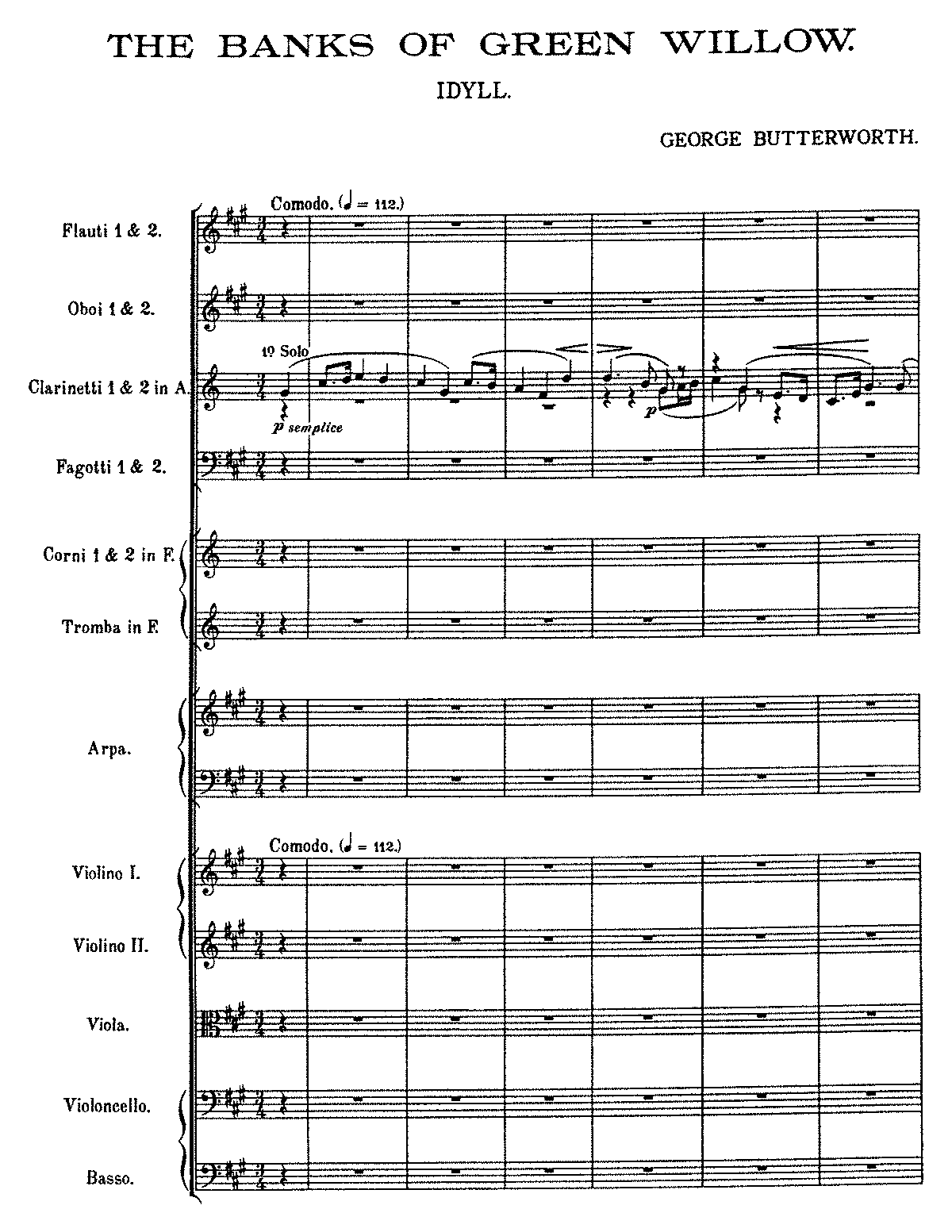
George Sainton Kaye Butterworth (1885 - 5 agosto 1916): The Banks of Green Willow, idillio per piccola orchestra (1913). Royal Liverpool Philharmonic Orchestra, dir. Grant Llewellyn.
La composizione si fonda su due melodie desunte da altrettanti ballad tradizionali: quello che dà nome al brano è noto anche come Bonnie Annie e The Green Banks of Yarrow; l’altro si intitola Green Bushes.
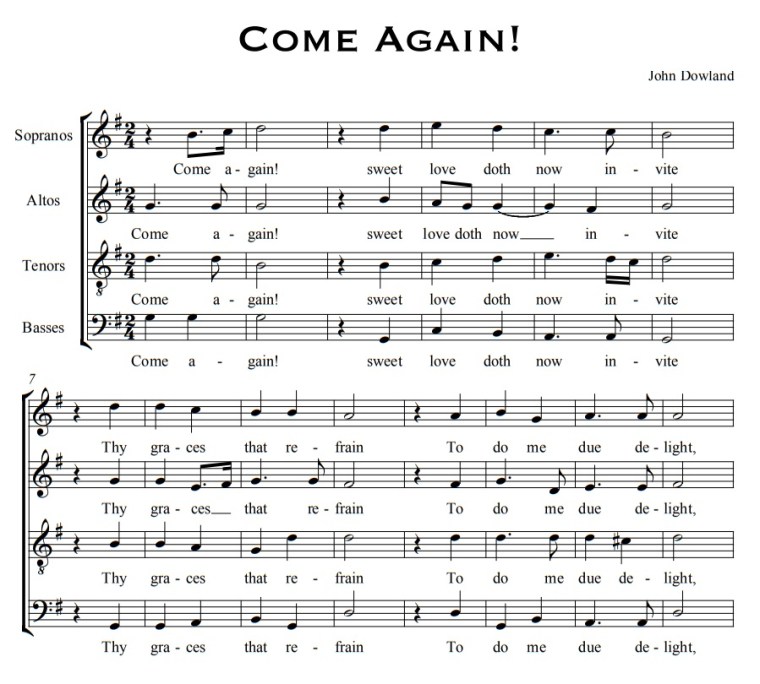
John Dowland (1563 - 1626): Come again, ayre* (dal First Booke of Songes or Ayres of fowre partes with Tableture for the Lute, 1597, n. 17). Paul Agnew, tenore; Christopher Wilson, liuto.
Come again! sweet love doth now invite
Thy graces that refrain
To do me due delight,
To see, to hear, to touch, to kiss, to die,
With thee again in sweetest sympathy.
Come again! that I may cease to mourn
Through thy unkind disdain;
For now left and forlorn
I sit, I sigh, I weep, I faint, I die
In deadly pain and endless misery.
All the day the sun that lends me shine
By frowns do cause me pine
And feeds me with delay;
Her smiles, my springs that makes my joys to grow,
Her frowns the Winters of my woe.
All the night my sleeps are full of dreams,
My eyes are full of streams.
My heart takes no delight
To see the fruits and joys that some do find
And mark the storms are me assign’d.
Out alas, my faith is ever true,
Yet will she never rue
Nor yield me any grace;
Her eyes of fire, her heart of flint is made,
Whom tears nor truth may once invade.
Gentle Love, draw forth thy wounding dart,
Thou canst not pierce her heart;
For I, that do approve
By sighs and tears more hot than are thy shafts
Did tempt while she for triumph laughs.
(*) Per ayre si intende un genere musicale fiorito in Inghilterra tra la fine del Cinquecento e la terza decade del secolo successivo. L’ayre è un brano a più voci (solitamente quattro) con accompagnamento di liuto; ciò che lo distingue dalle composizioni congeneri del periodo precedente è il fatto che alla voce più acuta è affidata una parte spiccatamente melodica, sul modello della «monodia accompagnata» italiana e dell’air de cour francese. Gli interpreti hanno dunque la possibilità di eseguire un ayre o secondo tradizione, con tutte le parti vocali e con l’accompagnamento del liuto ad libitum, oppure seguendo la moda dell’epoca, cioè con il canto della sola parte più acuta sostenuto dal liuto. In quest’ultimo caso, al liuto spesso si aggiunge una viola da gamba che ha il compito di irrobustire la linea del basso.
Al’fred Šnitke (Alfred Schnittke; 1934 - 3 agosto 1998): Suite in stile antico per violino e pianoforte op. 80 (1972). Irina Tseitlin, violino; Patrick Dheur, pianoforte.
Orlando di Lasso (1530/32 - 1594): Matona mia cara, villanella a 4 voci (dal Libro de Villanelle, Moresche, et altre Canzoni, 1581, n. 12). The Hilliard Ensemble, dir. Paul Hillier.
Matona mia cara, mi follere canzon
cantar sotto finestra, lantze bon compagnon. Don don don diri diri don don don don.
Ti prego m’ascoltare che mi cantar de bon
e mi ti foller bene come greco e capon.
Com’andar alle cazze, cazzar con le falcon,
mi ti portar beccazze, grasse come rognon.
Se mi non saper dire tante belle rason,
Petrarca mi non saper, ne fonte d’Helicon.
Se ti mi foller bene mi non esser poltron;
mi ficcar tutta notte, urtar come monton.
Sir Arthur Bliss (2 agosto 1891 - 1975): Concerto per violoncello e orchestra op. 120 (1970). Tim Hugh, violoncello; English Northern Philharmonia, dir. David Lloyd-Jones.


 Jean Barraqué (1928 - 17 agosto 1973): Chant après chant per voce, 6 percussionisti e pianoforte (1965-66), testi di Barraqué e Hermann Broch. Jamie Jordan, soprano; University of South Florida Percussion Ensemble: Jacob Dike, Armando Ayala, Kevin Cross, Beran Harp, Amanda Dezee e Christopher Herman; Corey Merenda, pianoforte; dir. Robert McCormick.


 Valerij Viktorovič Želobinskij (1913 - 13 agosto 1946): 24 Preludi per pianoforte op. 20 (1934). Jeroen Riemsdijk.






 Gianni Possio (3 agosto 1953): Serenata per 8 strumenti a fiato (1983). Ottetto Classico Italiano.

 la regina gioiosa