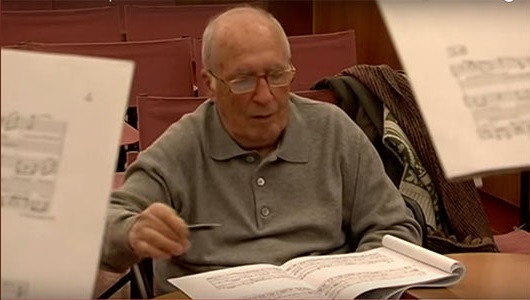
Urmas Sisask (9 settembre 1960 - 2022): Universumi hääled (Voci dell’universo), sinfonia per 4 pianoforti a 8-16 mani op. 88 (2002). Nata-Ly Sakkos, Toivo Peäske, Piret Väinmaa, Lauri Väinmaa, Kai Ratassepp, Mati Mikalai, Piret Habak e Reet Ruubel, pianoforti; Urmas Sisask, grancassa e tamburo sciamanico.
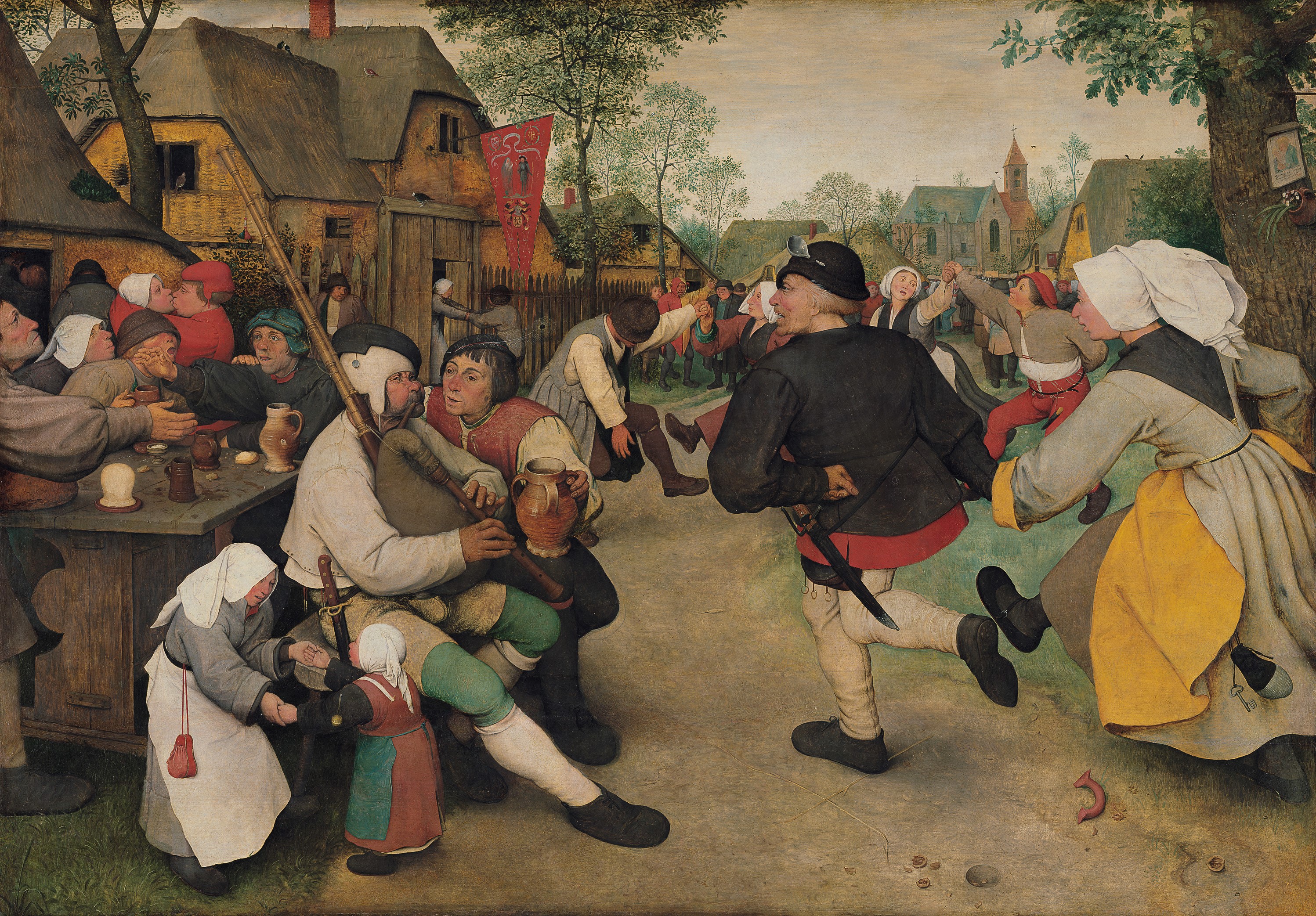
Pieter Bruegel il Vecchio (c1525 - 9 settembre 1569): Danza di contadini (c1568).
Mentre ammirate il famoso dipinto (cliccando sull’immagine la si ingrandisce) potete ascoltare la rinomata Bergerette «Sans Roch», tratta dal pregiatissimo Terzo libriccino di musica (1551) dell’esimio Tielman Susato, nella nota interpretazione del celebre New London Consort diretto dal famigerato Philip Pickett.
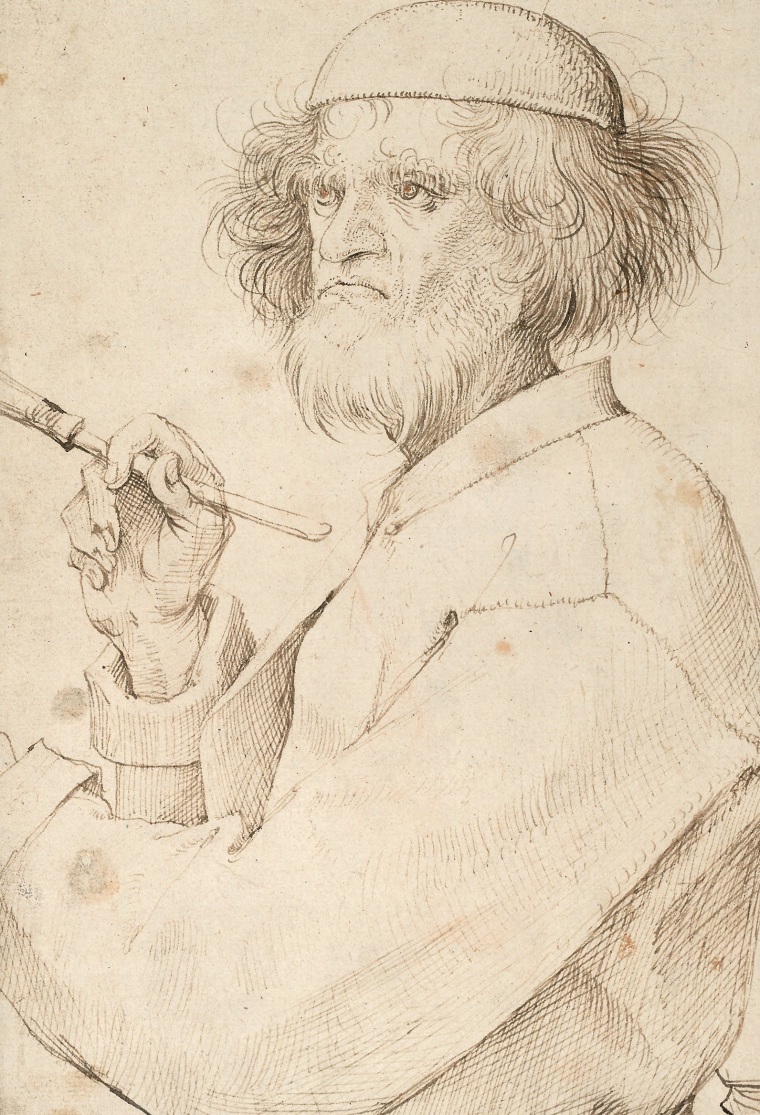
Presunto autoritratto di Pieter Bruegel il Vecchio
John Dowland (1563 - 1626): Lady if you so spight me, ayre « for one voice only to sing » su testo di sir Henry Lee of Ditchley (1533 - 1611). Emma Kirkby, soprano; Anthony Rooley, liuto.
Far from triumphing Court and wonted glory
He dwelt in shady unfrequented places,
Time’s prisoner now, he made his pastime story;
Glady forgets Court’s erst-afforded graces.
That goddess whom he served to heaven is gone,
And he on earth in darkness left to moan.
But lo, a glorious light from his dark rest
Shone from the place where erst this goddess dwelt;
A light whose beams the world with fruit hath blest;
Blest was the knight while he that light beheld.
Since then a star fixed on his head hath shined,
And a saint’s image in his heart is shrined.
Ravished with joy, so graced by such a saint,
He quite forgat his cell and self denaid;
He thought it shame in thankfulness to faint,
Debts due to princes must be duly paid;
Nothing so hateful to a noble mind
As finding kindness for to prove unkind.
But ah! poor knight, though thus in dream he ranged,
Hoping to serve this saint in sort most meet,
Time with his golden locks to silver changed
Hath with age-fetters bound him hands and feet.
Ay me! he cries, goddess, my limbs grow faint,
Though I Time’s prisoner be, be you my saint.
Il brano fu pubblicato dal figlio del compositore, Robert (1591 - 1641), nella raccolta A Musicall Banquet (Londra 1610, n. VIII).
Giuseppe Balzano (9 settembre 1616 - 1700): Adiuro vos, cantata per 3 voci soliste, coro e archi; testo tratto dal Cantico dei cantici (8:4-5). Dir. Joseph Vella.
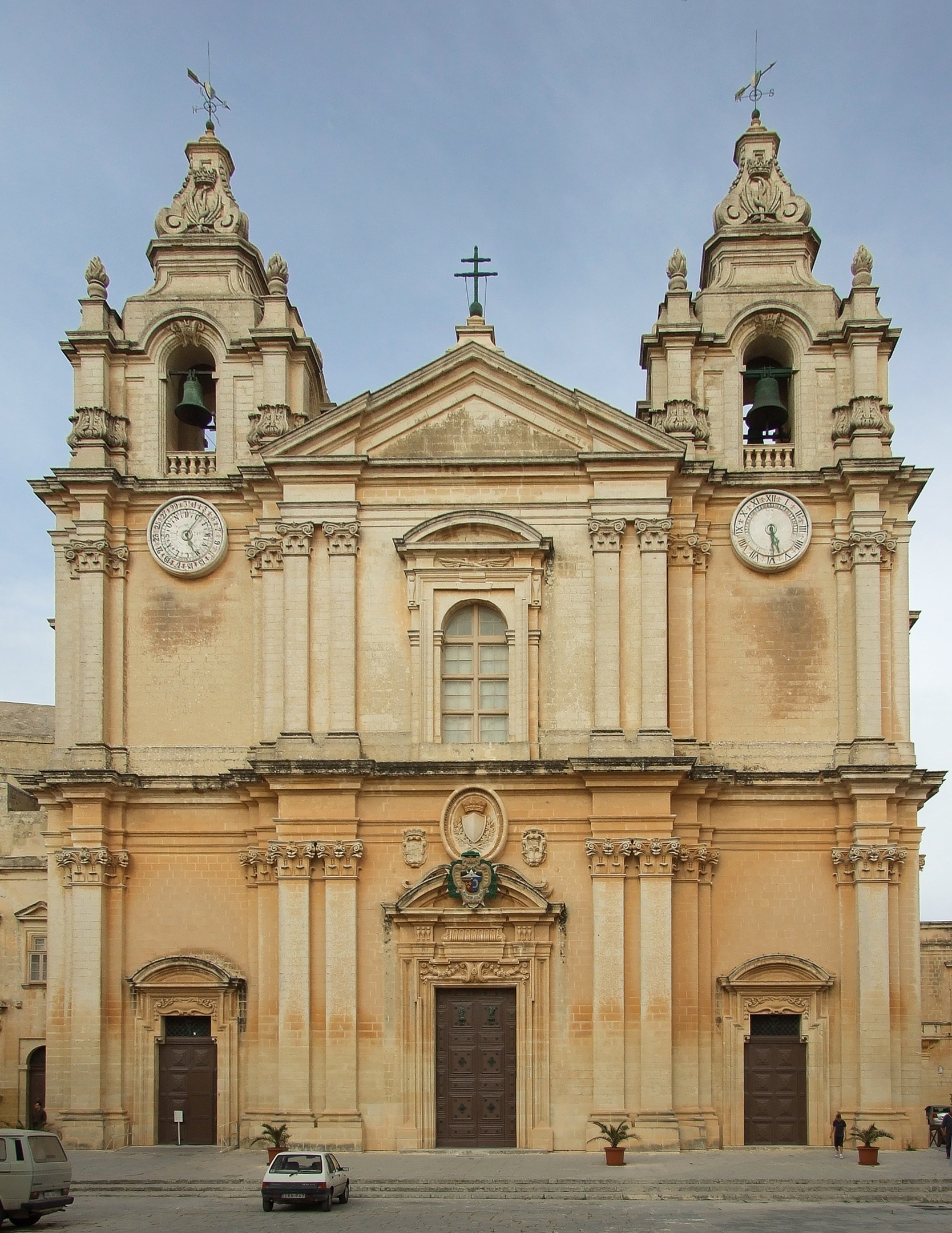
La Cattedrale di San Paolo in Medina (Malta), ove Balzano fu maestro di cappella dal 1661 al 1699.
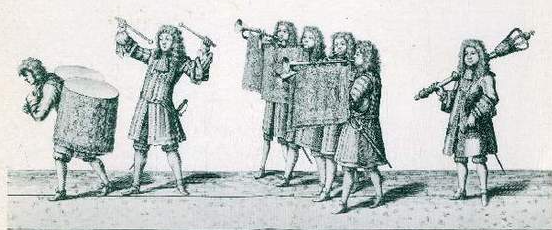
Henry Purcell (1659 - 1695): March per 4 flat trumpets (trombe da tirarsi). Baroque Brass of London; Robert Howes, tamburo.
(La partitura originale non prevede il tamburo: la parte venne aggiunta dal musicologo britannico Thurston Dart quando curò un’edizione pratica delle musiche composte da Purcell per i funerali della regina Maria.)
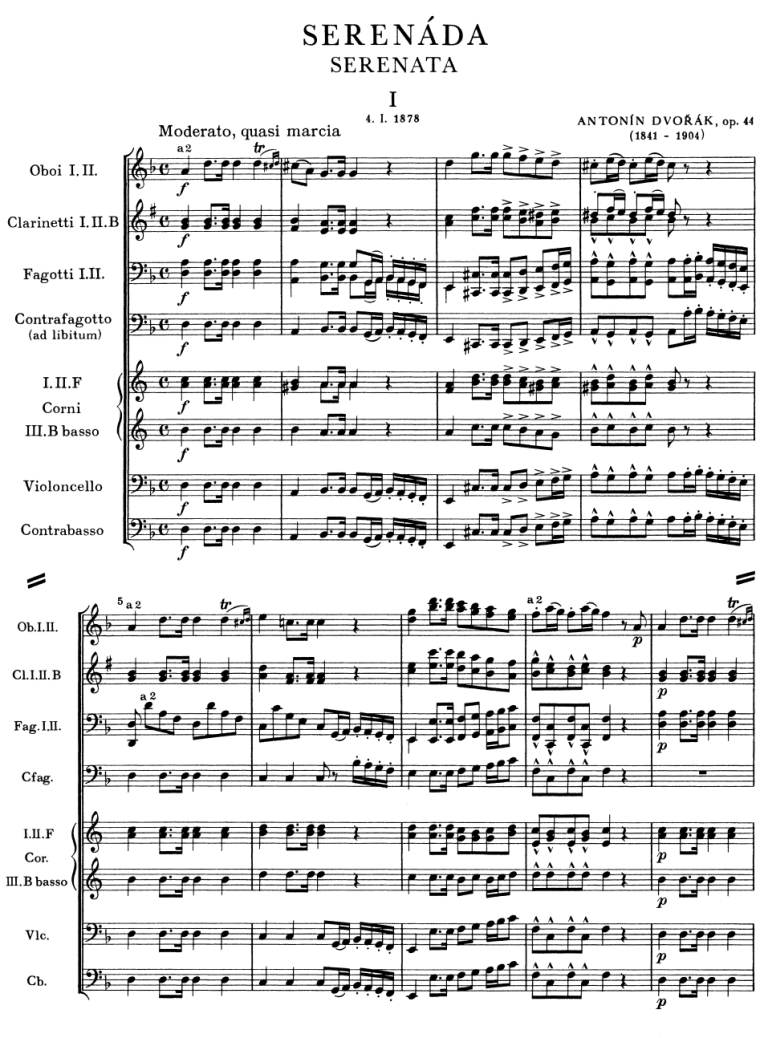
Antonín Dvořák (8 settembre 1841 - 1904): Serenata in re minore per 10 strumenti a fiato (2 oboi, 2 clarinetti, 2 fagotti, controfagotto ad libitum e 3 corni), violoncello e contrabbasso op. 44 (1878). Membri dell’Orchester des Bayerischen Rundfuks, dir. Rafael Kubelík.
Guillaume Tessier (sec. XVI): In a grove most rich of shade, ayre su testo di Philip Sidney (da Astrophel and Stella). Versione per 1 voce e liuto: Emily van Evera e Paul O’Dette; versione per 2 voci e liuto: Emma Kirkby, soprano; David Thomas, basso; Anthony Rooley, liuto.
In a grove most rich of shade
where birds wanton music made,
May then in his pied weeds showing,
new perfumes with flowers fresh growing.
Astrophel with Stella sweet
did for mutual comfort meet
both within themselves oppressed,
but each in the other blessed.
Him great harms had taught much care,
Her fair neck a foul yoke bare;
But her sight his cares did banish,
In his sight her yoke did vanish.
Wept they had, alas the while,
But now tears themselves did smile,
While their eyes, by love directed,
Interchangeably reflected.
Sigh they did, but now betwixt
Sighs of woe were glad sighs mixt;
With arms crossed, yet testifying
Restless rest, and living dying.
Their ears hungry of each word
Which the dear tongue would afford;
But their tongues restrained from walking,
Till their hearts had ended talking.
But when their tongues could not speak,
Love itself did silence break:
Love did set his lips asunder,
Thus to speak in love and wonder.
Therewithal away she went,
Leaving him so passion, rent
With what she had done and spoken,
That therewith my song is broken.
In a grove most rich of shade è l’ottava canzone di Astrophel and Stella: il testo è stato adattato a una composizione che il francese Guillaume Tessier aveva inserito nel proprio Premier Livre d’Airs tant en François, Italien qu’Espaignol…, edito a Parigi nel 1582 con una dedica (in italiano) «alla Sereniss. e Sacratiss. Regina d’Inghilterra»; è probabile che Sidney conoscesse personalmente Tessier.
Il brano venne poi ripubblicato da Robert Dowland (1591 - 1641) nella raccolta A Musicall Banquet (Londra 1610, n. VII), antologia dedicata a sir Robert Sidney, fratello di Philip e padrino del curatore.
Sir Peter Maxwell Davies (8 settembre 1934 - 2016): Orkney Wedding, with Sunrise (1985). Scottish Chamber Orchestra, dir. Ben Gernon.
Il brano ha inizio a 1:25; la cornamusa entra a 12:33 🙂
Daniel Bacheler (1572 - 1618 o 1619): Change thy mind since she doth change, ayre su testo di Robert Devereux, II conte di Essex (1567 - 1601). Nigel Rogers, tenore; Anthony Bailes, liuto.
To plead my faith, where faith hath no reward;
to move remorse, where favour is not borne;
to heap complaints, where she doth not regard,
were fruitless, bootless, vain and yield but scorn.
I loved her whom all the world admir’d.
I was refus’d of her that can love none;
and my vain hope, which far too high aspir’d,
is dead and buried and for ever gone.
Forget my name, since you have scorn’d my love,
and womanlike do not too late lament;
since for your sake I do all mischief prove,
I none accuse nor nothing do repent.
I was as fond as ever she was fair,
yet lov’d I not more than I now despair.
Nella raccolta A Musicall Banquet, pubblicata a Londra nel 1610 a cura di Robert Dowland, il secondo brano composto su testo di Robert Devereux è opera di Daniel Bacheler, liutista e compositore che fu dapprima al servizio di sir Francis Walsingham, potente ministro di Elisabetta I; in seguito attivo presso lo stesso conte di Essex. venne infine nominato groom of the privy chamber della regina consorte Anna di Danimarca.
Jean-Louis Duport (1749 - 7 settembre 1819): Concerto n. 4 in mi minore per violoncello e orchestra (c1798). Peter Hörr, violoncello e direzione; Hofkapelle Weimar.
Evgenij Fëdorovič Svetlanov (6 settembre 1928 - 2002): Sinfonia in si minore op. 13 (1956). Orchestra sinfonica accademica di stato dell’URSS diretta dall’autore (1975).
Anonimo (XVI-XVII secolo): O dear life, when shall it be, ayre su testo di Philip Sidney (1554 - 1586) tratto da Astrophel and Stella (Tenth Song). Emma Kirkby, soprano; David Thomas, basso; The Consort of Musicke, dir. Anthony Rooley.
O dear life, when shall it be
That mine eyes thine eyes may see;
And in them thy mind discover,
Whether absence hath had force,
Thy remembrance to divorce
From the image of thy lover?
Or if I myself find not,
After [Though my] parting aught forgot:
Nor debarr’d from Beauty’s treasure,
Let no tongue aspire to tell
In what high joys I shall dwell,
Only Thought aims at the pleasure.
Thought, therefore, I will send thee
To take up the place for me:
Long I will not after tarry:
There, unseen, thou may’st be bold,
Those fair wonders to behold,
Which in them my hopes do carry.
Thought, see thou no place forbear,
Enter bravely everywhere;
Seize on all to her belonging:
But, if thou wouldst guarded be,
Fearing her beams, take with thee
Strength of liking, rage of longing.
O my thought! my thoughts surcease,
Thy delights my woes increase;
My life fleets with too much thinking:
Think no more, but die in me,
Till thou shalt revived be,
At her lips my nectar drinking.
È di autore ignoto anche il secondo brano su testo di Philip Sydney inserito da Robert Dowland nella raccolta A Musicall Banquet (Londra 1610, n. V).
la 10ª canzone di Astrophel and Stella ispirò anche William Byrd (c1540 - 1623), che sui versi di Sidney compose un partsong a 5 voci (pubblicato in Songs of sundrie natures, 1589, n. 33). L’ascoltiamo qui nella interpretazione a voce sola con accompagnamento strumentale dei Musicians of Swanne Alley, solista il soprano Emily van Evera:
Hanns Eisler (1898 - 6 settembre 1962): Suite per orchestra n. 5 op. 34 (1934), dalle musiche per il film Dans les rues di Victor Trivas (1933). Collegium Musicum Leipzig, dir. Adolf Fritz Guhl.
Präludium: Larghetto
Intermezzo [1:48]
Tema con variazioni: 1. Larghetto [4:00]
Marsch [6:46]
Tema con variazioni: 2. Andante [8:13]
Andante eroico. Andante – Marschtempo [11:20]
Tema con variazioni: 3. Andante [14:00]
Finale: Larghetto – Allegro. Eilend [16:38]
Eisler è noto soprattutto quale autore di Auferstanden aus Ruinen (1949), su testo di Johannes R. Becher, che fu l’inno della Repubblica democratica tedesca.
Isabella Leonarda (Isabella Calegari) detta la Musa novarese (6 settembre 1620 - 1704): Sonata in re minore per violino e basso continuo (ultima delle 12 Sonate a 1, 2, 3, e 4 istromenti op. 16, 1693). Ensemble Bizzarrie Armoniche.
Adagio
Allegro e presto [1:51]
Vivace e largo [3:05]
Aria: Allegro [7:53]
Veloce [9:21]
Isabella Leonarda: Magnificat. Gruppo vocale Musica Laudantes, dir. Riccardo Doni; Cappella strumentale del Duomo di Novara, dir. Paolo Monticelli.
Giacomo Meyerbeer (5 settembre 1791 - 1864): Quintetto in mi bemolle maggiore per clarinetto e archi (1813). Dieter Klöcker, clarinetto; Daniel Stabrawa e Christian Stadelmann, violini; Niethard Resa, viola; Jan Diesselhorst, violoncello.
Anonimo (sec. XVI-XVII): Go, my flock, go get you hence, ayre su testo di Philip Sidney (1554 - 1586) tratto da Astrophel and Stella. Nigel Rogers, tenore; Anthony Bailes, liuto.
Go, my flock, go get you hence,
Seek some other place of feeding;
Where you may have some defence
From the storms in my breast breeding
And showers from mine eyes proceeding.
Leave a wretch in whom all woe
Can abide to keep no measure:
Merry flock! such one forego,
Unto whom mirth is displeasure:
Only rich in mischief’s treasure.
Stella! fayrest shepherdess!
Fayrest but yet cruelst ever! Stella! whom the heav’ns still bless!
Though against me she persever;
Though I bliss inherit never.
Stella hath refusèd me! Astrophel that so well servèd,
In this pleasant spring, must see,
While in pride flowers be preservèd
Himself only winter-starvèd.
Why, alas, then doth she swear
That she loveth me so dearly?
Seeing me so long to bear
Coals of love that burn so clearly:
And yet leave me hopeless merely?
No, she hates me, well away!
Fayning love, somewhat to please me:
Knowing, if she should display
All her hate, Death would soon seize me,
And of hideous torments ease me.
Then my dear flock now adieu!
But, alas, if in your straying,
Heavenly Stella meet with you,
Tell her, in your piteous blaying,
Her poor slave’s unjust decaying.
Personalità di spicco nell’Inghilterra elisabettiana, sir Philip Sidney è noto fra l’altro quale autore di una raccolta di versi (108 sonetti e 11 canzoni) in stile petrarchesco, pubblicata postuma nel 1591 con il titolo Astrophel and Stella: vi si celebra l’amore del poeta per Penelope Devereux (1563 - 1607).
Sorella maggiore del più noto Robert, 2° conte di Essex e favorito di Elisabetta I, quando aveva 13 anni Penelope fu promessa in sposa a Sidney; per ragioni non del tutto chiarite, il progetto andò a monte e, all’inizio del 1581, Penelope sposò controvoglia Robert Rich, in seguito 1° conte di Warwick (1559 - 1619), dal quale ebbe sette figli; nei versi di Sidney ricorre sovente il termine rich, evidente allusione al nome assunto dall’amata con questo matrimonio. Nel 1595 Penelope divenne amante di Charles Blount, 8° barone Mountjoy (1563 - 1606), il quale le diede altri tre figli; ottenuto il divorzio nel 1605, alla fine di quell’anno Penelope sposò Blount.
L’ayre composto da autore ignoto sul testo di Go, my flock, nona canzone di Astrophel and Stella, venne pubblicato da Robert Dowland nella raccolta A Musicall Banquet (Londra 1610, n. IIII) — questa antologia è dedicata a sir Robert Sidney, fratello di Philip e padrino del curatore.
Mrs H. H. A. Beach (Amy Marcy Cheney Beach, 5 settembre 1867 - 1944): Concerto in do diesis minore per pianoforte e orchestra op. 45 (1896). Virginia Eskin, pianoforte; Utah Symphony Orchestra, dir. Joseph Silverstein.
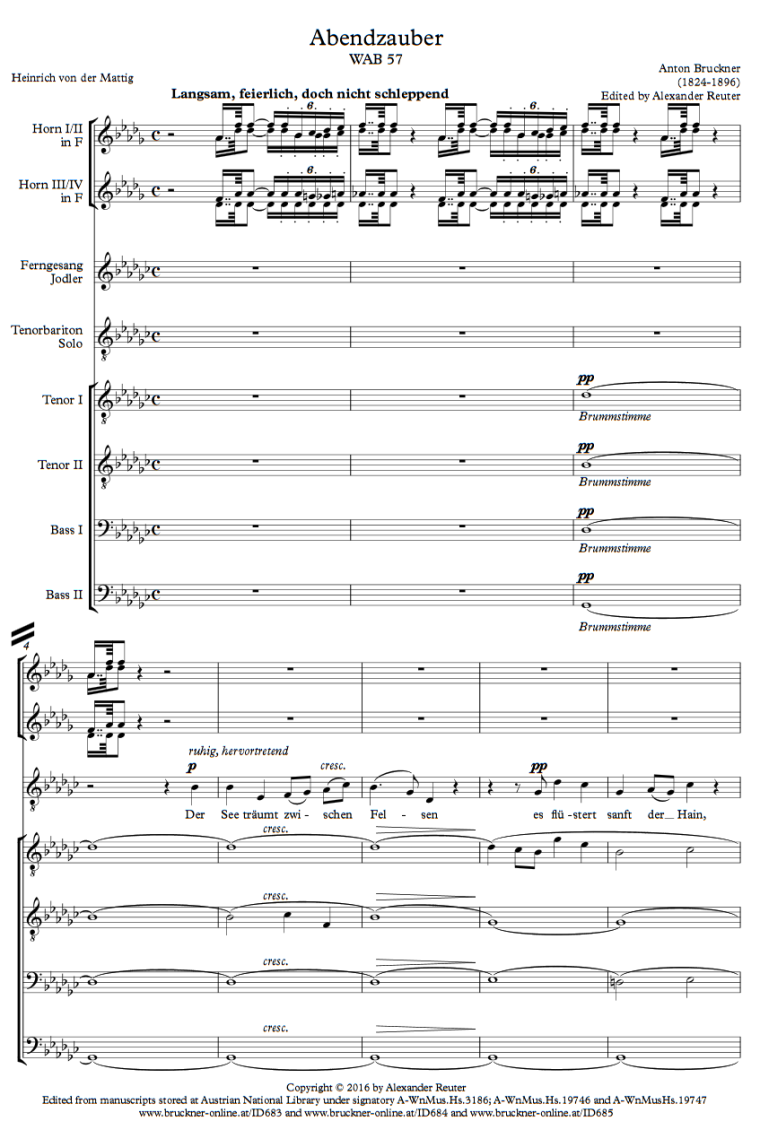
Anton Bruckner (4 settembre 1824 - 1896): Abendzauber per tenore o baritono, coro maschile (TTBB), 3 Jodler (SSA) e 4 corni (a mo’ di corni delle Alpi), WAB 57 (1878); testo di Heinrich von der Mattig, ossia il medico militare Heinrich Wallmann (1827-1898). Christoph Prégardien, tenore; Camerata Musica Limburg, dir. Jan Schumacher.
Der See träumt zwischen Felsen,
Es flüstert sanft der Hain.
Den Bergeshang beleuchtet
Des Mondes Silberschein.
Und aus dem Waldesdunkel
Hallt Nachtigallensang,
Und von dem See weh’n Lieder
Mit zauberhaftem Klang.
Ich saß am Seegestade,
Vertieft in süßen Traum;
Da träumte ich zu schweben
Empor zum Himmelsraum.
Wer könnte je vergessen
Den wonnevollen Ort!
Noch tief im Herzen klingen
Die Zaubertöne fort.
(Il lago sogna fra le rocce, il bosco mormora dolcemente. La luce argentea della luna rischiara il pendio della montagna.
Dal buio della foresta risuona il canto dell’usignolo, il lago sussurra magiche melodie.
Seduto in riva al lago, assorto in dorate fantasie, sognavo di salire in paradiso.
Chi potrebbe mai dimenticare un luogo così delizioso! Suoni fatati riecheggiano ancora nel profondo del cuore.)
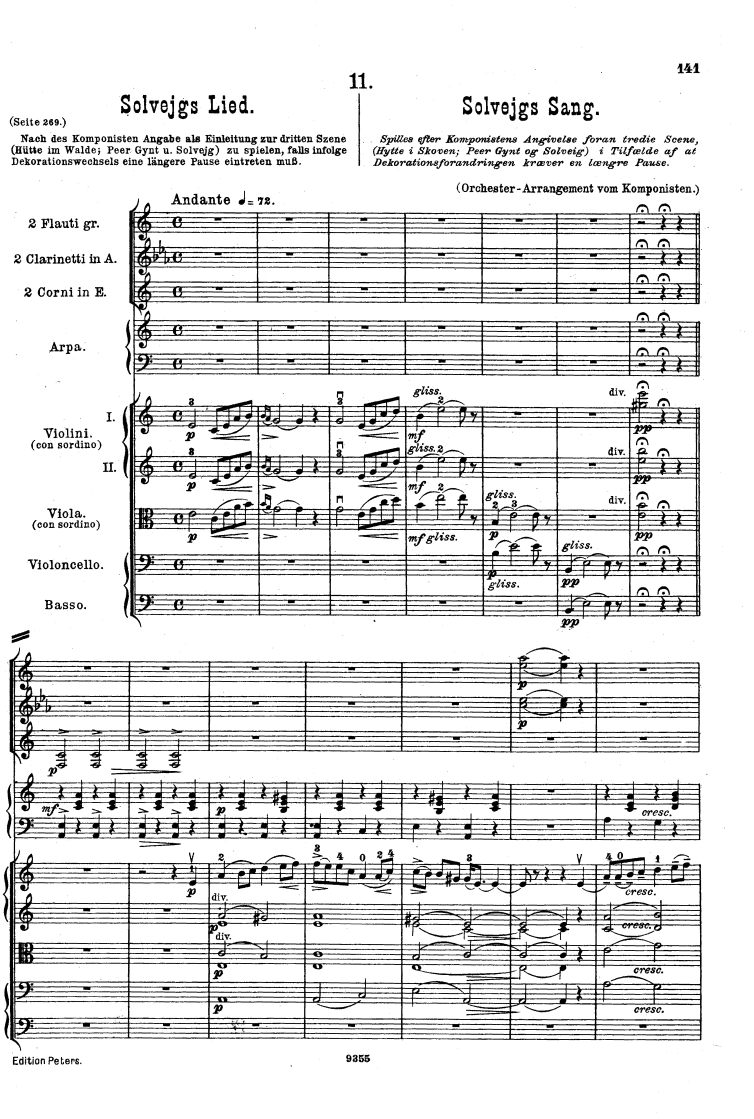
Edvard Grieg (1843 - 4 settembre 1907): «Solvejgs sang / Solvejgs Lied», dalle musiche di scena (1875) per il dramma Peer Gynt di Henrik Ibsen (atto III, n. 19); traduzione tedesca di Christian Morgenstern. Lucia Popp, soprano; Academy of St Martin in the Fields, dir. Neville Marriner.
Der Winter mag scheiden, der Frühling vergehn,
der Sommer mag verwelken, das Jahr verwehn,
Du kehrst mir zurück, gewiß, du wirst mein,
ich hab es versprochen, ich harre treulich dein.
Gott helfe dir, wenn du die Sonne noch siehst.
Gott segne dich, wenn du zu Füßen ihm kniest.
Ich will deiner harren, bis du mir nah,
und harrest du dort oben, so treffen wir uns da!
(Forse l’inverno passerà, la primavera se ne andrà, l’estate appassirà e l’anno intero svanirà, ma un giorno tornerai, lo so. E io fedelmente ti aspetterò, te l’ho promesso. Che Dio ti aiuti, se ancora vedi il sole. Che Dio ti benedica, se ti inginocchi davanti a Lui. Io ti aspetterò, fino a quando arriverai da me. E se rimarrai lassù, lassù ci incontreremo!)
Conosco molte interpretazioni di questa composizione, diverse sono disponibili online grazie a YouTube, ma nessuna mi commuove come quella di Lucia Popp.
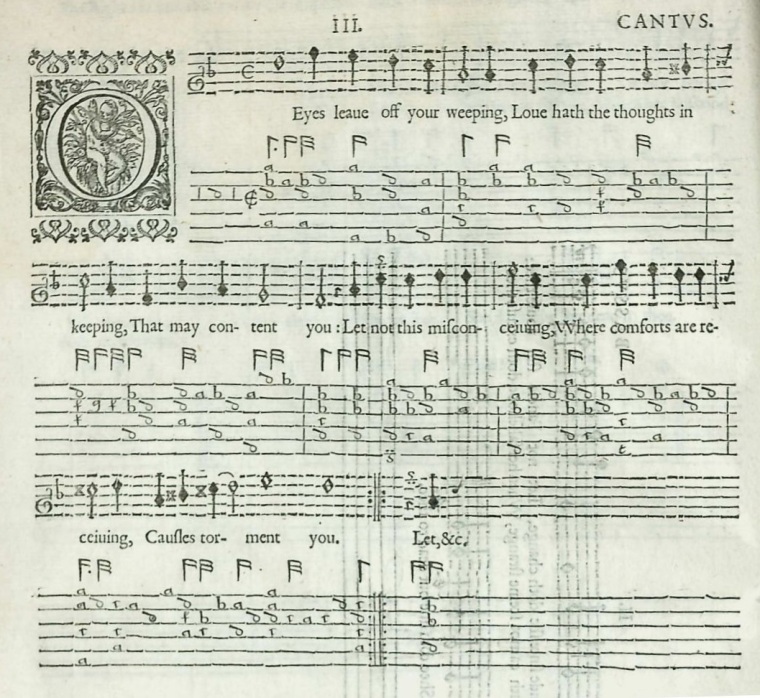
Robert Hales (attivo 1583 - 1616): O eyes, leave off your weeping, ayre su testo di autore anonimo (talvolta erroneamente attribuito a Nicholas Breton, 1542 - 1626). Emma Kirkby, soprano; Anthony Rooley, liuto.
O eyes, leave off your weeping,
love hath the thoughts in keeping
that may content you.
Let not this misconceiving,
where comforts are receiving,
causeless torment you.
Clouds threaten but a shower;
hope hath his happy hour,
though long in lasting.
Time needs must be attended
Love must not be offended
with too much hasting.
But O the painful pleasure,
where Love attends the leisure
of life’s wretchedness:
where Hope is but illusion,
and Fear is but confusion
of Love’s happiness.
But happy Hope, that seeth
how Hope and Hap agreeth,
of life deprive me;
or let me be assured
when life hath death endured
Love will revive me.
Di Robert Hales sappiamo che fu al servizio di Elisabetta I, apprezzato dalla sovrana in particolare quale cantante, e poi di Anna di Danimarca, consorte di Giacomo I; O eyes, leave off your weeping, pubblicato da Robert Dowland nella raccolta A Musicall Banquet (Londra 1610, n. 4), è l’unica sua composizione nota.
Darius Milhaud (4 settembre 1892 - 1974): Scaramouche, suite per sassofono contralto e orchestra op. 165c (1939), tratta delle musiche di scena per Le médécin volant di Molière. Simone Moschitz, sassofono; Orchestra UniMi, dir. Sebastiano Rolli.






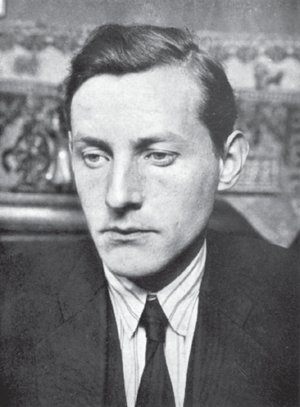 Willem Pijper (8 settembre 1894 - 1947): Sonata per pianoforte (1930). Ronald Brautigam.
  Jan van Gilse (1881 - 8 settembre 1944): Trio per flauto, violino e viola (c1927). Viotta Ensemble.
  Elisabetta de Gambarini (7 settembre 1731 - 1765): Sonata in do maggiore op. 1 n. 5 (1748). Paule van Parys, clavicembalo.

 Evgenij Fëdorovič Svetlanov (6 settembre 1928 - 2002): Sinfonia in si minore op. 13 (1956). Orchestra sinfonica accademica di stato dell’URSS diretta dall’autore (1975).





 la regina gioiosa