John Dowland (1563 - 20 febbraio 1626): Stay time a while thy flying, ayre (pubblicato in A Pilgrimes Solace. 1612, n. 7). Duo Mignarda: Donna Stewart, voce; Ron Andrico, liuto.
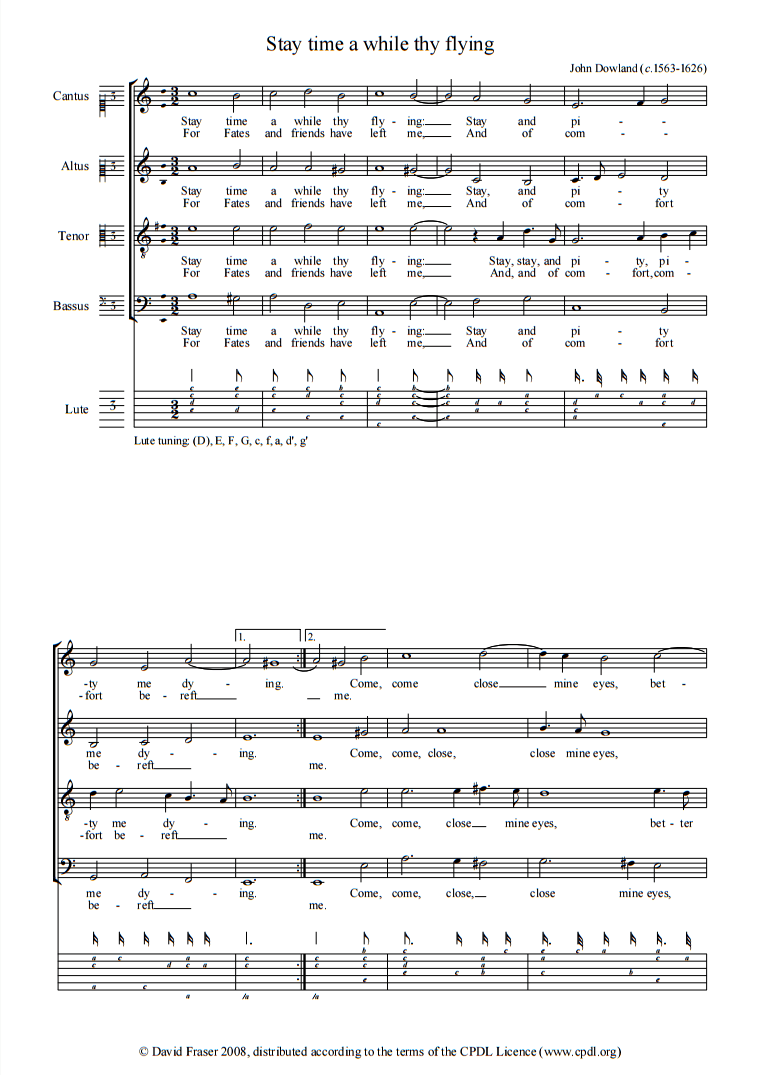
Stay time a while thy flying,
Stay and pittie me dying.
For Fates and friends have left mee,
And of comfort bereft mee.
Come, come close mine eyes, better to dye blessed,
Then to live thus distressed.
To whom shall I complaine me,
When thus friends doe disdaine mee?
T’is time that must befriend me,
Drown’d in sorrow to end mee.
Come, come close mine eyes, better to dye blessed,
Then to live thus distressed.
Teares but augment this fewell,
I feede by night (oh cruell),
Light griefes can speake their pleasure,
Mine are dumbe passing measure.
Quicke, quicke, close mine eyes, better to dye blessed,
Then here to live distressed.
John Dowland (1563 - 1626): Can she excuse my wrongs, ayre, dal First Booke of Songes or Ayres (1597). Emma Kirkby, soprano; Anthony Rooley, liuto.
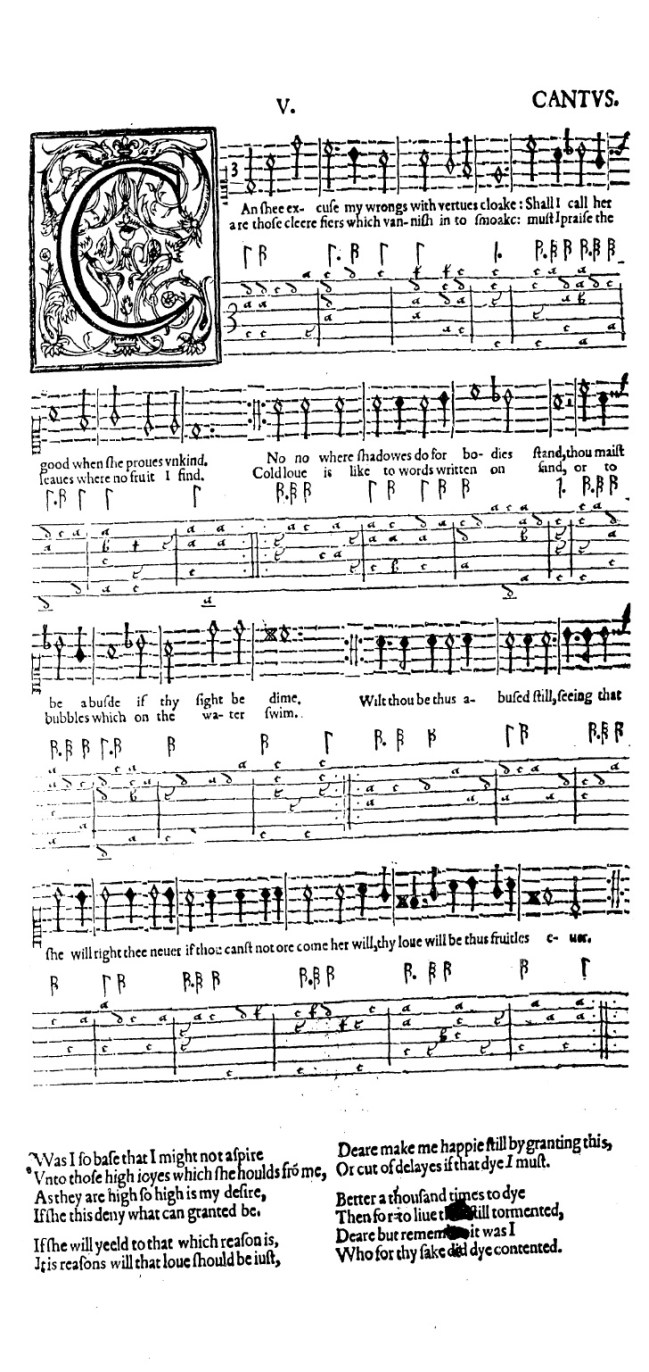
Can she excuse my wrongs with Virtue’s cloak?
Shall I call her good when she proves unkind?
Are those clear fires which vanish into smoke?
Must I praise the leaves where no fruit I find?
No, no; where shadows do for bodies stand,
That may’st be abus’d if thy sight be dim.
Cold love is like to words written on sand,
Or to bubbles which on the water swim.
Wilt thou be thus abused still,
Seeing that she will right thee never?
If thou canst not o’ercome her will,
Thy love will be thus fruitless ever.
Was I so base, that I might not aspire
Unto those high joys which she holds from me?
As they are high, so high is my desire,
If she this deny, what can granted be?
If she will yield to that which reason is,
It is reason’s will that love should be just.
Dear, make me happy still by granting this,
Or cut off delays if that I die must.
Better a thousand times to die
Than for to live thus still tormented:
Dear, but remember it was I
Who for thy sake did die contented.
Il testo – adattato a un tema di gagliarda: in qualche fonte, la versione strumentale del brano (qui) reca il titolo The Earl of Essex [ his ] Galliard – fa forse riferimento alle vicende di Robert Devereux, 2° conte di Essex (1566-1601), che potrebbe essere l’autore dei versi. È probabile che sia da collegarsi a Robert Devereux la citazione della melodia tradizionale The woods so wild, da Dowland inserita nel terzo periodo, affidata a una voce intermedia (tenore; testo: Wilt thou be thus abused still ecc.): farebbe riferimento al fatto che il conte di Essex soleva ritirarsi in una casa di sua proprietà, sita nei boschi a nord-est di Londra. The woods so wild è un ballad assai diffuso in epoca Tudor: pare che fosse particolarmente caro a Enrico VIII. Variazioni sulla melodia si devono a William Byrd (riportate dal Fitzwilliam Virginal Book e dal My Lady Nevell’s Book) e a Orlando Gibbons.
William Byrd (c1540 - 1623): The Woods so Wilde, variazioni. Michael Maxwell Steer, clavicembalo.
Orlando Gibbons (1583 - 1625): The Woods so Wild, variazioni. Michael Maxwell Steer, clavicembalo.
Un’altra interpretazione del brano di Dowland, ove la parte che comprende la citazione della melodia tradizionale è eseguita con un flauto dolce. Karin Gyllenhammar, soprano; Mirjam-Luise Münzel, flauto; David Leeuwarden, liuto; Alina Rotaru, clavicembalo.
John Dowland (1563 - 1626): His golden locks, dal First Booke of Songes (1597), n. 18. Emma Kirkby, soprano; Anthony Rooley, liuto.
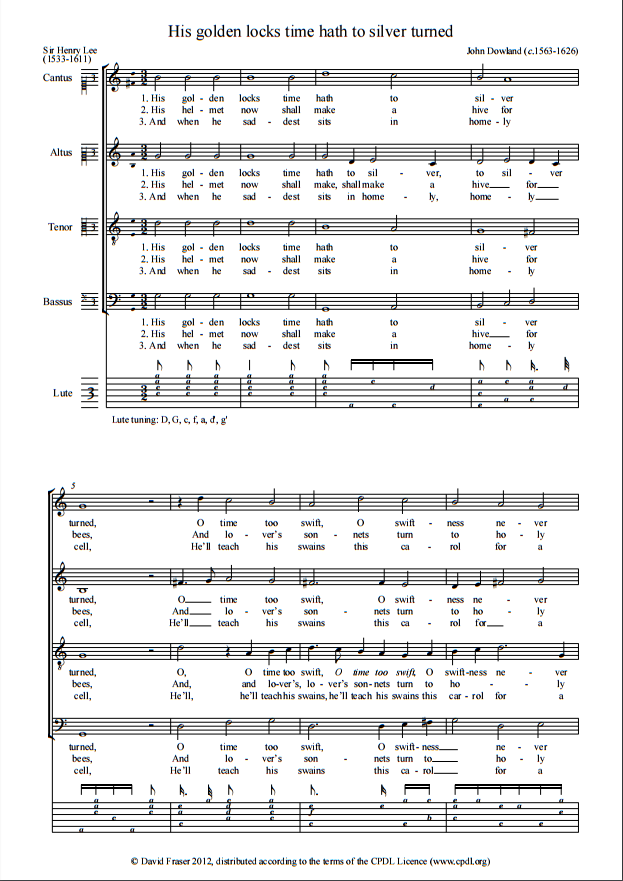
His golden locks Time hath to silver turned.
O Time too swift, O swiftness never ceasing:
His youth ‘gainst Time and Age hath ever spurned,
But spurned in vain; youth waneth by increasing.
Beauty, strength, youth are flowers but fading seen;
Duty, faith, love are roots, and ever green.
His helmet now shall make a hive for bees,
And lovers’ sonnets turn to holy psalms.
A man at arms must now serve on his knees,
And feed on prayers which are Age’s alms.
But though from Court to cottage he depart,
His Saint is sure of his unspotted heart.
And when he saddest sits in homely cell,
He’ll teach his swains this carol for a song:
Blest be the hearts that wish my Sov’reign well.
Curst be the soul that think her [him] any wrong.
Goddess [Ye gods], allow this aged man his right
To be your beadsman now, that was your knight.
John Dowland (1563 - 20 febbraio 1626): Lasso vita mia (da A Pilgrimes Solace, 1612, n. 11). Michael Chance, controtenore; Monica Huggett, violino; Bruce Dickey, cornetto; Paul Beyer, liuto e direzione.
Lasso vita mia, mi fa morire,
Crudel amor mio cor consume,
Da mille ferite, che mi fa morir.
Ahi me, deh, che non mi fa morire.
Crudel amor mi fa sofrir mille martire.
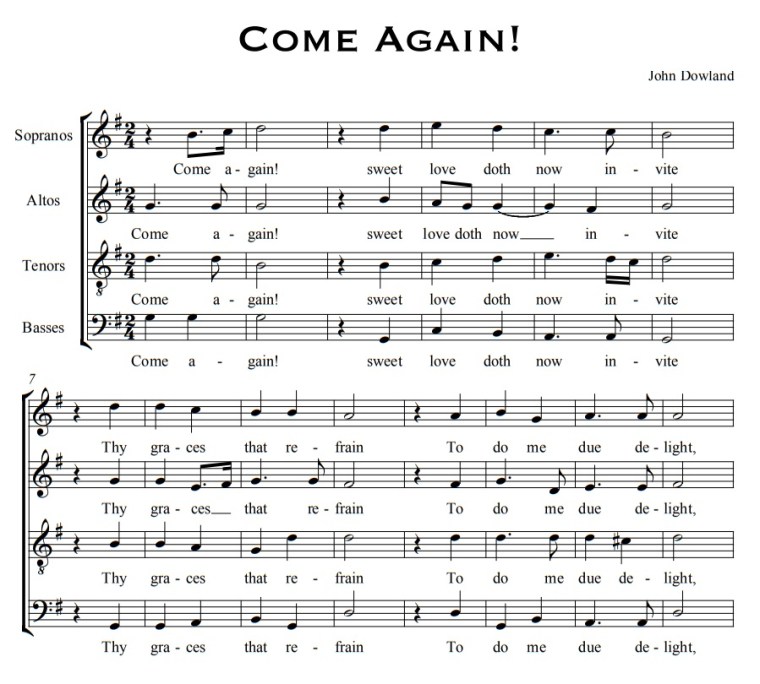
John Dowland (1563 - 1626): Come again, ayre* (dal First Booke of Songes or Ayres of fowre partes with Tableture for the Lute, 1597, n. 17). Paul Agnew, tenore; Christopher Wilson, liuto.
Come again! sweet love doth now invite
Thy graces that refrain
To do me due delight,
To see, to hear, to touch, to kiss, to die,
With thee again in sweetest sympathy.
Come again! that I may cease to mourn
Through thy unkind disdain;
For now left and forlorn
I sit, I sigh, I weep, I faint, I die
In deadly pain and endless misery.
All the day the sun that lends me shine
By frowns do cause me pine
And feeds me with delay;
Her smiles, my springs that makes my joys to grow,
Her frowns the Winters of my woe.
All the night my sleeps are full of dreams,
My eyes are full of streams.
My heart takes no delight
To see the fruits and joys that some do find
And mark the storms are me assign’d.
Out alas, my faith is ever true,
Yet will she never rue
Nor yield me any grace;
Her eyes of fire, her heart of flint is made,
Whom tears nor truth may once invade.
Gentle Love, draw forth thy wounding dart,
Thou canst not pierce her heart;
For I, that do approve
By sighs and tears more hot than are thy shafts
Did tempt while she for triumph laughs.
(*) Per ayre si intende un genere musicale fiorito in Inghilterra tra la fine del Cinquecento e la terza decade del secolo successivo. L’ayre è un brano a più voci (solitamente quattro) con accompagnamento di liuto; ciò che lo distingue dalle composizioni congeneri del periodo precedente è il fatto che alla voce più acuta è affidata una parte spiccatamente melodica, sul modello della «monodia accompagnata» italiana e dell’air de cour francese. Gli interpreti hanno dunque la possibilità di eseguire un ayre o secondo tradizione, con tutte le parti vocali e con l’accompagnamento del liuto ad libitum, oppure seguendo la moda dell’epoca, cioè con il canto della sola parte più acuta sostenuto dal liuto. In quest’ultimo caso, al liuto spesso si aggiunge una viola da gamba che ha il compito di irrobustire la linea del basso.
John Dowland (1563 - 1626): Now, O Now I Needs Must Part, ayre (pubblicato nel First Booke of Songes or Ayres of foure partes with Tableture for the Lute, 1597, n. 6). Les Canards Chantants: Sarah Holland, soprano; Robin Bier, contralto; Edd Ingham, tenore; Graham Bier, basso. Con la collaborazione del liutista Jacob Heringman, che all’inizio e alla fine [5:00] esegue la Frog Galliard di Dowland, composta sul medesimo tema musicale dell’ayre.
Now, o now I needs must part,
Parting though I absent mourn.
Absence can no joy impart:
Joy once fled cannot return.
While I live I needs must love,
Love lives not when Hope is gone.
Now at last Despair doth prove,
Love divided loveth none.
Sad despair doth drive me hence;
This despair unkindness sends.
If that parting be offence,
It is she which then offends.
Once the world moved not so fast,
Yet the journey sweeter seemed.
Now I see you rushing past,
No more time to stay and dream.
Dear when I from thee am gone,
Gone are all my joys at once,
I lov’d thee and thee alone,
In whose love I joyed once.
And although your sight I leave,
Sight wherein my joys do lie,
Till that death doth sense bereave,
Never shall affection die.
Dear, if I do not return,
Love and I shall die together.
For my absence never mourn
Whom you might have joyed ever;
Part we must though now I die,
Die I do to part with you.
Him despair doth cause to lie
Who both liv’d and dieth true.
(La quartina in corsivo non fa parte del testo originale: è un’interpolazione dei Canards Chantants, ideata appositamente per questo videoclip.)
Per ayre si intende un genere musicale fiorito in Inghilterra tra la fine del Cinquecento e la terza decade del secolo successivo. L’ayre è un brano a più voci (solitamente quattro) con accompagnamento di liuto; ciò che lo distingue dalle composizioni congeneri del periodo precedente è il fatto che alla voce più acuta è affidata una parte spiccatamente melodica, sul modello della «monodia accompagnata» italiana e dell’air de cour francese. Gli interpreti hanno dunque la possibilità di eseguire un ayre o secondo tradizione, con tutte le parti vocali e con l’accompagnamento del liuto ad libitum, oppure seguendo la moda dell’epoca, cioè con il canto della sola parte più acuta sostenuto dal liuto. In quest’ultimo caso, al liuto spesso si aggiunge una viola da gamba che ha il compito di irrobustire la linea del basso d’armonia.
Nel video dei Canards Chantants è visibile la riproduzione di una doppia pagina del First Booke di Dowland, stampato secondo le consuetudini dell’epoca, cioè disponendo le parti in modo che possano agevolmente essere lette da quattro cantanti seduti intorno a un tavolo; questo tipo di impaginazione è appunto detto “a libro di coro”.
John Dowland (1563 - 1626): In darkness let me dwell, ayre. Ellen Hargis, soprano; Jacob Heringman, liuto; Mary Springfels, viol.
In darkness let me dwell; the ground shall sorrow be,
The roof despair, to bar all cheerful light from me;
The walls of marble black, that moist’ned still shall weep;
My music, hellish jarring sounds, to banish friendly sleep.
Thus, wedded to my woes, and bedded in my tomb,
O let me living die, till death doth come, till death doth come.
Capolavoro di Dowland, il brano fu pubblicato dal figlio del compositore, Robert (1591 - 1641), nell’antologia A Musicall Banquet (Londra 1610, n. X). In darkness let me dwell è l’ultima delle composizioni vocali su testo inglese della raccolta: fanno seguito tre airs de cour francesi (tutti e tre di Pierre Guédron, il cui nome non è tuttavia menzionato nella pubblicazione), due romances spagnoli e cinque arie su testo italiano.
John Dowland (1563 - 1626): Lady if you so spight me, ayre. Martyn Hill, tenore; Anthony Rooley, liuto; Trevor Jones, viol.
Lady if you so spight me,
Wherfore do you so oft kisse and delight mee?
Sure that my hart opprest and overcloyed,
May breake thus overjoyde,
If you seeke to spill mee,
Come kisse me sweet and kill mee,
So shal your hart be eased,
And I shall rest content and dye well pleased.
Il brano fu pubblicato dal figlio del compositore, Robert (1591 - 1641), nella raccolta A Musicall Banquet (Londra 1610, n. IX).
John Dowland (1563 - 1626): Lady if you so spight me, ayre « for one voice only to sing » su testo di sir Henry Lee of Ditchley (1533 - 1611). Emma Kirkby, soprano; Anthony Rooley, liuto.
Far from triumphing Court and wonted glory
He dwelt in shady unfrequented places,
Time’s prisoner now, he made his pastime story;
Glady forgets Court’s erst-afforded graces.
That goddess whom he served to heaven is gone,
And he on earth in darkness left to moan.
But lo, a glorious light from his dark rest
Shone from the place where erst this goddess dwelt;
A light whose beams the world with fruit hath blest;
Blest was the knight while he that light beheld.
Since then a star fixed on his head hath shined,
And a saint’s image in his heart is shrined.
Ravished with joy, so graced by such a saint,
He quite forgat his cell and self denaid;
He thought it shame in thankfulness to faint,
Debts due to princes must be duly paid;
Nothing so hateful to a noble mind
As finding kindness for to prove unkind.
But ah! poor knight, though thus in dream he ranged,
Hoping to serve this saint in sort most meet,
Time with his golden locks to silver changed
Hath with age-fetters bound him hands and feet.
Ay me! he cries, goddess, my limbs grow faint,
Though I Time’s prisoner be, be you my saint.
Il brano fu pubblicato dal figlio del compositore, Robert (1591 - 1641), nella raccolta A Musicall Banquet (Londra 1610, n. VIII).
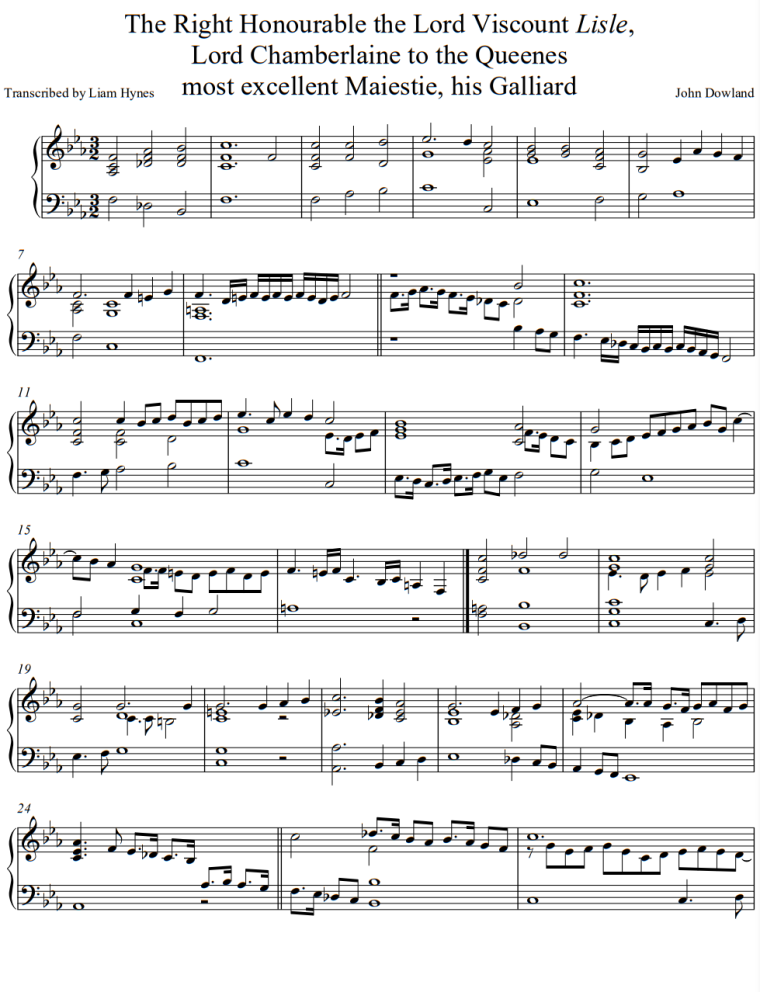
John Dowland (1563 - 1626): The Right Honourable the Lord Viscount Lisle, Lord Chamberlaine to the Queenes most excellent Maiestie, his Galliard. Nigel North, liuto.
A Musicall Banquet. Furnished with a varietie of delicious Ayres, Collected out of the best Authors in English, French, Spanish and Italian è il titolo di una raccolta di composizioni di diversi autori, curata e pubblicata a Londra nel 1610 da Robert Dowland (1591 - 1641), figlio di John, e dedicata a Robert Sidney (1563 - 1626), statista al servizio di Elisabetta I e Giacomo I. La silloge si apre con questa gagliarda dal titolo chilometrico, uno dei più celebri brani liutistici di Dowland: la composizione è espressamente intitolata a Sidney, che era stato creato visconte Lisle nel 1605 — e che più tardi, nel 1618, divenne il primo conte di Leicester.
John Dowland (1563 - 1626): Come away, come, sweet love, ayre (pubblicato nel First Booke of Songes or Ayres, 1597, n. 11):
– versione a 4 voci con accompagnamento di liuto: The Consort of Musicke, dir. Anthony Rooley;
– versione a 1 voce con accompagnamento di liuto: Alfred Deller. controtenore; Robert Spencer, liuto.
Come away, come, sweet love,
the golden morning breaks.
All the earth, all the air
of love and pleasure speaks:
teach thine arms then to embrace
and sweet rosy lips to kiss,
and mix our souls in mutual bliss.
Eyes were made for beauty’s grace,
viewing, rueing love’s long pain
procur’d by beauty’s rude disdain.
Come away, come, sweet love,
the golden morning wastes,
while the sun from his sphere
his fiery arrows casts:
making all the shadows fly,
playing, staying in the grove,
to entertain the stealth of love.
Thither sweet love let us hie,
flying, dying in desire,
wing’d with sweet hopes and heav’nly fire.
Come away, come, sweet love,
do not in vain adorn
beauty’s grace, that should rise
like to the naked morn:
lilies on the river’s side,
and fair Cyprian flow’rs new-blown,
desire no beauties but their own.
Ornament is nurse of pride,
pleasure, measure love’s delight:
haste then sweet love our wishèd flight.




 Julian Bream

 la regina gioiosa