Paul Hofhaimer (25 gennaio 1459 - 1537): Herzliebstes Bild, Lied a 3-4 voci (pubblicato per la prima volta nel Liederbuch zu vier Stimmen di Erhard Öglin, 1512, n. 37), qui interpretato a voce sola con accompagnamento di liuto. Bill Ives, tenore; Anthony Rooley, liuto.
Herzliebstes bild,
beweisst dich milt,
mit deiner lieb
und gunstgen mir
des gleych will ich
wann ich han dich,
nach lust und wunsch
meinss hertzen gir,
erwelt für all
in diesem tall,
mit reichem schal,
frey ich mich dein in eren.
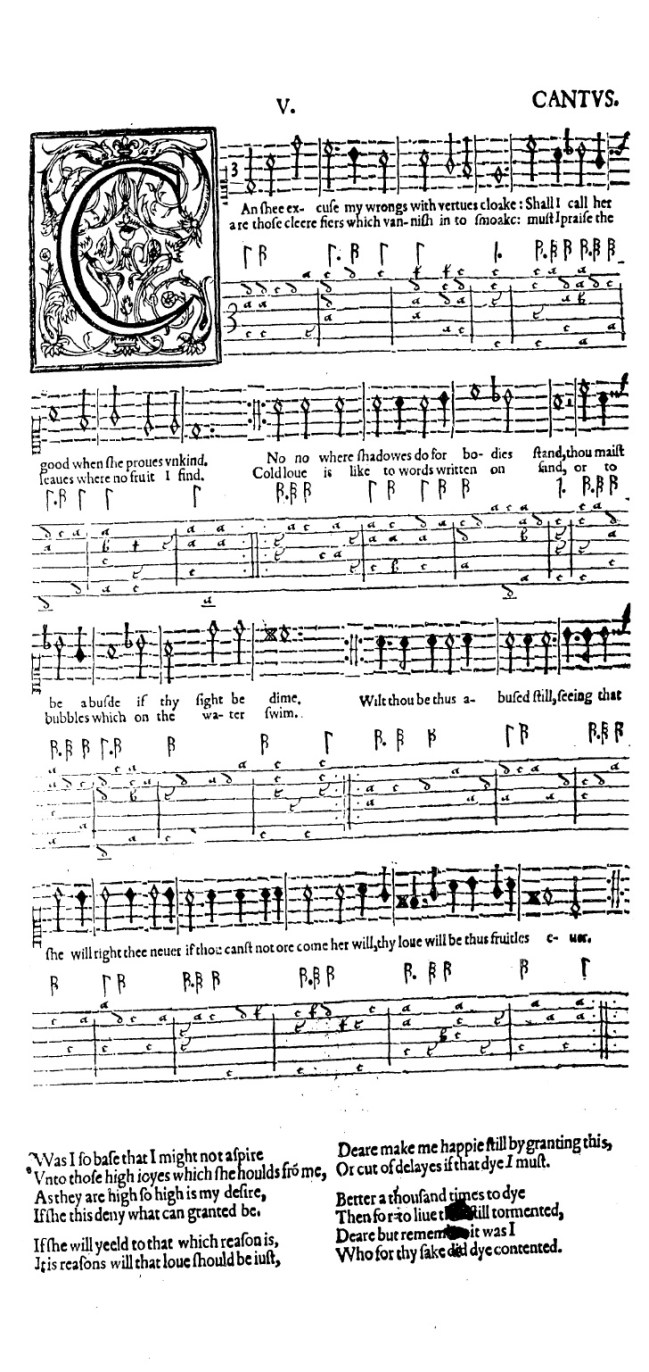
John Dowland (1563 - 1626): Can she excuse my wrongs, ayre, dal First Booke of Songes or Ayres (1597). Emma Kirkby, soprano; Anthony Rooley, liuto.
Can she excuse my wrongs with Virtue’s cloak?
Shall I call her good when she proves unkind?
Are those clear fires which vanish into smoke?
Must I praise the leaves where no fruit I find?
No, no; where shadows do for bodies stand,
That may’st be abus’d if thy sight be dim.
Cold love is like to words written on sand,
Or to bubbles which on the water swim.
Wilt thou be thus abused still,
Seeing that she will right thee never?
If thou canst not o’ercome her will,
Thy love will be thus fruitless ever.
Was I so base, that I might not aspire
Unto those high joys which she holds from me?
As they are high, so high is my desire,
If she this deny, what can granted be?
If she will yield to that which reason is,
It is reason’s will that love should be just.
Dear, make me happy still by granting this,
Or cut off delays if that I die must.
Better a thousand times to die
Than for to live thus still tormented:
Dear, but remember it was I
Who for thy sake did die contented.
Il testo – adattato a un tema di gagliarda: in qualche fonte, la versione strumentale del brano (qui) reca il titolo The Earl of Essex [ his ] Galliard – fa forse riferimento alle vicende di Robert Devereux, 2° conte di Essex (1566-1601), che potrebbe essere l’autore dei versi. È probabile che sia da collegarsi a Robert Devereux la citazione della melodia tradizionale The woods so wild, da Dowland inserita nel terzo periodo, affidata a una voce intermedia (tenore; testo: Wilt thou be thus abused still ecc.): farebbe riferimento al fatto che il conte di Essex soleva ritirarsi in una casa di sua proprietà, sita nei boschi a nord-est di Londra. The woods so wild è un ballad assai diffuso in epoca Tudor: pare che fosse particolarmente caro a Enrico VIII. Variazioni sulla melodia si devono a William Byrd (riportate dal Fitzwilliam Virginal Book e dal My Lady Nevell’s Book) e a Orlando Gibbons.
William Byrd (c1540 - 1623): The Woods so Wilde, variazioni. Michael Maxwell Steer, clavicembalo.
Orlando Gibbons (1583 - 1625): The Woods so Wild, variazioni. Michael Maxwell Steer, clavicembalo.
Un’altra interpretazione del brano di Dowland, ove la parte che comprende la citazione della melodia tradizionale è eseguita con un flauto dolce. Karin Gyllenhammar, soprano; Mirjam-Luise Münzel, flauto; David Leeuwarden, liuto; Alina Rotaru, clavicembalo.
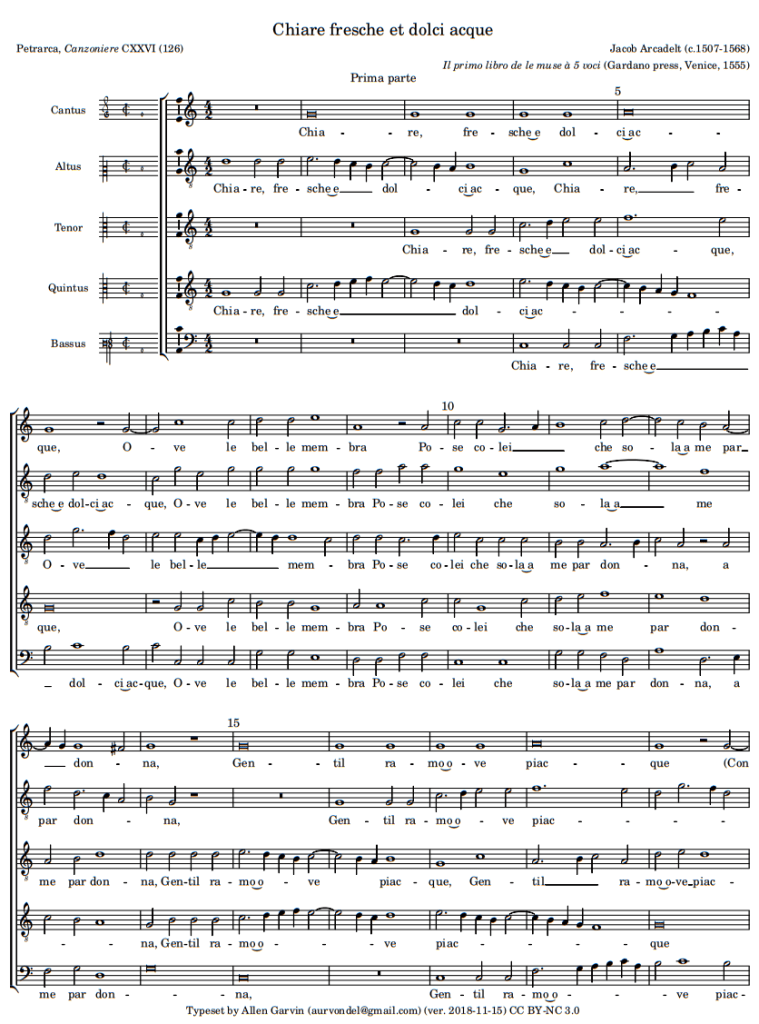
Jacques Arcadelt (1507 - 14 ottobre 1568): Chiare, fresche e dolci acque, madrigale a 5 voci (pubblicato nella raccolta Il primo libro de le Muse a cinque voci composto da diversi eccellentissimi musici, 1555, n. 1); testo di Francesco Petrarca (Canzoniere CXXVI, 1-3). The Consort of Musicke, dir. Anthony Rooley.
1ª parte :
Chiare, fresche e dolci acque,
ove le belle membra
pose colei che sola a me par donna;
gentil ramo ove piacque
(con sospir’ mi rimembra)
a lei di fare al bel fiancho colonna;
herba et fior’ che la gonna
leggiadra ricoverse
co l’angelico seno;
aere sacro, sereno,
ove Amor co’ begli occhi il cor m’aperse:
date udïenza insieme
a le dolenti mie parole extreme.
2ª parte :
S’egli è pur mio destino
e ’l cielo in ciò s’adopra,
ch’Amor quest’occhi lagrimando chiuda,
qualche gratia il meschino
corpo fra voi ricopra,
et torni l’alma al proprio albergo ignuda.
La morte fia men cruda
se questa spene porto
a quel dubbioso passo:
ché lo spirito lasso
non poria mai in piú riposato porto
né in piú tranquilla fossa
fuggir la carne travagliata et l’ossa.
3ª parte :
Tempo verrà anchor forse
ch’a l’usato soggiorno
torni la fera bella et mansüeta,
et là ’v’ella mi scorse
nel benedetto giorno,
volga la vista disïosa et lieta,
cercandomi; et, o pietà!,
già terra in fra le pietre
vedendo, Amor l’inspiri
in guisa che sospiri
sí dolcemente che mercé m’impetre,
et faccia forza al cielo,
asciugandosi gli occhi col bel velo.
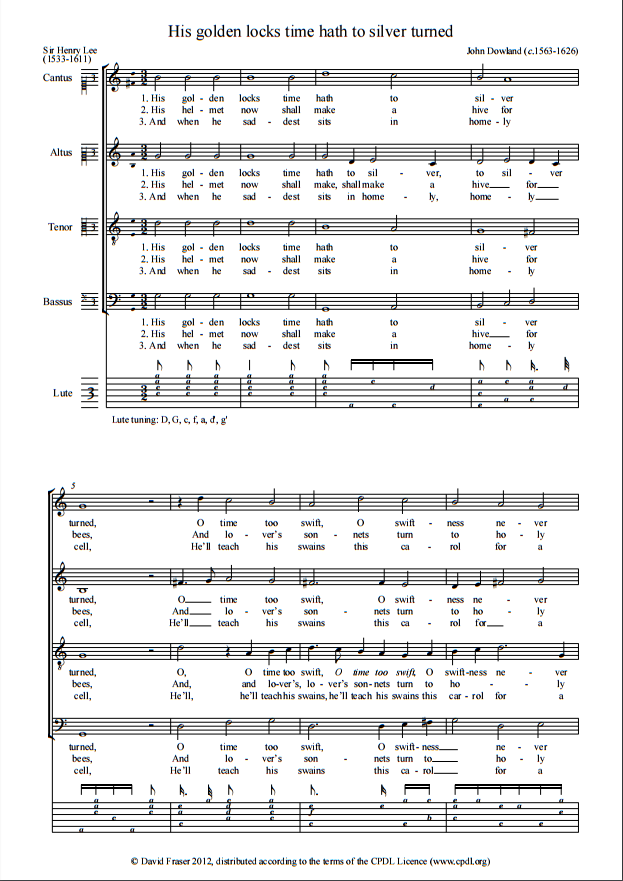
John Dowland (1563 - 1626): His golden locks, dal First Booke of Songes (1597), n. 18. Emma Kirkby, soprano; Anthony Rooley, liuto.
His golden locks Time hath to silver turned.
O Time too swift, O swiftness never ceasing:
His youth ‘gainst Time and Age hath ever spurned,
But spurned in vain; youth waneth by increasing.
Beauty, strength, youth are flowers but fading seen;
Duty, faith, love are roots, and ever green.
His helmet now shall make a hive for bees,
And lovers’ sonnets turn to holy psalms.
A man at arms must now serve on his knees,
And feed on prayers which are Age’s alms.
But though from Court to cottage he depart,
His Saint is sure of his unspotted heart.
And when he saddest sits in homely cell,
He’ll teach his swains this carol for a song:
Blest be the hearts that wish my Sov’reign well.
Curst be the soul that think her [him] any wrong.
Goddess [Ye gods], allow this aged man his right
To be your beadsman now, that was your knight.
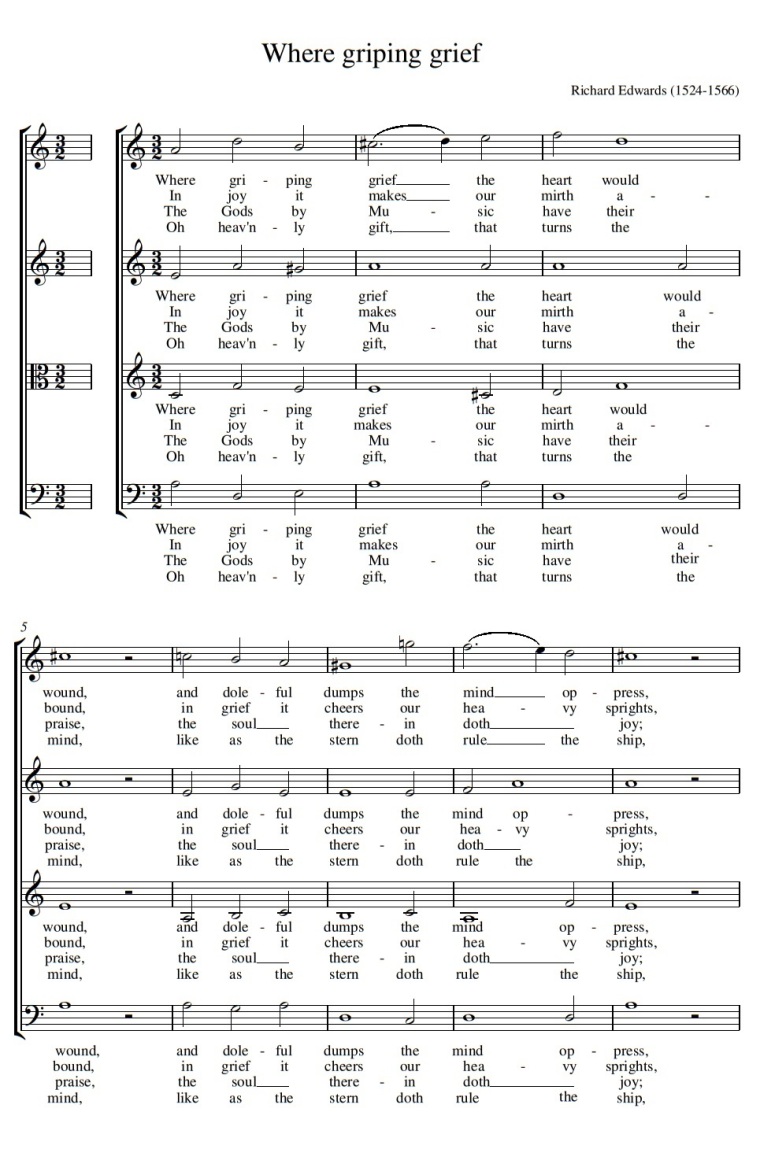
Anonimo (probabilmente Richard Edwardes, 1525 - 1566): Where griping grief. Versione per voce (soprano) e liuto: Emma Kirkby e Anthony Rooley. Versione a 4 voci: Deller Consort.
Where griping grief the heart would wound
And doleful dumps the mind oppress,
There music with her silver sound
Is wont with speed to give redress
Of troubled minds, for ev’ry sore,
Sweet music hath a salve in store.
In joy it makes our mirth abound,
In grief it cheers our heavy sprites,
The careful head relief hath found,
By music’s pleasant sweet delights;
Our senses, what should I say more,
Are subject unto Music’s law.
The gods by music have their praise,
The soul therein doth joy;
For as the Roman poets say,
In seas whom pirates would destroy,
A dolphin saved from death most sharp,
Arion playing on his harp.
O heavenly gift, that turns the mind,
Like as the stern doth rule the ship,
Of music whom the gods assigned,
To comfort man whom cares would nip,
Since thou both man and beast doth move,
What wise man then will thee reprove.
Forse figlio illegittimo di Enrico VIII, Richard Edwardes fu poeta, autore drammatico, gentiluomo della Chapel Royal e maestro del coro di voci bianche della medesima istituzione sotto le regine Maria e Elisabetta I. Nei suoi ultimi anni compilò un’ampia silloge di testi poetici di autori diversi, cui aggiunse, firmandoli, alcuni componimenti propri, e fra questi appunto Where gripyng grief, con il titolo In commendation of Musick. La raccolta, intitolata The Paradise of Dainty Devices, fu pubblicata postuma nel 1576, a cura di Henry Disle; dei molti volumi miscellanei dati alle stampe in quel periodo fu il più fortunato, tant’è vero che fu ristampato nove volte nei successivi trent’anni.
Del testo si trovano, anche nel web, numerose varianti, quasi tutte di poco conto, a cominciare da «When… Then…» invece di «Where… There…» nella prima strofa; ma è chiaramente un errore l’«Anon» che non di rado sostituisce «Arion» all’inizio dell’ultimo verso della terza strofa: Edwardes fa infatti riferimento a Arione di Métimna, l’antico citaredo che secondo Erodoto inventò il ditirambo e che, racconta il mito, si salvò da sicura morte in mare lasciandosi portare a riva da un delfino che aveva ammaliato con il canto.
Albrecht Dürer: Arion (c1514)
Le due fonti manoscritte che ci hanno tramandato la musica di Where griping grief (il Mulliner Book, raccolta di composizioni per strumento a tastiera databile fra il 1550 e il 1585 circa; e il Brogyntyn Lute Book, c1595) non riportano né il testo né il nome dell’autore: si ritiene probabile che anche la musica sia dello stesso Edwardes. La melodia è finemente cesellata; pur procedendo prevalentemente per gradi congiunti, presenta non pochi intervalli più ampi, fra cui un’insolita (per l’epoca) ottava diminuita — sulle parole «dumps the» nel secondo verso della prima strofa.
Il brano doveva essere abbastanza noto all’epoca di Shakespeare, perché questi lo cita in una scena di Romeo e Giulietta. Alla fine del IV atto, dopo che la Nutrice ha rinvenuto il corpo esanime della giovane Capuleti e un cupo inatteso dolore strazia i suoi familiari, alcuni musicisti, che erano stati convocati per allietare la festa delle nozze di Giulietta con il conte Paride, ripongono mestamente gli strumenti e stanno per andarsene quando sopraggiunge Pietro (servitore della Nutrice) e chiede ai musici di suonare per lui; gli altri rispondono che non è il momento adatto per far musica, sicché Pietro inizia a battibeccare con loro e infine, citando Where griping grief, trova il modo di insolentirli. La scena consiste in una lunga serie di giochi di parole a sfondo musicale, da alcuni critici considerati di bassa lega — tanto che qualche traduttore italiano ha pensato bene di omettere l’intero passo. Ma secondo me la scena non è affatto priva di interesse, ragion per cui la riporto qui di seguito: a sinistra l’originale inglese, a destra non esattamente una traduzione, ma piuttosto una reinterpretazione, con alcune esplicite allusioni a musiche famose ai tempi del Bardo e già note ai frequentatori di questo blog.
PETER
Musicians, O musicians, Heart’s Ease, Heart’s Ease. O, an you will have me live, play Heart’s Ease.
PIETRO
Musici, o musici, Chi passa, Chi passa. Se volete ch’io viva, suonate Chi passa.
FIRST MUSICIAN
Why Heart’s ease?
1° MUSICO
Perché Chi passa?
PETER
O musicians, because my heart itself plays My Heart is Full. O, play me some merry dump to comfort me.
PIETRO
O musici, perché il mio cuore sta danzando un passamezzo che non passa. Prego, suonate qualche allegro lamento per confortarmi.
FIRST MUSICIAN
Not a dump, we. ‘Tis no time to play now.
1° MUSICO
No, niente lamenti. Non è il momento di suonare.
PETER
You will not then?
PIETRO
Non volete suonare?
FIRST MUSICIAN
No.
1° MUSICO
No.
PETER
I will then give it you soundly.
PIETRO
Allora ve le suonerò io, sentirete.
FIRST MUSICIAN
What will you give us?
1° MUSICO
Che cosa sentiremo?
PETER
No money, on my faith, but the gleek. I will give you the minstrel.
PIETRO
Oh, non un tintinnar di monete, ve l’assicuro, ma piuttosto una canzon…atura. Ecco, vi tratterò da menestrelli.
FIRST MUSICIAN
Then I will give you the serving creature.
1° MUSICO
E allora noi ti tratteremo da giullare.
PETER
Then will I lay the serving creature’s dagger on your pate. I will carry no crotchets. I’ll re you, I’ll fa you. Do you note me?
PIETRO
E allora riceverete la sonagliera del giullare sulla zucca. Vi avevo chiesto lamenti e mi date capricci. Così ve le suonerò: prendete nota.
FIRST MUSICIAN
An you re us and fa us, you note us.
1° MUSICO
Se ce le suoni, prenderemo davvero le tue note.
SECOND MUSICIAN
Pray you, put up your dagger and put out your wit.
2° MUSICO
Per favore, riponi la tua sonagliera e va’ adagio.
PETER
Then have at you with my wit. I will dry-beat you with an iron wit and put up my iron dagger. Answer me like men.
(sings)
When griping grief the heart doth wound
And doleful dumps the mind oppress,
Then Music with her silver sound—
Why «silver sound»? Why «Music with her silver sound»? What say you, Simon Catling?
PIETRO
Andrò a mio agio e vi metterò a disagio. I miei adagi non sono meno pesanti della sonagliera. Rispondete dunque, da uomini, ai miei colpi.
(canta)
Quando ferisce il cuore arduo tormento
E la mente grava penoso tedio,
Allora Musica dal suon d’argento…
Perché «suon d’argento»? Perché dice «Musica dal suon d’argento»? Tu che ne dici, Simon Cantino?
FIRST MUSICIAN
Marry, sir, because silver hath a sweet sound.
1° MUSICO
Diamine, signore, perché l’argento ha un dolce suono.
PETER
Prates. What say you, Hugh Rebeck?
PIETRO
Ciance. E tu che dici, Ugo Ribeca?
SECOND MUSICIAN
I say, «silver sound» because musicians sound for silver.
2° MUSICO
Dico: «suon d’argento» perché i musicisti suonano per guadagnarsi dell’argento.
PETER
Prates too. What say you, James Soundpost?
PIETRO
Ciance anche queste. E tu, Giaco Bischero?
THIRD MUSICIAN
Faith, I know not what to say.
3° MUSICO
In fede mia, non so che dire.
PETER
Oh, I cry you mercy, you are the singer. I will say for you. It is «Music with her silver sound» because musicians have no gold for sounding.
(sings)
Then Music with her silver sound
With speedy help doth lend redress.
(exit)
PIETRO
Oh, ti chiedo scusa: tu sei quello che canta. Be’, risponderò io per te: dice «Musica col suon d’argento» perché i musicisti non hanno mai oro da far risonare.
(canta)
Allora Musica dal suon d’argento
Con lesto soccorso pone rimedio.
(esce)
FIRST MUSICIAN
What a pestilent knave is this same!
1° MUSICO
Che pestifero furfante è costui!
SECOND MUSICIAN
Hang him, Jack! Come, we’ll in here, tarry for the mourners and stay dinner.
(exeunt)
2° MUSICO
Lascialo perdere! Venite, entriamo: aspetteremo quelli che verranno per il funerale e ci fermeremo a pranzo.
(escono)
Anonymous (probably Richard Edwardes, 1525 - 1566): Where griping grief. Two versions:
– as a song for 1 voice (soprano) and lute: Emma Kirkby and Anthony Rooley.
– as a partsong for 4 voices: the Deller Consort.
Where griping grief the heart would wound
And doleful dumps the mind oppress,
There music with her silver sound
Is wont with speed to give redress
Of troubled minds, for ev’ry sore,
Sweet music hath a salve in store.
In joy it makes our mirth abound,
In grief it cheers our heavy sprites,
The careful head relief hath found,
By music’s pleasant sweet delights;
Our senses, what should I say more,
Are subject unto Music’s law.
The gods by music have their praise,
The soul therein doth joy;
For as the Roman poets say,
In seas whom pirates would destroy,
A dolphin saved from death most sharp,
Arion playing on his harp.
O heavenly gift, that turns the mind,
Like as the stern doth rule the ship,
Of music whom the gods assigned,
To comfort man whom cares would nip,
Since thou both man and beast doth move,
What wise man then will thee reprove.
Richard Edwardes, possibly an illegitimate son of Henry VIII, was a poet, playwright, gentleman of the Chapel Royal and choirmaster of the same institution in the reigns of Mary and Elizabeth I. In his later years he compiled an extensive anthology of poems by various authors, adding his own, including Where griping grief (under the title In commendation of Musick). The anthology, titled The Paradise of Dainty Devices, appeared posthumously in 1576, edited by Henry Disle; it was the most successful of the numerous miscellaneous books printed at the end of the sixteenth century: it was in fact reprinted nine times in the following thirty years.
There are, even on the Internet, many variants of Where griping grief, almost all of little importance, such as for example «When… Then…» instead of «Where… There…» in the first line; but the «Anon» which often replaces «Arion» at the beginning of the last line of the third stanza is clearly a mistake: Edwardes in fact refers to Arion of Methymna, a kitharode in ancient Greece credited with inventing the dithyramb: according to the myth, Arion was saved from certain death at sea by being carried ashore by a dolphin that he had enchanted with his own singing.
Albrecht Dürer: Arion (c1514)
The two manuscript sources that have handed down the music of Where griping grief (the Mulliner Book, a collection of pieces for keyboard instrument dating between about 1550 and 1585; and the Brogyntyn Lute Book, c1595) do not bear neither the text nor the name of the composer: the music is thought to be probably by Edwardes himself. Where griping grief has a finely chiseled tune; though proceeding mainly in joint degrees, it has several larger intervals, including an unusual (at that time) diminished octave — to the words «dumps the» in the second line of the first stanza.
Where griping grief must have been quite well known in Shakespeare’s time, so much so that its first stanza is quoted in a scene from Romeo and Juliet, at the end of the fourth act, after the Nurse has found the lifeless body of the young Capulet and a gloomy unexpected pain torments his relatives; the news also saddens some musicians, who had been summoned to cheer Juliet’s wedding party: they are putting away their instruments before leaving when Peter (the Nurse’s servant) asks them to play for him; since the musicians have no intention of pleasing him, Peter begins to argue with them and finally, quoting Where griping grief, finds a way to insult them.
PETER
Answer me like men.
(sings)
When griping grief the heart doth wound
And doleful dumps the mind oppress,
Then Music with her silver sound—
Why «silver sound»? Why «Music with her silver sound»? What say you, Simon Catling?
FIRST MUSICIAN
Marry, sir, because silver hath a sweet sound.
PETER
Prates. What say you, Hugh Rebeck?
SECOND MUSICIAN
I say, «silver sound» because musicians sound for silver.
PETER
Prates too. What say you, James Soundpost?
THIRD MUSICIAN
Faith, I know not what to say.
PETER
Oh, I cry you mercy, you are the singer. I will say for you. It is «Music with her silver sound» because musicians have no gold for sounding.
(sings)
Then Music with her silver sound
With speedy help doth lend redress.
(exit)
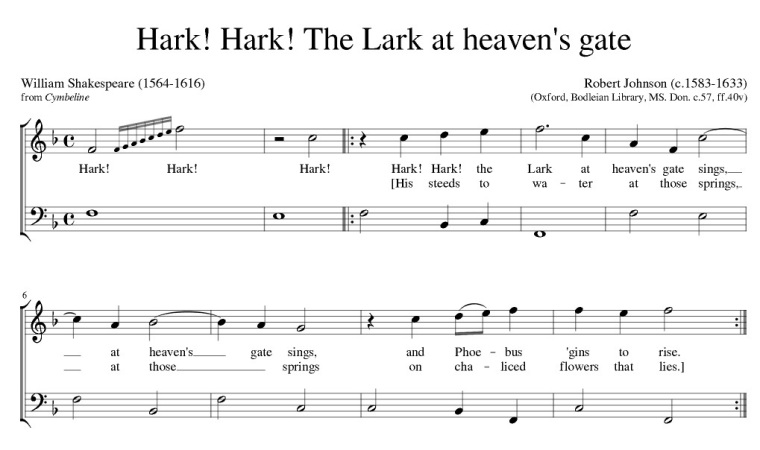
Hark! hark! the lark, Cloten’s song in Shakespeare’s play Cymbeline, King of Britain (c1609), act 2, scene 3. Emma Kirkby, soprano; Anthony Rooley, lute.
Hark! hark! the lark at heaven’s gate sings,
And Phoebus ’gins arise,
His steeds to water at those springs
On chalic’d flowers that lies;
And winking Mary-buds begin
To ope their golden eyes;
With everything that pretty is,
My lady sweet, arise:
Arise, arise!
This setting of Hark! hark! the lark survives in a music manuscript owned by the Bodleian Library, University of Oxford (MS Don. c.57, f. 40v), and has been attributed to Robert Johnson (c1583 - 1633). Johnson became lutenist to king James I in 1604 and was closely associated with Shakespeare’s company, to which he provided songs for various plays including The Winter’s Tale (1610) and The Tempest (1611).
Leone Leoni (c1560 - 24 giugno 1627): Cor mio, deh, non languire, madrigale a 5 voci (pubblicato in Bell’Alba: quinto libro de madrigali a cinque voci, 1602, n. 9) su testo di Battista Guarini. The Consort of Musicke, dir. Anthony Rooley.
Cor mio, deh, non languire,
Che fai teco languir l’anima mia.
Odi i caldi sospiri: a te gl’invia,
La pietate e’l desire.
S’i’ ti potessi dar morendo aita,
Morrei per darti vita.
Ma vivi ohimé, ch’ingiustamente more,
Chi vivo tien ne l’altrui petto il core.
Take, O take those lips away,
That so sweetly were forsworn;
And those eyes, the break of day,
Lights that do mislead the morn:
But my kisses bring again
Seals of love, though seal’d in vain.
Hide, O hide those hills of snow
That thy frozen bosom bears,
On whose tops the pinks that grow
Are yet of those that April wears,
But first set my poor heart free,
Bound in those icy chains by thee.
La prima strofa si trova nella commedia di Shakespeare Misura per misura (atto IV, scena 1a), rappresentata per la prima volta nel 1604; non sappiamo su quale melodia fosse cantata. Prima e seconda strofa sono nel dramma Rollo Duke of Normandy, or The Bloody Brother, scritto in collaborazione da John Fletcher, Philip Massinger, Ben Jonson e George Chapman in data imprecisabile (comunque non prima del 1612). Non è dato di sapere se la seconda strofe sia un’aggiunta di Fletcher oppure se tanto Shakespeare quanto Fletcher si siano rifatti a una canzone popolare in voga ai loro tempi.
Il testo è stato musicato da diversi autori. Il primo in ordine cronologico fu John Wilson (1595 - 1674), il quale nel 1614 succedette a Robert Johnson quale primo compositore dei King’s Men, la compagnia teatrale cui apparteneva Shakespeare. Ascoltiamo il suo lavoro in… versione shakespeariana (ossia limitata alla sola prima strofa) interpretata da Alfred Deller (voce) e Desmond Dupré (liuto); e poi nella versione integrale cantata dal soprano Anna Dennis, accompagnata da Hanneke van Proosdij al clavicembalo, Elisabeth Reed alla viola da gamba e David Tayler all’arciliuto.
The first stanza is featured in Shakespeare’s play Measure for Measure (act 4, scene 1), first represented in 1604; we do not know to what tune it was sung. Both the stanzas feature in the play Rollo Duke of Normandy, or The Bloody Brother, co-written by John Fletcher, Philip Massinger, Ben Jonson and George Chapman and performed at an unspecified date (though not earlier than 1612). It is not known whether the second stanza is an addition by Fletcher or whether both Shakespeare and Fletcher drew on a popular song in vogue in their time.
These verses have been set to music by various composers. The first in chronological order was John Wilson (1595 - 1674), who in 1614 succeeded Robert Johnson as principal composer for the King’s Men, the theater company to which Shakespeare belonged. Let’s listen to his work in… a Shakespearean version (i.e. the first stanza only) performed by Alfred Deller (voice) and Desmond Dupré (lute); and then in the complete version sung by soprano Anna Dennis, accompanied by Hanneke van Proosdij on harpsichord, Elisabeth Reed on viola da gamba and David Tayler on archlute.
John Weldon (1676 - 1736): Take, O take those lips away per voce e continuo (c1707). Emma Kirkby, soprano; Anthony Rooley, liuto.
Robert Lucas de Pearsall (1795 - 1856), Take, O take those lips away per coro a 5 voci a cappella op. 6 (1830). Cantores Musicæ Antiquæ, dir. Jeffery Kite-Powell.
Mrs H. H. A. Beach (Amy Marcy Cheney Beach, 1867 - 1944): Take, O take those lips away per voce e pianoforte, n. 2 dei Three Shakespeare Songs op. 37 (1897). Virginia Mims, soprano.
Peter Warlock (pseudonimo di Philip Heseltine, 1894 - 1930): Take, O take those lips away per voce e pianoforte (1916-17). Benjamin Luxon, baritono; David Willison, pianoforte.
Roger Quilter (1877 - 1953): Take, O take those lips away per voce e pianoforte, n. 4 dei Five Shakespeare Songs op. 23 (1921). Philippe Sly, basso-baritono; Michael McMahon, pianoforte.
Madeleine Dring (1923 - 1977): Take, O take those lips away per voce e pianoforte (c1950). Michael Hancock-Child, tenore; Ro Hancock-Child, pianoforte.
Emma Lou Diemer (1927): Take, O take those lips away, da Three Madrigals per coro e pianoforte (1960). The Colorado Chorale, dir. Frank Eychaner.
Claudio Monteverdi (1567 - 1643): Lamento della Ninfa, da Madrigali guerrieri et amorosi (VIII Libro di madrigali, 1638, n. 22), su testo di Ottavio Rinuccini. Emma Kirkby, soprano; Paul Agnew e Andrew King, tenori; Alan Ewing, basso; The Consort of Musicke, dir. Anthony Rooley.
Lo stesso testo messo in musica da Antonio Brunelli, ma Monteverdi ne dà un’interpretazione completamente diversa.
Non havea Febo ancora
recato al mondo il dì,
che del suo albergo fuora
una donzella uscì.
Miserella, ah più no, no,
tanto gel soffrir non può.
Sul pallidetto volto
scorgeasi il suo dolor,
spesso gli venia sciolto
un gran sospir dal cor.
Si calpestando i fiori
errava hor qua, hor là,
e i suoi perduti amori
così piangendo va.
Amor, dicea, e il pie’
mirando il ciel fermò,
dove, dov’ è la fe’
che ‘l traditor giurò?
Se il ciglio ha più sereno
colei che ‘l mio non è,
già non gli alberga in seno
amor si nobil fè.
Fa’ ch’ei ritorni mio
Amor com’ei pur fu,
o tu m’ancidi, ch’io
non mi tormenti più.
Né mai più dolci baci
da quella bocca havrà,
né più soavi, ah taci,
taci, che troppo il sa.
Poiché di lui mi struggo,
dove stima non fa,
che sì, che sì ch’io ‘l fuggo
ch’ancor mi pregherà?
Sì tra sdegnosi pianti
sfogava il suo dolor;
sì dei gentili amanti
misto è col gelo amor.
Heinrich Schütz (8 ottobre 1585 - 1672): Di marmo siete voi SWV 17, madrigale a 5 voci (n. 17 del Primo libro de madrigali, 1611) su testo di Giambattista Marino. The Consort of Musicke, dir. Anthony Rooley.
Di marmo siete voi,
donna, a colpi d’amore,
al pianto mio,
e di marmo son io
alle vostr’ire e agli strali suoi
per natura,
per amor io costante
e voi dura.
Ambo siam sassi
e l’un e l’altro è scoglio,
io di fé e voi d’orgoglio.
Giulio Caccini (1551 - 1618): Amarilli, mia bella, aria a voce sola e basso continuo (pubblicata nel volume Le nuove musiche, 1601, n. 8). Emma Kirkby, soprano; Anthony Rooley, liuto.
Amarilli, mia bella
Non credi, o del mio cor dolce desio,
D’esser tu l’amor mio?
Credilo pur, e se timor t’assale,
Prendi questo mio strale,
Aprimi il petto e vedrai scritto in core:
Amarilli, Amarilli, Amarilli
è il mio amore.
Amarilli, mia bella di Giulio Caccini venne poi ripubblicata da Robert Dowland (1591 - 1641) nella raccolta A Musicall Banquet (Londra 1610, n. XIX).
Pierre Guédron (c1565 - c1621): Vous que le bonheur rappelle, air de cour (pubblicato a cura di Robert Dowland in A Musicall Banquet, Londra 1610, n. XIII). The Consort of Musicke, dir. Anthony Rooley.
Vous que le bonheur rappelle
à un servage ancien,
mourez aux pieds de la belle
qui vous daigne faire sien.
Glorieuse en votre perte,
honorez votre vainqueur,
qui vous a la porte ouverte
de la prison de son coeur.
Heureux venez vous donc rendre
à celle qui vous a pris;
c’est honneur de se voir prendre
à qui tient tout à mépris.
L’honneur d’un brave adversaire
honore votre trépas,
heureux qu’en mourant peut faire
que son nom ne meure pas.
John Dowland (1563 - 1626): Lady if you so spight me, ayre. Martyn Hill, tenore; Anthony Rooley, liuto; Trevor Jones, viol.
Lady if you so spight me,
Wherfore do you so oft kisse and delight mee?
Sure that my hart opprest and overcloyed,
May breake thus overjoyde,
If you seeke to spill mee,
Come kisse me sweet and kill mee,
So shal your hart be eased,
And I shall rest content and dye well pleased.
Il brano fu pubblicato dal figlio del compositore, Robert (1591 - 1641), nella raccolta A Musicall Banquet (Londra 1610, n. IX).
John Dowland (1563 - 1626): Lady if you so spight me, ayre « for one voice only to sing » su testo di sir Henry Lee of Ditchley (1533 - 1611). Emma Kirkby, soprano; Anthony Rooley, liuto.
Far from triumphing Court and wonted glory
He dwelt in shady unfrequented places,
Time’s prisoner now, he made his pastime story;
Glady forgets Court’s erst-afforded graces.
That goddess whom he served to heaven is gone,
And he on earth in darkness left to moan.
But lo, a glorious light from his dark rest
Shone from the place where erst this goddess dwelt;
A light whose beams the world with fruit hath blest;
Blest was the knight while he that light beheld.
Since then a star fixed on his head hath shined,
And a saint’s image in his heart is shrined.
Ravished with joy, so graced by such a saint,
He quite forgat his cell and self denaid;
He thought it shame in thankfulness to faint,
Debts due to princes must be duly paid;
Nothing so hateful to a noble mind
As finding kindness for to prove unkind.
But ah! poor knight, though thus in dream he ranged,
Hoping to serve this saint in sort most meet,
Time with his golden locks to silver changed
Hath with age-fetters bound him hands and feet.
Ay me! he cries, goddess, my limbs grow faint,
Though I Time’s prisoner be, be you my saint.
Il brano fu pubblicato dal figlio del compositore, Robert (1591 - 1641), nella raccolta A Musicall Banquet (Londra 1610, n. VIII).
Guillaume Tessier (sec. XVI): In a grove most rich of shade, ayre su testo di Philip Sidney (da Astrophel and Stella). Versione per 1 voce e liuto: Emily van Evera e Paul O’Dette; versione per 2 voci e liuto: Emma Kirkby, soprano; David Thomas, basso; Anthony Rooley, liuto.
In a grove most rich of shade
where birds wanton music made,
May then in his pied weeds showing,
new perfumes with flowers fresh growing.
Astrophel with Stella sweet
did for mutual comfort meet
both within themselves oppressed,
but each in the other blessed.
Him great harms had taught much care,
Her fair neck a foul yoke bare;
But her sight his cares did banish,
In his sight her yoke did vanish.
Wept they had, alas the while,
But now tears themselves did smile,
While their eyes, by love directed,
Interchangeably reflected.
Sigh they did, but now betwixt
Sighs of woe were glad sighs mixt;
With arms crossed, yet testifying
Restless rest, and living dying.
Their ears hungry of each word
Which the dear tongue would afford;
But their tongues restrained from walking,
Till their hearts had ended talking.
But when their tongues could not speak,
Love itself did silence break:
Love did set his lips asunder,
Thus to speak in love and wonder.
Therewithal away she went,
Leaving him so passion, rent
With what she had done and spoken,
That therewith my song is broken.
In a grove most rich of shade è l’ottava canzone di Astrophel and Stella: il testo è stato adattato a una composizione che il francese Guillaume Tessier aveva inserito nel proprio Premier Livre d’Airs tant en François, Italien qu’Espaignol…, edito a Parigi nel 1582 con una dedica (in italiano) «alla Sereniss. e Sacratiss. Regina d’Inghilterra»; è probabile che Sidney conoscesse personalmente Tessier.
Il brano venne poi ripubblicato da Robert Dowland (1591 - 1641) nella raccolta A Musicall Banquet (Londra 1610, n. VII), antologia dedicata a sir Robert Sidney, fratello di Philip e padrino del curatore.
Anonimo (XVI-XVII secolo): O dear life, when shall it be, ayre su testo di Philip Sidney (1554 - 1586) tratto da Astrophel and Stella (Tenth Song). Emma Kirkby, soprano; David Thomas, basso; The Consort of Musicke, dir. Anthony Rooley.
O dear life, when shall it be
That mine eyes thine eyes may see;
And in them thy mind discover,
Whether absence hath had force,
Thy remembrance to divorce
From the image of thy lover?
Or if I myself find not,
After [Though my] parting aught forgot:
Nor debarr’d from Beauty’s treasure,
Let no tongue aspire to tell
In what high joys I shall dwell,
Only Thought aims at the pleasure.
Thought, therefore, I will send thee
To take up the place for me:
Long I will not after tarry:
There, unseen, thou may’st be bold,
Those fair wonders to behold,
Which in them my hopes do carry.
Thought, see thou no place forbear,
Enter bravely everywhere;
Seize on all to her belonging:
But, if thou wouldst guarded be,
Fearing her beams, take with thee
Strength of liking, rage of longing.
O my thought! my thoughts surcease,
Thy delights my woes increase;
My life fleets with too much thinking:
Think no more, but die in me,
Till thou shalt revived be,
At her lips my nectar drinking.
È di autore ignoto anche il secondo brano su testo di Philip Sydney inserito da Robert Dowland nella raccolta A Musicall Banquet (Londra 1610, n. V).
la 10ª canzone di Astrophel and Stella ispirò anche William Byrd (c1540 - 1623), che sui versi di Sidney compose un partsong a 5 voci (pubblicato in Songs of sundrie natures, 1589, n. 33). L’ascoltiamo qui nella interpretazione a voce sola con accompagnamento strumentale dei Musicians of Swanne Alley, solista il soprano Emily van Evera:
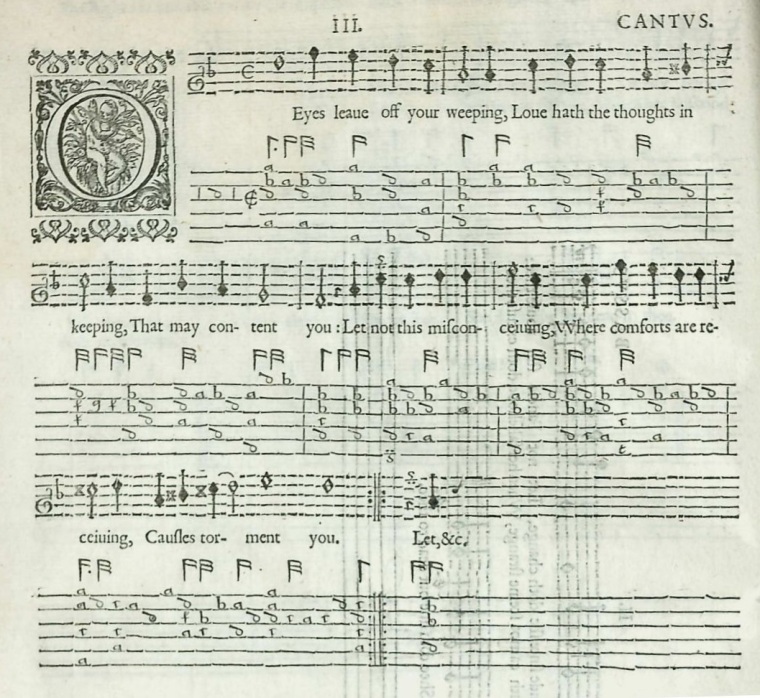
Robert Hales (attivo 1583 - 1616): O eyes, leave off your weeping, ayre su testo di autore anonimo (talvolta erroneamente attribuito a Nicholas Breton, 1542 - 1626). Emma Kirkby, soprano; Anthony Rooley, liuto.
O eyes, leave off your weeping,
love hath the thoughts in keeping
that may content you.
Let not this misconceiving,
where comforts are receiving,
causeless torment you.
Clouds threaten but a shower;
hope hath his happy hour,
though long in lasting.
Time needs must be attended
Love must not be offended
with too much hasting.
But O the painful pleasure,
where Love attends the leisure
of life’s wretchedness:
where Hope is but illusion,
and Fear is but confusion
of Love’s happiness.
But happy Hope, that seeth
how Hope and Hap agreeth,
of life deprive me;
or let me be assured
when life hath death endured
Love will revive me.
Di Robert Hales sappiamo che fu al servizio di Elisabetta I, apprezzato dalla sovrana in particolare quale cantante, e poi di Anna di Danimarca, consorte di Giacomo I; O eyes, leave off your weeping, pubblicato da Robert Dowland nella raccolta A Musicall Banquet (Londra 1610, n. 4), è l’unica sua composizione nota.
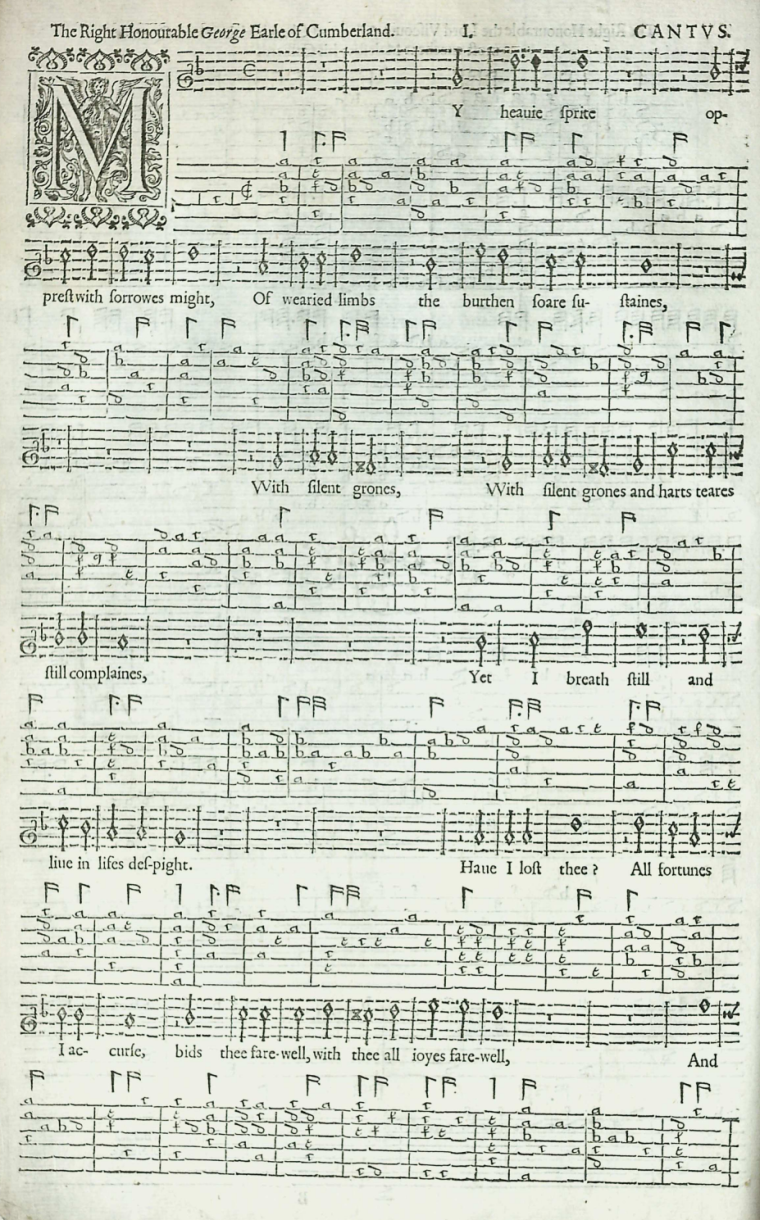
Anthony Holborne (c1545 - 1602): My heavy sprite, oppress’d with sorrow’s might, ayre su testo di George Clifford, III conte di Cumberland (1558 - 1606). Emma Kirkby, soprano; Anthony Rooley, liuto.
My heavy sprite, oppress’d with sorrow’s might,
of wearied limbs the burden sore sustains,
with silent groans and heart’s tears still complains,
yet I breathe still and live in life’s despite.
Have I lost thee? All fortunes I accurse
bids, thee farewell, with thee all joys farewell,
and for thy sake this world becomes my hell.
My heavy sprite di Anthony Holborne è il primo brano vocale della raccolta A Musicall Banquet, pubblicata a Londra nel 1610 a cura di Robert Dowland (1591 - 1641).
John Dowland (1563 - 1626): Come away, come, sweet love, ayre (pubblicato nel First Booke of Songes or Ayres, 1597, n. 11):
– versione a 4 voci con accompagnamento di liuto: The Consort of Musicke, dir. Anthony Rooley;
– versione a 1 voce con accompagnamento di liuto: Alfred Deller. controtenore; Robert Spencer, liuto.
Come away, come, sweet love,
the golden morning breaks.
All the earth, all the air
of love and pleasure speaks:
teach thine arms then to embrace
and sweet rosy lips to kiss,
and mix our souls in mutual bliss.
Eyes were made for beauty’s grace,
viewing, rueing love’s long pain
procur’d by beauty’s rude disdain.
Come away, come, sweet love,
the golden morning wastes,
while the sun from his sphere
his fiery arrows casts:
making all the shadows fly,
playing, staying in the grove,
to entertain the stealth of love.
Thither sweet love let us hie,
flying, dying in desire,
wing’d with sweet hopes and heav’nly fire.
Come away, come, sweet love,
do not in vain adorn
beauty’s grace, that should rise
like to the naked morn:
lilies on the river’s side,
and fair Cyprian flow’rs new-blown,
desire no beauties but their own.
Ornament is nurse of pride,
pleasure, measure love’s delight:
haste then sweet love our wishèd flight.


 English translation: please
  Forse figlio illegittimo di Enrico VIII, Richard Edwardes fu poeta, autore drammatico, gentiluomo della Chapel Royal e maestro del coro di voci bianche della medesima istituzione sotto le regine Maria e Elisabetta I. Nei suoi ultimi anni compilò un’ampia silloge di testi poetici di autori diversi, cui aggiunse, firmandoli, alcuni componimenti propri, e fra questi appunto Where gripyng grief, con il titolo In commendation of Musick. La raccolta, intitolata The Paradise of Dainty Devices, fu pubblicata postuma nel 1576, a cura di Henry Disle; dei molti volumi miscellanei dati alle stampe in quel periodo fu il più fortunato, tant’è vero che fu ristampato nove volte nei successivi trent’anni.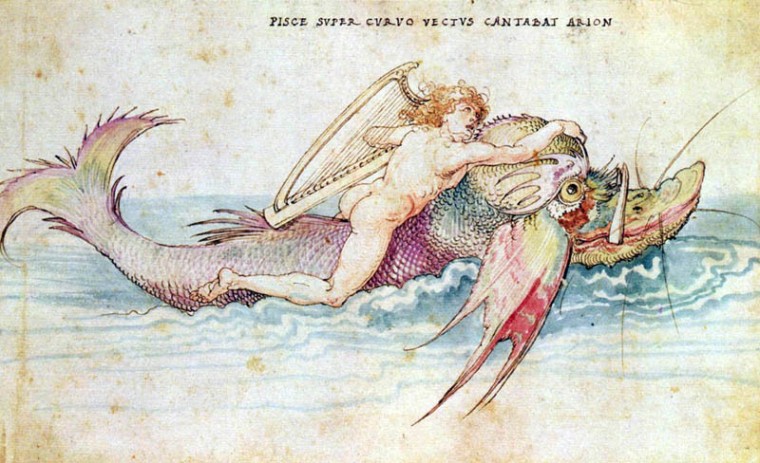

 La prima strofa si trova nella commedia di Shakespeare Misura per misura (atto IV, scena 1a), rappresentata per la prima volta nel 1604; non sappiamo su quale melodia fosse cantata. Prima e seconda strofa sono nel dramma Rollo Duke of Normandy, or The Bloody Brother, scritto in collaborazione da John Fletcher, Philip Massinger, Ben Jonson e George Chapman in data imprecisabile (comunque non prima del 1612). Non è dato di sapere se la seconda strofe sia un’aggiunta di Fletcher oppure se tanto Shakespeare quanto Fletcher si siano rifatti a una canzone popolare in voga ai loro tempi.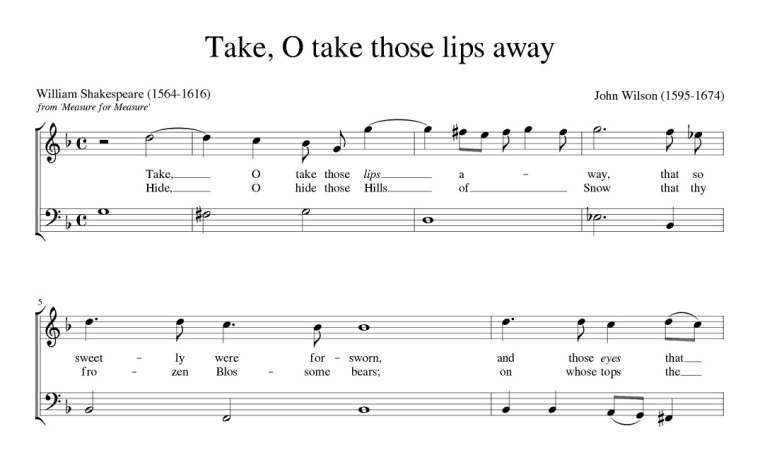




 la regina gioiosa