Only peace, only rest

Henry Purcell (10 settembre 1659 - 1695): Close thine eyes and sleep secure, devotional song per soprano, basso e continuo Z 184 (pubblicato in Harmonia Sacra, 1688) su testo di Francis Quarles. Hana Blažíková, soprano; Peter Kooij, basso; L’Armonia Sonora, dir. e viola da gamba Mieneke van der Velden.

Close thine eyes and sleep secure;
Thy soul is safe, thy body sure;
He that guards thee, He thee keeps,
Who never slumbers, never sleeps.
A quiet conscience in a quiet breast
Has only peace, has only rest:
The music and the mirth of kings
Are out of tune unless she sings;
Then close thine eyes in peace and rest secure,
No sleep so sweet as thine, no rest so sure.


By the Roadside

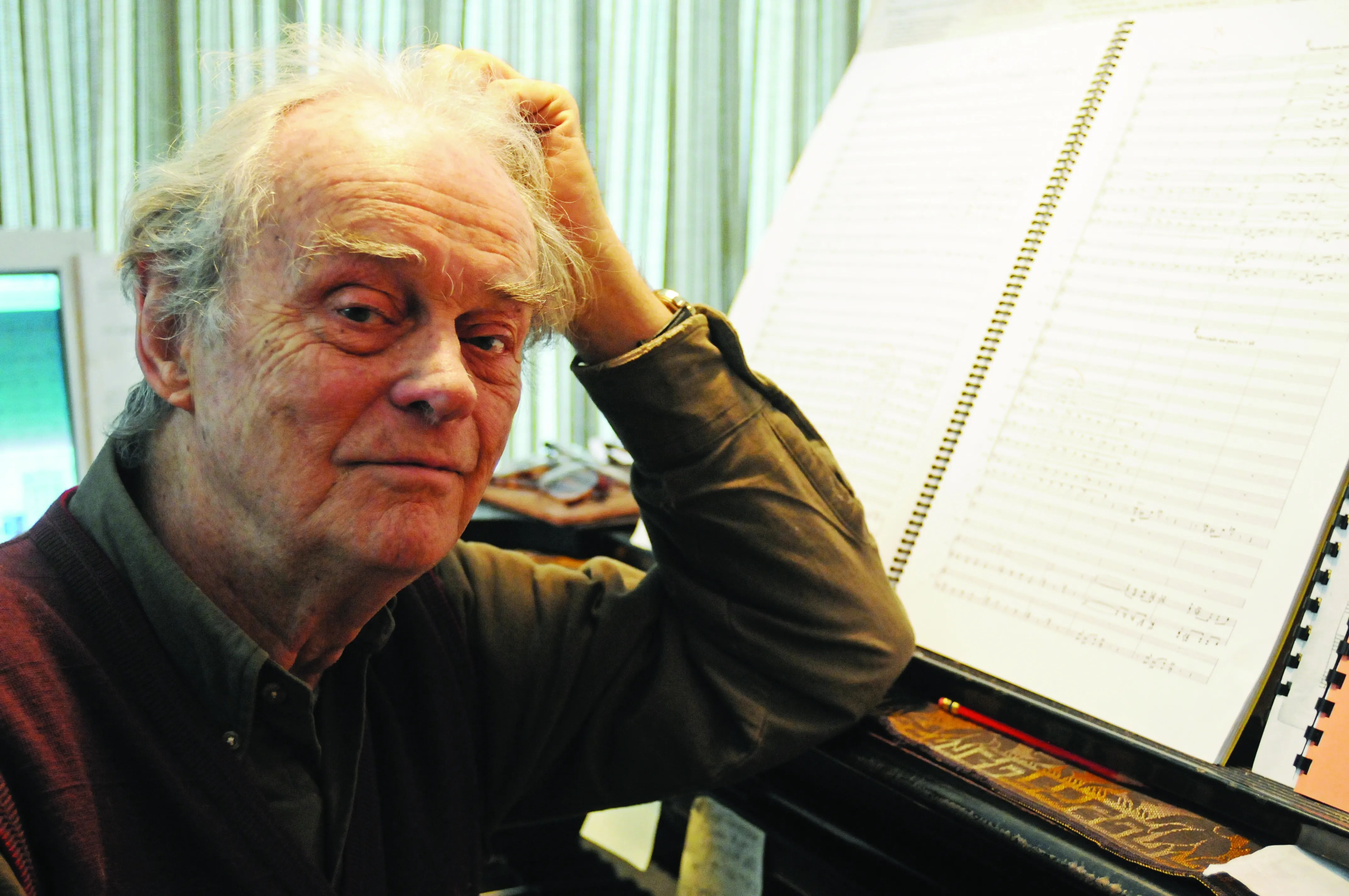
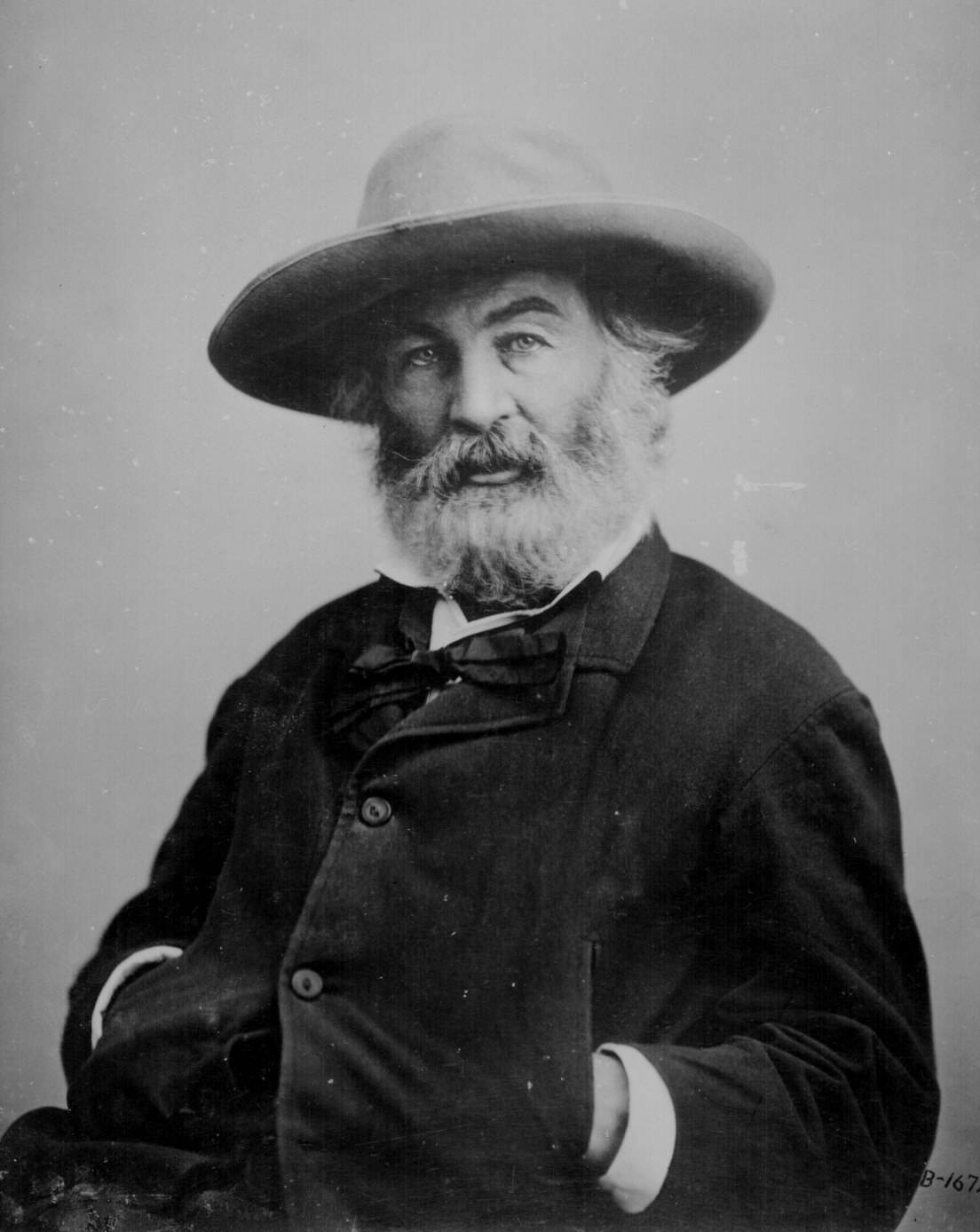
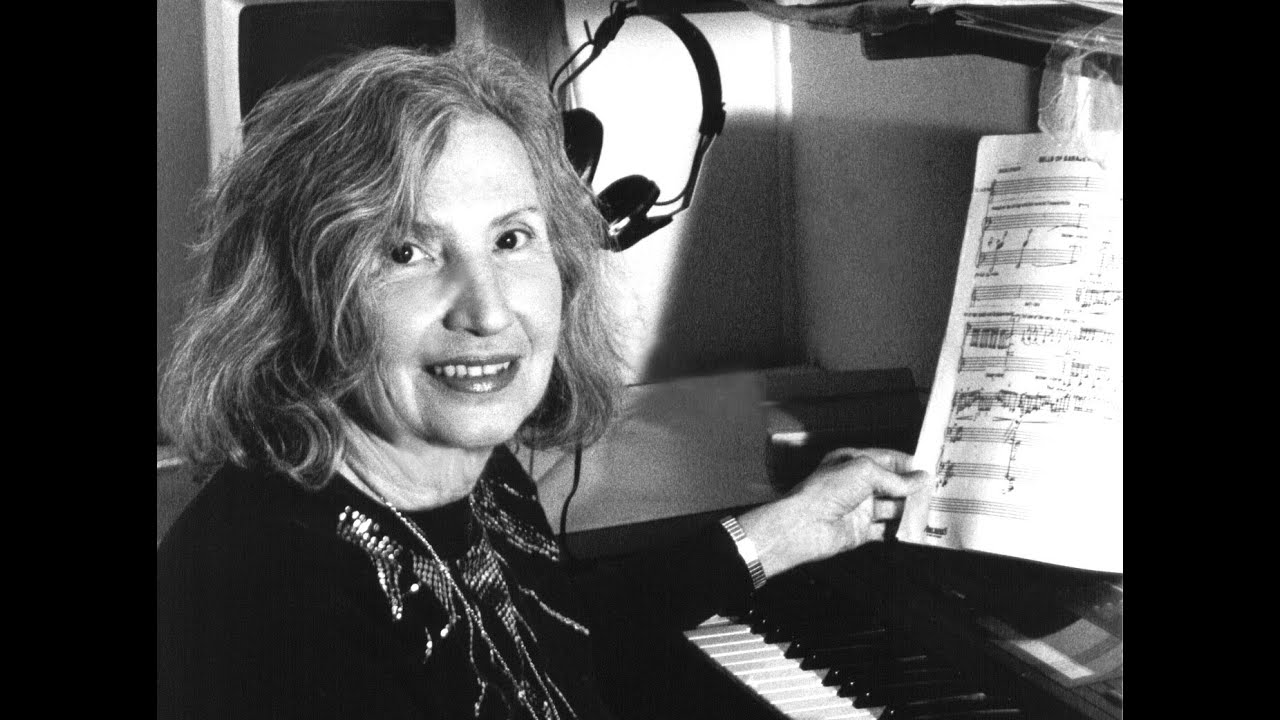
Ruth Schönthal (24 giugno 1924 - 2006): By the Roadside, 6 songs su versi di Walt Whitman (1975). Berenice Bramson, soprano, accompagnata al pianoforte dall’autrice.

  1. Mother and Babe
    I see the sleeping babe nestling the breast of its mother,
    The sleeping mother and babe — hush’d, I study them long and long.
  2. Thought
    Of obedience, faith, adhesiveness;
    As I stand aloof and look, there is to me something profoundly affecting in large
    masses of men, following the lead of those who do not believe in men.
  3. Visor’d
    A mask, a perpetual disguiser of herself,
    Concealing her face, concealing her form,
    Changes and transformations every hour, every moment,
    Falling upon her even when she sleeps.
  4. To old age
    I see in you the estuary that enlarges and spreads
    itself grandly as it pours in the great sea.
  5. A farm picture
    Through the ample open door of the peaceful country barn,
    A sunlit pasture field with cattle and horses feeding,
    And haze and vista, and the far horizon fading away.
  6. A child’s amaze
    Silent and amazed even when a little boy,
    I remember I heard the preacher every Sunday put God in his statements,
    As contending against some being or influence.


Riccioli d’argento

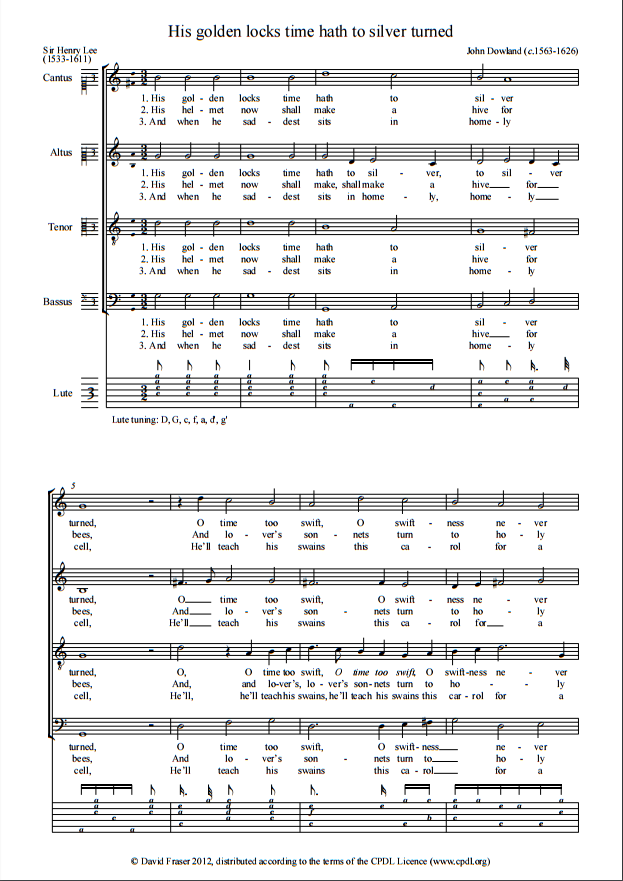
John Dowland (1563 - 1626): His golden locks, dal First Booke of Songes (1597), n. 18. Emma Kirkby, soprano; Anthony Rooley, liuto.

His golden locks Time hath to silver turned.
O Time too swift, O swiftness never ceasing:
His youth ‘gainst Time and Age hath ever spurned,
But spurned in vain; youth waneth by increasing.
Beauty, strength, youth are flowers but fading seen;
Duty, faith, love are roots, and ever green.

His helmet now shall make a hive for bees,
And lovers’ sonnets turn to holy psalms.
A man at arms must now serve on his knees,
And feed on prayers which are Age’s alms.
But though from Court to cottage he depart,
His Saint is sure of his unspotted heart.

And when he saddest sits in homely cell,
He’ll teach his swains this carol for a song:
Blest be the hearts that wish my Sov’reign well.
Curst be the soul that think her [him] any wrong.
Goddess [Ye gods], allow this aged man his right
To be your beadsman now, that was your knight.

His golden locks

The bryghtest myrrour

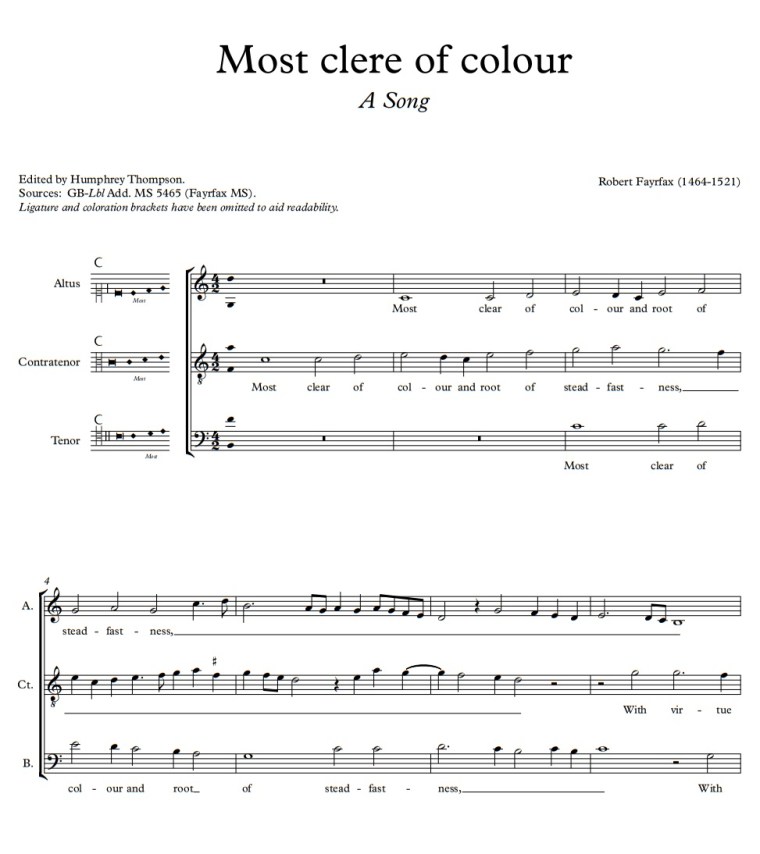
Robert Fayrfax (23 aprile 1464 - 1521): Most clere of colour per 3 voci a cappella. The Hilliard Ensemble.

Most clere of colour and rote of stedfastness,
With vertu connyng her maner is lede,
Which that passyth my mynde for to express
Of her bounte, beaute and womanhode;
The bryghtest myrrour and floure of goodlyhed,
Which that all men knowith, both more and less;
Thes vertues byn pryntyd in her doutless.

Six Songs

Denis ApIvor (14 aprile 1916 - 2004): Six Songs per voce e pianoforte. Moira Harris, soprano; Wills Morgan, tenore; Richard Black, pianoforte.

  1. A hert tae break (testo: anonimo scozzese, 1946)
  2. As the holly groweth green (Enrico VIII; 1936) [2:35]
  3. Flos Lunae (Ernest Christopher Dowson; 1939) [4:15]
  4. Maw Bonnie Lad (anonimo scozzese; 1974-75) [7:49]
  5. Spleen (Dowson; 1939) [9:23]
  6. Villanelle (Dowson; 1939) [13:52]

Rediscoveries

Rediscoveries: Old & New Music of Ireland. Joanne Quigley-McParland, violino; David Quigley, pianoforte.

  • Jean Schwartz (1878 - 1956): My Irish Molly O. (arrangiamento di Philip Martin)
  • Anonimo: An Coulin (arrangiamento di Michael Esposito)
  • Anonimo: 5 airs irlandesi (arrangiamento di John Larchey)
  • Anonimo: Silent O Moyle (The Song of Fionnula) (arrangiamento di Michael Esposito)
  • Charles Villiers Stanford (1852 - 1924): The Long Dance
  • Anonimo: Sliabh na mBan (arrangiamento di Joanne Quigley-McParland)
  • Percy Grainger (1882 - 1961): Molly on the Shore (arrangiamento di Fritz Kreisler)
  • Anonimo: The Lark in the Clear Air (arrangiamento di Paul Reade)
  • Guido Papini (1847 - 1912): Irish Fantasy op. 125 n. 5
  • Philip Martin (1947): Martin’s Lament
  • Anonimo: The Star of the County Down (arrangiamento di Joanne Quigley-McParland)
  • Charles Wood (1866 - 1926): Two Irish Dances
  • Éamonn Ó Gallchobhair (1906 - 1982): Reel
  • Philip Martin: Mollyfication
  • Anonimo: The Derry Air (arrangiamento di Geoffrey O’Connor Morris)

 - 

September Song

Kurt Weill (1900 - 1950): September Song (1938); testo di Maxwell Anderson (1888 - 1959). Lotte Lenya, voce; American Theater Songs Orchestra, dir. Maurice Levine.

Oh, it’s a long, long while from May to December
But the days grow short when you reach September
When the autumn weather turns the leaves to flame
One hasn’t got time for the waiting game.

Oh, the days dwindle down to a precious few
September, November
And these few precious days I’ll spend with you
These precious days I’ll spend with you.

See, hear, touch, kiss, die

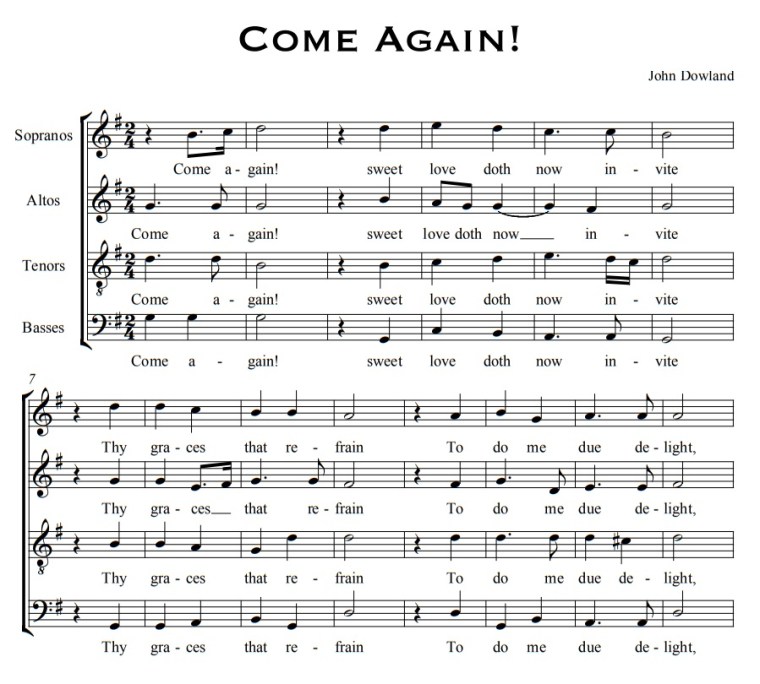
John Dowland (1563 - 1626): Come again, ayre* (dal First Booke of Songes or Ayres of fowre partes with Tableture for the Lute, 1597, n. 17). Paul Agnew, tenore; Christopher Wilson, liuto.

Come again! sweet love doth now invite
Thy graces that refrain
To do me due delight,
To see, to hear, to touch, to kiss, to die,
With thee again in sweetest sympathy.

Come again! that I may cease to mourn
Through thy unkind disdain;
For now left and forlorn
I sit, I sigh, I weep, I faint, I die
In deadly pain and endless misery.

All the day the sun that lends me shine
By frowns do cause me pine
And feeds me with delay;
Her smiles, my springs that makes my joys to grow,
Her frowns the Winters of my woe.

All the night my sleeps are full of dreams,
My eyes are full of streams.
My heart takes no delight
To see the fruits and joys that some do find
And mark the storms are me assign’d.

Out alas, my faith is ever true,
Yet will she never rue
Nor yield me any grace;
Her eyes of fire, her heart of flint is made,
Whom tears nor truth may once invade.

Gentle Love, draw forth thy wounding dart,
Thou canst not pierce her heart;
For I, that do approve
By sighs and tears more hot than are thy shafts
Did tempt while she for triumph laughs.

(*) Per ayre si intende un genere musicale fiorito in Inghilterra tra la fine del Cinquecento e la terza decade del secolo successivo. L’ayre è un brano a più voci (solitamente quattro) con ac­com­pa­gna­mento di liuto; ciò che lo distingue dalle composizioni congeneri del periodo precedente è il fatto che alla voce più acuta è affidata una parte spiccatamente melodica, sul modello della «monodia accompagnata» italiana e dell’air de cour francese. Gli interpreti hanno dunque la possibilità di eseguire un ayre o secondo tradizione, con tutte le parti vocali e con l’ac­com­pa­gna­mento del liuto ad libitum, oppure seguendo la moda dell’epoca, cioè con il canto della sola parte più acuta sostenuto dal liuto. In quest’ultimo caso, al liuto spesso si aggiunge una viola da gamba che ha il compito di irrobustire la linea del basso.

Shakespeariana – XXXVIII Greensleeves – XX 🇬🇧

Lady Greensleeves & Mistress Ford

Anonymous (second half of the sixteenth century, British): Greensleeves. Alfred Deller, countertenor; Desmond Dupre, lute.
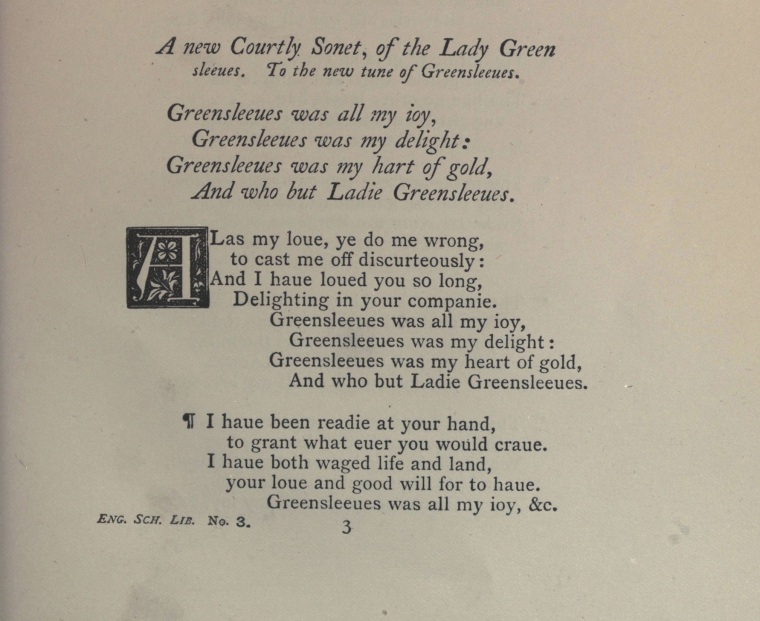
Deller’s interpretation gives us the opportunity to hear both the oldest known version of Greensleeves tune and some stanzas taken from the first known edition of the lyrics, a 1584 collection entitled A Handful of Pleasant Delites. Here is the full text (italicized stanzas are omitted by Deller):

Alas, my love, you do me wrong
To cast me off discourteously,
For I have loved you well and long,
Delighting in your company.

  Greensleeves was all my joy,
  Greensleeves was my delight,
  Greensleeves was my heart of gold,
  And who but my lady Greensleeves.

I have been ready at your hand,
To grant whatever you would crave;
I have both waged life and land,
Your love and good-will for to have.

I bought three kerchers to thy head,
That were wrought fine and gallantly;
I kept them both at board and bed,
Which cost my purse well-favour’dly.

I bought thee petticoats of the best,
The cloth so fine as fine might be:
I gave thee jewels for thy chest;
And all this cost I spent on thee.

Thy smock of silk both fair and white,
With gold embroidered gorgeously;
Thy petticoat of sendall right;
And this I bought thee gladly.

Thy girdle of gold so red,
With pearls bedecked sumptously,
The like no other lasses had;
And yet you do not love me!

Thy purse, and eke thy gay gilt knives,
Thy pin-case, gallant to the eye;
No better wore the burgess’ wives;
And yet thou wouldst not love me!

Thy gown was of the grassy green,
The sleeves of satin hanging by;
Which made thee be our harvest queen;
And yet thou wouldst not love me!

Thy garters fringed with the gold,
And silver aglets hanging by;
Which made thee blithe for to behold;
And yet thou wouldst not love me!

My gayest gelding thee I gave,
To ride wherever liked thee;
No lady ever was so brave;
And yet thou wouldst not love me!

My men were clothed all in green,
And they did ever wait on thee;
All this was gallant to be seen;
And yet thou wouldst not love me!

They set thee up, they took thee down,
They served thee with humility;
Thy foot might not once touch the ground;
And yet thou wouldst not love me!

For every morning, when thou rose,
I sent thee dainties, orderly,
To cheer thy stomach from all woes;
And yet thou wouldst not love me!

Thou couldst desire no earthly thing,
But still thou hadst it readily,
Thy music still to play and sing;
And yet thou wouldst not love me!

And who did pay for all this gear,
That thou didst spend when pleased thee?
Even I that am rejected here,
And thou disdainst to love me!

Well! I will pray to God on high,
That thou my constancy mayst see,
And that, yet once before I die,
Thou wilt vouchsafe to love me!

Greensleeves, now farewell! Adieu!
God I pray to prosper thee!

For I am still thy lover true;
Come once again and love me!

Incipit From a reprint, dated 1878, of A Handful of Pleasant Delites
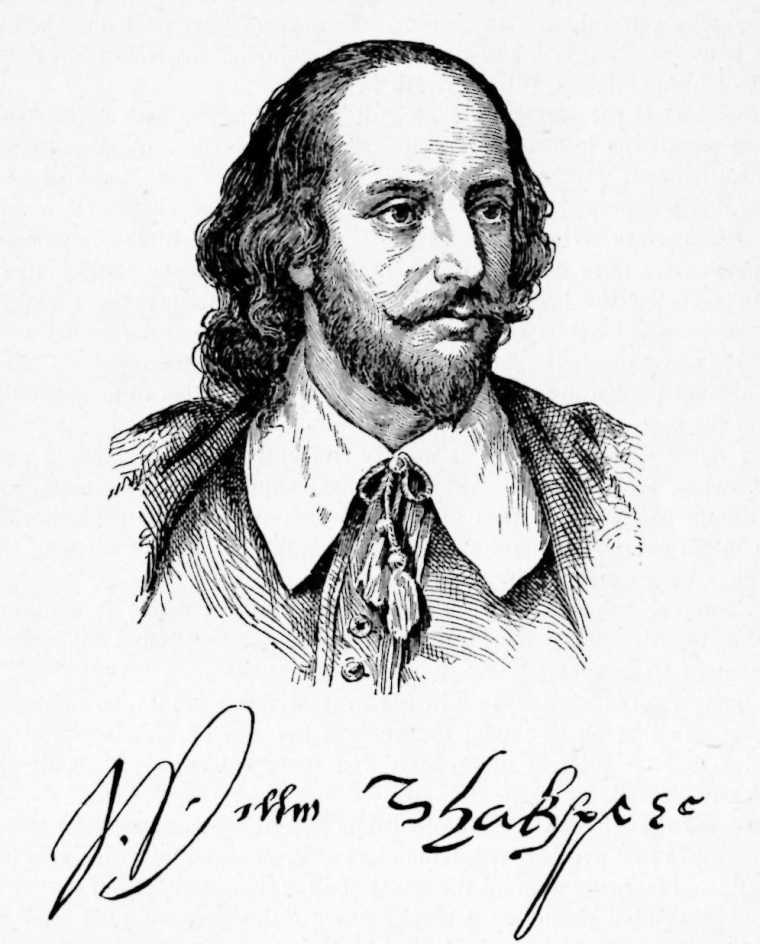

Greensleeves cannot be missing from an anthology of Shakespearean music: the ballad of the beautiful green-sleeved lady is in fact mentioned twice in the comedy The Merry Wives of Windsor (first published in 1602, though believed to have been written in or before 1597). Its plot is well known: the pot-bellied and cash-strapped knight John Falstaff awkwardly tries to seduce two ladies, Mistress Ford and Mistress Page, married to wealthy merchants living in Windsor (in Berkshire); by gaining their favour, Sir John hopes to fix his financial woe, but is quickly unmasked: the wives find he sent them identical love letters and take revenge by playing tricks on Falstaff.
When the hoax comes to light, Mistress Ford comments on the fact with these words (act 2, scene 1):

I shall think the worse of fat men, as long as I have an eye to make difference of men’s liking: and yet he would not swear; praised women’s modesty; and gave such orderly and well-behaved reproof to all uncomeliness, that I would have sworn his disposition would have gone to the truth of his words; but they do no more adhere and keep place together than the Hundredth Psalm to the tune of Green Sleeves.

It’s true: Psalm 100 does not adhere to Greensleeves; but it must be said that this is a purely metrical matter — the verses of the psalm («O be joyful in the Lord, all ye lands» according to the Great Bible, 1539) do not fit at all to the tune of the ballad — and not a sort of moral prohibition. Adapting a sacred text to a familiar secular melody (this is called contrafactum) has never been a problem, and we have already seen (click here) that Greensleeves itself has given its tune to a religious chant.

The last prank against Falstaff takes place in the forest of Windsor, where he is invited to go, dressed as a hunter, for a love rendezvous (act 5, scene 5). «Sir John!» says Mistress Ford, «Art thou there, my deer? my male deer?»; Falstaff replies by stating that «a tempest of provocation» will not be able to distract him from her, even if the sky thunders «to the tune of Green Sleeves»:

My doe with the black scut! Let the sky rain potatoes; let it thunder to the tune of Green Sleeves, hail kissing-comfits and snow eringoes; let there come a tempest of provocation, I will shelter me here.

(A few brief explanations:
potatoes: when the potato was introduced to Europe, precisely at the time of Shake­speare, it was considered an aphrodisiac;
kissing-comfits: perfumed sugar sweets, used to freshen the breath;
eringoes: does not refer to the herbaceous plants of this name, but to the pleurotus eryngii, called king trumpet or king oyster mushroom, considered an aphrodisiac since ancient times.)

Shakespeare

Shakespeariana – XXXVIII Greensleeves – XX 🇮🇹

Lady Greensleeves & Mistress Ford

Anonimo inglese della seconda metà del Cinquecento: Greensleeves. Alfred Deller, controtenore; Desmond Dupré, liuto.
L’interpretazione di Deller e Dupré ci dà modo di ascoltare la più antica versione conosciuta della melodia e, insieme, alcune strofe tratte dalla prima edizione nota del testo, una raccolta del 1584 intitolata A Handful of Pleasant Delites. Ecco il testo completo (le parti in corsivo sono omesse da Deller):

Alas, my love, you do me wrong
To cast me off discourteously,
For I have loved you well and long,
Delighting in your company.

  Greensleeves was all my joy,
  Greensleeves was my delight,
  Greensleeves was my heart of gold,
  And who but my lady Greensleeves.

I have been ready at your hand,
To grant whatever you would crave;
I have both waged life and land,
Your love and good-will for to have.

I bought three kerchers to thy head,
That were wrought fine and gallantly;
I kept them both at board and bed,
Which cost my purse well-favour’dly.

I bought thee petticoats of the best,
The cloth so fine as fine might be:
I gave thee jewels for thy chest;
And all this cost I spent on thee.

Thy smock of silk both fair and white,
With gold embroidered gorgeously;
Thy petticoat of sendall right;
And this I bought thee gladly.

Thy girdle of gold so red,
With pearls bedecked sumptously,
The like no other lasses had;
And yet you do not love me!

Thy purse, and eke thy gay gilt knives,
Thy pin-case, gallant to the eye;
No better wore the burgess’ wives;
And yet thou wouldst not love me!

Thy gown was of the grassy green,
The sleeves of satin hanging by;
Which made thee be our harvest queen;
And yet thou wouldst not love me!

Thy garters fringed with the gold,
And silver aglets hanging by;
Which made thee blithe for to behold;
And yet thou wouldst not love me!

My gayest gelding thee I gave,
To ride wherever liked thee;
No lady ever was so brave;
And yet thou wouldst not love me!

My men were clothed all in green,
And they did ever wait on thee;
All this was gallant to be seen;
And yet thou wouldst not love me!

They set thee up, they took thee down,
They served thee with humility;
Thy foot might not once touch the ground;
And yet thou wouldst not love me!

For every morning, when thou rose,
I sent thee dainties, orderly,
To cheer thy stomach from all woes;
And yet thou wouldst not love me!

Thou couldst desire no earthly thing,
But still thou hadst it readily,
Thy music still to play and sing;
And yet thou wouldst not love me!

And who did pay for all this gear,
That thou didst spend when pleased thee?
Even I that am rejected here,
And thou disdainst to love me!

Well! I will pray to God on high,
That thou my constancy mayst see,
And that, yet once before I die,
Thou wilt vouchsafe to love me!

Greensleeves, now farewell! Adieu!
God I pray to prosper thee!

For I am still thy lover true;
Come once again and love me!

Incipit Da una ristampa, datata 1878, di A Handful of Pleasant Delites


In una antologia di «musica scespiriana», Greensleeves non può mancare: la canzone della bella signora dalle maniche verdi è infatti menzionata nella commedia The Merry Wives of Windsor (pubblicata per la prima volta nel 1602, ma si ritiene sia stata scritta prima del 1597). La trama è nota: il panciuto e squattrinato cavaliere John Falstaff tenta maldestramente di sedurre due signore, Mistress Ford e Mistress Page, sposate a ricchi borghesi di Windsor (nel Berkshire); ottenendo i loro favori sir John spera di sistemare le proprie finanze, ma viene subito smascherato: le due donne si accorgono di aver ricevuto lettere d’amore identiche, perciò decidono di vendicarsi e ordiscono alcune perfide burle ai danni di Falstaff.
Quando l’imbroglio viene scoperto, questo è il commento di Mistress Ford (atto II, scena 1ª):

I shall think the worse of fat men, as long as I have an eye to make difference of men’s liking: and yet he would not swear; praised women’s modesty; and gave such orderly and well-behaved reproof to all uncomeliness, that I would have sworn his disposition would have gone to the truth of his words; but they do no more adhere and keep place together than the Hundredth Psalm to the tune of Green Sleeves.

È vero, Greensleeves non va d’accordo con il Salmo 100: ma è un impedimento di carattere puramente metrico – i versi («Acclamate il Signore, voi tutti della terra»; nella versione della Great Bible, 1539: «O be joyful in the Lord, all ye lands») non combaciano affatto con la melodia – e non una sorta di divieto morale. L’adattamento di un testo sacro a una melodia profana («travestimento spirituale») non ha mai costituito un problema, e del resto abbiamo già visto (qui) che, nel corso della sua storia pluricentenaria, la stessa Greensleeves ha prestato la propria melodia a un canto religioso.

L’ultima burla ai danni di Falstaff ha luogo nella foresta di Windsor, dove egli viene invitato a recarsi, vestito da cacciatore, per un incontro amoroso (atto V, scena 5ª). «Sir John!», lo apostrofa Mistress Ford, «Art thou there, my deer? my male deer?»; Falstaff risponde affermando che nemmeno una «tempesta di amorose provocazioni», fra le quali la melodia di Greensleeves, riuscirà a distoglierlo da lei:

My doe with the black scut! Let the sky rain potatoes; let it thunder to the tune of Green Sleeves, hail kissing-comfits and snow eringoes; let there come a tempest of provocation, I will shelter me here.

(Qualche breve spiegazione:
potatoes: quando la patata fu introdotta in Europa, appunto all’epoca di Shakespeare, era considerata afrodisiaca;
kissing-comfits: dolcetti di zucchero profumati, usati per rinfrescare l’alito;
eringoes: non si riferisce alle piante erbacee in Italia chiamate calcatreppole, bensì al fungo da noi comunemente noto come cardoncello, nome scientifico pleurotus eryngii, fin dall’Antichità considerato afrodisiaco.)

Shakespeare

Greensleeves – XIX 🇮🇹

Con il suo ensemble, The Broadside Band, Jeremy Barlow ha lavorato a lungo e proficuamente sulle musiche utilizzate da Johann Christoph Pepusch nell’Opera del mendicante (The Beggar’s Opera, 1728) di John Gay: la quale è l’unica ballad opera di cui si parli ancora ai nostri giorni, grazie anche al rifacimento brechtiano del 1928, Die Drei­groschenoper, che adotta però musiche originali composte da Kurt Weill. Per l’Opera del mendicante invece, com’è noto, Pepusch adattò i testi di Gay a melodie che all’epoca avevano una certa notorietà, prendendole a prestito da broadside ballads, arie d’opera, inni religiosi e canti di tradizione popolare.
Oltre a produrre un’edizione completa del lavoro di Gay e Pepusch, Barlow e la sua band hanno inciso (per Harmonia Mundi, 1982) anche un’antologia degli airs più famosi (in tutto nove brani), di ciascuno dei quali proponendo non solo la versione dell’Opera del mendicante ma anche la composizione originale e eventuali altre sue trasformazioni, varianti e parodie.
L’ultima sezione dell’antologia, che qui sottopongo alla vostra attenzione, è dedicato a Greensleeves. Comprende, nell’ordine:

  1. una improvvisazione sul passamezzo antico, eseguita al liuto da George Weigand

  2. Greensleeves, la più antica versione nota della melodia (dal William Ballet’s Lute Book, c1590-1603) con la più antica versione nota del testo (da A Handful of Pleasant Delights, 1584), cantata da Paul Elliott accompagnato al liuto da Weigand [1:13]

    Alas, my love, you do me wrong,
    To cast me off discourteously.
    And I have loved you so long,
    Delighting in your company.

     Greensleeves was all my joy,
     Greensleeves was my delight,
     Greensleeves was my heart of gold,
     And who but my Lady Greensleeves.

    I have been ready at your hand,
    To grant whatever you wouldst crave,
    I have both waged life and land,
    Your love and goodwill for to have.

    Well I will pray to God on high
    That thou my constancy mayst see,
    And that yet once before I die,
    Thou wilt vouchsafe to love me.

    Greensleeves, now farewell, adieu,
    God I pray to prosper thee,
    For I am still thy lover true,
    Come once again and love me.

  3. Greensleeves, la versione più diffusa all’inizio del Seicento, secondo William Cobbold (1560 - 1639) e altri autori, con improvvisazioni eseguite da Weigand alla chitarra barocca e da Rosemary Thorndycraft al bass viol [4:07]

  4. la versione dell’Opera del mendicante che già conosciamo, interpretata ancora da Elliott a solo [5:27]

  5. un misto di tre jigs irlandesi eseguito da Barlow al flauto e da Alastair McLachlan al violino [6:03]:
    A Basket of Oysters (da Moore’s Irish Melodies, 1834)
    A Basket of Oysters or Paddythe Weaver (Aird’s selection, 1788)
    Greensleeves (versione raccolta a Limerick nel 1852)

Greensleeves – XIX 🇬🇧

With his ensemble, The Broadside Band, Jeremy Barlow worked extensively and profitably on the music used by Johann Christoph Pepusch in John Gay’s The Beggar’s Opera (1728): it is the only ballad opera still being talked about in our days, thanks also to Bertolt Brecht’s 1928 remake, Die Dreigroschenoper, which however has original music composed by Kurt Weill. It is not the same for The Beggar’s Opera: Gay’s lyrics were in fact adapted by Pepusch to melodies that at the time already had a certain notoriety, borrowing them from broadside ballads, opera arias, religious hymns and folk songs.
Barlow and his band have recorded a complete edition of Gay and Pepusch’s work, as well as an anthology of its most famous airs (nine pieces in all), of each of which they presented not only The Beggar’s Opera version, but also the original composition and some of its variants and parodies.
The last track of the anthology, the one I submit to your attention here, is dedicated to Greensleeves. It includes, in order:

  1. a lute extemporisation on passamezzo antico ground, performed by George Weigand

  2. Greensleeves, earliest version of melody (from William Ballet’s Lute Book, c1590-1603) with earliest surviving words (A Handful of Pleasant Delights, 1584), sung by Paul Elliott accompanied on lute by Weigand [1:13]

    Alas, my love, you do me wrong,
    To cast me off discourteously.
    And I have loved you so long,
    Delighting in your company.

     Greensleeves was all my joy,
     Greensleeves was my delight,
     Greensleeves was my heart of gold,
     And who but my Lady Greensleeves.

    I have been ready at your hand,
    To grant whatever you wouldst crave,
    I have both waged life and land,
    Your love and goodwill for to have.

    Well I will pray to God on high
    That thou my constancy mayst see,
    And that yet once before I die,
    Thou wilt vouchsafe to love me.

    Greensleeves, now farewell, adieu,
    God I pray to prosper thee,
    For I am still thy lover true,
    Come once again and love me.

  3. Greensleeves, the most widespread version at the beginning of the seventeenth century, according to William Cobbold (1560 - 1639) and other authors, with improvisations performed by Weigand on baroque guitar and by Rosemary Thorndycraft on bass viol [4:07]

  4. The Beggar’s Opera version (we already know it) sung by Elliott a solo [5:27]

  5. a medley of three Irish jigs performed by Barlow on flute and Alastair McLachlan on violin [6:03]:
    A Basket of Oysters (da Moore’s Irish Melodies, 1834)
    A Basket of Oysters or Paddythe Weaver (Aird’s selection, 1788)
    Greensleeves (collected Limerick 1852).

Shakespeariana – XXXIII

English translation: please click here.

Il suon d’argento


Anonimo (probabilmente Richard Edwardes, 1525 - 1566): Where griping grief. Versione per voce (soprano) e liuto: Emma Kirkby e Anthony Rooley. Versione a 4 voci: Deller Consort.

Where griping grief the heart would wound
 And doleful dumps the mind oppress,
There music with her silver sound
 Is wont with speed to give redress
Of troubled minds, for ev’ry sore,
 Sweet music hath a salve in store.

In joy it makes our mirth abound,
 In grief it cheers our heavy sprites,
The careful head relief hath found,
 By music’s pleasant sweet delights;
Our senses, what should I say more,
 Are subject unto Music’s law.

The gods by music have their praise,
 The soul therein doth joy;
For as the Roman poets say,
 In seas whom pirates would destroy,
A dolphin saved from death most sharp,
 Arion playing on his harp.

O heavenly gift, that turns the mind,
 Like as the stern doth rule the ship,
Of music whom the gods assigned,
 To comfort man whom cares would nip,
Since thou both man and beast doth move,
 What wise man then will thee reprove.


Forse figlio illegittimo di Enrico VIII, Richard Edwardes fu poeta, autore drammatico, gen­tiluo­mo della Chapel Royal e maestro del coro di voci bianche della medesima istituzione sotto le regine Maria e Elisabetta I. Nei suoi ultimi anni compilò un’ampia silloge di testi poetici di autori diversi, cui aggiunse, firmandoli, alcuni componimenti propri, e fra questi appunto Where gripyng grief, con il titolo In commendation of Musick. La raccolta, intitolata The Paradise of Dainty Devices, fu pubbli­cata postuma nel 1576, a cura di Henry Disle; dei molti volumi mi­scel­la­nei dati alle stampe in quel periodo fu il più fortunato, tant’è vero che fu ristampato nove volte nei successivi trent’anni.
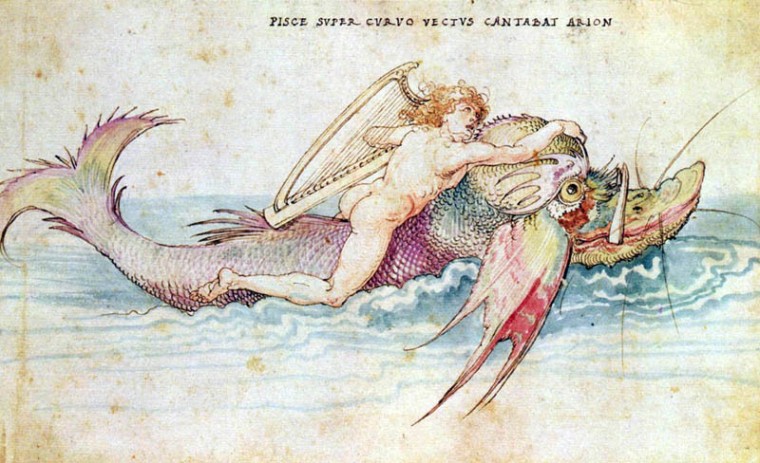
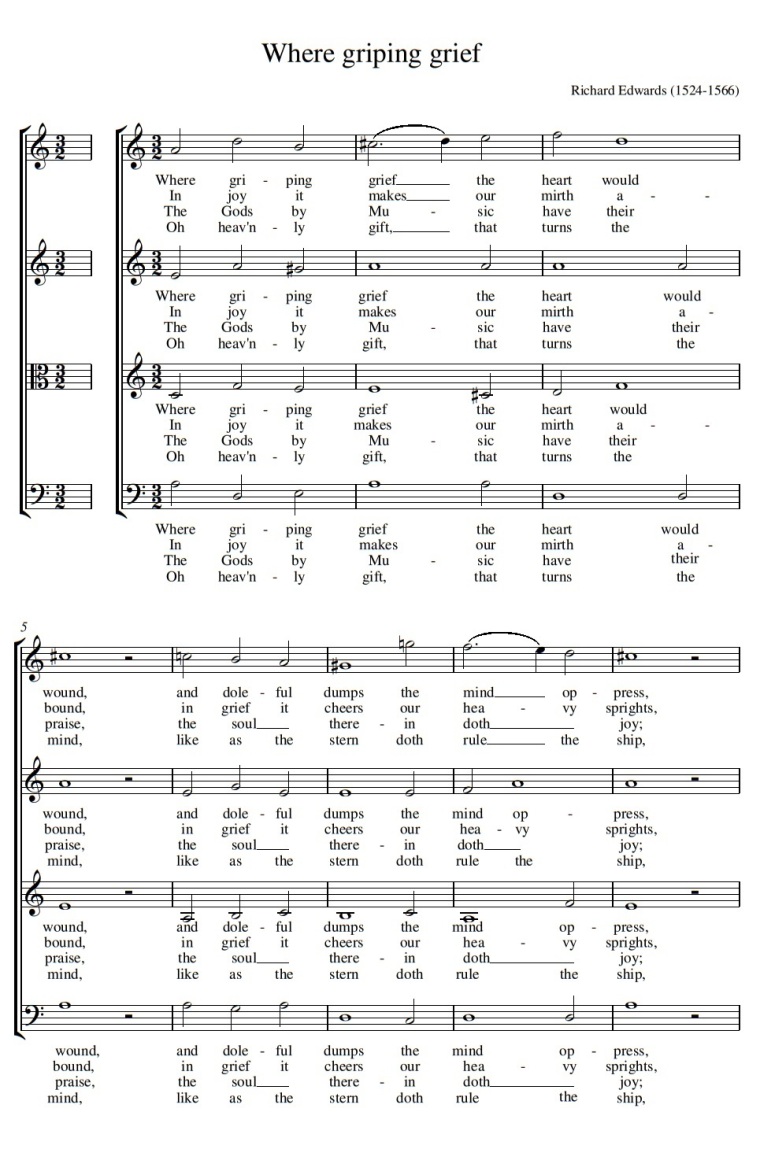
Del testo si trovano, anche nel web, numerose varianti, quasi tutte di poco conto, a cominciare da «When… Then…» invece di «Where… There…» nella prima strofa; ma è chiaramente un errore l’«Anon» che non di rado sostituisce «Arion» all’inizio dell’ultimo verso della terza strofa: Edwardes fa infatti riferimento a Arione di Métimna, l’antico citaredo che secondo Erodoto inventò il ditirambo e che, racconta il mito, si salvò da sicura morte in mare lasciandosi portare a riva da un delfino che aveva ammaliato con il canto.

Dürer: Arion (c1514)
Albrecht Dürer: Arion (c1514)

Le due fonti manoscritte che ci hanno tramandato la musica di Where griping grief (il Mulliner Book, raccolta di composizioni per strumento a tastiera databile fra il 1550 e il 1585 circa; e il Brogyntyn Lute Book, c1595) non riportano né il testo né il nome dell’autore: si ritiene probabile che anche la musica sia dello stesso Edwardes. La melodia è finemente cesellata; pur procedendo prevalentemente per gradi congiunti, presenta non pochi intervalli più ampi, fra cui un’insolita (per l’epoca) ottava diminuita — sulle parole «dumps the» nel secondo verso della prima strofa.

Il brano doveva essere abbastanza noto all’epoca di Shakespeare, perché questi lo cita in una scena di Romeo e Giulietta. Alla fine del IV atto, dopo che la Nutrice ha rinvenuto il corpo esanime della giovane Capuleti e un cupo inatteso dolore strazia i suoi familiari, alcuni musicisti, che erano stati convocati per allietare la festa delle nozze di Giulietta con il conte Paride, ripongono mestamente gli strumenti e stanno per andarsene quando sopraggiunge Pietro (servitore della Nutrice) e chiede ai musici di suonare per lui; gli altri rispondono che non è il momento adatto per far musica, sicché Pietro inizia a battibeccare con loro e infine, citando Where griping grief, trova il modo di insolentirli. La scena consiste in una lunga serie di giochi di parole a sfondo musicale, da alcuni critici considerati di bassa lega — tanto che qualche traduttore italiano ha pensato bene di omettere l’intero passo. Ma secondo me la scena non è affatto priva di interesse, ragion per cui la riporto qui di seguito: a sinistra l’originale inglese, a destra non esattamente una traduzione, ma piuttosto una reinterpretazione, con alcune esplicite allusioni a musiche famose ai tempi del Bardo e già note ai frequentatori di questo blog.

PETER
Musicians, O musicians, Heart’s Ease, Heart’s Ease. O, an you will have me live, play Heart’s Ease.
PIETRO
Musici, o musici, Chi passa, Chi passa. Se volete ch’io viva, suonate Chi passa.
FIRST MUSICIAN
Why Heart’s ease?
1° MUSICO
Perché Chi passa?
PETER
O musicians, because my heart itself plays My Heart is Full. O, play me some merry dump to comfort me.
PIETRO
O musici, perché il mio cuore sta danzando un passamezzo che non passa. Prego, suonate qualche allegro lamento per confortarmi.
FIRST MUSICIAN
Not a dump, we. ‘Tis no time to play now.
1° MUSICO
No, niente lamenti. Non è il momento di suonare.
PETER
You will not then?
PIETRO
Non volete suonare?
FIRST MUSICIAN
No.
1° MUSICO
No.
PETER
I will then give it you soundly.
PIETRO
Allora ve le suonerò io, sentirete.
FIRST MUSICIAN
What will you give us?
1° MUSICO
Che cosa sentiremo?
PETER
No money, on my faith, but the gleek. I will give you the minstrel.
PIETRO
Oh, non un tintinnar di monete, ve l’assicuro, ma piuttosto una canzon…atura. Ecco, vi tratterò da menestrelli.
FIRST MUSICIAN
Then I will give you the serving creature.
1° MUSICO
E allora noi ti tratteremo da giullare.
PETER
Then will I lay the serving creature’s dagger on your pate. I will carry no crotchets. I’ll re you, I’ll fa you. Do you note me?
PIETRO
E allora riceverete la sonagliera del giullare sulla zucca. Vi avevo chiesto lamenti e mi date capricci. Così ve le suonerò: prendete nota.
FIRST MUSICIAN
An you re us and fa us, you note us.
1° MUSICO
Se ce le suoni, prenderemo davvero le tue note.
SECOND MUSICIAN
Pray you, put up your dagger and put out your wit.
2° MUSICO
Per favore, riponi la tua sonagliera e va’ adagio.
PETER
Then have at you with my wit. I will dry-beat you with an iron wit and put up my iron dagger. Answer me like men.
(sings)
 When griping grief the heart doth wound
 And doleful dumps the mind oppress,
 Then Music with her silver sound—
Why «silver sound»? Why «Music with her silver sound»? What say you, Simon Catling?
PIETRO
Andrò a mio agio e vi metterò a disagio. I miei adagi non sono meno pesanti della sonagliera. Rispondete dunque, da uomini, ai miei colpi.
(canta)
 Quando ferisce il cuore arduo tormento
 E la mente grava penoso tedio,
 Allora Musica dal suon d’argento…
Perché «suon d’argento»? Perché dice «Musica dal suon d’argento»? Tu che ne dici, Simon Cantino?
FIRST MUSICIAN
Marry, sir, because silver hath a sweet sound.
1° MUSICO
Diamine, signore, perché l’argento ha un dolce suono.
PETER
Prates. What say you, Hugh Rebeck?
PIETRO
Ciance. E tu che dici, Ugo Ribeca?
SECOND MUSICIAN
I say, «silver sound» because musicians sound for silver.
2° MUSICO
Dico: «suon d’argento» perché i musicisti suonano per guadagnarsi dell’argento.
PETER
Prates too. What say you, James Soundpost?
PIETRO
Ciance anche queste. E tu, Giaco Bischero?
THIRD MUSICIAN
Faith, I know not what to say.
3° MUSICO
In fede mia, non so che dire.
PETER
Oh, I cry you mercy, you are the singer. I will say for you. It is «Music with her silver sound» because musicians have no gold for sounding.
(sings)
 Then Music with her silver sound
 With speedy help doth lend redress.
(exit)
PIETRO
Oh, ti chiedo scusa: tu sei quello che canta. Be’, risponderò io per te: dice «Musica col suon d’argento» perché i musicisti non hanno mai oro da far risonare.
(canta)
 Allora Musica dal suon d’argento
 Con lesto soccorso pone rimedio.
(esce)
FIRST MUSICIAN
What a pestilent knave is this same!
1° MUSICO
Che pestifero furfante è costui!
SECOND MUSICIAN
Hang him, Jack! Come, we’ll in here, tarry for the mourners and stay dinner.
(exeunt)
2° MUSICO
Lascialo perdere! Venite, entriamo: aspette­remo quelli che verranno per il funerale e ci fermeremo a pranzo.
(escono)

Shakespeariana – XXXIII

Her silver sound


Anonymous (probably Richard Edwardes, 1525 - 1566): Where griping grief. Two versions:
– as a song for 1 voice (soprano) and lute: Emma Kirkby and Anthony Rooley.
– as a partsong for 4 voices: the Deller Consort.

Where griping grief the heart would wound
 And doleful dumps the mind oppress,
There music with her silver sound
 Is wont with speed to give redress
Of troubled minds, for ev’ry sore,
 Sweet music hath a salve in store.

In joy it makes our mirth abound,
 In grief it cheers our heavy sprites,
The careful head relief hath found,
 By music’s pleasant sweet delights;
Our senses, what should I say more,
 Are subject unto Music’s law.

The gods by music have their praise,
 The soul therein doth joy;
For as the Roman poets say,
 In seas whom pirates would destroy,
A dolphin saved from death most sharp,
 Arion playing on his harp.

O heavenly gift, that turns the mind,
 Like as the stern doth rule the ship,
Of music whom the gods assigned,
 To comfort man whom cares would nip,
Since thou both man and beast doth move,
 What wise man then will thee reprove.


Richard Edwardes, possibly an illegitimate son of Henry VIII, was a poet, playwright, gentleman of the Chapel Royal and choirmaster of the same institution in the reigns of Mary and Elizabeth I. In his later years he compiled an extensive anthology of poems by various authors, adding his own, including Where griping grief (under the title In commendation of Musick). The anthology, titled The Paradise of Dainty Devices, appeared posthumously in 1576, edited by Henry Disle; it was the most successful of the numerous miscellaneous books printed at the end of the sixteenth century: it was in fact reprinted nine times in the following thirty years.

There are, even on the Internet, many variants of Where griping grief, almost all of little importance, such as for example «When… Then…» instead of «Where… There…» in the first line; but the «Anon» which often replaces «Arion» at the beginning of the last line of the third stanza is clearly a mistake: Edwardes in fact refers to Arion of Methymna, a kitharode in ancient Greece credited with inventing the dithyramb: according to the myth, Arion was saved from certain death at sea by being carried ashore by a dolphin that he had enchanted with his own singing.

Dürer: Arion (c1514)
Albrecht Dürer: Arion (c1514)

The two manuscript sources that have handed down the music of Where griping grief (the Mulliner Book, a collection of pieces for keyboard instrument dating between about 1550 and 1585; and the Brogyntyn Lute Book, c1595) do not bear neither the text nor the name of the composer: the music is thought to be probably by Edwardes himself. Where griping grief has a finely chiseled tune; though proceeding mainly in joint degrees, it has several larger intervals, including an unusual (at that time) diminished octave — to the words «dumps the» in the second line of the first stanza.

Where griping grief must have been quite well known in Shakespeare’s time, so much so that its first stanza is quoted in a scene from Romeo and Juliet, at the end of the fourth act, after the Nurse has found the lifeless body of the young Capulet and a gloomy unexpected pain torments his relatives; the news also saddens some musicians, who had been summoned to cheer Juliet’s wedding party: they are putting away their instruments before leaving when Peter (the Nurse’s servant) asks them to play for him; since the musicians have no intention of pleasing him, Peter begins to argue with them and finally, quoting Where griping grief, finds a way to insult them.

PETER

Answer me like men.
(sings)
 When griping grief the heart doth wound
 And doleful dumps the mind oppress,
 Then Music with her silver sound—
Why «silver sound»? Why «Music with her silver sound»? What say you, Simon Catling?

FIRST MUSICIAN

Marry, sir, because silver hath a sweet sound.

PETER

Prates. What say you, Hugh Rebeck?

SECOND MUSICIAN

I say, «silver sound» because musicians sound for silver.

PETER

Prates too. What say you, James Soundpost?

THIRD MUSICIAN

Faith, I know not what to say.

PETER

Oh, I cry you mercy, you are the singer. I will say for you. It is «Music with her silver sound» because musicians have no gold for sounding.
(sings)
 Then Music with her silver sound
 With speedy help doth lend redress.
(exit)

Swanee x 3

George Gershwin (1898 - 11 luglio 1937): Swanee (1919) eseguito al pianoforte dall’autore (incisione su rullo per pianoforte automatico). Il brano fu concepito, almeno in parte, come parodia di Old Folks At Home ovvero Swanee River (1851), famosissimo minstrel song di Stephen Foster.


Lo stesso brano cantato da Al Jolson, sul testo originale di Irving Caesar, nel film Rapsodia in blu (Rhapsody in Blue), biografia cinematografica di Gershwin diretta nel 1945 da Irving Rapper.

I’ve been away from you a long time.
I never thought I’d missed you so.
Somehow I feel
You love is real,
Near you I long to wanna be.
The birds are singin’, it is song time,
The banjos strummin’ soft and low.
I know that you
Yearn for me too.
Swanee! You’re calling me!

Swanee!
How I love you, how I love you!
My dear ol’ Swanee,
I’d give the world to be
Among the folks in
D-I-X-I-E-ven now My mammy’s
Waiting for me,
Praying for me,
Down by the Swanee.
The folks up north will see me no more
When I go to the Swanee Shore!


Swanee eseguito dal Banjo-Orchestra, uno strumento meccanico recentemente prodotto dalla D. C. Ramey Piano Company di Marysville, Ohio, sulla base del pressoché omonimo Banjorchestra, realizzato nel 1914 dalla Connorized Music Company, che aveva sedi a New York, a Chicago e a Saint Louis.

Shakespeariana – XXVIII

Ophelia sings

Anonymous (16th century): How should I your true love know, song of Ophelia from Shakespeare’s play Hamlet, act 4, scene 5. Alfred Deller, countertenor; Desmond Dupré, lute.

How should I your true-love know
From another one?
By his cockle bat and staff
And his sandal shoon.

He is dead and gone, lady,
He is dead and gone;
At his head a grass-green turf,
At his heels a stone.

White his shroud as the mountain snow,
Larded with sweet flowers.
Which bewept to the grave did go
With true-love showers.

Cabanel, Ophelia (1883)
Alexandre Cabanel (1823-1889): Ophelia (1883)

Shakespeariana – XXVI

Calleno custure me

Anonymous (16th century): Calleno custure me, song. Alfred Deller, countertenor; Desmond Dupré, lute.

When as I view your comely grace
  Calleno custure me,
Your golden hairs, your angel’s face,
  Calleno custure me.

Your azure veins much like the skies
Your silver teeth, your crystal eyes.

Your coral lips, your crimson cheeks
That gods and men both love and leeks.

My soul with silence moving sense
Doth wish of God with reverence.

Long life and virtue you possess
To match the gifts of worthiness.


The recurring line (chorus) which gives the song its title is probably an adaptation to the English pronunciation of the Irish Cailín ó chois tSiúre mé, i.e. « I am a girl from the Suir-side » (Suir is a river in Ireland that flows into the Atlantic Ocean near Waterford): a harp composition with this title is mentioned in a seventeenth-century Irish poetic text.
The earliest known source for the tune (no text) is William Ballet’s Lute Book, a composite volume containing lute tablature dating back to the late 16th century and owned by the Library of Trinity College, Dublin. Here the piece is performed by Dorothy Linell:


On this tune William Byrd (c1540 - 1623) composed a short but flavorful set of variations for keyboard instrument, preserved in the Fitzwilliam Virginal Book under the title Callino Casturame (n. [CLVIII]). YouTube offers various performances: I chose those of David Clark Little on the virginal and Lorenzo Cipriani on the organ.


Calleno custure me often appears in anthologies of Shakespearean music: it is in fact mentioned in Henry V (act 4, scene 4) within a pun that sounds a bit silly today, but which bears witness to the song’s popularity in Shakespeare’s time.
The scene takes place before the battle of Azincourt: Pistol, the king’s old party companion, surprises a French soldier, Le Fer, who has infiltrated the English lines. Fearing that Pistol wants to kill him, the Frenchman tries to cajole him, however speaking to him in his own language:
« Je pense que vous êtes gentilhomme de bonne qualité. »
Unable to understand even a syllable, Pistol replies by mimicking Le Fer’s speech, the sound of whose words evidently reminds him of our song:
« Qualtitie calmie custure me!  »
In short, he mimics it with a kind of “meh, meh, meh” but more elegant 🙂
Then Le Fer agrees with Pistol, who frees him for the price of two hundred crowns.

Shakespeariana – XXVI

English translation: please click here.

Calleno custure me

Anonimo del XVI secolo: Calleno custure me. Alfred Deller, controtenore; Desmond Dupré, liuto.

When as I view your comely grace
  Calleno custure me,
Your golden hairs, your angel’s face,
  Calleno custure me.

Your azure veins much like the skies
Your silver teeth, your crystal eyes.

Your coral lips, your crimson cheeks
That gods and men both love and leeks.

My soul with silence moving sense
Doth wish of God with reverence.

Long life and virtue you possess
To match the gifts of worthiness.


Il verso ricorrente che dà titolo alla composizione è probabilmente un adattamento alla pronuncia inglese della frase in gaelico irlandese Cailín ó chois tSiúre mé, ossia « Sono una ragazza delle rive del Suir » (fiume che sfocia nell’Atlantico in prossimità di Waterford): la frase compare quale titolo di una composizione per arpa in un testo poetico irlandese del XVII secolo.
La più antica fonte nota della melodia (priva di testo) è il William Ballet’s Lute Book, una raccolta manoscritta di composizioni intavolate per liuto, risalente al tardo Cinquecento e conservata nella Biblioteca del Trinity College di Dublino. Qui il brano è interpretato da Dorothy Linell:


La melodia è stata rielaborata da William Byrd (c1540 - 4 luglio 1623) in una breve ma saporita serie di variazioni per strumento a tastiera, tramandataci dal Fitzwilliam Virginal Book con il titolo Callino Casturame (n. [CLVIII]). YouTube ne offre numerose interpretazioni: ho scelto quelle di David Clark Little al virginale e Lorenzo Cipriani all’organo.


Resta da segnalare che Caleno custure me figura spesso nelle antologie di musiche scespiriane: è infatti citata nell’Enrico V (atto IV, scena 4a) in un gioco di parole che oggi suona alquanto insulso, ma che testimonia la popolarità della canzone all’epoca del Bardo.
La scena si svolge prima della battaglia di Azincourt: Pistol, vecchio compagno di bagordi del re, sorprende un soldato francese, Le Fer, infiltratosi fra le linee inglesi. Temendo che l’altro voglia ammazzarlo, il francese tenta di blandirlo, parlandogli però nella propria lingua:
« Je pense que vous êtes gentilhomme de bonne qualité. »
Non riuscendo a comprendere nemmeno una sillaba, Pistol risponde scimmiottando la parlata di Le Fer, il suono delle cui parole evidentemente gli rammenta il titolo della nostra canzone:
« Qualtitie calmie custure me!  »
Gli fa insomma il verso, una specie di “gnegnegné” ma più raffinato 🙂
Le Fer poi si accorda con Pistol, che in cambio di duecento scudi lo lascia libero.

Shakespeariana – XXV

Tu-whit

Thomas Augustine Arne (1710 - 1778): When icicles hang by the wall, song of winter from Shakespeare’s play Love’s Labour’s Lost, act 5, scene 2. Julia Gooding, soprano; ensemble Passacaglia.

When icicles hang by the wall
 And Dick the shepherd blows his nail
And Tom bears logs into the hall
 And milk comes frozen home in pail,
When blood is nipp’d and ways be foul,
Then nightly sings the staring owl,
   Tu-whit;
Tu-who, a merry note,
While greasy Joan doth keel the pot.

When all aloud the wind doth blow
 And coughing drowns the parson’s saw
And birds sit brooding in the snow
 And Marian’s nose looks red and raw,
When roasted crabs hiss in the bowl,
Then nightly sings the staring owl,
   Tu-whit;
Tu-who, a merry note,
While greasy Joan doth keel the pot.

Shakespeariana – XXIV

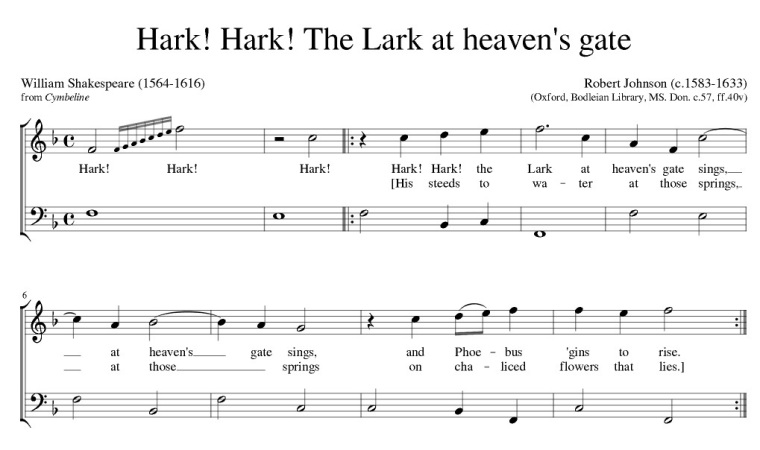
At heaven’s gate

Hark! hark! the lark, Cloten’s song in Shakespeare’s play Cymbeline, King of Britain (c1609), act 2, scene 3. Emma Kirkby, soprano; Anthony Rooley, lute.

Hark! hark! the lark at heaven’s gate sings,
And Phoebus ’gins arise,
His steeds to water at those springs
On chalic’d flowers that lies;
And winking Mary-buds begin
To ope their golden eyes;
With everything that pretty is,
My lady sweet, arise:
Arise, arise!

This setting of Hark! hark! the lark survives in a music manuscript owned by the Bodleian Library, University of Oxford (MS Don. c.57, f. 40v), and has been attributed to Robert Johnson (c1583 - 1633). Johnson became lutenist to king James I in 1604 and was closely associated with Shakespeare’s company, to which he provided songs for various plays including The Winter’s Tale (1610) and The Tempest (1611).

Shakespeariana – XXII

Musick to heare

Igor Stravinsky (Igor’ Fëdorovič Stravinskij; 1882 - 1971): Three Songs from William Shakespeare for mezzo-soprano, flute, clarinet and viola (1953). Anna Molnár, mezzo-soprano; Annamária Bán, flute; Csaba Pálfi, clarinet; Péter Tornyai, viola.

  1. Musick to heare (Sonnet 8)

    Musick to heare, why hear’st thou musick sadly?
    Sweets with sweets warre not, ioy delights in ioy:
    Why lou’st thou that which thou receaust not gladly,
    Or else receau’st with pleasure thine annoy?
    If the true concord of well tuned sounds,
    By vnions married, do offend thine eare,
    They do but sweetly chide thee, who confounds
    In singlenesse the parts that thou should’st beare:
    Marke how one string sweet husband to an other,
    Strikes each in each by mutuall ordering;
    Resembling sier, and child, and happy mother,
    Who all in one, one pleasing note do sing:
      Whose speechlesse song being many, seeming one,
      Sings this to thee, thou single wilt proue none.

  2. Full fadom five (Ariel’s song from The Tempest) [3:07]

    Full fadom five thy Father lies,
     Of his bones are Corrall made:
    Those are pearles that were his eies,
     Nothing of him that doth fade,
    But doth suffer a Sea-change
    Into something rich, & strange:
    Sea-Nimphs hourly ring his knell.
      Ding dong ding dong.
    Harke now I heare them; ding dong bell.

  3. Spring (cuckoo’s song from Love’s Labour’s Lost) [4:43]

    When Daisies pied, and Violets blew,
    And Cuckow-buds of yellow hew,
    And Ladie-smockes all silver white,
    Do paint the Medowes with delight,
    The Cuckow then on everie tree
    Mockes married men; for thus sings he,
    Cuckow! Cuckow, Cuckow! O worde of feare,
    Unpleasing to a married eare.

Shakespeariana – XVII

Sing all a green willow – Shakespeare’s cut

Anonimo (sec. XVI-XVII): The Willow Song. Duo Mignarda: Donna Stewart, voce; Ron Andrico, liuto.

The poor soul sat sighing by a sycamore tree,
 Sing willow, willow, willow,
With his hand in his bosom and his head upon his knee,
 O willow, willow, willow shall be my garland.

  Sing all a green willow, willow, willow, willow;
  Aye me, the green willow must be my garland!

He sighed to his singing, and made a great moan:
I am dead to all pleasure, my true love she is gone.

The mute bird sat by him was made tame by his moans,
The true tears fell from him would have melted the stones.

Come all you forsaken and mourn you with me.
Who speaks of a false love, mine’s falser than she.

Let love no more boast her in palace nor bower.
It buds, but it blasteth ere it be a flower.

Though fair and more false, I die with thy wound.
Thou hast lost the truest lover that goes upon the ground.

Let nobody chide her, her scorns I approve.
She was born to be false, and I to die for her love.

Take this for my farewell and latest adieu,
Write this on my tomb, that in love I was true.


Dopo aver ascoltato la versione di Rossini e quella di Verdi, ecco la Canzone del salice « originale », ossia il ballad cantato da Desdemona nella 3a scena dell’atto IV dell’Otello scespiriano, come ci è stato tramandato da un manoscritto conservato nella British Library (Add. 15117, databile intorno al 1615). È una bella canzone triste, nello stile malinconico che era di moda nell’Inghilterra elisabettiana. Nei primi versi è ben descritta una persona af­flitta da profonda malinconia, in una postura non molto dis­si­mile da quella dell’angelo in una celebre incisione di Dürer (Melencolia I, 1514).
Da sottolineare che il comportamento di Desdemona contrav­viene alle consuetudini teatrali dell’epoca: era infatti consi­de­ra­to disdicevole che un personaggio di rango elevato si producesse in esibizioni canore sulla scena. Ma Desdemona è in preda a una forte agitazione, teme per la propria vita e teme ancora di più che Otello possa considerarla infedele: per questo motivo il suo canto — come del resto quello di Ofelia impazzita (Amleto IV:5) — poteva essere tollerato.
Con la Canzone del salice Shakespeare ha trovato il modo più efficace di rappresentare il turbamento di Desdemona, pervasa da presentimenti di morte ma ancora profondamente innamorata di Otello: nell’armonia, il continuo alternarsi di modo minore e maggiore rende musicalmente il contrasto dei suoi sentimenti, mentre nel testo la ripetizione insistita della parola willow (il salice è da sempre simbolo della tristezza d’amore) dà l’idea del suo intimo tormento.

After listening to The Willow Song set to music by Rossini and by Verdi, here is now the « original » version, i.e. the ballad that Desdemona sings in Shakespeare’s Othello (act 4, scene 3): this piece has come down to us through a manuscript which is preserved in the British Library (Add. 15117, datable around 1615). It’s a beautiful sad song, in the melancholy style that was popular in Elizabethan England. The first stanza well describes a person afflicted by a profound melancholy, in a posture not unlike that took by the angel in a Dürer’s famous engraving (Melencolia I, 1514).
It should be noted that Desdemona’s behavior contravenes the theatrical customs of the time: it was in fact considered unbecoming for a high-ranking character to perform singing on stage. But Desdemona is in the throes of a strong agitation, she is in fear for her own life, and fears even more that Othello might believe her unfaithful: for this reason her singing — like that of Ophelia gone mad (Hamlet, act 4, scene 5) — can be tolerated.
With The Willow Song Shakespeare finds the most effective way of representing Desdemona’s turmoil, pervaded by forebodings of death but still deeply in love with Othello: the continuous alternation of minor and major modes musically renders the contrast of her feelings, while the insistent repetition of the word willow (a tree which has always been a symbol of love sadness) illustrates her inner torment.

Shakespeariana – XIV

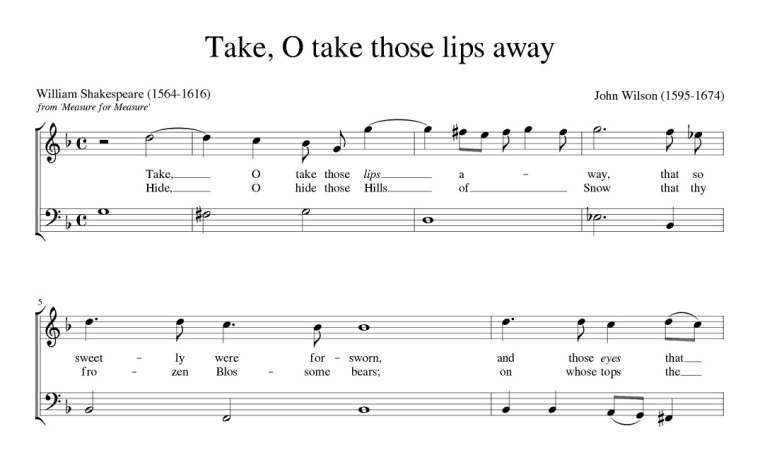
Take those lips away

Take, O take those lips away,
That so sweetly were forsworn;
And those eyes, the break of day,
Lights that do mislead the morn:
But my kisses bring again
Seals of love, though seal’d in vain.

Hide, O hide those hills of snow
That thy frozen bosom bears,
On whose tops the pinks that grow
Are yet of those that April wears,
But first set my poor heart free,
Bound in those icy chains by thee.

La prima strofa si trova nella commedia di Shakespeare Misura per misura (atto IV, scena 1a), rappresentata per la prima volta nel 1604; non sappiamo su quale melodia fosse cantata. Prima e seconda strofa sono nel dramma Rollo Duke of Normandy, or The Bloody Brother, scritto in collaborazione da John Fletcher, Philip Massinger, Ben Jonson e George Chapman in data imprecisabile (comunque non prima del 1612). Non è dato di sapere se la seconda strofe sia un’aggiunta di Fletcher oppure se tanto Shakespeare quanto Fletcher si siano rifatti a una canzone popolare in voga ai loro tempi.
Il testo è stato musicato da diversi autori. Il primo in ordine cronologico fu John Wilson (1595 - 1674), il quale nel 1614 succedette a Robert Johnson quale primo compositore dei King’s Men, la compagnia teatrale cui apparteneva Shakespeare. Ascoltiamo il suo lavoro in… versione shake­speariana (ossia limitata alla sola prima strofa) interpretata da Alfred Deller (voce) e Desmond Dupré (liuto); e poi nella versione integrale cantata dal soprano Anna Dennis, accompagnata da Hanneke van Proosdij al clavicembalo, Elisabeth Reed alla viola da gamba e David Tayler all’arciliuto.

The first stanza is featured in Shakespeare’s play Measure for Measure (act 4, scene 1), first represented in 1604; we do not know to what tune it was sung. Both the stanzas feature in the play Rollo Duke of Normandy, or The Bloody Brother, co-written by John Fletcher, Philip Massinger, Ben Jonson and George Chapman and performed at an unspecified date (though not earlier than 1612). It is not known whether the second stanza is an addition by Fletcher or whether both Shakespeare and Fletcher drew on a popular song in vogue in their time.
These verses have been set to music by various composers. The first in chronological order was John Wilson (1595 - 1674), who in 1614 succeeded Robert Johnson as principal composer for the King’s Men, the theater company to which Shakespeare belonged. Let’s listen to his work in… a Shakespearean version (i.e. the first stanza only) performed by Alfred Deller (voice) and Desmond Dupré (lute); and then in the complete version sung by soprano Anna Dennis, accompanied by Hanneke van Proosdij on harpsichord, Elisabeth Reed on viola da gamba and David Tayler on archlute.


John Weldon (1676 - 1736): Take, O take those lips away per voce e continuo (c1707). Emma Kirkby, soprano; Anthony Rooley, liuto.


Robert Lucas de Pearsall (1795 - 1856), Take, O take those lips away per coro a 5 voci a cappella op. 6 (1830). Cantores Musicæ Antiquæ, dir. Jeffery Kite-Powell.


Mrs H. H. A. Beach (Amy Marcy Cheney Beach, 1867 - 1944): Take, O take those lips away per voce e pianoforte, n. 2 dei Three Shakespeare Songs op. 37 (1897). Virginia Mims, soprano.


Peter Warlock (pseudonimo di Philip Heseltine, 1894 - 1930): Take, O take those lips away per voce e pianoforte (1916-17). Benjamin Luxon, baritono; David Willison, pianoforte.


Roger Quilter (1877 - 1953): Take, O take those lips away per voce e pianoforte, n. 4 dei Five Shakespeare Songs op. 23 (1921). Philippe Sly, basso-baritono; Michael McMahon, pianoforte.


Madeleine Dring (1923 - 1977): Take, O take those lips away per voce e pianoforte (c1950). Michael Hancock-Child, tenore; Ro Hancock-Child, pianoforte.


Emma Lou Diemer (1927): Take, O take those lips away, da Three Madrigals per coro e pianoforte (1960). The Colorado Chorale, dir. Frank Eychaner.

Le cose che piacciono a me

Stephen Hough (1961) esegue una propria rielaborazione al pianoforte del song di Richard Rodgers My Favourite Things, tratto dal musical The Sound of Music (1955).

Il brano di Rodgers è stato reinterpretato moltissime volte da numerosi musicisti, in particolare da John Coltrane: ne parla Sandro Dandria in un suo articolo recente, davvero interessante.

Thatt was my woe

Robert Fayrfax (23 aprile 1464 - 1521): Thatt was my woe a 2 voci a cappella. The Cardinall’s Musick.

Thatt was my woe is nowe my most gladness,
Thatt was my payne is nowe my joyus chaunce;
Thatt was my ffere is nowe my sykyrness;
Thatt was my greffe is nowe my allegeaunce.
Thus hath nowe grace enrychyd my plesaunce,
Wherfor I am and shal be tyll I dye
your trew servaunt with thought, hart and body.

The Protestation & Love’s Constancy

The Protestation: A Sonnet
(Thomas Carew, 1595 - 1640)

No more shall meads be deck’d with flowers,
Nor sweetness dwell in rosy bowers,
Nor greenest buds on branches spring,
Nor warbling birds delight to sing,
Nor April violets paint the grove,
If I forsake [When once I leave] my Celia’s love.

The fish shall in the ocean burn,
And fountains sweet shall bitter turn;
The humble oak no flood shall know,
When floods shall highest hills o’er-flow;
Blacke Lethe shall oblivion leave,
If e’er my Celia I deceive.

Love shall his bow and shaft lay by,
And Venus’ doves want wings to fly;
The sun refuse to show his light,
And day shall then be turn’d to night;
And in that night no star appear,
If once I leave my Celia dear.

Love shall no more inhabit earth,
Nor lovers more shall love for worth,
Nor joy above in heaven dwell,
Nor pain torment poor souls in hell;
Grim death no more shall horrid prove,
If e’er I leave bright Celia’s love.


Love’s Constancy, sul testo di Carew, è fra le composizioni più note di Nicholas Lanier (1588 - 24 febbraio 1666); in rete se ne trovano varie interpretazioni: vi propongo l’ascolto di quelle che mi paiono le più interessanti.

Amanda Sidebottom, soprano, e Erik Ryding, liuto.


Anna Dennis, soprano; Hanneke van Proosdij, clavicembalo; Elisabeth Reed, viola da gamba; David Tayler, chitarra barocca.


La performance del soprano Ellen Hargis accompagnata da Paul O’Dette alla tiorba è accessibile soltanto su YouTube, in quanto il proprietario del video ne ha disattivata la visione in altri siti web. Potete ascoltarla qui.

Anton van Dyck: ritratto di Nicholas Lanier

Anton van Dyck: ritratto di Nicholas Lanier

Dal Diario di Virginia Woolf

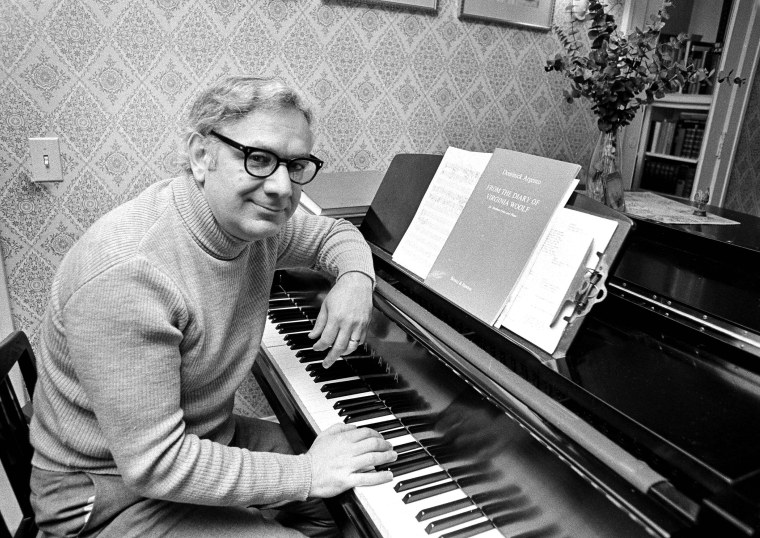
Dominick Argento (1927 - 20 febbraio 2019): From the Diary of Virginia Woolf, ciclo di composizioni per canto e pianoforte (1974). Janet Baker, mezzosoprano, e Martin Isepp, pianoforte (primi interpreti).
I testi sono tratti da A Writer’s Diary: Being Extracts from the Diary of Virginia Woolf, pubblicato nel 1954; il ciclo valse a Dominick Argento il Premio Pulitzer per la musica nel 1975. In merito a questo lavoro del compositore statunitense sono disponibili in rete un’accurata analisi di Noelle Woods e una guida all’interpretazione curata da Jacquelyn Matava.

I. The Diary (April, 1919)

What sort of diary should I like mine to be? Something… so elastic that it will embrace anything, solemn, slight or beautiful that comes into my mind. I should like it to resemble some deep old desk… in which one flings a mass of odds and ends without looking them through. I should like to come back, after a year or two, and find that the collection had sorted itself and refined itself and coalesced, as such deposits so mysteriously do, into a mould, transparent enough to reflect the light of our life…

II. Anxiety (October, 1920) [3:56]

Why is life so tragic; so like a little strip of pavement over an abyss. I look down; I feel giddy; I wonder how I am ever to walk to the end. But why do I feel this: Now that I say it I don’t feel it. The fire burns; we are going to hear the Beggar’s Opera. Only it lies all about me; I can’t keep my eyes shut… And with it all how happy I am—if it weren’t for my feeling that it’s a strip of pavement over an abyss.

III. Fancy (February, 1927) [5:53]

Why not invent a new kind of play; as for instance:
Woman thinks…
He does.
Organ plays.
She writes.
They say:
She sings.
Night speaks
They miss

IV. Hardy’s Funeral (January, 1928) [8:34]

Yesterday we went to Hardy’s funeral. What did I think of? Of Max Beerbohm’s letter… or a lecture… about women’s writing. At intervals some emotion broke in. But I doubt the capacity of the human animal for being dignified in ceremony. One catches a bishop’s frown and twitch; sees his polished shiny nose; suspects the rapt spectacled young priest, gazing at the cross he carries, of being a humbug; …next here is the coffin, an overgrown one; like a stage coffin, covered with a white satin cloth; bearers elderly gentlemen rather red and stiff, holding to the corners; pigeons flying outside, …procession to poets corner; dramatic “In sure and certain hope of immortality” perhaps melodramatic… Over all this broods for me some uneasy sense of change and mortality and how partings are deaths; and then a sense of my own fame… and a sense of the futility of it all.

V. Rome (May, 1935) [15:03]

Rome: tea. Tea in café. Ladies in bright coats and white hats. Music. Look out and see people like movies… Ices. Old man who haunts the Greco… Fierce large jowled old ladies…talking about Monaco (; about) Talleyrand. Some very poor black wispy women. The effect of dowdiness produced by wispy hair. (Rome. Sunday café… Very cold…) The Prime Minister’s letter offering to recommend me for the Companion of Honour. No.

VI. War (June, 1940) [18:19]

This, I thought yesterday, may be my last walk… the war — our waiting while the knives sharpen for the operation — has taken away the outer wall of security. No echo comes back. I have no surroundings… Those familiar circumvolutions — those standards — which have for so many years given back an echo and so thickened my identity are all wide and wild as the desert now. I mean, there is no “autumn”, no winter. We pour to the edge of a precipice… and then? I can’t conceive that there will be a 27th June 1941.

VII. Parents (December, 1940) [24:13]

How beautiful they were, those old people — I mean father and mother — how simple, how clear, how untroubled. I have been dipping into old letters and father’s memoirs. He loved her: oh and was so candid and reasonable and transparent… How serene and gay even, their life reads to me: no mud; no whirlpools. And so human — with the children and the little hum and song of the nursery. But if I read as a contemporary I shall lose my child’s vision and so must stop. Nothing turbulent; nothing involved; no introspection.

VIII. Last Entry (March, 1941) [28:57]

No: I intend no introspection. I mark Henry James’ sentence: observe perpetually. Observe the oncome of age. Observe greed. Observe my own despondency. By that means it becomes serviceable. Or so I hope. I insist on spending this time to the best advantage. I will go down with my colours flying… Occupation is essential. And now with some pleasure I find that it’s seven; and must cook dinner. Haddock and sausage meat. I think it is true that one gains a certain hold on sausage and haddock by writing them down.
[…to come back after a year or two, and find that the collection had sorted itself and refined itself and coalesced, as such deposits so mysteriously do, into a mould transparent enough to reflect the light of our life.]

VW
DA

Songs from Liquid Days

Philip Glass (31 gennaio 1937): Songs from Liquid Days per voci e ensemble strumentale (1985) su testi di Paul Simon, Suzanne Vega, David Byrne e Laurie Anderson. Philip Glass Ensemble, dir. Michael Riesman.

  1. Changing Opinion, testo di Paul Simon. Con Bernard Fowler, voce
  2. Lightning, testo di Suzanne Vega. Con Janice Pendarvis, voce
  3. Freezing, testo di Suzanne Vega. Con The Kronos Quartet; Linda Ronstadt, voce
  4. Liquid Days (Part One), testo di David Byrne. Con The Roches, voci
  5. Open the Kingdom (Liquid Days, Part Two), testo di David Byrne. Con Douglas Perry, voce
  6. Forgetting, testo di Laurie Anderson. Con The Kronos Quartet; Linda Ronstadt e The Roches, voci

I. Changing opinion (Paul Simon)

Gradually
we became aware
of a hum in the room
an electrical hum in the room.
It went mmmmmm

We followed it from
corner to corner.
We pressed out ears
against the walls.
We crossed diagonals
and put our hands on the floor.
It went mmmmmm.

Sometimes it was
a murmur.
Sometimes it was
a pulse.
Sometimes it seemed
to disappear.
But then with a quarter-turn
of the head.
it would roll around the sofa.
A nimbus humming cloud
mmmmmm

Maybe it’s the hum
of a calm refrigerator
cooling on a big night.
Maybe it’s the hum
of our parents’ voices
long ago in a soft light
mmmmmm.
Maybe it’s the hum
of changing opinion
or a foreign language
in prayer.
Maybe it’s the mantra
of the walls and wiring.
Deep breathing
in soft air
mmmmmm

II. Lightning (Suzanne Vega)

Lightning struck a while ago
And it’s blazing much too fast
But give it rain of waiting time
And it will surely pass
Blow over
And it’s happening so quickly
As I feel the flaming time
And I grope about the embers
To relieve my stormy mind
Blow over

Shaken this has left me
And laughing and undone
With a blinding bolt of sleeplessness
That’s just begun
And a windy crazy running
Through the nights and through the days
And a crackling
Of the time burned away
Burned away

Now I feel it in my blood
All hot and sharp and white
With a whipcrack and a thunder
And a flash of flooding light
But there’ll be a thick and smoky
Silence in the air
When the fire finally dies
And I’m wondering who’ll be left there.

In the ashes of time
Burned away
Burned away

III. Freezing (Suzanne Vega)

If you had no name
If you had no history
If you have no books
If you had no family

If it were only you
Naked on the grass
Who would you be then?
This is what he asked
And I said I wasn’t really sure
But I would probably be
Cold

And now I’m freezing
Freezing

IV. Liquid Days (Part One) (David Byrne)

Oh Round Desire
Oh Red Delight
The River is Blood
The Time is Spent
Love likes me
Love takes it shoes off and sits on the couch
Love has an answer for everything
Love smiles gently…and crosses its legs well here we are well here we are

Sleep
Sleep

Sleep…Being in Air
Sleep…Turning to speak
Sleep…Losing our Way
Sleep…Pour it all Out

We are old Friends
I offer Love a Beer
Love watches Television
Love needs a bath
Love could use a shave
Love rolls out of the chair and wiggles on the floor
Jumps Up
I’m Laughing at Love
Drink Me
Drink Me
Drink Me
Drink Me

Drive…Why do You Ask?
Breaths…Still is the Night
Drive…It is much Further
Sleep…Than We Thought

In Liquid Days
Land Travel(s) Hard
Fly Home Daughter
Cover Your Ears

V. Open the Kingdom (Liquid Days, Part Two) (David Byrne)

Days of fishes
Distant roar
Turning to speak
Turning to hear

Open the Kingdom
Open the Kingdom
Open the Kingdom
Open the Kingdom…

In my way
In my way
Being most uncertain
And This Remains

Still for better
Birds of Voices
The Field of Living

I am Asking

I am Asking

I am Asking

Returning Love
Returning With Love
Then it was
Written with Love

VI. Forgetting (Laurie Anderson)

A man wakes up to the sound of rain
From a dream about his lovers
Who pass through his room.

They brush lightly by, these lovers.
They pass. Never touching.
These passing lovers move through his room.

The man is awake now
He can’t get to sleep again.
So he repeats these words
Over and over again:
Bravery. Kindness. Clarity.
Honesty. Compassion. Generosity.
Bravery. Honesty. Dignity.
Clarity. Kindness. Compassion.

Sul mare, verso Skye

Michael Tippett (2 gennaio 1905 - 8 gennaio 1998): Over the sea to Skye per coro a cappella (1956). BBC Singers, dir. Stephen Cleobury.

Rielaborazione di una delle più belle melodie scozzesi di ogni tempo, il brano di Tippett si dipana su parte del testo che sir Harold Boulton (1859-1935) adattò alla melodia tradizionale e pubblicò nel 1884 con il titolo The Skye Boat Song; i versi fanno riferimento a un episodio semileggendario della vita di Carlo Edoardo Stuart, risalente a poco più di due mesi dopo la battaglia di Culloden, cioè a fine giugno 1746, quando Bonnie Prince Charlie, accompagnato da Flora MacDonald e altri giacobiti, attraversò in barca il Mar delle Ebridi, da South Uist a Skye.

Speed, bonnie boat, like a bird on the wing,
Onward! the sailors cry;
Carry the lad that’s born to be King
Over the sea to Skye.

Loud the winds howl, loud the waves roar,
Thunderclouds rend the air;
Baffled, our foes stand by the shore,
Follow they will not dare.

Speed, bonnie boat, like a bird on the wing…

Though the waves leap, soft shall ye sleep,
Ocean’s a royal bed.
Rocked in the deep, Flora will keep
Watch by your weary head.

Speed, bonnie boat, like a bird on the wing…

Many’s the lad fought on that day,
Well the Claymore could wield,
When the night came, silently lay
Dead on Culloden’s field.

Speed, bonnie boat, like a bird on the wing…

Burned are their homes, exile and death
Scatter the loyal men;
Yet ere the sword cool in the sheath
Charlie will come again.


The Skye Boat Song viene frequentemente cantato sui versi dedicati al medesimo soggetto da Robert Louis Stevenson (n. 42 della raccolta Songs of Travel, 1892):

Sing me a song of a lad that is gone,
Say, could that lad be I?
Merry of soul he sailed on a day
Over the sea to Skye.

Mull was astern, Rùm on the port,
Eigg on the starboard bow;
Glory of youth glowed in his soul;
Where is that glory now?

Sing me a song of a lad that is gone…

Give me again all that was there,
Give me the sun that shone!
Give me the eyes, give me the soul,
Give me the lad that’s gone!

Sing me a song of a lad that is gone…

Billow and breeze, islands and seas,
Mountains of rain and sun,
All that was good, all that was fair,
All that was me is gone.

Sing me a song of a lad that is gone…

Con il testo di Stevenson leggermente modificato, in relazione alla storia narrata («a lad» diventa così «a lass»), The Skye Boat Song è parte fondamentale della colonna sonora di una recente serie televisiva di successo. L’elaborazione musicale è di Dominik Hauser, la voce di Kathryn Jones.


Fra le interpretazioni esclusivamente strumentali, la più nota è certo quella di sir James Galway accompagnato da The Chieftains.

Bonnie Prince Charlie
Carlo Edoardo Stuart ritratto da Allan Ramsay (1745)