
Thomas Augustine Arne (12 marzo 1710 - 1778): Concerto per organo e strumenti n. 4 in si bemolle maggiore (1751). Jean Guillou, organo; Radio-Symphonie-Orchester Berlin, dir. René Klopfenstein.
- Con spirito
- Minuetto
- Giga: Moderato

Thomas Augustine Arne (12 marzo 1710 - 1778): Concerto per organo e strumenti n. 4 in si bemolle maggiore (1751). Jean Guillou, organo; Radio-Symphonie-Orchester Berlin, dir. René Klopfenstein.
Thomas Augustine Arne (12 marzo 1710 - 1778): The Morning, cantata (1755). Anastasia Terranova, soprano; Emile ter Schegget, flauto dolce; Schola Cantorum Basiliensis.
The glittering sun begins to rise
On yonder hill, and paints the skies.
The lark his warbling matin sings,
Each flower in all its beauty springs.
The village up, the shepherd tries
His pipe, and to the woodland hies.
Oh! that on th¹enamelled green
My Delia, lovely maide, were seen,
Fresher than the roses bloom,
Sweeter than the mead¹s perfume.
Go, gentle gales, and bear my sighs away,
To Delia¹s ear the tender notes convey.
As some lonely turtle his lost love deplores,
And with shrill echoes fills the sounding shores.
So I like him, abandoned and forlorn,
With ceaseless plaints my absent Delia mourn.
Go, gentle gales, and bear my sighs along;
The birds shall cease to tune their evening song,
The winds to blow, the waving woods to move,
And streams to murmer e¹er I cease to love.
Not bubbling fountains to the thirsty swain,
Nor balmy sleep to labourers spent with pain,
Nor showers to larks, nor sunshine to the bee,
Are half so pleasing as thy sight to me.

Tu-whit
Thomas Augustine Arne (1710 - 1778): When icicles hang by the wall, song of winter from Shakespeare’s play Love’s Labour’s Lost, act 5, scene 2. Julia Gooding, soprano; ensemble Passacaglia.
When icicles hang by the wall
And Dick the shepherd blows his nail
And Tom bears logs into the hall
And milk comes frozen home in pail,
When blood is nipp’d and ways be foul,
Then nightly sings the staring owl,
Tu-whit;
Tu-who, a merry note,
While greasy Joan doth keel the pot.
When all aloud the wind doth blow
And coughing drowns the parson’s saw
And birds sit brooding in the snow
And Marian’s nose looks red and raw,
When roasted crabs hiss in the bowl,
Then nightly sings the staring owl,
Tu-whit;
Tu-who, a merry note,
While greasy Joan doth keel the pot.

Many sighs about nothing
Thomas Augustine Arne (1710 - 1778): Sigh no more, ladies, dalle musiche di scena (1748) per Much ado about nothing di W. Shakespeare (atto II, scena 3a).
– Versione per voce solista e orchestra d’archi: Alexander Young, tenore; Martin Isepp, clavicembalo; Wiener Rundfunkorchester, dir. Brian Priestman.
– Versione per 3 voci virili (TTB) a cappella: The Hilliard Ensemble.
Sigh no more, ladies, sigh no more.
Men were deceivers ever,
One foot in sea, and one on shore,
To one thing constant never.
Then sigh not so, but let them go,
And be you blithe and merry,
Converting all your sounds of woe
Into hey down derry.
Sing no more ditties, sing no more
Of dumps so dull and heavy.
The fraud of men was ever so
Since summer first was leavy.
Then sigh not so, but let them go,
And be you blithe and merry,
Converting all your sounds of woe
Into hey down derry.
Thomas Augustine Arne (12 marzo 1710 - 1778): Concerto per clavicembalo e orchestra n. 5 in sol minore. Trevor Pinnock, clavicembalo e direzione; The English Concert.
Quando, per pura curiosità, ho cercato “home sweet home” nel web, sono rimasto alquanto sorpreso: nei primi 150 risultati della ricerca eseguita tramite Google, non compare nemmeno una volta il nome di Henry Bishop.
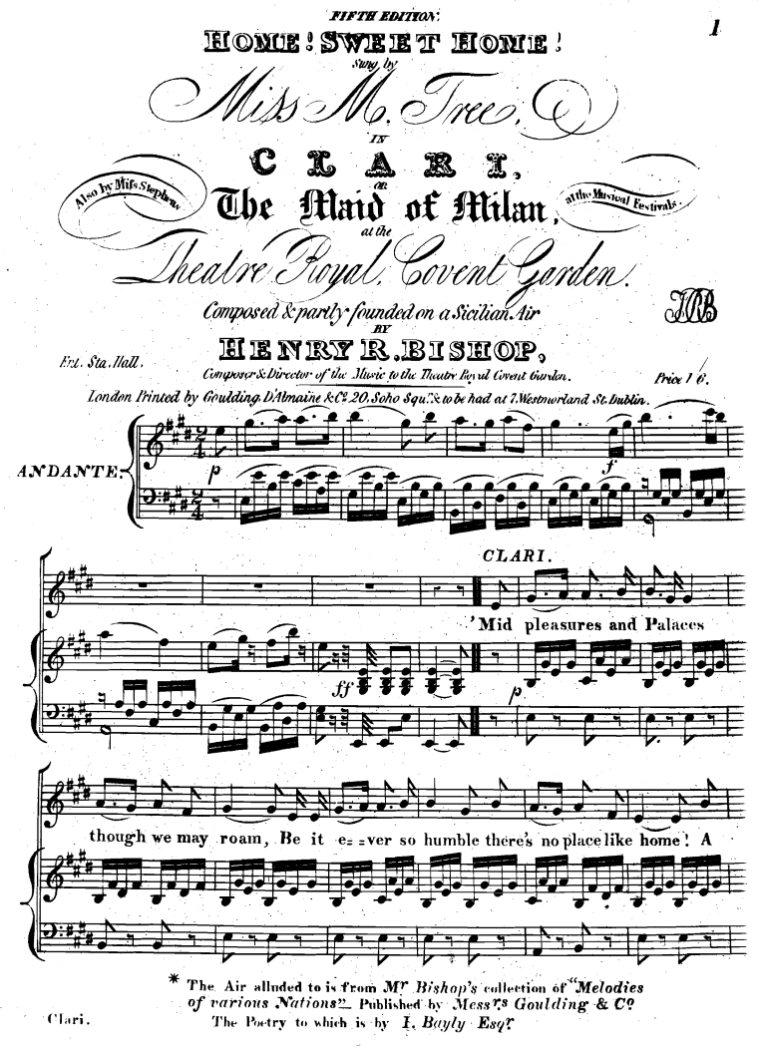
“Musicista?” chiederete voi. Certo: sir Henry Rowley Bishop (18 novembre 1786 - 1855) scrisse un gran numero di cantate, balletti e opere liriche; fra queste ultime si annovera Clari, or The Maid of Milan (1823), composta su libretto dello statunitense John Howard Payne: fa parte dell’opera l’aria «Mid pleasures and palaces» nota, per via del refrain, appunto con il titolo Home! Sweet Home! Qui potete ascoltarla nell’interpretazione del soprano Greta Bradman accompagnata dall’arpista Suzanne Handel:
Mid pleasures and palaces though we may roam,
Be it ever so humble, there’s no place like home;
A charm from the skies seems to hallow us there,
Which seek thro’ the world, is ne’er met elsewhere.
Home! Home!
Sweet, sweet home!
There’s no place like home,
There’s no place like home!
An exile from home splendor dazzles in vain.
Oh, give me my lowly thatched cottage again,
The birds singing gaily that came at my call
And gave me the peace of mind, dearer than all.
Home! Home!
Sweet, sweet home!
There’s no place like home,
there’s no place like home!
Home! Sweet Home! venne pubblicato come brano a sé stante, in un primo tempo con la dicitura «composed and partly founded on a Sicilian Air» (in seguito Bishop ammise di aver inventato questo particolare a scopo promozionale). Divenne subito incredibilmente popolare: in breve tempo ne furono vendute oltre centomila copie. Nel 1852, curata dall’autore, ne uscì una nuova edizione a stampa come parlour ballad (cioè, in sostanza, una romanza da camera), e in questa veste ottenne ampio successo anche negli Stati Uniti: difatti, ancora oggi è spesso presente nelle antologie di musiche risalenti agli anni della guerra di secessione (1861-1865).
La vasta popolarità di cui Home! Sweet Home! godette nel corso dell’Ottocento è testimoniata dal fatto che la sua melodia è citata in varie composizioni dell’epoca. Già nel 1827 venne utilizzata dallo svedese Franz Berwald (1796 - 1868) nella sezione mediana, Andante con variazioni, del suo Konzertstück per fagotto e orchestra op. 2 — qui interpretato da Patrik Håkansson con l’Orchestra sinfonica di Gävle diretta da Petri Sakari:
[l’Andante con variazioni ha inizio a 5:43]
Altra citazione celebre si trova all’inizio della «scena della pazzia» (aria «Cielo, a’ miei lunghi spasimi», atto II, scena 3ª) nella tragedia lirica Anna Bolena, rappresentata nel 1830, di Donizetti (1797 - 1848) — ascoltate Maria Callas:
Risale al 1855 circa l’opus 72 di Sigismond Thalberg (1812 - 1871), Home! Sweet Home! Air Anglais varié per pianoforte; nel video qui sotto è eseguito da Dennis Hennig:
Un’altra breve serie di variazioni, per cornetta a pistoni sola, si deve a Jean-Baptiste Arban (1825 – 1889); per ascoltarla (o riascoltarla) — potete farlo leggendo (o rileggendo) allo stesso tempo uno spassoso racconto di Jerome K. Jerome — cliccate qui.
Voglio menzionare ancora, per finire, la Fantaisie sur deux mélodies anglaises per organo op. 43 di Alexandre Guilmant (1837 - 1911): in questa composizione, del 1887 circa, Home! Sweet Home! è associato a un altro famosissimo brano inglese, Rule, Britannia! di Thomas Arne (1710 - 1778). Ecco la Fantaisie di Guilmant eseguita da Bernhard Schneider all’organo Klais della Chiesa di Sankt Aegidien in Braunschweig:

 la regina gioiosa