
Al’fred Šnitke (Alfred Schnittke; 24 novembre 1934 - 1998): Sinfonia n. 0 (1956-57). Cape Philharmonic Orchestra, dir. Owain Arwel Hughes.
- Allegro ma non troppo
- Scherzo: Allegro vivace [13:04]
- Andante [20:17]
- Allegro [30:49]

Al’fred Šnitke (Alfred Schnittke; 24 novembre 1934 - 1998): Sinfonia n. 0 (1956-57). Cape Philharmonic Orchestra, dir. Owain Arwel Hughes.
Dame Elizabeth Violet Maconchy Le Fanu (1907 - 11 novembre 1994): Sinfonia per doppia orchestra d’archi (1953). London Symphony Orchestra, dir. Vernon Handley.
Charles Ives (20 ottobre 1874 - 1954): Sinfonia n. 4 (c1912-c1925). BBC Symphony Orchestra, dir. David Robertson.

Charles Ives (20 ottobre 1874 - 1954): Seconda Sinfonia (1902, rev. 1910). Concertgebouworkest, dir. Michael Tilson Thomas.
Adoro questo americanissimo pasticcio (nel senso nobile, gastronomico e musicale, del termine) e la spernacchiante dissonanza che vi pone termine 

Hakon Børresen (1876 - 6 ottobre 1954): Sinfonia n. 2 in la maggiore op. 7, Havet (Il mare; 1904). Hr-Sinfonieorchester, dir. Ole Schmidt.

Michael Ancher (1849 – 1927): ritratto di Hakon Børresen (1910)
Georges Onslow (1784 - 3 ottobre 1853): Sinfonia n. 1 in la maggiore op. 41 (c1830). Sinfonieorchester des Norddeutschen Rundfunks, dir. Johannes Goritzki.

Gija Kančeli (1935 - 2 ottobre 2019): Quarta Sinfonia In memoria di Michelangelo (1975). Orchestra nazionale della Georgia, dir. Džansug Kakhidze.
Christopher Rouse (1949 - 21 settembre 2019): Sinfonia n. 2 (1994). Houston Symphony Orchestra, dir. Christoph Eschenbach.

Allan Pettersson (19 settembre 1911 - 1980): Sinfonia n. 8 (1968-69). Norrköpings Symfoniorkester, dir. Leif Segerstam.
Parte 1ª
Parte 2ª [19:41]
 Kunihiko Hashimoto (14 settembre 1904 - 1949): Sinfonia n. 1 in re maggiore (1940). Orchestra sinfonica metropolitana di Tōkyō, dir. Ryusuke Numajiri.
Arnold Schoenberg (13 settembre 1874 - 1951): Kammersymphonie n. 2 op. 38 (abbozzata nel 1906, completata nel 1939). Sinfonieorchester des Saarländischen Rundfunks, dir. Bruno Maderna (in concerto: Saarbrücken, 30 giugno 1969).

Franz Xaver Richter (1709 - 12 settembre 1789): Sinfonia con Fuga in sol minore VB 29. Czech Ensemble Baroque, dir. Roman Válek.

Henry Hadley (1871 - 6 settembre 1937): Seconda Sinfonia in fa minore op. 30, The Four Seasons (1899). Royal Philharmonic Orchestra, dir. Karl Krueger.

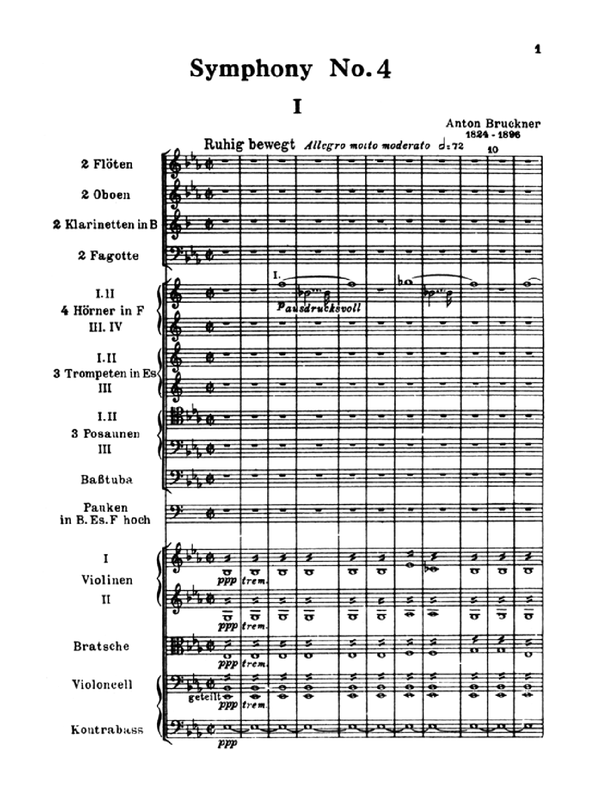
Anton Bruckner (1824 - 1896): Sinfonia n. 4 in mi bemolle maggiore, Romantische (1874, varie revisioni 1878-88). Wiener Philharmoniker, dir. Claudio Abbado.
Nikolaj Andreevič Roslavec (1880 - 23 agosto 1944): Sinfonia da camera n. 1 (1926). Orchestra da camera del Teatro Bol’šoj, dir. Aleksandr Lazarev.

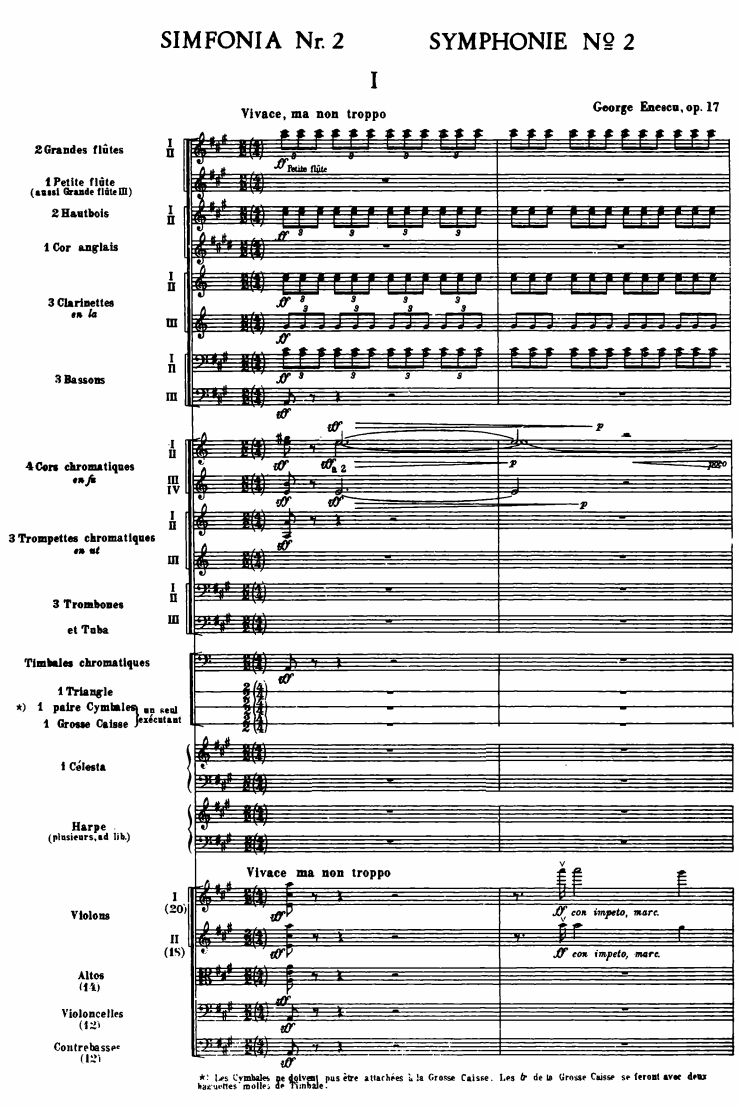
George Enescu (19 agosto 1881 - 1955): Sinfonia n. 2 in la maggiore op. 17 (1914). Tampere Filharmonia, dir. Hannu Lintu.
William Schuman (4 agosto 1910 - 1992): Sinfonia n. 3 (1941). New York Philharmonic Orchestra, dir. Leonard Bernstein.

 Tadeusz Baird (26 luglio 1928 - 1981): Sinfonia n. 3 (1969). Orkiestra Filharmonii Narodowej w Warszawie (Orchestra filarmonica nazionale di Varsavia), dir. Jan Krenz.
Leopold Antonín Koželuh (26 giugno 1747 - 1818): Sinfonia in sol minore op. 22 n. 3, P I:5 (c1787).London Mozart Players, dir. Matthias Bamert.

Théodore Dubois (1837 - 11 giugno 1924): Symphonie française in fa minore (1908). Orchestra Les Siècles, dir. François-Xavier Roth.

Ann Millikan (10 giugno 1963): Millikan Symphony per orchestra (2015), dedicata alla memoria di Bob Millikan (1957-2012), fratello della compositrice. Jennifer Curtis, violino solista (nel IV movimento); Boston Modern Orchestra Project, dir. Gil Rose.
Mikuláš Schneider-Trnavský (24 maggio 1881 - 28 maggio 1958): Sinfonia n. 1 in mi minore, Spomienková (1956). Symfonický orchester Slovenského rozhlasu v Bratislave (Orchestra sinfonica della Radio slovacca a Bratislava), dir. Ondrej Lenárd.

 Georg Schumann (1866 - 23 maggio 1952): Sinfonia in si minore (1887). Münchner Rundfunkorchester, dir. Christoph Gedschold.
Alice Mary Smith (19 maggio 1839 - 1884): Sinfonia n. 1 in do minore (1863). London Mozart Players, dir. Howard Shelley.

Johannes Matthias Sperger (1750 - 13 maggio 1812): Sinfonia per archi in do maggiore (1782). Musica Aeterna Bratislava, dir. Peter Zajíček.

Georg Joseph Vogler (1749 - 6 maggio 1814): Sinfonia in re minore (1782). London Mozart Players, dir. Matthias Bamert.

Michael Daugherty (28 aprile 1954): Metropolis Symphony (1988–93). Nashville Symphony Orchestra, dir. Giancarlo Guerrero.
I began composing my Metropolis Symphony in 1988, inspired by the celebration in Cleveland of the fiftieth anniversary of Superman’s first appearance in the comics. When I completed the score in 1993, I dedicated it to the conductor David Zinman, who had encouraged me to compose the work, and to the Baltimore Symphony Orchestra. The Metropolis Symphony evokes an American mythology that I discovered as an avid reader of comic books in the fifties and sixties. Each movement of the symphony — which may be performed separately — is a musical response to the myth of Superman. I have used Superman as a compositional metaphor in order to create an independent musical world that appeals to the imagination. The symphony is a rigorously structured, non-programmatic work, expressing the energies, ambiguities, paradoxes, and wit of American popular culture. Like Charles Ives, whose music recalls small-town America early in our century, I draw on my eclectic musical background to reflect on late-twentieth-century urban America. Through complex orchestration, timbral exploration, and rhythmic polyphony, I combine the idioms of jazz, rock, and funk with symphonic and avant-garde composition.
I. Lex
« Lex » derives its title from one of Superman’s most vexing foes, the supervillain and business tycoon Lex Luthor. Marked “Diabolical” in the score, this movement features a virtuoso violin soloist (Lex) who plays a fiendishly difficult fast triplet motive in perpetual motion, pursued by the orchestration and a percussion section that includes four referee whistles placed quadraphonically on stage.
II. Krypton
« Krypton » refers to the exploding planet from which the infant Superman escaped. A dark, microtonal soundworld is created by glissandi in the strings, trombone, and siren. Two percussionists play antiphonal fire bells throughout the movement, as it evolves from a recurring solo motive in the cellos into ominous calls from the brass section. Gradually the movement builds toward an apocalyptic conclusion.
III. Mxyzptlk
« Mxyzptlk » is named after a mischievous imp from the fifth dimension who regularly wreaks havoc on Metropolis. This brightly orchestrated movement is the scherzo of the symphony, emphasizing the upper register of the orchestra. It features two dueling flute soloists who are positioned stereophonically on either side of the conductor. Rapidly descending and ascending flute runs are echoed throughout the orchestra, while open-stringed pizzicato patterns, moving strobe-like throughout the orchestra, are precisely choreographed to create a spatial effect.
IV. Oh, Lois!
« Oh, Lois! » invokes Lois Lane, news reporter at the Daily Planet alongside Clark Kent (alias Superman). Marked with the tempo “faster than a speeding bullet,” this five-minute concerto for the orchestra uses flexatone and whip to provide a lively polyrhythmic counterpoint that suggests a cartoon history of mishaps, screams, dialogue, crashes, and disasters, all in rapid motion.
V. Red Cape Tango
« Red Cape Tango » was composed after Superman’s fight to the death with Doomsday, and is my final musical work based on the Superman mythology. The principal melody, first heard in the bassoon, is derived from the medieval Latin death chant “Dies irae.” This dance of death is conceived as a tango, presented at times like a concertino comprising string quintet, brass trio, bassoon, chimes, and castanets. The tango rhythm, introduced by the castanets and heard later in the finger cymbals, undergoes a gradual timbral transformation, concluding dramatically with crash cymbals, brake drum, and timpani. The orchestra alternates between legato and staccato sections to suggest a musical bullfight.
Michael Daugherty

Jean-Féry Rebel (18 aprile 1666 - 1747): Les Élémens, «simphonie nouvelle» (1737). Le Concert des Nations, dir. Jordi Savall.
Ispirata dall’omonimo balletto di Michel-Richard Delalande e André-Cardinal Destouches, che Rebel aveva diretto alle Tuileries di Parigi il 3 dicembre 1721, fu eseguita la prima volta come azione coreografica — interpreti, fra gli altri, Françoise Prévost (futura consuocera di Rebel), Marie Sallé, David Dumoulin e Louis Dupré — dopo una rappresentazione della tragédie en musique di Lully Cadmus et Hermione (1673).
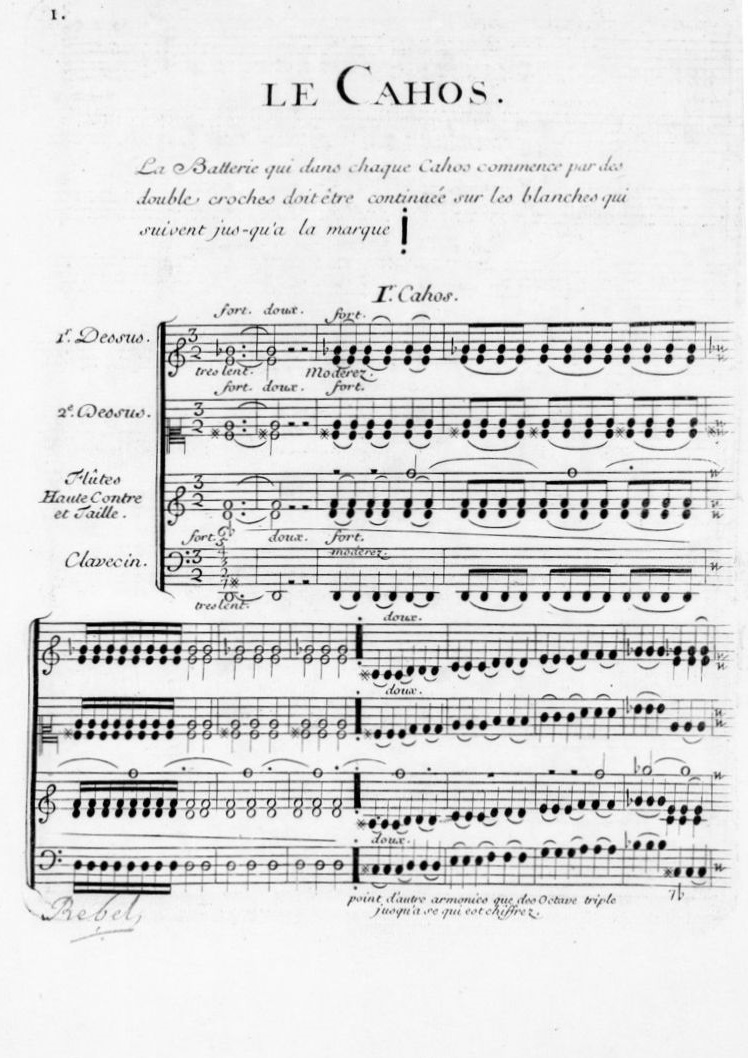
È una sinfonia a programma ante litteram. La parte introduttiva, intitolata Le cahos, descrive musicalmente il caos degli elementi naturali (acqua, aria, terra, fuoco) prima che essi trovassero ciascuno il proprio posto nell’ordine cosmico. L’identificazione tra caos primordiale e caos armonico (illustrata da Rebel nell’Avertissement anteposto alla partitura nella 1a edizione) fa sì che nelle prime sette battute gli strumenti eseguano simultaneamente tutti i suoni della scala: la dissonanza risolve nell’accordo perfetto coincidente con il momento in cui gli elementi, dopo l’iniziale resistenza, docilmente si conformano all’ordine cosmico. Seguono sette parti che corrispondono ai sette stadi del processo di separazione degli elementi, ognuno dei quali è rappresentato musicalmente da una sezione dell’orchestra (il basso simboleggia l’immobilità della terra, i flauti la fluidità dell’acqua e la leggerezza dell’aria, gli archi l’irrequietezza del fuoco) ed è caratterizzato da un proprio tema musicale.
Franz Berwald (1796 - 3 aprile 1868): Sinfonia n. 2 re maggiore, Sinfonie capricieuse (1842). Helsingborgs Symfoniorkester, dir. Okko Kamu.

 Els Aarne (nome d’arte di Else Paëmuru; 30 marzo 1917 - 1995): Seconda Sinfonia (1966). Eesti Riiklik Sümfooniaorkester, dir. Neeme Järvi.
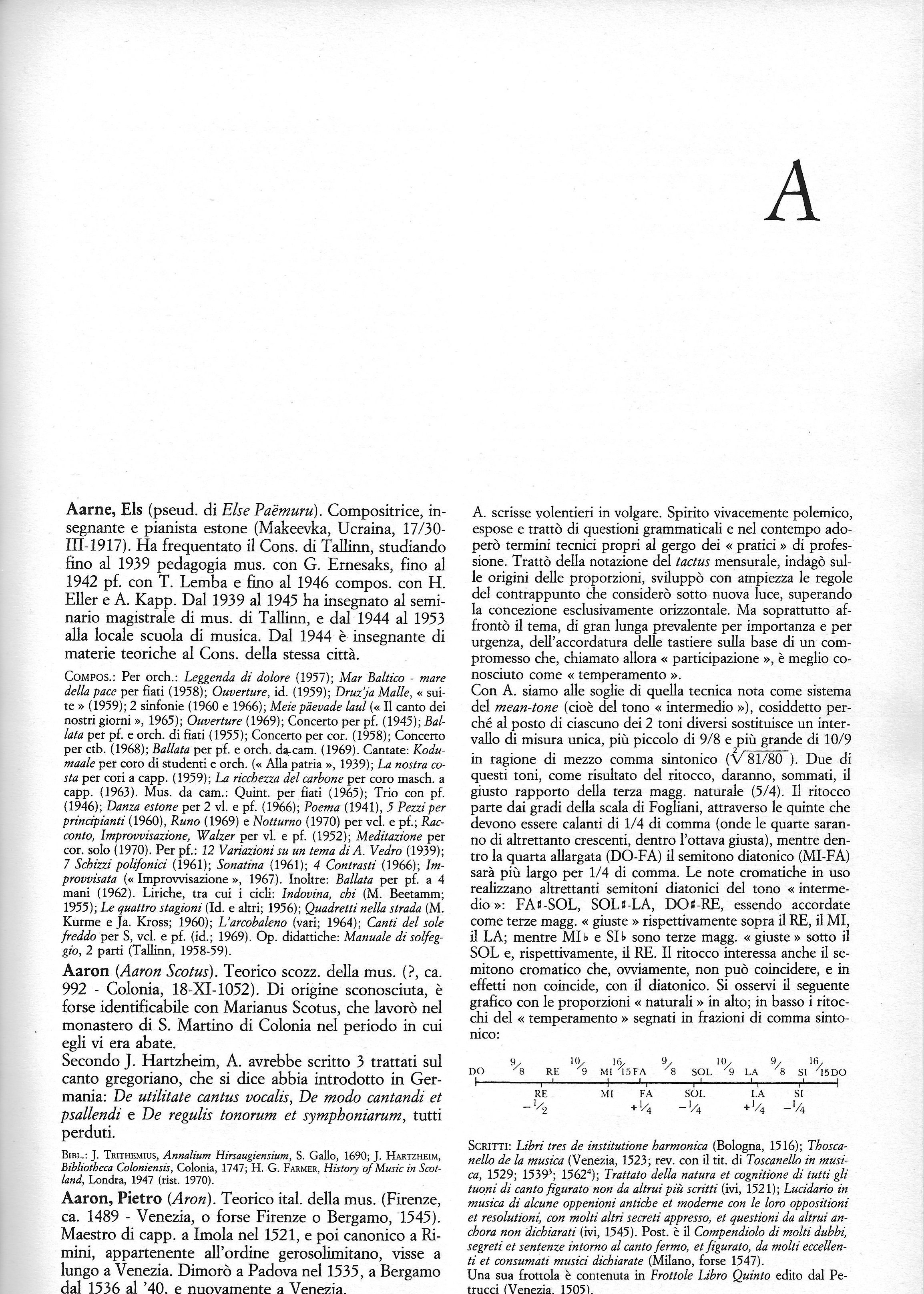
La prima «voce» del Dizionario di musica della Utet (Deumm), sezione Biografie (l’anno di pubblicazione è il 1985), è dedicata a Els Aarne.

 la regina gioiosa