Noël alsaziano

Anonimo (tradizionale): Dors, ma colombe, noël. La Maîtrise de Dijon.

Dors, ma colombe,
dors, le soir tombe,
chante la vierge à l’enfant Dieu.
Dors: moi, je veille.
Quand on sommeille
on voit s’ouvrir le grand ciel bleu.
  Chantez, beaux anges,
  bercez l’enfant
  qui, dans ses langes,
  rit en rêvant.

Dors, il fait sombre
à travers l’ombre,
Souffle un grand vent qui meut le toit.
Dors tout de même,
Jésus que j’aime:
L’âne et le boeuf sont près de toi.
  Chantez, beaux anges,
  bercez l’enfant
  qui, dans ses langes,
  rit en rêvant.


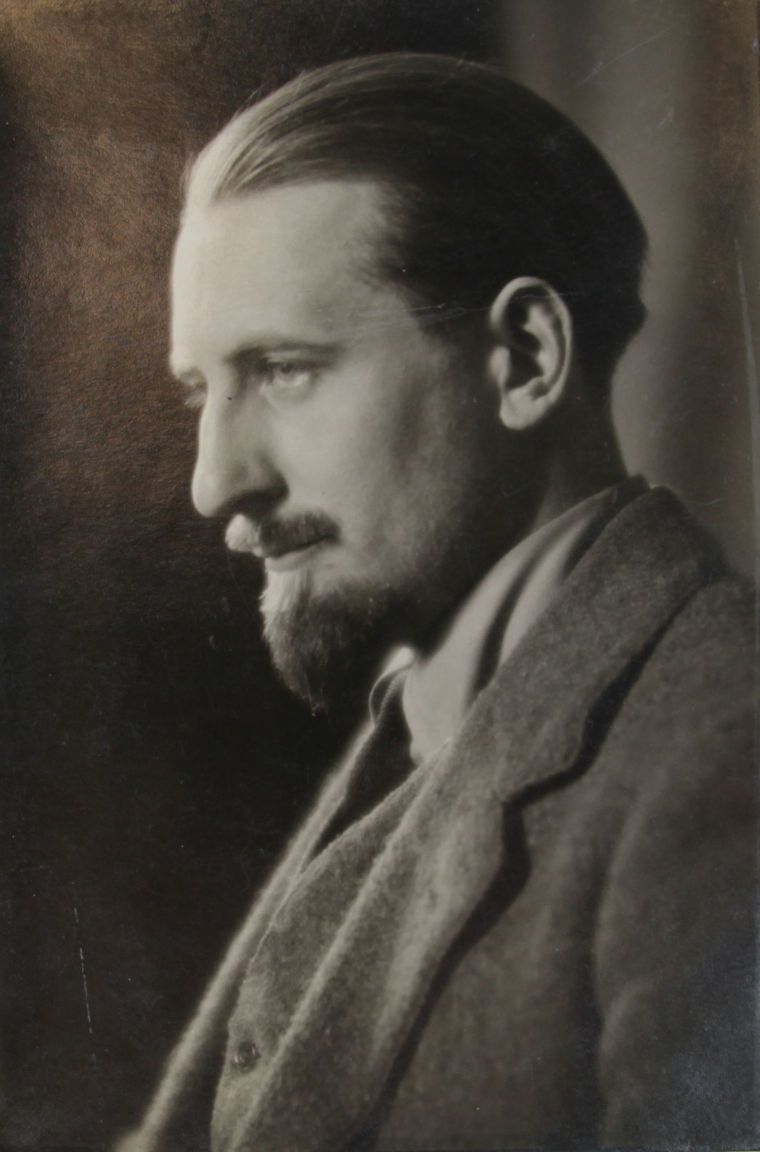
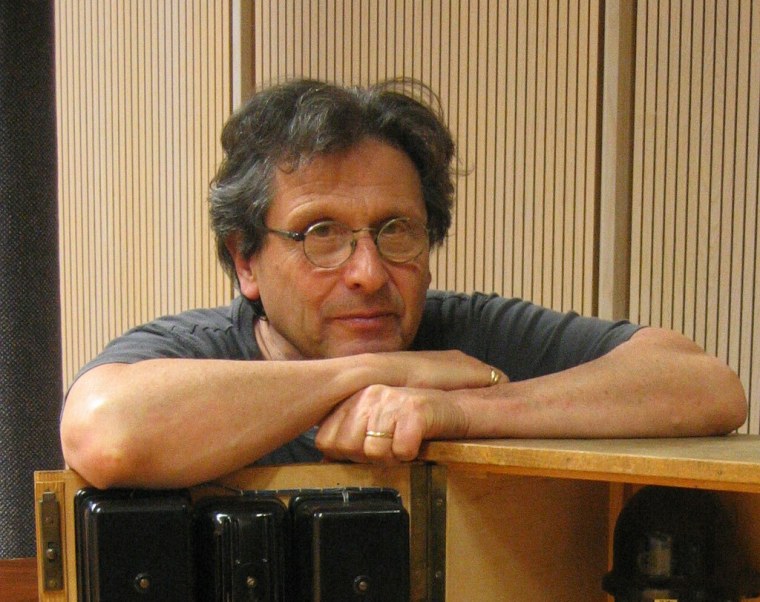
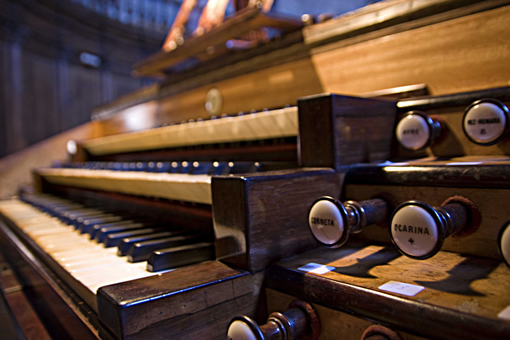
Pietro Cattaneo (1998): Variations sur un noël alsacien per organo (2018). Carson Cooman.
Laetentur YouTubers. Buon Natale!

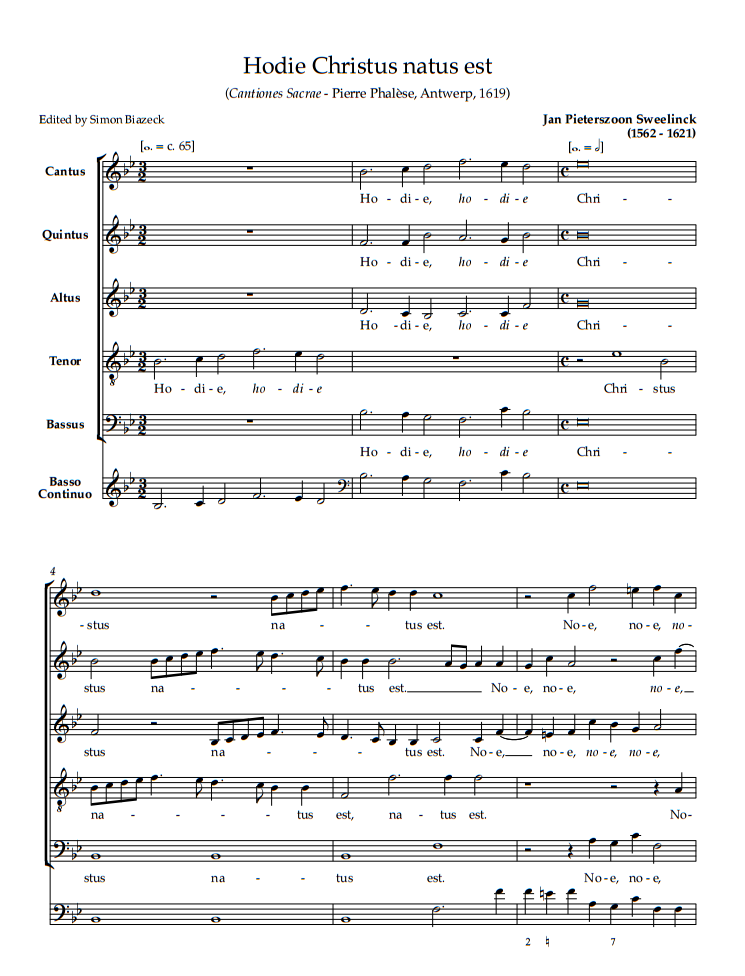
Jan Pieterszoon Sweelinck (1562 - 1621): Hodie Christus natus est, mottetto a 5 voci (dalla raccolta di Cantiones sacrae del 1619). L’esegue un ensemble virtuale formato da cinque cantanti, titolari di altrettanti canali di YouTube: Wei Jiang, soprano I; Julie Gaulke, soprano II; Simone Lo Castro, contralto; Stefan Wyatt, tenore; Patrick Williams, basso.

Hodie Christus natus est
hodie Salvator apparuit:
hodie in terra canunt Angeli,
laetantur Archangeli:
hodie exsultant justi, dicentes:
Gloria in excelsis Deo, alleluja.

Sweelinck - Hodie Christus natus est

Praeter rerum seriem

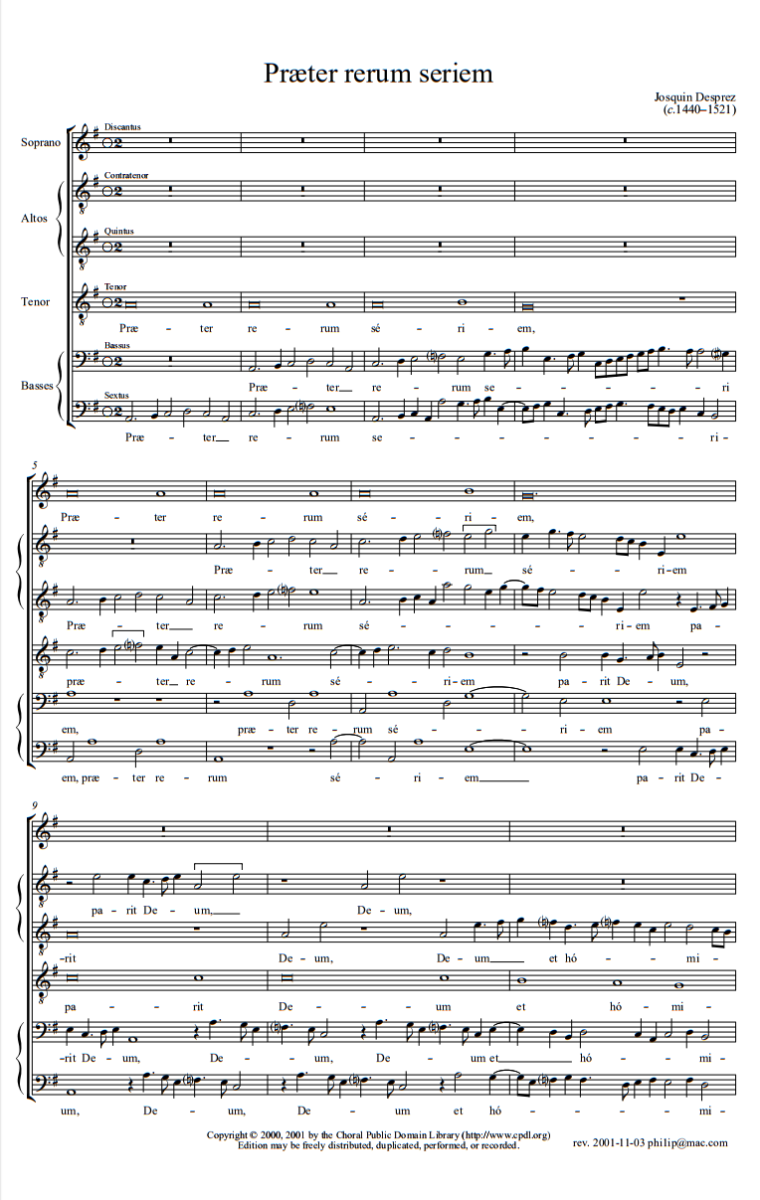
Josquin des Prez (c1450 - 1521): Praeter rerum seriem, mottetto a 6 voci (pubblicato in Motetti de la corona, Libro III, 1519). Lumina Ensemble, dir. Anna Pope.

Præter rerum seriem
parit Deum hominem
virgo mater.
Nec vir tangit virginem
nec prolis originem
novit pater.

Virtus Sancti Spiritus
opus illud cœlitus
operatur.
Initus et exitus
partus tui penitus
quis scrutatur?

Dei providentia
quæ disponit omnia
tam suave.
Tua puerperia
transfer in mysteria.
Mater ave.

Josquin, Praeter rerum seriem


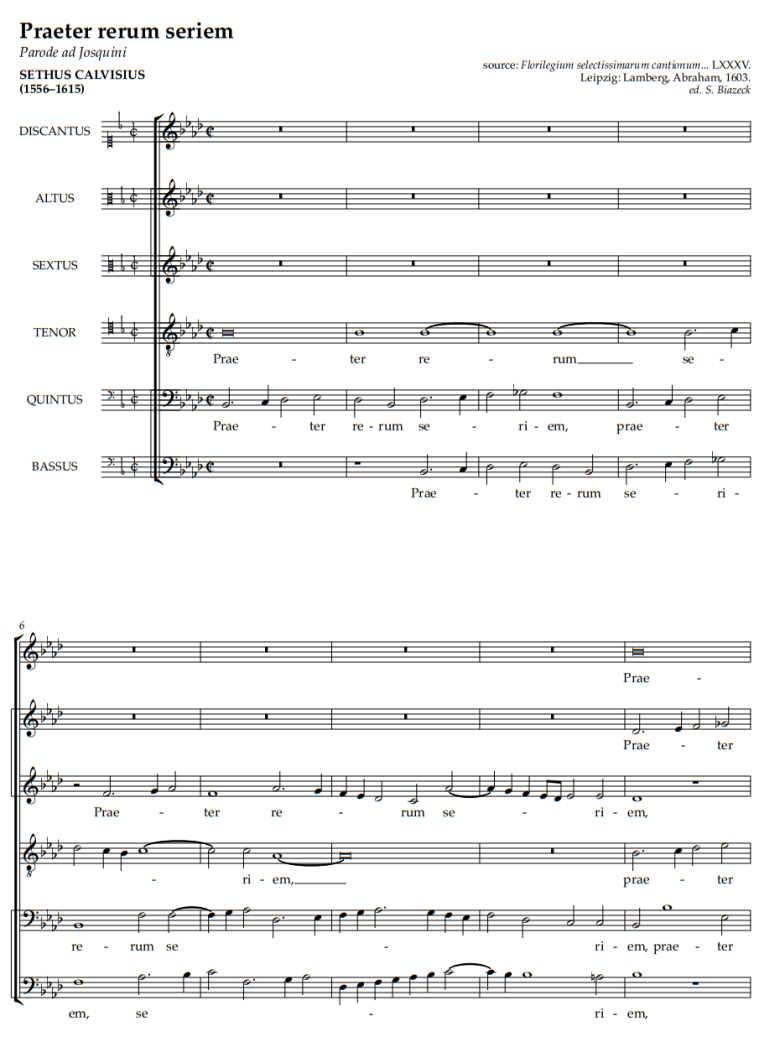
Sethus Calvisius (Seth Kalwitz; 1556 - 1615): Praeter rerum seriem, mottetto a 6 voci, parode ad Josquini (pubblicato in Florilegium selectissimarum cantionum, 1603, n. 85). Kaleidos Ensemble.

Praeter rerum seriem
Parit Deum et hominem
Virgo mater.
Nec vir tangit virginem,
Nec prolis originem
Novit pater.

Virtus Sancti Spiritus
Opus illud caelitus
Operatur.
Initus et exitus
Partus tui penitus
Quis scrutatur?

Dei providentia
Haec disponit omnia
Tam suave,
Et pios caelestia
Transfert in mysteria.
Puer ave.

Calvisius, Praeter rerum seriem

Andante amoroso

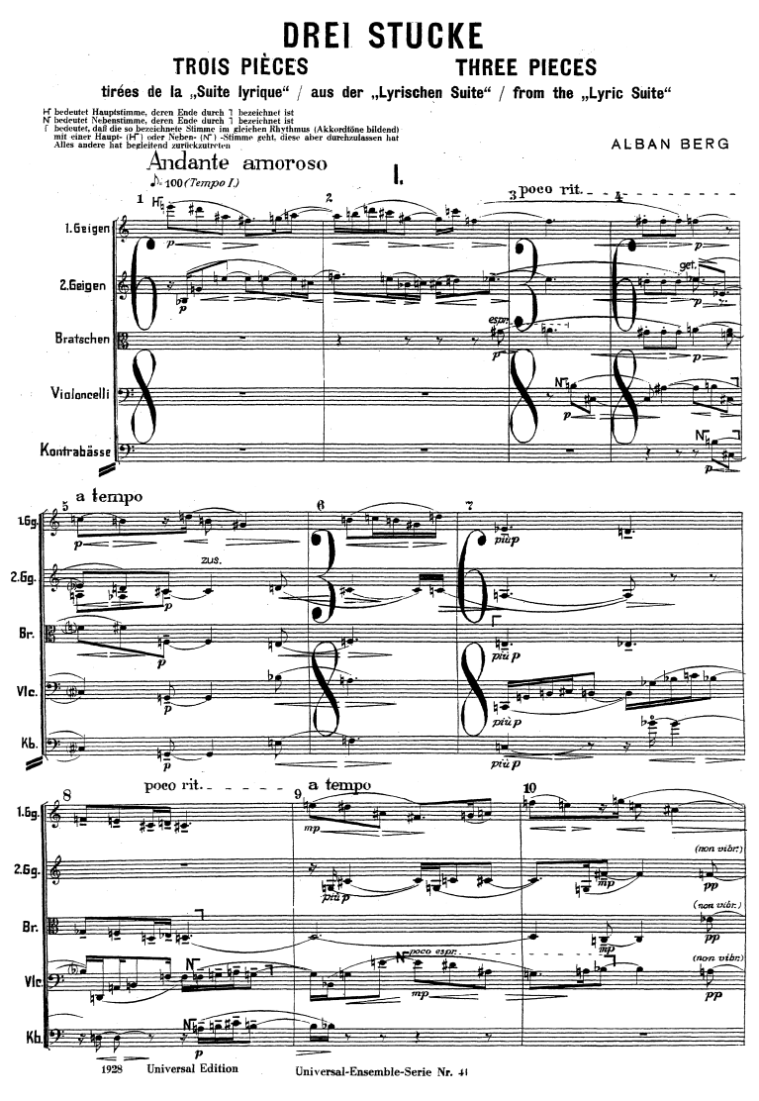
Alban Berg (1885 - 24 dicembre 1935): Tre Pezzi per orchestra d’archi (1928), dalla Lyrische Suite. Orchestre philharmonique de Radio France, dir. Daniel Harding.
La Lyrische Suite risale agli anni 1925-26, è per quartetto d’archi ed è suddivisa in 6 movimenti; di questi, Berg ha adattato per orchestra il II, il III e il IV.

  1. Andante amoroso
  2. Allegro misterioso [6:46] – Trio estatico [8:24] – Tempo I [9:18]
  3. Adagio appassionato [10:32]

In floribus rosarum et liliis convalium

John Dunstable (o Dunstaple; c1390 - 24 dicembre 1453): Speciosa facta es, mottetto a 3 voci. Gothic Voices, dir. Christopher Page.

Speciosa facta es et suavis in delitiis virginitatis
sancta Dei genitrix quam videntes filiae Syon
vernantem in floribus rosarum et liliis convalium.
Beatissimam praedicaverunt et regine laudaverunt eam.

Gran polka nazionale

Michele Novaro (23 dicembre 1818 - 1885): Roma e Venezia, gran polka nazionale in fa maggiore per pianoforte (c1864). Vito Maggiolino.

Questa vivace danza contiene citazioni del Canto degli italiani, composto dallo stesso Novaro sul celebre testo di Mameli, e della Marcia reale d’ordinanza di Giuseppe Gabetti, inno della monarchia sabauda.

With carols and songs


Anonimo (sec. XVI): All Hail to the Days, carol natalizio inglese, noto anche come Drive the Cold Winter Away e In Praise of Christmas. The Baltimore Consort (strumentale); The Sixteen, dir. Harry Christophers.

All hail to the days
  that merit more praise
Than all the rest of the year,
And welcome the nights
  that double delights,
As well for the poor as the peer!
Good fortune attend
  each merry man’s friend,
That doth but the best that he may;
Forgetting old wrongs,
  with carols and songs,
To drive the cold winter away.

This time of the year
  is spent in good cheer,
And neighbours together do meet,
To sit by the fire,
  with friendly desire,
Each other in love do greet;
Old grudges forgot,
  are put in the pot,
All sorrows aside they lay,
The old and the young
  doth carol his song,
To drive the cold winter away.

To mask and to mum
  kind neighbours will come
With wassails of nut-brown ale,
To drink and carouse
  to all in the house,
As merry as bucks in the dale;
Where cake, bread and cheese
  is brought for your fees,
To make you the longer stay;
At the fire to warm
  will do you no harm,
To drive the cold winter away.

Felice inverno a tutti 🙂

Allégrement

André Jolivet (1905 - 20 dicembre 1974): Concerto per strumenti a percussione e orchestra. Masako Iguchi, percussione; San Francisco Conservatory of Music Orchestra, dir. Alasdair Neale.

  1. Robuste
  2. Dolent [5:35]
  3. Rapidamente [11:20]
  4. Allégrement [15:95]

Per Jolivet — che ha una concezione molto beethoveniana della figura del compositore, il quale deve assumersi il compito di fare da vera e propria guida morale — la musica è prima di tutto comunione: fra compositore e natura nel momento della composizione, fra compositore e pubblico nel momento dell’esecuzione. Fare musica è “far leva sul sentimento dell’umano”, dando all’arte musicale “il suo senso originale antico, quando era l’espressione magica e incantatrice della religiosità degli uomini”. Jolivet cerca costantemente, lungo l’intero arco della sua attività creativa, di ampliare il linguaggio musicale, senza però perdere mai i profondi agganci con il “sistema cosmico universale”.

L’arco di Ulisse (Harbison 85)

John Harbison (20 dicembre 1938): Ulysses’ Bow, II atto del balletto Ulysses (1983). Pittsburgh Symphony Orchestra, dir. André Previn.

  1. Prelude: Premonitions
  2. Scene I: Ulysses’ Return
  3. Interlude I: Ulysses and Argos
  4. Scene II: The Suitors
  5. Interlude II: While the Suitors Sleep
  6. Scene III: Penelope – Interlude III: Penelope’s Dream
  7. Scene IV: The Trial of the Bow
  8. Interlude IV: The Ritual of Purification
  9. Scene V: Reunion

Siciliana variata

Francesco Antonio Bonporti (1672 - 19 dicembre 1749): Sere­nata IV in la minore (c1720). Luigi Mangiocavallo, violino; Claudio Ronco, violoncello; Marco Mencoboni, clavi­cembalo.

  1. Larghetto
  2. Siciliana variata: Comodo [3:08]
  3. Chiusa: Allegro [9:10]

Bethlehem Down

Peter Warlock (pseudonimo di Philip Heseltine; 1894 – 17 dicembre 1930): Bethlehem Down, carol per coro a 4 voci (1927) su testo Bruce Blunt (1899 – 1957). Coro del King’s College di Cambridge.

«When He is King we will give Him a King’s gifts,
Myrrh for its sweetness, and gold for a crown,
Beautiful robes», said the young girl to Joseph,
Fair with her first-born on Bethlehem Down.

Bethlehem Down is full of the starlight,
Winds for the spices, and stars for the gold,
Mary for sleep, and for lullaby music,
Songs of a shepherd by Bethlehem fold.

When He is King they will clothe Him in grave-sheets,
Myrrh for embalming, and wood for a crown,
He that lies now in the white arms of Mary,
Sleeping so lightly on Bethlehem Down.

Here He has peace and a short while for dreaming,
Close-huddled oxen to keep him from cold,
Mary for love, and for lullaby music,
Songs of a shepherd by Bethlehem Down.


Lo stesso brano nella trascrizione per orchestra d’archi realizzata nel 2002 da Philip Lane (1950-). Royal Ballet Sinfonia, dir. Gavin Sutherland.


Fantasia – XII

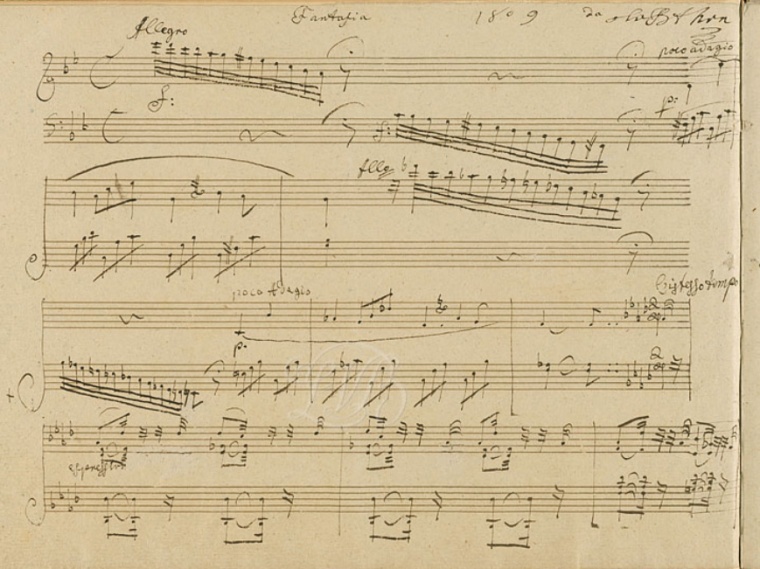
Ludwig van Beethoven (circa 16 dicembre 1770 - 1827): Fantasia in sol minore-si bemolle maggiore per pianoforte op. 77 (1809). Edwin Fischer (1952).
Ai suoi tempi Beethoven era considerato un grande improvvisatore: con la sua maestria in questo campo conquistò i salotti aristocratici viennesi, procurandosi amicizie e mecenatismo. Secondo Carl Czerny, che di Beethoven fu allievo, la Fantasia op. 77 dà un’idea esatta dell’arte improv­visatoria beethoveniana.

LvB, op. 77

La tormenta

Georgij Vasil’evič Sviridov (16 dicembre 1915 - 1998): La tormenta (Метель), suite sinfonica tratta dalla colonna sonora del film omonimo, diretto nel 1964 da Vladimir Basov su sceneggiatura ispirata dal racconto breve di Puškin che reca il medesimo titolo (dalle Novelle del compianto Ivan Petrovič Belkin, 1831). Orchestra filarmonica di Mosca, dir. Igor’ Manašerov.

  1. Trojka (Тройка)
  2. Valzer (Вальс) [3:04]
  3. Primavera e autunno (Весна и осень) [7:21]
  4. Romanza (Романс) [9:32]
  5. Pastorale (Пастораль) [14:42]
  6. Marcia militare (Военный марш) [16:49]
  7. Il matrimonio (Венчание) [19:21]
  8. Echi del valzer (Отзвуки вальса) [21:51]
  9. Strada d’inverno (Зимняя дорога) [23:44]

Il Mozart dell’Odenwald

Joseph Martin Kraus (1756 - 15 dicembre 1792): Sinfonia in do minore VB 142 (?1783). Concerto Köln, dir. Werner Ehrhardt.
È forse questa la sinfonia eseguita a Eszterháza nell’ottobre 1783 e dedicata a Haydn, il quale ne diede un giudizio assai lusinghiero.

  1. Larghetto – Allegro
  2. Andante [9:15]
  3. Allegro assai [14:29]

Laudamus

Michel-Richard Delalande (15 dicembre 1657 - 1726): Te Deum, grand motet per soli, coro e orchestra S.32 (1684). Emmanuelle de Negri e Dagmar Šaškova, soprani; Sean Clayton, haute-contre; Cyril Auvity, tenore; André Morsch, basso; Le Poème Harmo­nique e Ensemble Aedes, dir. Vincent Dumestre.

  1. Te Deum laudamus
  2. Te aeternum Patrem [2:12]
  3. Tibi omnes angeli [3:21]
  4. Sanctus, Sanctus, Sanctus [5:07]
  5. Te gloriosus Apostolorum [6:42]
  6. Te per orbem terrarum [9:12]
  7. Tu rex gloriae [10:35]
  8. Tu, ad liberandum [12:54]
  9. Tu, devicto mortis aculeo [15:14]
  10. Tu ad dexteram Dei sedes [18:02]
  11. Te ergo quaesumus [19:28]
  12. Aeterna fac cum sanctis [21:10]
  13. Salvum fac populum tuum [23:00]
  14. Et rege eos [24:17]
  15. Per singulos dies benedicimus te [26:02]
  16. Dignare, Domine [28:18]
  17. Miserere nostri [29:33]
  18. In te, Domine, speravi [31:08]

For Cornelius (Alvin Curran 85)

Alvin Curran (13 dicembre 1938): For Cornelius per pianoforte (1981-94). Eve Egoyan.

« For Cornelius was written in December 1981 just after my hearing the news of the accidental and tragic death of the English composer Cornelius Cardew. Cornelius was a visionary and his humane, prophetic powers affected everyone around him. Since my first meeting with him in Rome in 1965 and later through the many collaborations of MEV (Musica Elettronica Viva) and Cardew’s AMM group, his subtle influence has remained with me. For Cornelius is structured simply in three sections — a song, a thundering study on slowly changing harmonies, and a chorale. Though not intentionally made so, this piece may be seen as a tribute to Cardew’s own utopian dreams of making “elitist” music popular » (Alvin Curran).

I vestiti nuovi dell’imperatore

Rachel Portman (11 dicembre 1960): The Emperor’s New Clothes, suite sinfonica dalla colonna sonora dell’omonimo film (2001) di Alan Taylor.

Un film molto garbato, ambientato a Parigi ma girato in buona parte 🙂 a Torino, ha come protagonista Ian Holm nei panni di Napoleone: il quale, dopo Waterloo, potrebbe aver avuto una sorte assai diversa da quella che raccontano i libri di storia…
A very lovely film, set in Paris but partly shot in Turin, stars Ian Holm in the role of Napoleon: who, after Waterloo, may have had a very different fate from the one the history books tell…

A poster from The Emperor’s New Clothes. In the background on the left you can see the Valentino Castle in Turin, which in the film fiction becomes a Parisian building.