
Ralph Vaughan Williams (12 ottobre 1872 - 1958): Fantasia (quasi variazione) on the Old 104th Psalm Tune per pianoforte, coro e orchestra (1950). John Hunt, pianoforte; Cornell A Capella Chorus e The Rochester Chamber Orchestra, dir. Robert Hull.

Ralph Vaughan Williams (12 ottobre 1872 - 1958): Fantasia (quasi variazione) on the Old 104th Psalm Tune per pianoforte, coro e orchestra (1950). John Hunt, pianoforte; Cornell A Capella Chorus e The Rochester Chamber Orchestra, dir. Robert Hull.
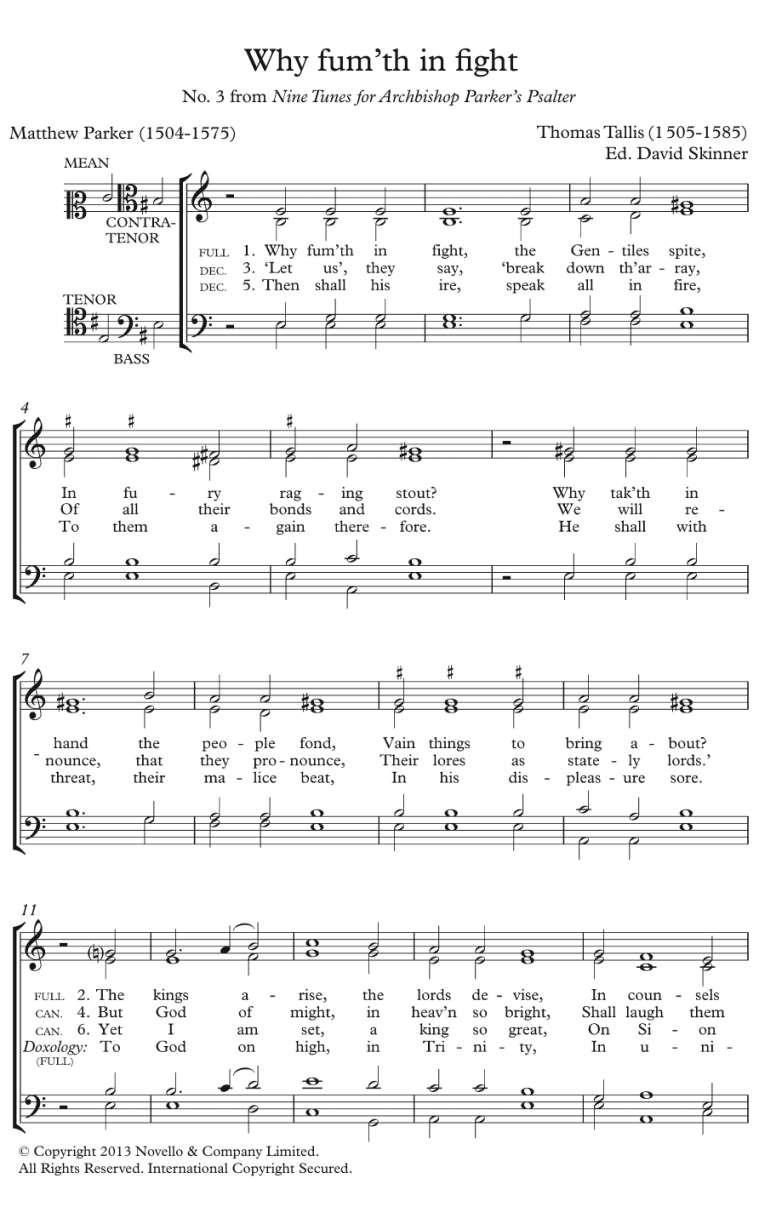
Thomas Tallis (c1505 - 1585): Why fum’th in fight? (Salmo 2:1-2), composto per il salterio dell’arcivescovo di Canterbury, Matthew Parker (1567). Theatre of Voices, dir. Paul Hillier.
Why fum’th in fight the Gentiles spite, in fury raging stout?
Why tak’th in hand the people fond, vain things to bring about?
The Kings arise, the Lords devise, in counsels met thereto,
against the Lord with false accord, against His Christ they go.
Ralph Vaughan Williams (12 ottobre 1872 - 1958): Fantasia on a Theme by Thomas Tallis per doppia orchestra d’archi (1910).
 Dmitro Stepanovič Bortnjanskij (1751 - 10 ottobre 1825): Inno cherubico. Coro filarmonico da camera estone, dir. Paul Hillier.
Иже херувимы тайно образующе,
и Животворящей Троицѣ трисвятую пѣснь припѣвающе,
Всякое нынѣ житейское отложимъ попеченіе,
Аминь, аминь,
яко да Царя всѣхъ подъимемъ,
ангельскими невидимо дориносима чинми.
Аллилуіа, аллилуіа, аллилуіа.
(Noi che misticamente raffiguriamo i cherubini, e alla vivifica Trinità cantiamo l’inno Trisagio, deponiamo ogni mondana preoccupazione – Amen, amen – affinché possiamo accogliere il Re di tutti, invisibilmente scortato dalle schiere angeliche – Alleluia, alleluia, alleluia.)
Pierre de Manchicourt (c1510 - 5 ottobre 1564): Laudate Dominum omnes gentes, mottetto a 6 voci. Huelgas Ensemble, dir. Paul van Nevel.
1ª pars:
Laudate Dominum, omnes gentes;
laudate eum, omnes populi:
resurrexit Dominus, alleluia.
Unus est Christus qui regnat;
laudate Dominum, omnes gentes:
Christus triumphat, alleluia.
Unus est Christus qui renovat;
laudate eum, omnes populi:
Christus glorificat, alleluia.
Unus est Christus qui coronat;
laudate Dominum, omnes gentes, alleluia.
2ª pars:
Plaudite ergo, omnes gentes,
quoniam confirmata est super nos misericordia ejus, alleluia;
et veritas Domini manet in æternum:
laudate eum, omnes populi.
Questo mottetto ha una caratteristica che lo rende unico fra le composizioni congeneri dell’epoca di Manchicourt: presenta un refrain sulla parola «alleluia», riproposto cinque volte (prima pars: a 0:54, 1:45, 2:36, 3:19; secunda pars: a 4:52), continuamente variato.

Francisco Guerrero (4 ottobre 1528 - 1599): Gabriel archangelus, mottetto a 4 voci. Ensemble La Sestina.
1a pars :
Gabriel archangelus locutus est ad Virginem dicens:
«Ave Maria, gratia plena, dominus tecum, benedicta tu in mulieribus.»
2a pars :
Gabriel archangele veni in adjutorio populo Dei,
qui semper assistis in conspectu Domini.

Jacques Colebault detto Jacquet de Mantua (1483 - 2 ottobre 1559): Salve virgo virginum, mottetto a 4 voci. Ensemble «Jachet de Mantoue».
Salve virgo virginum,
salve lumen luminum,
vale, dulce lilium.
Salve, mater pauperum.
Mater Christi, tu peperisti regem omnium:
gaude pura spes futura deprecantium;
tu in hora mortis nostrae ora Christum Dominum ,
ne damnemur in aeternum.
Speciosa pretiosa lux errantium,
generosa, gratiosa sis in hac valle te laudantium
consolatrix et gaudium, apud Patrem et Filium.

Quirino Gasparini (1721 - 30 settembre 1778): Adoramus te, antifona a 4 voci a cappella, un tempo erroneamente attribuita a Mozart (K 327). St. Martin’s Chamber Choir, dir. Timothy J. Krueger.
Adoramus te, Domine Jesu Christe, et benedicimus tibi
Quia per sanctam crucem tuam redemisti mundum.

Florent Schmitt (28 settembre 1870 - 1958): Psaume XLVII per soprano, coro, organo e orchestra op. 38 (1904). Andréa Guiot, soprano; Gaston Litaize, organo; Choeur et Orchestre National de l’ORTF, dir. Jean Martinon.
Gloire au Seigneur!
Nations, frappez des mains toutes ensemble
Chantez la gloire de Dieu, mêlez vos voix!
Parce que le Seigneur est très élevé
Et très redoutable et qu’il est le roi supreme
Qui a l’empire en toute la terre!
Chantez la gloire de Dieu par des cris d’allégresse!
Parce que le Seigneur est très élevé et très puissant.
Il est très grand, puissant et très élevé.
Qu’une sainte allégresse parte des coeurs
pour monter vers lui.
Que de vos voix et de vos âmes
Les chants de joie clamant:
Gloire au Seigneur!
Exaltez-vous à sa gloire.
Il nous a assujetti les peuples
Il a mis les nations sous nos pieds!
Gloire au Seigneur, Gloire au Dieu suprême!
Il a choisi dans son héritage
La beauté de Jacob qu’il a aimée avec tendresse.
Dieu est monté au milieu des chants de joie
Et le Seigneur est monté à la voix de la
trompette éclatante!
Nations, frappez des mains toutes ensemble!
Mêlez vos voix
Parce que le Seigneur et très élevée et très redoutable
Et qu’il est le Roi suprême,
Qui a l’empire en toute la terre
Chantez la gloire de Dieu
Par des cris d’une saint allégresse,
Gloire au Seigneur!

Alcuni catches (canoni) a 3 e a 4 voci di Henry Purcell (10 settembre 1659 - 1695) interpretati da Alfred Deller con il suo Consort.
Come, let us drink,
’Tis in vain to think
Like fools on grief or sadness:
Let our money fly,
And our sorrows dye,
All worldly care is madness.
But wine and good cheer
Will in spight of our fear
Inspire our hearts with mirth, boys;
The time we live
To wine let us give,
Since all must turn to Earth, boys.
Hand about the bowl
The delight of my soul,
And to my hand commend it;
A fig for chink
’Twas made to buy drink,
And before we go hence we’ll spend it.
Prithee hen’t so sad and serious,
Nothing’s got by grief or cares;
Melancholy’s too imperious,
When it comes, still domineers.
But if bus’ness, love or sorrow
That possesses thus thy mind,
Bid ’em come again tomorrow,
We are now to mirth inclin’d.
Let the glass run its round
And each good fellow keep his ground,
And if there be any flincher found
We’ll have his soul new coin’d.
I gave her cakes and I gave her ale,
I gave her sack and sherry;
I kiss’d her once and I kiss’d her twice,
And we were wondrous merry.
I gave her beads and bracelets fine,
I gave her dold down-derry;
I thought she was a-fear’d till she strok’d my beard,
And we were wondrous merry.
Merry my heart, merry my cocks,
Merry my sprites, hey down-derry;
I kiss’d her once and I kiss’d her twice,
And we were wondrous merry.
’Tis women makes us love,
’Tis love that makes us sad,
’Tis sadness makes us drink,
And drinking makes us mad.
Segnalo che anche Enzo Martinelli ha voluto ricordare Henry Purcell nel suo genetliaco 🙂
Isabella Leonarda (Isabella Calegari) detta la Musa novarese (6 settembre 1620 - 1704): Sonata in re minore per violino e basso continuo (ultima delle 12 Sonate a 1, 2, 3, e 4 istromenti op. 16, 1693). Ensemble Bizzarrie Armoniche.
Isabella Leonarda: Magnificat. Gruppo vocale Musica Laudantes, dir. Riccardo Doni; Cappella strumentale del Duomo di Novara, dir. Paolo Monticelli.

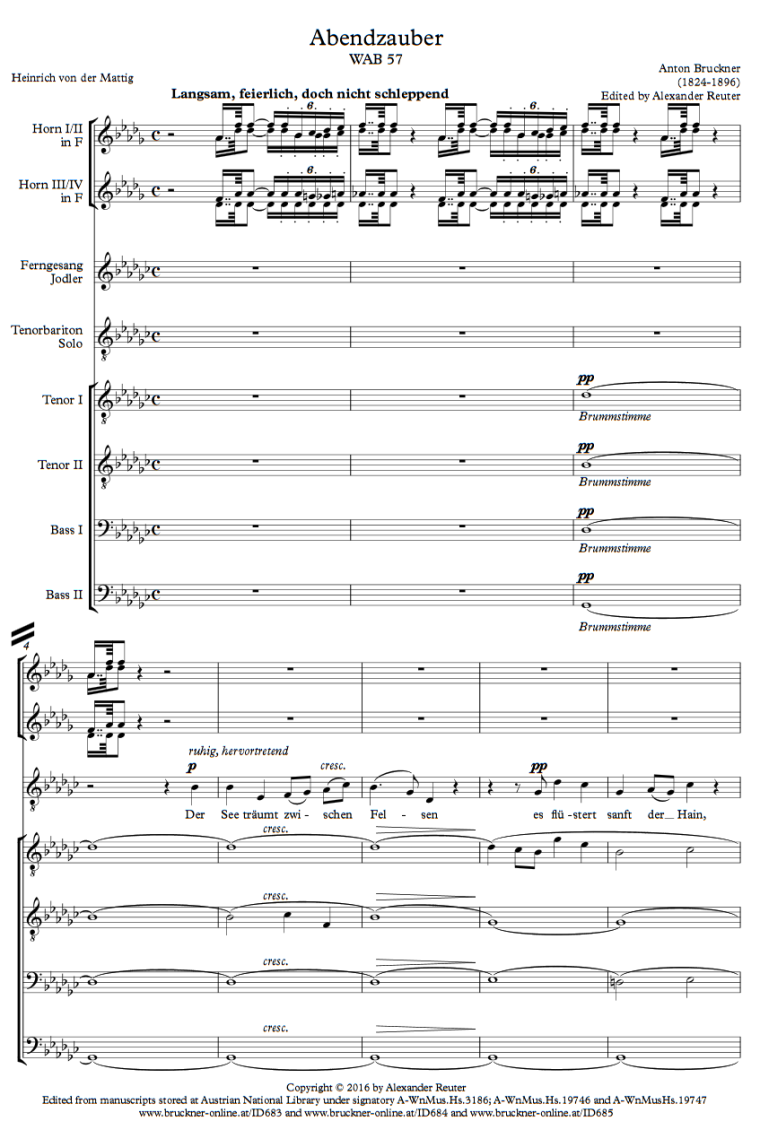
Anton Bruckner (4 settembre 1824 - 1896): Abendzauber per tenore o baritono, coro maschile (TTBB), 3 Jodler (SSA) e 4 corni (a mo’ di corni delle Alpi), WAB 57 (1878); testo di Heinrich von der Mattig, ossia il medico militare Heinrich Wallmann (1827-1898). Christoph Prégardien, tenore; Camerata Musica Limburg, dir. Jan Schumacher.
Der See träumt zwischen Felsen,
Es flüstert sanft der Hain.
Den Bergeshang beleuchtet
Des Mondes Silberschein.
Und aus dem Waldesdunkel
Hallt Nachtigallensang,
Und von dem See weh’n Lieder
Mit zauberhaftem Klang.
Ich saß am Seegestade,
Vertieft in süßen Traum;
Da träumte ich zu schweben
Empor zum Himmelsraum.
Wer könnte je vergessen
Den wonnevollen Ort!
Noch tief im Herzen klingen
Die Zaubertöne fort.
(Il lago sogna fra le rocce, il bosco mormora dolcemente. La luce argentea della luna rischiara il pendio della montagna.
Dal buio della foresta risuona il canto dell’usignolo, il lago sussurra magiche melodie.
Seduto in riva al lago, assorto in dorate fantasie, sognavo di salire in paradiso.
Chi potrebbe mai dimenticare un luogo così delizioso! Suoni fatati riecheggiano ancora nel profondo del cuore.)
Simon Bainbridge (30 agosto 1952 - 2021): Herbsttag / Autumn Day per doppio coro a cappella (1993) su testo di Rainer Maria Rilke nella traduzione inglese di James Blair Leishman. The Ionian Singers, dir. Timothy Salter.
|
Herr: es ist Zeit. Der Sommer war sehr groß Befiehl den letzten Früchten voll zu sein; Wer jetzt kein Haus hat, baut sich keines mehr. |
Lord, it is time. The summer was so great. Command the last fruits to incarnadine; He’ll not build now, who has no house awaiting. |

Félicien David (1810 - 29 agosto 1876): Le désert, ode-symphonie in 3 parti per voce recitante, tenore, coro maschile e orchestra, testo poetico di Auguste Colin (1844). Olivier Pascalin, recitante; Bruno Lazzaretti, tenore; Chor der St.-Hedwigs-Kathedrale Berlin; Rundfunk-Sinfonieorchester Berlin, dir. Guido Maria Guida.
Questa composizione è il frutto (maturato oltre dieci anni dopo) del viaggio in Egitto e in Medio Oriente compiuto da David nel 1833, all’epoca della sua adesione al sansimonismo. Il testo narra il percorso di una carovana attraverso il deserto del Sahara: affronta una tempesta di sabbia, fa sosta per la notte, riprende il cammino al levar del giorno rendendo omaggio a Allah. L’ode è articolata in 3 parti a loro volta suddivise in scene fra loro indipendenti:
PARTE I, L’entrée au désert. L’orchestra evoca l’immensità silente del deserto; si ode la preghiera di un coro di pellegrini che rende omaggio a Allah; dopo, in lontananza, si avverte il rumore della carovana (Marche de la caravane), dapprima sommesso, poi sempre più forte man mano che questa si avvicina. Si leva una forte tempesta di sabbia (Le simoun), amplificata dalla disperata supplica del coro che invoca Allah affinché abbia pietà dei credenti. Tornata la calma, la carovana può riprendere il cammino.
PARTE II, La nuit [22:26]. Il coro intona un cantico alla notte; seguono due brani strumentali, la Fantaisie arabe («air syrien») e la Danse des almées, che richiamano remote atmosfere orientali. Si celebra la vita libera del deserto in contrapposizione a quella civilizzata (La liberté au désert); l’episodio si conclude con una Rêverie du soir fondata sopra una melodia orientale udita da David al tempo del suo soggiorno in Egitto. Il silenzio, immobile, si distende nuovamente sul deserto.
PARTE III, Le lever du soleil [35:09]. Il sole si alza sul deserto e lo inonda di luce e di amore; solo il canto del muezzin (Chant du muezzin) increspa l’atmosfera immobile del Sahara. La carovana si rimette in cammino (Le départ de la caravane). L’ode si conclude con un omaggio corale a Allah.

Josquin des Prez (c1450 - 27 agosto 1521): Alma redemptoris mater, antifona (mottetto) a 4 voci (1518). Ensemble De Labyrinto.
Alma Redemptoris Mater, quae pervia coeli porta manes,
et stella maris, succurre cadenti, surgere qui curat, populo:
tu quae genuisti, natura mirante, tuum sanctum Genitorem,
Virgo prius ac posterius, Gabrielis ab ore sumens illud Ave, peccatorum miserere.

Tomás Luis de Victoria (1548 - 27 agosto 1611): Alma redemptoris mater, antifona a 8 voci (pubblicata in Cantica B. Virginis, 1581, n. 18). Ensemble Plus Ultra, dir. Michael Noone.

Tomás Luis de Victoria (1548 - 27 agosto 1611): Nigra sum, sed formosa, antifona (mottetto) a 6 voci (pubblicato in Motecta festorum totius anni cum Communi Sanctorum, quae partim senis, partim quinis, partim quaternis, alia octonis vocibus concinuntur, 1585, n. 3); testo tratto dal Canticum canticorum (I:5, II:10-12) in parte modificato.
Alcune interpretazioni del mio mottetto preferito. Nell’ordine:
– The Tallis Scholars, dir. Peter Phillips
– Chanticleer
– The Song Company
– Ensemble Plus Ultra, dir. Michael Noone
Nigra sum sed formosa filia Jerusalem
Ideo dilexit me Dominus et introduxit me in cubiculum suum et dixit mihi:
surge amica mea et veni.
Jam hiems transiit, imber abiit et recessit,
Flores apparuerunt in terra nostra, tempus putationis advenit.
Victoria è uno dei più straordinari compositori di ogni tempo. Ogni volta che ho l’occasione di ascoltare la sua musica mi sorprende la maestria con cui riesce a creare architetture polifoniche di complesse senza mai rinunciare all’intelligibilità del testo e alla piacevolezza dell’insieme. Questo brano è un esempio significativo della sua arte formidabile.

 Johann Rosenmüller (24 agosto 1619 - 1684): Magnificat in do minore. Ensemble ARTEK e Les Sacqueboutiers de Toulouse, dir. Gwendolyn Toth.
Constant Lambert (23 agosto 1905 - 21 agosto 1951): The Rio Grande, cantata per voce solista, coro, pianoforte, ottoni, archi e percussione (1927) su testo di Sacheverell Sitwell. Jean Temperley, mezzosoprano; London Madrigal Singers, dir. Christopher Bishop; London Symphony Orchestra, dir. André Previn.
By the Rio Grande
They dance no sarabande
On level banks like lawns above the glassy, lolling tide;
Nor sing they forlorn madrigals
Whose sad note stirs the sleeping gales
Till they wake among the trees and shake the boughs,
And fright the nightingales;
But they dance in the city, down the public squares,
On the marble pavers with each colour laid in shares,
At the open church doors loud with light within.
At the bell’s huge tolling,
By the river music, gurgling, thin
Through the soft Brazilian air.
The Comendador and Alguacil are there
On horseback, hid with feathers, loud and shrill
Blowing orders on their trumpets like a bird’s sharp bill
Through boughs, like a bitter wind, calling
They shine like steady starlight while those other sparks are failing
In burnished armour, with their plumes of fire,
Tireless while all others tire.
The noisy streets are empty and hushed is the town
To where, in the square, they dance and the band is playing;
Such a space of silence through the town to the river
That the water murmurs loud –
Above the band and crowd together;
And the strains of the sarabande,
More lively than a madrigal,
Go hand in hand
Like the river and its waterfall
As the great Rio Grande rolls down to the sea.
Loud is the marimba’s note
Above these half -salt waves,
And louder still the tympanum,
The plectrum, and the kettle-drum,
Sullen and menacing
Do these brazen voices ring.
They ride outside,
Above the salt-sea’s tide.
Till the ships at anchor there
Hear this enchantment,
Of the soft Brazilian air,
By those Southern winds wafted,
Slow and gentle,
Their fierceness tempered
By the air that flows between.

Siegmund von Hausegger (16 agosto 1872 - 1948): Natursymphonie per orchestra (1911) con coro finale su testo di Goethe (Proemio, pubblicato nel 1817 come introduzione a Zur Naturwissenschaft überhaupt ). WDR Rundfunkchor Köln, WDR Sinfonieorchester Köln, dir. Ari Rasilainen.
Im Namen dessen, der sich selbst erschuf!
Von Ewigkeit in schaffendem Beruf;
In Seinem Namen, der den Glauben schafft,
Vertrauen, Liebe, Tätigkeit und Kraft;
In jenes Namen, der, so oft genannt,
Dem Wesen nach blieb immer unbekannt:
Soweit das Ohr, soweit das Auge reicht,
Du findest nur Bekanntes, das ihm gleicht,
Und deines Geistes höchster Feuerflug
Hat schon am Gleichnis, hat am Bild genug;
Es zieht dich an, es reißt dich heiter fort,
Und wo du wandelst, schmückt sich Weg und Ort;
Du zählst nicht mehr, berechnest keine Zeit,
Und jeder Schritt ist Unermeßlichkeit.

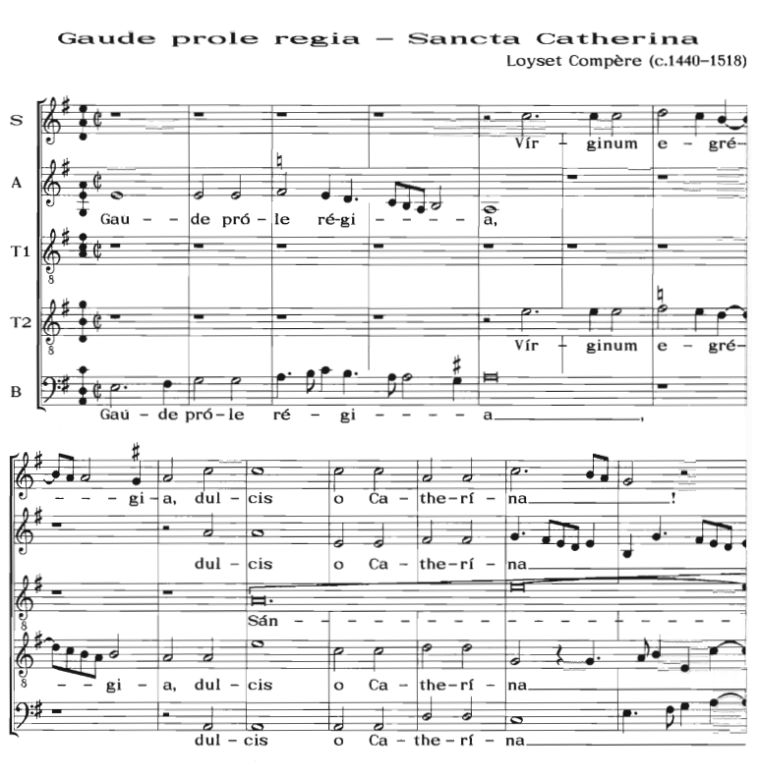
Loyset Compère (c1445 - 16 agosto 1518): Gaude prole regia, mottetto a 5 voci in lode di santa Caterina d’Alessandria. Capella Sancti Michaelis.
Gaude prole regia,
Virginum egregia,
dulcis o Catherina!
Congaudet exercitus
Cherub te divinitus
ferens in montem Sinai.
Costo regi Cypri nata,
moxque Christo desponsata
passa Alexandria.
Te clamat sanctam in caelis
omnis natio fidelis,
Francia cum Flandria.
Symphonisant dulce melos
cives qui habitant caelos
tam digno consortio.
Sponso tuo occurristi,
laureata quae fuisti,
digna caeli portio.
Psallit laudes, canit hymnos,
cantus personat divinos
fidelis ecclesia.
Laudes erumpit annuas,
colens passiones tUas
duraque supplicia.
o quam dulcis, quam formosa
quamque Christo gratiosa
est haec regis filia!
Quae spreta mundanitate
amplexaque castitate
nitet super filia.
Da captivis libertatem,
aegrotis incolumitatem,
sis spes te deprecantium.
Confer quaeso peregrinis
sanitatem in divinis,
sis via errantium.
Tandem pia Virgo cave,
ne quid in cor nostrum pravae
infundat diabolus.
Sed reice si quid assit
ut post mortem aeterna sit
mansio nostra polus.
Sancta Catherina, ora pro nobis.
Amen.
Alexander Ackermann alias Alexander Agricola (c1457 - 15 agosto 1506): Magnificat primi toni a 4 voci. Ensemble Chanticleer.
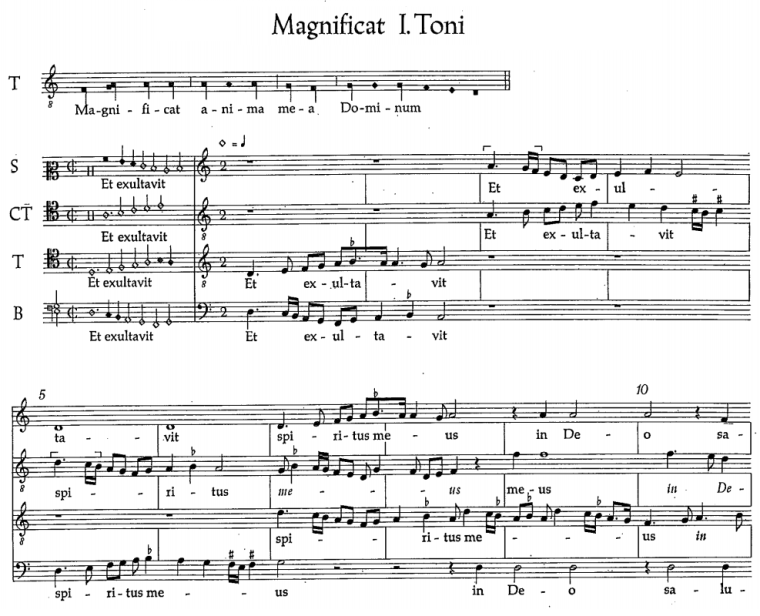
Girolamo Giacobbi (10 agosto 1567 - 1629): Magnificat a 18 voci (dalla raccolta Prima Parte de i Salmi Concertati a due, e piu chori, 1609). Color Temporis, dir. Alberto Allegrezza.

Lorenzo Ratti (c1589 - 10 agosto 1630): Si bona suscepimus, mottetto a voci e strumenti; testo da Giobbe 2:10 e 1:21. Ensemble Concerto romano e Li sacri cornetti, dir. Alessandro Quarta.
Si bona suscepimus de manu Dei,
mala autem quare non sustineamus?
Dominus dedit, Dominus abstulit; sicut Domino placuit, ita factum est:
sit nomen Domini benedictum.
Nudus egressus sum de utero matris meae, et nudus revertar illuc.

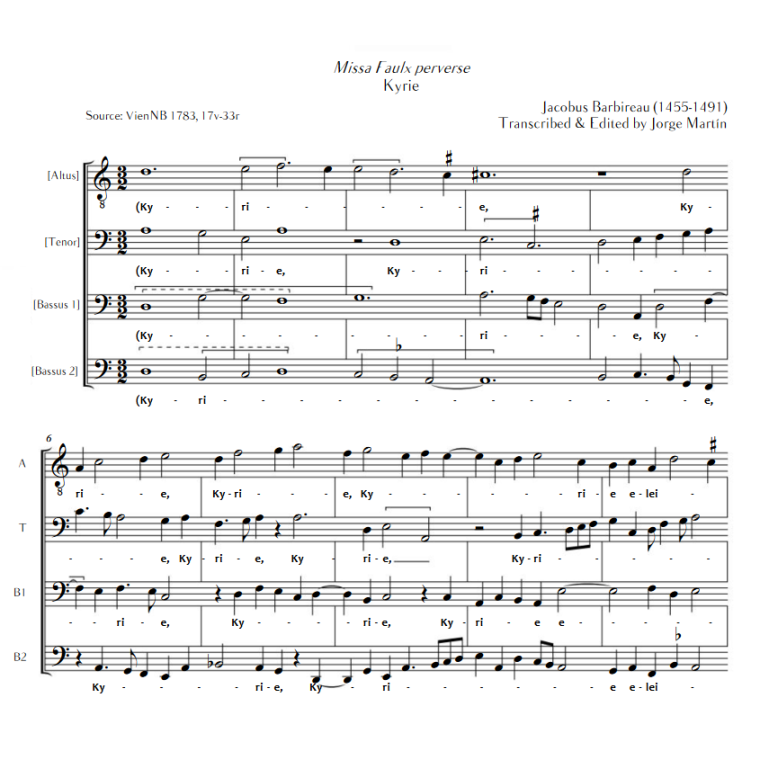
Jacobus Barbireau (1455 - 7 agosto 1491): Missa «Faulx perverse» a 4 voci. Ensemble «Josquin Desprez».
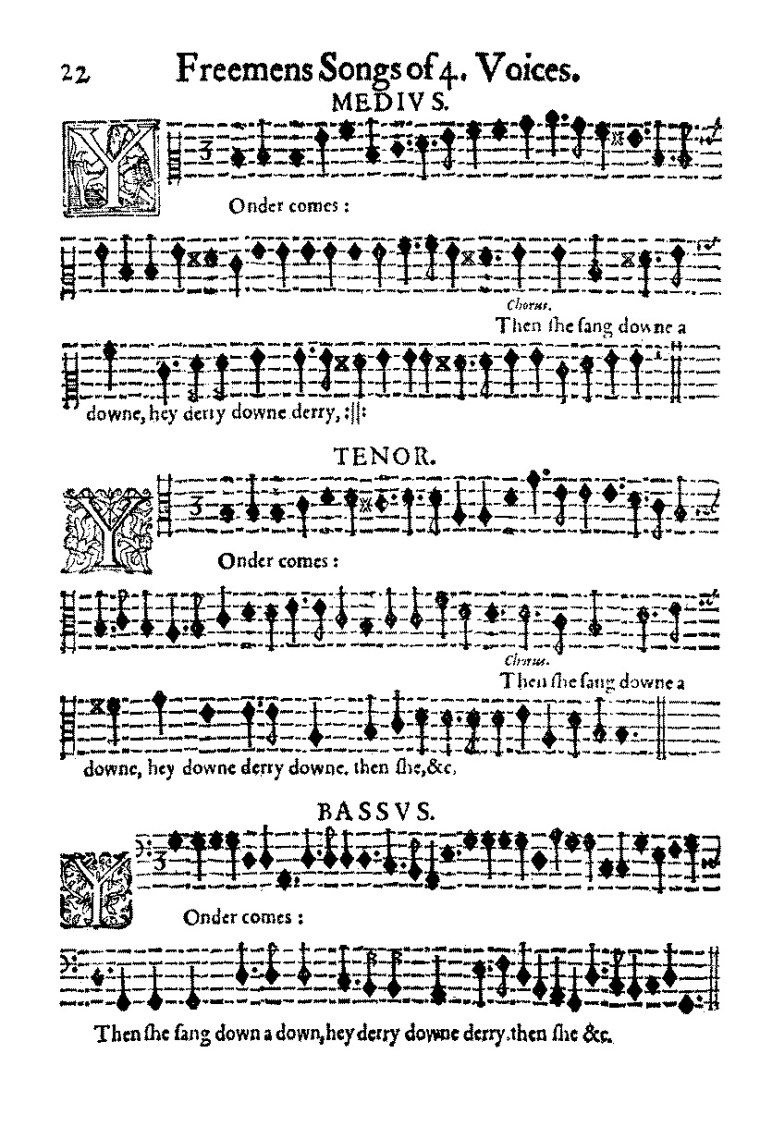
Thomas Ravenscroft (c1582 - c1633): Yonder comes a courteous knight, partsong a 4 (pubblicato in Deuteromelia, 1609, n. 22). Pro Cantione Antiqua.
Notevoli il testo, che presenta alla fine una «morale» davvero curiosa 🙂 , e l’armonizzazione, severa e moderna allo stesso tempo, nonché l’interpretazione dell’ensemble Pro Cantione Antiqua.
Yonder comes a courteous knight,
Lustely raking over the lay;
He was well ware of a bonny lasse,
As she came wand’ring over the way.
Then she sang downe a downe, hey downe derry.
Jove you speed, fayre ladye, he said,
Among the leaves that be so greene;
If I were a king, and wore a crowne,
Full soone, fair lady, shouldst thou be a queen.
Also Jove save you, faire lady,
Among the roses that be so red;
If I have not my will of you,
Full soone, faire lady, shall I be dead.
[Then he lookt east, then hee lookt west,
He lookt north, so did he south;
He could not finde a privy place,
For all lay in the divel’s mouth.]
If you will carry me, gentle sir,
A mayde unto my father’s hall,
Then shall you have your will of me,
Under purple and under paule.
[He set her up upon a steed,
And him selfe upon another,
And all the day he rode her by,
As though they had been sister and brother.]
When she came to her father’s hall,
It was well walled round about;
She rode in at the wicket-gate,
And shut the foure-ear’d foole without.
You had me, quoth she, abroad in the field,
Among the corne, amidst the hay,
Where you might had your will of mee,
For, in good faith, sir, I never said nay.
[Ye had me also amid the field,
Among the rushes that were so browne,
Where you might had your will of me,
But you had not the face to lay me downe.]
He pulled out his nut-browne sword,
And wipt the rust off with his sleeve,
And said: Jove’s curse come to his heart,
That any woman would beleeve!
When you have your owne true-love
A mile or twaine out of the towne,
Spare not for her gay clothing,
But lay her body flat on the ground.
Francesco Corteccia (27 luglio 1502 - 1571): Vientene, almo riposo, madrigale a 5 voci (pubblicato nel Libro primo de madrigali a cinque & a sei voci, 1547). John Elwes, tenore; Les Sacqueboutiers de Toulouse.
Vientene, almo riposo, ecco ch’io torno
e ne discaccio il giorno,
posate erbette e fronde,
e spogliatevi piagge e arboscelli,
entrate o pastorelli,
entrate o ninfe bionde,
entro al bel nido adorno
ognun s’adagi, e dorma al mio ritorno.
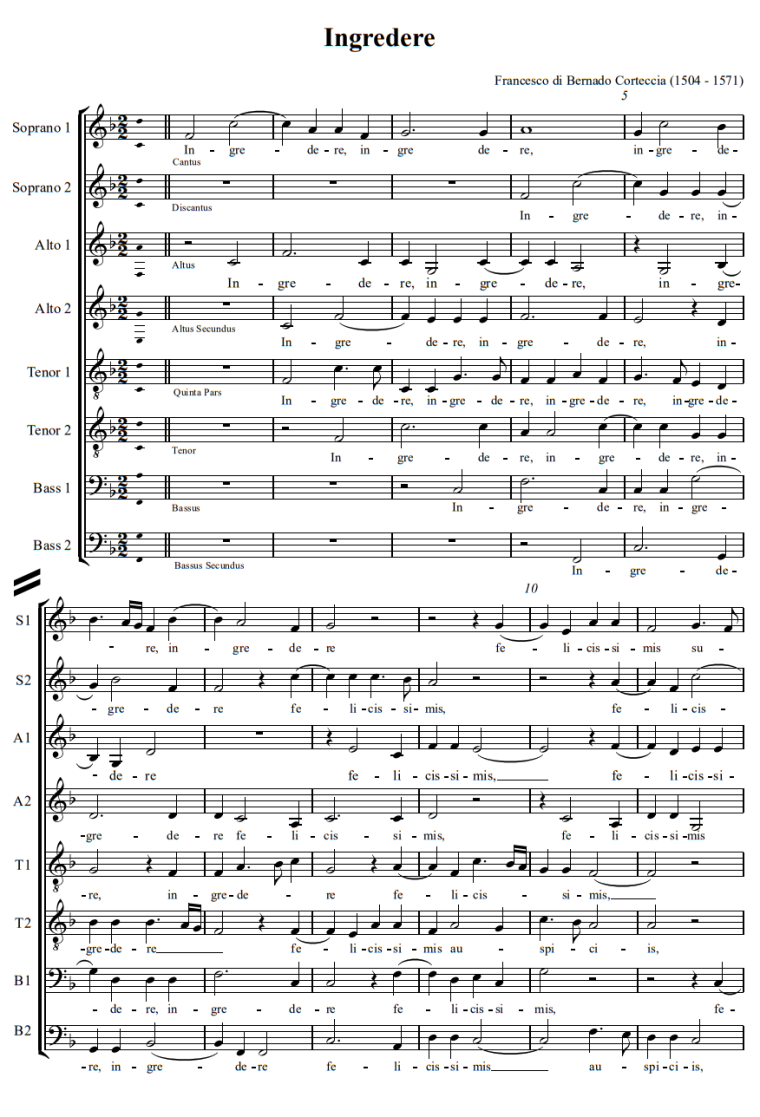
Corteccia: Ingredere, mottetto a 8 voci in 2 cori (pubblicato in Musiche fatte nelle nozze dello illustrissimo Duca di Firenze, il signor Cosimo de’ Medici, et della illustrissima consorte sua, madonna Leonora da Tolletto, 1539, n. 2). Nel primo video, il mottetto è eseguito dall’ensemble del Centre de Musique Ancienne di Ginevra, dallo Studio di Musica Rinascimentale di Palermo e dalla Schola «Jacopo da Bologna» diretti da Gabriel Garrido; nel secondo, Eduardo Antonello esegue tutte le parti con i suoi cromorni.
Ingredere felicissimis, auspiciis urbem tuam Helionora ac optime
prolis fecunda, ita domi similem patri foris avo sobolem producas
ut Mediceo nomini eiusque devotissimis civibus securitatem prestes eternam.
Andrzej Koszewski (26 luglio 1922 - 2015): Serioso-Giocoso per coro misto a 8 voci (1989). Coro da camera 441Hz, dir. Anna Wilczewska.

Anonimo: Bushes and Briars, canto tradizionale inglese. Alfred Deller, controtenore; Desmond Dupré, liuto.
La «scoperta» di questo brano si deve a Ralph Vaughan Williams, che l’udì cantare da un pastore nell’Essex e ne pubblicò un arrangiamento per coro maschile a 4 voci a cappella nel 1908.
Through bushes and through briars,
I lately took my way;
All for to hear the small birds sing,
And the lambs to skip and play.
I overheard my own true love,
Her voice it was so clear;
Long time I have been waiting
For the coming of my dear.
Sometimes I am uneasy
And troubled in my mind;
Sometimes I think I’ll go to my love
And tell to him my mind.
And if I should go to my love,
My love he will say «Nay»;
If I show to him my boldness,
He’ll ne’er love me again.
L’arrangiamento di Vaughan Williams eseguito da The Gentlemen of St. John’s.

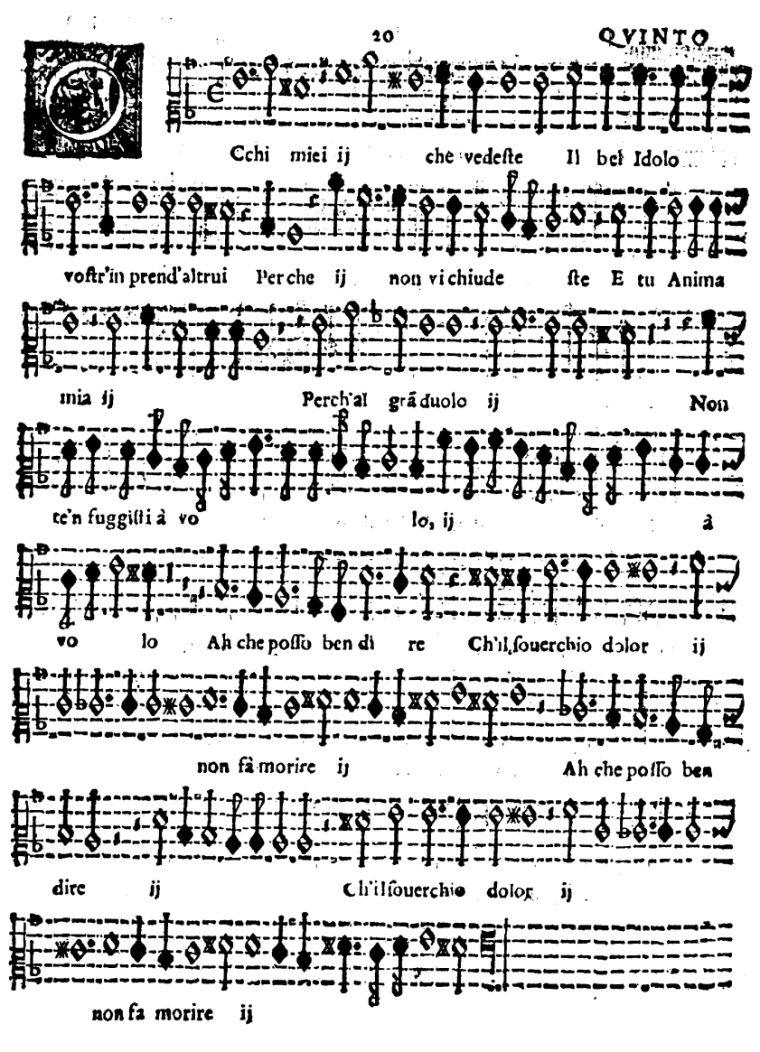
Pomponio Nenna (1556 - 25 luglio 1608): Occhi miei che vedeste, madrigale a 5 voci (pubblicato nel Quarto Libro de madrigali a cinque voci, 1609, n. 20); testo di Battista Guarini. Concerto Italiano, dir. Rinaldo Alessandrini.
Occhi miei che vedeste
Il bell’idolo vostro in preda altrui
Perché non vi chiudeste?
E tu, Anima mia,
Perché al gran duolo
Non t’en fuggisti a volo?
Ah, che posso ben dire
Che il soverchio dolor
Non fa morire.
Thomas Ravenscroft (c1582 - c1633): A wooing song of a yeoman of Kent’s son, partsong a 1-4 voci (da Melismata, 1611, n. 22). Pro Cantione Antiqua.
I have house and land in Kent,
And if you’ll love me, love me now;
Twopence-halfpenny is my rent,
I cannot come every day to woo.
Twopence-halfpenny is his rent,
And he cannot come every day to woo.
Ich am my vather’s eldest zonne,
My mother eke doth love me well,
For ich can bravely clout my shoone,
And ich full well can ring a bell.
For he can bravely clout his shoone,
And he full well can ring a bell.
My vather he gave me a hog,
My mouther she gave me a zow;
I have a God-vather dwels thereby,
And he on me bestowed a plow.
He has a God-vather dwells thereby,
And he on him bestowed a plough.
One time I gave thee a paper of pins,
Another time a tawdry-lace;
And if thou wilt not grant me love,
In truth ich die bevore thy face.
And if thou wilt not grant his love,
In truth he’ll die bevore thy vace.
Ich have been twice our Whitson-lord,
Ich have had ladies many vair,
And eke thou hast my heart in hold
And in my mind zeems passing rare.
And eke thou hast his heart in hold
And in his mind seems passing rare.
Ich will put on my best white slops
And ich will wear my yellow hose,
And on my head a good grey hat,
And in’t ich stick a lovely rose.
And on his head a good grey hat,
And in’t he’ll stick a lovely rose.
Wherefore cease off, make no delay,
And if you’ll love me, love me now;
Or else ich zeek zome oderwhere,
For I cannot come every day to woo.
Or else he’ll zeek zome oderwhere,
For he cannot come every day to woo.
La melodia è, nella parte iniziale, molto simile a quella di The Three Ravens, i versi portano a tutt’altro contesto. Anche in questo caso Ravenscroft dimostra di essere un musicista di vaglia, la sua armonizzazione è elegante e moderna, e la bravura degli interpreti fa il resto.

Annie Laurie, ballad scozzese attribuita a William Douglas (1672? - 1748) con melodia di Alicia Scott (nata Alicia Ann Spottiswoode, 1810 - 1900). Interpreti Deanna Durbin (registrazione del 1936: Durbin aveva 14 anni) e, in un arrangiamento di Alice Parker e Robert Shaw, il Westminster Choir diretto da Joseph Flummerfelt.
Maxwelton’s braes are bonnie,
Where early fa’s the dew,
‘Twas there that Annie Laurie
Gi’ed me her promise true.
Gi’ed me her promise true —
Which ne’er forgot will be,
And for bonnie Annie Laurie
I’d lay me down and dee.
Her brow is like the snaw-drift,
Her neck is like the swan,
Her face it is the fairest,
That ‘er the sun shone on.
That ‘er the sun shone on —
And dark blue is her e’e,
And for bonnie Annie Laurie
I’d lay me down and dee.
Like dew on gowans lying,
Is the fa’ o’ her fairy feet,
And like winds, in simmer sighing,
Her voice is low and sweet.
Her voice is low and sweet —
And she’s a’ the world to me;
And for bonnie Annie Laurie
I’d lay me down and dee.
Secondo la tradizione, l’amore fra William Douglas, capitano dei Royal Scots, e Annie, figlia di Robert Laurie, primo baronetto di Maxwellton, fu osteggiato dal padre di lei, forse perché Annie era all’epoca molto giovane, o forse perché Douglas era fedele alla causa giacobita. Comunque sia, si sa per certo che Douglas infine si consolò fra le braccia di una ereditiera del Lanarkshire, Elizabeth Clerk di Glenboig: i due convolarono a nozze nel 1706 a Edimburgo. Tre anni dopo, Annie sposò Alexander Fergusson, 14° Laird di Craigdarroch; ebbe una vita relativamente felice e morì ottantunenne nel 1764.
Non è certo che il testo della ballata sia stato scritto da William Douglas: è probabile che il vero autore sia lo scrittore e giornalista scozzese Allan Cunningham (1784 - 1842), il quale collaborò alla stesura del Ballad Book curato da Charles Kirkpatrick Sharpe (1781? - 1851), la cui edizione originale, del 1823, contiene la prima pubblicazione a stampa di Annie Laurie. Il testo fu poi rimaneggiato da Alicia Scott per adattarlo alla musica da lei stessa precedentemente composta per un’altra poesia scozzese, Kempye Kaye.
Il fantasma della camera azzurra
(Storia di mio zio)
— Non voglio impaurirvi — iniziò mio zio, con tono di voce particolarmente solenne, per non dire che faceva gelare il sangue nelle vene — e, se preferite che non ne parli, non lo farò; ma il fatto è che proprio questa casa, dove siamo ora riuniti, è infestata.
— Non me lo dica! — esclamò Mister Coombes.
— Che mi dice a fare di non dirglielo, se l’ho appena detto? — ribatté lo zio con una certa stizza. — Lei dice cose assurde! Vi dico che questa casa è infestata. Regolarmente, la Vigilia di Natale, la Camera azzurra [a casa dello zio chiamavano Camera azzurra la stanza vicina a quella dei bambini, perché quasi tutto il servizio da toletta era di quel colore] è infestata dal fantasma di un criminale, un uomo che una volta uccise con un pezzo di carbone uno di quei cantanti che, a Natale, vanno di casa in casa.
— Come fece? — chiese Mister Coombes, con curiosità e impazienza. — Fu difficile?
— Non so come fece — rispose lo zio, — non mi spiegò il procedimento. Il cantante era in piedi dentro l’entrata principale e stava cantando una ballata. Si presume che, quando aprì la bocca per il si bemolle, il criminale abbia lanciato il pezzo di carbone da una delle finestre e questo si sia infilato nella gola del cantante e l’abbia soffocato.
— Bisogna essere un bravo tiratore, ma vale certamente la pena di provare — mormorò pensosamente Mister Coombes.
— Ma quello non fu il suo unico crimine, ahimé! — aggiunse lo zio. — Prima, aveva ucciso un solista di cornetta.
— No! Ma è un fatto veramente accaduto? — chiese Mister Coombes.
— Certo che è un fatto veramente accaduto — rispose lo zio, irritato. — Almeno, per quanto si possa parlare di fatti in casi di questo tipo. Com’è pignolo, stasera. Le prove indiziarie erano schiaccianti. Il poveretto, il solista di cornetta, si trovava in questa zona da appena un mese. Il vecchio Mister Bishop, che allora gestiva il Jolly Sand Boys, e dal quale ho saputo la storia, diceva di non aver mai visto un solista di cornetta più operoso e attivo. Il solista di cornetta conosceva solo due motivi, ma Mister Bishop diceva che quell’uomo non avrebbe potuto suonare con più energia, né per più ore al giorno, se ne avesse conosciuti quaranta. I due motivi che suonava erano Annie Laurie e Home! Sweet Home! e, per ciò che concerne l’esecuzione della prima melodia, Mister Bishop diceva che l’avrebbe capita anche un bambino. Questo musicista, questo povero artista senza amici, aveva l’abitudine di venire regolarmente a suonare in questa strada, proprio qui di fronte, due ore ogni sera. Una sera, fu visto entrare proprio in questa casa, evidentemente in risposta a un invito, ma non fu mai visto uscirne!
— I cittadini provarono a offrire una ricompensa per il suo ritrovamento? — chiese Mister Coombes.
— Neanche mezzo penny — replicò lo zio.
— Un’altra estate — continuò lo zio, — venne qui una banda musicale tedesca, che voleva (così annunciarono, al loro arrivo) fermarsi fino all’autunno. Due giorni dopo il loro arrivo, tutta la compagnia, dei pezzi d’uomini così sani e vigorosi che faceva piacere guardarli, fu invitata a cena da questo criminale e, dopo aver passato a letto le ventiquattr’ore successive, lasciò la città: degli uomini finiti, gravemente ammalati di dispepsia. Il medico condotto, che li aveva assistiti, disse che, secondo lui, difficilmente anche uno solo di loro sarebbe stato in grado di suonare di nuovo un’aria.
— Lei… lei non conosce la ricetta, vero? — chiese Mister Coombes.
— Sfortunatamente no — replicò lo zio, — ma si disse che l’ingrediente principale fosse pasticcio di carne di maiale del buffet della stazione. Ho dimenticato gli altri crimini di quest’uomo — continuò lo zio, — prima li conoscevo tutti, ma la mia memoria non è più quella di una volta. Non penso, comunque, di fare torto alla sua memoria se affermo che non fu del tutto estraneo alla morte, e poi al seppellimento, di un signore che suonava l’arpa con le dita dei piedi; e che non aveva la coscienza pulita neppure circa la tomba solitaria di un forestiero sconosciuto che venne una volta in questa zona, un contadinello italiano che suonava l’organetto di Barberia. Ogni anno, la Vigilia di Natale — disse lo zio in tono basso e solenne, rompendo lo strano silenzio sgomento che, come un’ombra, sembrava essersi lentamente infiltrato, furtivo, nella stanza, per poi avvolgerla completamente, — il fantasma di questo criminale infesta la Camera azzurra, proprio in questa casa. Là, da mezzanotte fino al canto del gallo, tra grida selvagge soffocate e gemiti e risate di scherno e il suono spettrale di orridi tonfi, sostiene una fiera lotta fantasma con gli spiriti del solista di cornetta e del cantante assassinato, aiutati, ogni tanto, dalle ombre della banda musicale tedesca, mentre il fantasma dell’arpista strangolato suona folli melodie spettrali, con dita di piedi fantasma, sullo spettro di un’arpa rotta.
Lo zio disse che la Camera azzurra era praticamente inutile, come camera da letto, la Vigilia di Natale.
— Ascoltate! — disse lo zio alzando una mano verso il soffitto, in segno di ammonimento, mentre noi trattenevamo il respiro e ascoltavamo. — Ascoltate! Credo che siano loro: nella Camera azzurra!
da Jerome K. Jerome, Storie di fantasmi per il dopocena
(Told After Supper, 1891. Qui il testo originale.)
Jean-Baptiste Arban (1825 - 1889): Variazioni per cornetta a pistoni su Home! Sweet Home! di sir Henry Bishop (1786 - 1855).


 la regina gioiosa