
With his ensemble, The Broadside Band, Jeremy Barlow worked extensively and profitably on the music used by Johann Christoph Pepusch in John Gay’s The Beggar’s Opera (1728): it is the only ballad opera still being talked about in our days, thanks also to Bertolt Brecht’s 1928 remake, Die Dreigroschenoper, which however has original music composed by Kurt Weill. It is not the same for The Beggar’s Opera: Gay’s lyrics were in fact adapted by Pepusch to melodies that at the time already had a certain notoriety, borrowing them from broadside ballads, opera arias, religious hymns and folk songs.
Barlow and his band have recorded a complete edition of Gay and Pepusch’s work, as well as an anthology of its most famous airs (nine pieces in all), of each of which they presented not only The Beggar’s Opera version, but also the original composition and some of its variants and parodies.
The last track of the anthology, the one I submit to your attention here, is dedicated to Greensleeves. It includes, in order:
-
a lute extemporisation on passamezzo antico ground, performed by George Weigand
-
Greensleeves, earliest version of melody (from William Ballet’s Lute Book, c1590-1603) with earliest surviving words (A Handful of Pleasant Delights, 1584), sung by Paul Elliott accompanied on lute by Weigand [1:13]
Alas, my love, you do me wrong,
To cast me off discourteously.
And I have loved you so long,
Delighting in your company.Greensleeves was all my joy,
Greensleeves was my delight,
Greensleeves was my heart of gold,
And who but my Lady Greensleeves.I have been ready at your hand,
To grant whatever you wouldst crave,
I have both waged life and land,
Your love and goodwill for to have.Well I will pray to God on high
That thou my constancy mayst see,
And that yet once before I die,
Thou wilt vouchsafe to love me.Greensleeves, now farewell, adieu,
God I pray to prosper thee,
For I am still thy lover true,
Come once again and love me. -
Greensleeves, the most widespread version at the beginning of the seventeenth century, according to William Cobbold (1560 - 1639) and other authors, with improvisations performed by Weigand on baroque guitar and by Rosemary Thorndycraft on bass viol [4:07]
-
The Beggar’s Opera version (we already know it) sung by Elliott a solo [5:27]
-
a medley of three Irish jigs performed by Barlow on flute and Alastair McLachlan on violin [6:03]:
– A Basket of Oysters (da Moore’s Irish Melodies, 1834)
– A Basket of Oysters or Paddythe Weaver (Aird’s selection, 1788)
– Greensleeves (collected Limerick 1852).



 Louis Durey (1888 - 3 luglio 1979): Sonatina per flauto e pianoforte op. 25 (1920). Daniela Dottori, flauto; Luca Moscardi, pianoforte.


 La Fantasia on Greensleeves è in realtà un arrangiamento, realizzato nel 1934 da Ralph Greaves con l’approvazione di Vaughan Williams, di un brano dell’opera Sir John in Love (1929), basata sulla commedia di Shakespeare Le allegre comari di Windsor. Utilizza non solo il ballad cui si allude nel titolo, ma anche una melodia tradizionale intitolata Lovely Joan, che Vaughan Williams aveva ascoltato nel Suffolk.
  The Fantasia on Greensleeves is actually an arrangement, made in 1934 by Ralph Greaves with the approval of Vaughan Williams, of a piece from the opera Sir John in Love (1929), based on Shakespeare’s play The Merry Wives of Windsor. It uses not only the ballad alluded to in the title, but also a traditional tune called Lovely Joan, which Vaughan Williams heard in Suffolk.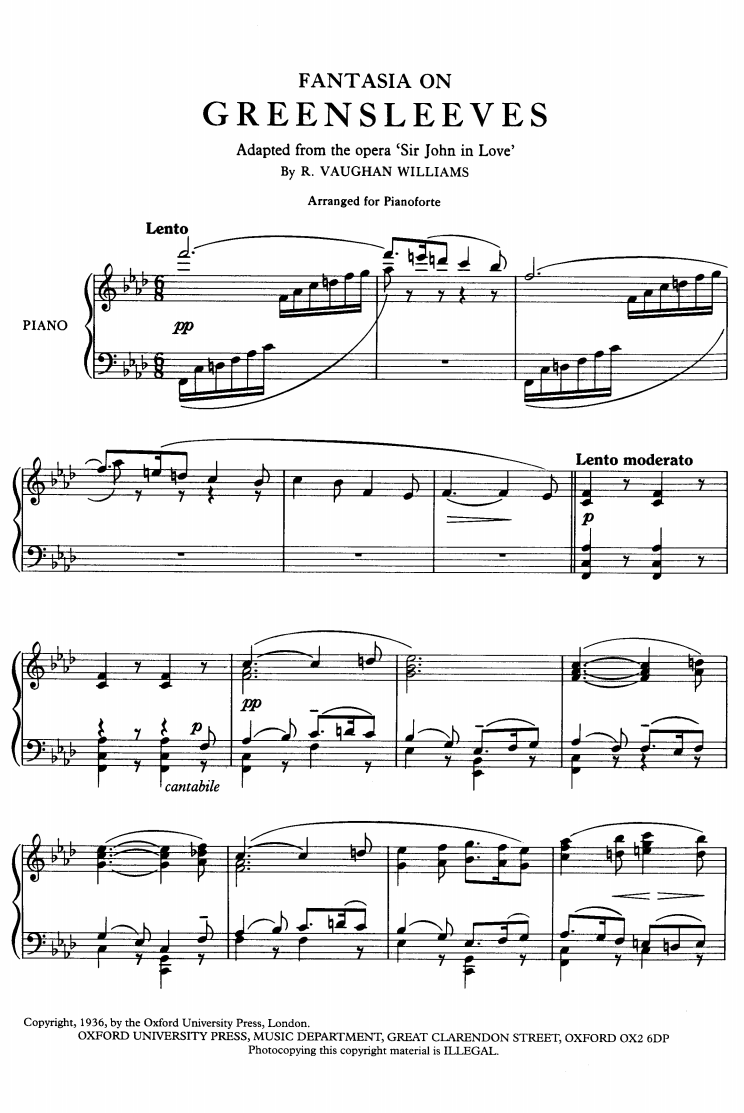



 Louis-Emmanuel Jadin (1768 - 11 aprile 1853): Sonata in sol maggiore per flauto e pianoforte op. 13 n. 1. Frédéric Chatoux, flauto; Bertrand Giraud, pianoforte.








 la regina gioiosa