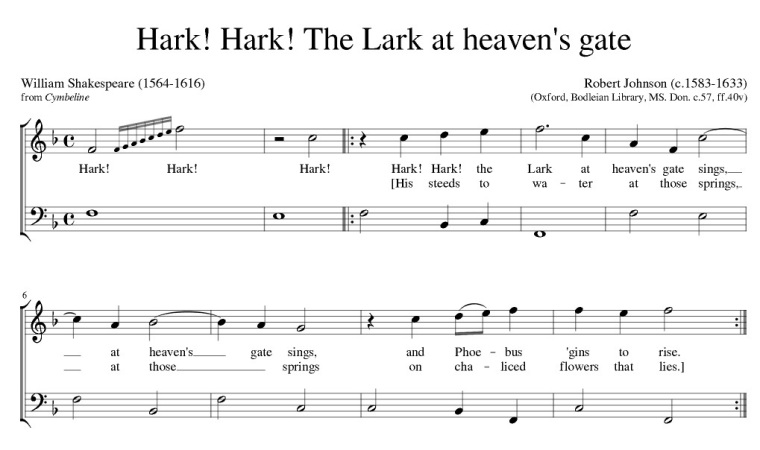
Hark! hark! the lark, Cloten’s song in Shakespeare’s play Cymbeline, King of Britain (c1609), act 2, scene 3. Emma Kirkby, soprano; Anthony Rooley, lute.
Hark! hark! the lark at heaven’s gate sings,
And Phoebus ’gins arise,
His steeds to water at those springs
On chalic’d flowers that lies;
And winking Mary-buds begin
To ope their golden eyes;
With everything that pretty is,
My lady sweet, arise:
Arise, arise!
This setting of Hark! hark! the lark survives in a music manuscript owned by the Bodleian Library, University of Oxford (MS Don. c.57, f. 40v), and has been attributed to Robert Johnson (c1583 - 1633). Johnson became lutenist to king James I in 1604 and was closely associated with Shakespeare’s company, to which he provided songs for various plays including The Winter’s Tale (1610) and The Tempest (1611).
Valéry Sauvage interpreta la più antica versione conosciuta di Greensleeves (anonima, riportata dal manoscritto noto come William Ballet’s Lute Book, c1590-1603) insieme con le variazioni composte da Francis Cutting (c1550 - 1595/96).
Valéry Sauvage performs the earliest known version of Greensleeves (anonymous, found in a manuscript known as the William Ballet’s Lute Book, c1590-1603) and the variations by Francis Cutting (c1550 - 1595/96).
Anonimo (sec. XVI-XVII): The Willow Song. Duo Mignarda: Donna Stewart, voce; Ron Andrico, liuto.
The poor soul sat sighing by a sycamore tree,
Sing willow, willow, willow,
With his hand in his bosom and his head upon his knee,
O willow, willow, willow shall be my garland.
Sing all a green willow, willow, willow, willow;
Aye me, the green willow must be my garland!
He sighed to his singing, and made a great moan:
I am dead to all pleasure, my true love she is gone.
The mute bird sat by him was made tame by his moans,
The true tears fell from him would have melted the stones.
Come all you forsaken and mourn you with me.
Who speaks of a false love, mine’s falser than she.
Let love no more boast her in palace nor bower.
It buds, but it blasteth ere it be a flower.
Though fair and more false, I die with thy wound.
Thou hast lost the truest lover that goes upon the ground.
Let nobody chide her, her scorns I approve.
She was born to be false, and I to die for her love.
Take this for my farewell and latest adieu,
Write this on my tomb, that in love I was true.
Dopo aver ascoltato la versione di Rossini e quella di Verdi, ecco la Canzone del salice « originale », ossia il ballad cantato da Desdemona nella 3a scena dell’atto IV dell’Otello scespiriano, come ci è stato tramandato da un manoscritto conservato nella British Library (Add. 15117, databile intorno al 1615). È una bella canzone triste, nello stile malinconico che era di moda nell’Inghilterra elisabettiana. Nei primi versi è ben descritta una persona afflitta da profonda malinconia, in una postura non molto dissimile da quella dell’angelo in una celebre incisione di Dürer (Melencolia I, 1514).
Da sottolineare che il comportamento di Desdemona contravviene alle consuetudini teatrali dell’epoca: era infatti considerato disdicevole che un personaggio di rango elevato si producesse in esibizioni canore sulla scena. Ma Desdemona è in preda a una forte agitazione, teme per la propria vita e teme ancora di più che Otello possa considerarla infedele: per questo motivo il suo canto — come del resto quello di Ofelia impazzita (Amleto IV:5) — poteva essere tollerato.
Con la Canzone del salice Shakespeare ha trovato il modo più efficace di rappresentare il turbamento di Desdemona, pervasa da presentimenti di morte ma ancora profondamente innamorata di Otello: nell’armonia, il continuo alternarsi di modo minore e maggiore rende musicalmente il contrasto dei suoi sentimenti, mentre nel testo la ripetizione insistita della parola willow (il salice è da sempre simbolo della tristezza d’amore) dà l’idea del suo intimo tormento.
After listening to The Willow Song set to music by Rossini and by Verdi, here is now the « original » version, i.e. the ballad that Desdemona sings in Shakespeare’s Othello (act 4, scene 3): this piece has come down to us through a manuscript which is preserved in the British Library (Add. 15117, datable around 1615). It’s a beautiful sad song, in the melancholy style that was popular in Elizabethan England. The first stanza well describes a person afflicted by a profound melancholy, in a posture not unlike that took by the angel in a Dürer’s famous engraving (Melencolia I, 1514).
It should be noted that Desdemona’s behavior contravenes the theatrical customs of the time: it was in fact considered unbecoming for a high-ranking character to perform singing on stage. But Desdemona is in the throes of a strong agitation, she is in fear for her own life, and fears even more that Othello might believe her unfaithful: for this reason her singing — like that of Ophelia gone mad (Hamlet, act 4, scene 5) — can be tolerated.
With The Willow Song Shakespeare finds the most effective way of representing Desdemona’s turmoil, pervaded by forebodings of death but still deeply in love with Othello: the continuous alternation of minor and major modes musically renders the contrast of her feelings, while the insistent repetition of the word willow (a tree which has always been a symbol of love sadness) illustrates her inner torment.
Elegante e assai gradevole la versione per due voci e liuto di Rómulo Vega-González, che l’interpreta insieme con Munia Cabal-Jiménez: i due pronunciano le parole come inglesi del tardo Cinquecento 🙂
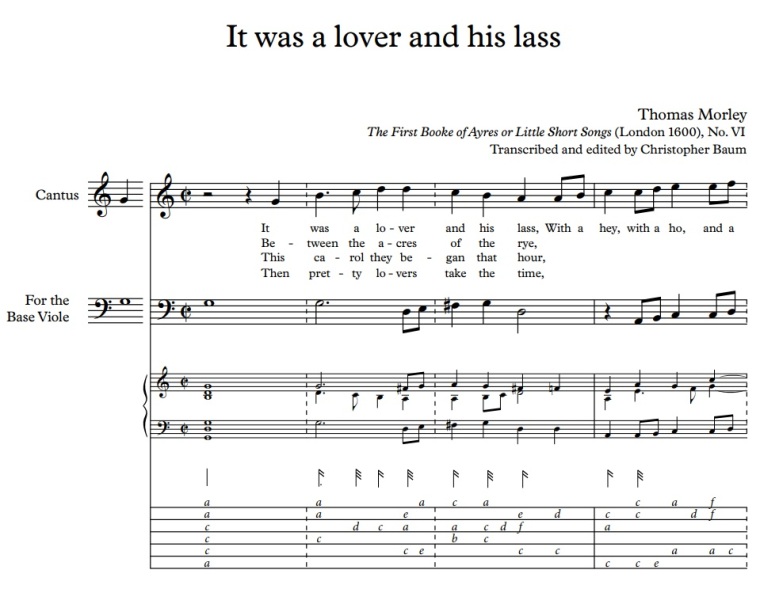
Thomas Morley (c1557 - 1602): It was a lover and his lass, ayre (pubblicato nel First Book of Ayres or Little Short Songs, 1600, n. 6) su testo di William Shakespeare (da Come vi piace, atto V, scena 3ª). Alfred Deller, haute-contre; Desmond Dupré, liuto.
It was a lover and his lass,
With a hey, and a ho, and a hey-nonny-no,
That o’er the green corn-field did pass
In spring-time, the only pretty ring-time,
When birds do sing, hey ding-a-ding ding:
Sweet lovers love the spring.
Between the acres of the rye,
These pretty country folks would lie.
This carol they began that hour,
How that a life was but a flower.
And therefore take the present time,
For love is crowned with the prime.
Thomas Morley è uno dei più importanti compositori di musica profana dell’Inghilterra elisabettiana; insieme con Robert Johnson (c1583-c1634) è autore delle uniche composizioni coeve su versi di Shakespeare che ci siano pervenute. Morley è ricordato, oltre che per le sue composizioni, per aver pubblicato un trattato musicale (A Plain and Easie Introduction to Practicall Musicke, 1597) che ebbe vasta popolarità per oltre duecento anni e che tuttora è considerato fondamentale perché contiene preziose informazioni sulla musica dell’epoca.
Thomas Morley is one of the most important composers of secular music in Elizabethan England; he and Robert Johnson (c1583-c1634) are the authors of the only surviving contemporary musical settings on lyrics by Shakespeare. Morley is remembered, as well as for his compositions, for a musical treatise (A Plain and Easie Introduction to Practicall Musicke, 1597) which had large popularity for almost two centuries and even today is an important reference for information about sixteenth century music.
John Dowland (1563 - 1626): Now, O Now I Needs Must Part, ayre (pubblicato nel First Booke of Songes or Ayres of foure partes with Tableture for the Lute, 1597, n. 6). Les Canards Chantants: Sarah Holland, soprano; Robin Bier, contralto; Edd Ingham, tenore; Graham Bier, basso. Con la collaborazione del liutista Jacob Heringman, che all’inizio e alla fine [5:00] esegue la Frog Galliard di Dowland, composta sul medesimo tema musicale dell’ayre.
Now, o now I needs must part,
Parting though I absent mourn.
Absence can no joy impart:
Joy once fled cannot return.
While I live I needs must love,
Love lives not when Hope is gone.
Now at last Despair doth prove,
Love divided loveth none.
Sad despair doth drive me hence;
This despair unkindness sends.
If that parting be offence,
It is she which then offends.
Once the world moved not so fast,
Yet the journey sweeter seemed.
Now I see you rushing past,
No more time to stay and dream.
Dear when I from thee am gone,
Gone are all my joys at once,
I lov’d thee and thee alone,
In whose love I joyed once.
And although your sight I leave,
Sight wherein my joys do lie,
Till that death doth sense bereave,
Never shall affection die.
Dear, if I do not return,
Love and I shall die together.
For my absence never mourn
Whom you might have joyed ever;
Part we must though now I die,
Die I do to part with you.
Him despair doth cause to lie
Who both liv’d and dieth true.
(La quartina in corsivo non fa parte del testo originale: è un’interpolazione dei Canards Chantants, ideata appositamente per questo videoclip.)
Per ayre si intende un genere musicale fiorito in Inghilterra tra la fine del Cinquecento e la terza decade del secolo successivo. L’ayre è un brano a più voci (solitamente quattro) con accompagnamento di liuto; ciò che lo distingue dalle composizioni congeneri del periodo precedente è il fatto che alla voce più acuta è affidata una parte spiccatamente melodica, sul modello della «monodia accompagnata» italiana e dell’air de cour francese. Gli interpreti hanno dunque la possibilità di eseguire un ayre o secondo tradizione, con tutte le parti vocali e con l’accompagnamento del liuto ad libitum, oppure seguendo la moda dell’epoca, cioè con il canto della sola parte più acuta sostenuto dal liuto. In quest’ultimo caso, al liuto spesso si aggiunge una viola da gamba che ha il compito di irrobustire la linea del basso d’armonia.
Nel video dei Canards Chantants è visibile la riproduzione di una doppia pagina del First Booke di Dowland, stampato secondo le consuetudini dell’epoca, cioè disponendo le parti in modo che possano agevolmente essere lette da quattro cantanti seduti intorno a un tavolo; questo tipo di impaginazione è appunto detto “a libro di coro”.
Francesco Canova, detto Francesco da Milano, Francesco del Liuto e il Divino (1497 - 15 aprile 1543): Fantasia per liuto, n. 33 del catalogo Ness. Monica Pustilnik, vihuela.
David Kellner (c1670 - 6 aprile 1748): Chaconne in la maggiore per liuto (pubblicata in XVI. Auserlesene Lauten-Stücke, 1747, n. 7). José Miguel Moreno.
Filippo Azzaiolo (c1530/40 - p1570): Chi passa per ’sta strada, villotta a 4 voci. Eseguita da: The Musicians of Swanne Alley; The King’s Singers; Denis Raisin-Dadre, flauto, e ens. Doulce Mémoire; Yo-Yo Ma, violoncello, e The Silk Road Ensemble; Marco Beasley, voce, e ens. Accordone, dir. Guido Morini.
Chi passa per ‘sta strad’ e non sospira,
Beato s’è, falalilela,
Beato è chillo chi lo puote fare,
Per la reale.
Affacciati mo’
Se non ch’io moro mo’, falalilela.
Affacciati, ché tu mi dai la vita,
Meschino me, falalilela,
Se ‘l cielo non ti possa consolare,
Per la reale.
Affacciati mo’
Se non ch’io moro mo’, falalilela.
Et io ci passo da sera e mattina,
Meschino me, falalilela,
Et tu, crudele, non t’affacci mai,
Perché lo fai?
Affacciati mo’
Se non ch’io moro mo’, falalilela.
Compar Vassillo, che sta a loco suo,
Beato s’è, falalilela,
Salutami ‘no poco la comare,
Per la reale.
Affacciati mo’
Se non ch’io moro mo’, falalilela.
Giacomo Gorzanis (1525 - 1578): Padoana detta Chi passa per questa strada (trascrizione della villotta di Azzaiolo). Massimo Lonardi, liuto.
Anonimo (Inghilterra, sec. XVI): Chi passa (dal Marsh lute book). Valéry Sauvage, liuto.
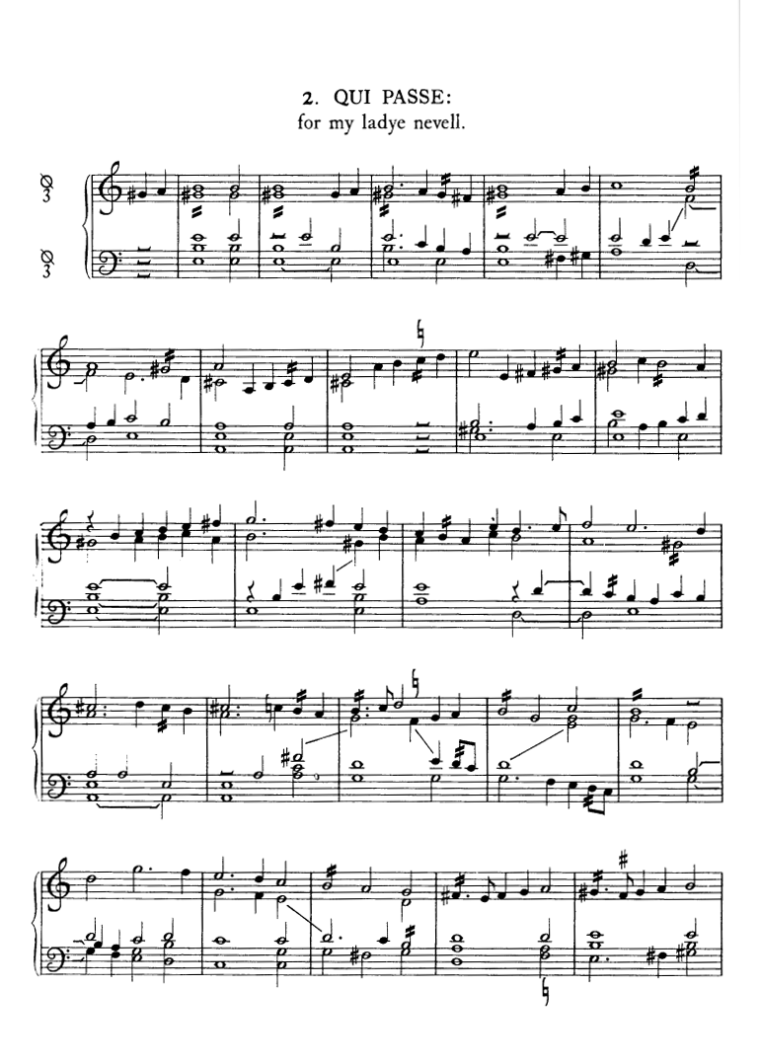
William Byrd (c1540 - 1623): Qui Passe, dal My Ladye Nevells Booke (n. 2). Timothy Roberts, virginale.
Thomas Campian (o Campion; 1567 - 1° marzo 1620): I care not for these ladies, ayre (pubblicato in A Booke of Ayres, 1601). Alfred Deller, controtenore; Desmond Dupré, liuto.
I care not for these ladies
That must be wooed and prayed:
Give me kind Amaryllis,
The wanton country maid.
Nature art disdaineth,
Her beauty is her own.
Her when we court and kiss,
She cries, “Forsooth, let go!”
But when we come where comfort is,
She never will say no.
If I love Amaryllis,
She gives me fruit and flowers:
But if we love these ladies,
We must give golden showers.
Give them gold, that sell love,
Give me the nut-brown lass,
Who, when we court and kiss,
She cries, “Forsooth, let go!”
But when we come where comfort is,
She never will say no.
These ladies must have pillows,
And beds by strangers wrought;
Give me a bower of willows,
Of moss and leaves unbought,
And fresh Amaryllis,
With milk and honey fed;
Who, when we court and kiss,
She cries, “Forsooth, let go!”
But when we come where comfort is,
She never will say no.
The Protestation: A Sonnet
(Thomas Carew, 1595 - 1640)
No more shall meads be deck’d with flowers,
Nor sweetness dwell in rosy bowers,
Nor greenest buds on branches spring,
Nor warbling birds delight to sing,
Nor April violets paint the grove,
If I forsake [When once I leave] my Celia’s love.
The fish shall in the ocean burn,
And fountains sweet shall bitter turn;
The humble oak no flood shall know,
When floods shall highest hills o’er-flow;
Blacke Lethe shall oblivion leave,
If e’er my Celia I deceive.
Love shall his bow and shaft lay by,
And Venus’ doves want wings to fly;
The sun refuse to show his light,
And day shall then be turn’d to night;
And in that night no star appear,
If once I leave my Celia dear.
Love shall no more inhabit earth,
Nor lovers more shall love for worth,
Nor joy above in heaven dwell,
Nor pain torment poor souls in hell;
Grim death no more shall horrid prove,
If e’er I leave bright Celia’s love.
Love’s Constancy, sul testo di Carew, è fra le composizioni più note di Nicholas Lanier (1588 - 24 febbraio 1666); in rete se ne trovano varie interpretazioni: vi propongo l’ascolto di quelle che mi paiono le più interessanti.
Amanda Sidebottom, soprano, e Erik Ryding, liuto.
Anna Dennis, soprano; Hanneke van Proosdij, clavicembalo; Elisabeth Reed, viola da gamba; David Tayler, chitarra barocca.
La performance del soprano Ellen Hargis accompagnata da Paul O’Dette alla tiorba è accessibile soltanto su YouTube, in quanto il proprietario del video ne ha disattivata la visione in altri siti web. Potete ascoltarla qui.
Hans Neusidler (1508 - 2 febbraio 1563): Wascha Mesa (passamezzo) per liuto (pubblicato in Ein newgeordent künstlich Lautenbuch, 1536). Valéry Sauvage.
Di Gentian, attivo intorno alla metà del Cinquecento, non si sa pressoché nulla; con il suo nome ci sono pervenute una ventina di chansons, quasi tutte pubblicate da Attaingnant. Di Je suis Robert ho trovato in rete, fra le altre, queste due interpretazioni: a voce sola e liuto, eseguita da Valéry Sauvage; e a quattro voci, quelle del formidabile Ensemble «Clément Janequin».
Je suis Robert, le beau Robert,
Qui la brunette tant aimoit.
Ne scauroit on trouver un messagier en France
Qui se voulust aller au jardin de plaisance
Dire à Robert, Robert, le beau Robert,
Que la brunette se mouroit.
Je suis Robert…
Quand Robert eust oui la certaine nouvelle
Il a bridé Moreau et luy a mis la selle,
Picqua des é- des éperons jolis,
Pour la brunette secourir.
Je suis Robert…
Quand Robert fust entré au milieu de la ville
Il a oui chanter l’alouette jolie
Qui en son chant, son joli chant disoit
Que la brunette guérissoit.
Je suis Robert, le beau Robert,
Qui la brunette tant aimoit.
Due diversissime interpretazioni della canzonetta a 4 voci Fa’ una canzone di Orazio Vecchi (6 dicembre 1550 - 1605). Ensemble Arduo d’Amore e duo Munia Cabal – Rómulo Vega-González.
Fa’ una canzone senza note nere,
Se mai bramasti la mia grazia havere,
Falla d’un tuono ch’invita al dormire,
Dolcemente, dolcemente facendola finire.
Per entro non vi spargere durezze
Ché le mie orecchie non vi sono avezze.
Né vi far cifra o segno contra segno:
Sopra ogni cosa quest’è ‘l mio disegno.
Con questo stile il fortunato Orfeo
Proserpina la giù placar poteo.
Questo è lo stile che quetar già feo
Con dolcezza a Saul lo spirto reo.
Henry Lawes (5 dicembre 1595 - 1662): Slide soft, you silver floods, ayre. Anna Prohaska, soprano; Simon Martyn-Ellis, liuto.
Slide soft, you silver floods
And ev’ry Spring
Within these shady woods.
Let no bird sing,
But from this grove a turtle dove
Be seen to couple with his love.
But silence on each dale and mountain dwell,
Whilst that I weeping bid my love farewell.
You nymphs of Thetis’ train,
You mermaids fair
That on these shores do plane
Your seagreen hair,
As you in trammels knit your locks
Weep ye, and force the craggy rocks.
In heavy murmurs through broad shores tell
How that I weeping bid my love farewell.
Thomas Ford (c1580 - sepolto il 17 novembre 1648): Faire, sweet, cruell, ayre (pubblicato in Musicke of Sundrie Kindes, 1607, vol. I, n. 7). Victoria Cassano, soprano; Javier Ovejero Mayoral, liuto.
Faire, sweet, cruell, why doest thou flie mee,
Goe not, oh goe not from thy deerest,
Though thou doest hasten I am nie thee,
When thou see’mst farre then am I neerest,
Tarrie then and take me with you.
Fie, fie, sweetest here is no danger,
Flie not, oh flie not loue pursues thee,
I am no foe, nor forraine stranger,
Thy scornes with fresher hope renewes me,
Tarrie then and take me with you.
Claudin de Sermisy (c1490 - 13 ottobre 1562): Secourez moy, chanson a 4 voci (pubblicata nella raccolta Trente et sept chansons musicales a quatre parties, 1531); testo di Clément Marot. Ensemble «Clément Janequin».
Secourez-moi ma dame par amours
Ou autrement la mort me vient quérir.
Autre que vous ne peut donner secours
À mon las coeur lequel s’en va mourir.
Hélas, hélas, venez tôt secourir
Celui qui vit pour vous en grand tristesse,
Car de son coeur vous êtes la maîtresse.
Anonimo (XVI-XVII secolo): O bella più che la stella diana, aria a voce sola e continuo. Ensemble A Musicall Banquet: Baltazar Zúñiga, tenore; Rebeca Ferri, violoncello; Francesco Tomasi, liuto.
O bella più che la stella diana,
Che par innanzi della mia patrona,
Mia regina, dolce mio amore,
Pietà, cuor mio, pietà, non più dolore.
Bene mio caro, cuore mio bello,
Tu sei la mala morte mia,
La freccia che mi passa il cuore.
Con questa composizione di autore ignoto si conclude la raccolta A Musicall Banquet pubblicata a Londra nel 1610 a cura di Robert Dowland (1591 - 1641).
Giulio Caccini (1551 - 1618): Amarilli, mia bella, aria a voce sola e basso continuo (pubblicata nel volume Le nuove musiche, 1601, n. 8). Emma Kirkby, soprano; Anthony Rooley, liuto.
Amarilli, mia bella
Non credi, o del mio cor dolce desio,
D’esser tu l’amor mio?
Credilo pur, e se timor t’assale,
Prendi questo mio strale,
Aprimi il petto e vedrai scritto in core:
Amarilli, Amarilli, Amarilli
è il mio amore.
Amarilli, mia bella di Giulio Caccini venne poi ripubblicata da Robert Dowland (1591 - 1641) nella raccolta A Musicall Banquet (Londra 1610, n. XIX).
Giulio Caccini (1551 - 1618): Dovrò dunque morire?, aria a voce sola e basso continuo su testo di Ottavio Rinuccini (pubblicata nel volume Le nuove musiche, 1601, n. 11). Anne Sofie von Otter, soprano; Jakob Lindberg, liuto.
Dovrò dunque morire?
Pria che di nuovo io miri,
voi bramata cagion de miei martiri?
Mio perduto tesoro,
non potrò dirvi pria ch’io mora
Io moro?
O miseria inaudita,
non poter dir a voi morrò mia vita.
Questa aria di Giulio Caccini è stata poi ripubblicata da Robert Dowland (1591 - 1641) nella raccolta A Musicall Banquet (Londra 1610, n. XVIII).
Domenica Maria Melli (1545 - p1615): Se di farmi morire, aria a voce sola e continuo (pubblicata in Seconde musiche di Domenico Maria Melli, reggiano: Madrigali, canzonette, arie, dialoghi, a una e due voci per cantare nel chitarrone o cembalo, 1602, n. 8). Ensemble A Musicall Banquet: Baltazar Zúñiga, tenore; Rebeca Ferri, violoncello; Francesco Tomasi, liuto.
Se di farmi morire
Con crudeltà pensate,
Certo che v’ingannate.
Ché da la crudeltà nascono l’ire,
E da l’ire lo sdegno
Che scaccia Amor
Dal suo superbo regno.
Questo brano è stato poi ripubblicato da Robert Dowland (1591 - 1641) nella raccolta A Musicall Banquet (Londra 1610, n. XVII).
Anonimo (XVI-XVII secolo): Sta notte mi sognava, aria pubblicata da Robert Dowland nella raccolta A Musicall Banquet (Londra 1610, n. XV). Andreas Scholl, controtenore; Marcus Märkl, liuto.
Sta notte mi sognava
ch’all’inferno mestamente me n’andava,
non per i miei peccati
ma per veder che fanno i dannati.
Stando là mi pareva
che nel mezzo Plutone si sedeva
tra quei spiriti infernali
che dann’all’alma tanti strazi mali.


 Valéry Sauvage performs the earliest known version of Greensleeves (anonymous, found in a manuscript known as the William Ballet’s Lute Book, c1590-1603) and the variations by Francis Cutting (c1550 - 1595/96).
 Dopo aver ascoltato








 Thomas Ford (c1580 - sepolto il 17 novembre 1648): Faire, sweet, cruell, ayre (pubblicato in Musicke of Sundrie Kindes, 1607, vol. I, n. 7). Victoria Cassano, soprano; Javier Ovejero Mayoral, liuto.



 la regina gioiosa