Per Romeo e Giulietta

David Diamond (1915 - 13 giugno 2005): Music for Shakespeare’s «Romeo and Juliet», suite per orchestra (1947). New York Chamber Symphony Orchestra, dir. Gerard Schwarz.

  1. Overture: Allegro Maestoso
  2. Balcony Scene: Andante semplice [3:10
  3. Romeo and Friar Laurence: Andante [8:16
  4. Juliet and her Nurse: Allegretto scherzando [11:58
  5. The Death of Romeo and Juliet: Andante sospirando [14:11]


L’approfondimento
di Pierfrancesco Di Vanni

David Diamond: melodie americane tra trionfi e avversità

David Diamond viene oggi ricordato come una figura di spicco tra i compositori della sua generazione negli Stati Uniti. Le sue prime opere si distinguono per l’uso di armonie triadiche, spesso con ampie spaziature che conferiscono loro un carattere tipicamente americano, sebbene alcune composizioni riflettano consapevolmente un’influenza stilistica francese. Con il tempo, il suo linguaggio musicale si orientò verso un maggiore cromatismo.

Formazione prestigiosa e inizi di carriera
Nato a Rochester, New York, Diamond intraprese studi musicali approfonditi presso il Cleveland Institute of Music e la Eastman School of Music, dove fu allievo di Bernard Rogers. Perfezionò la sua formazione ricevendo lezioni private da figure di calibro internazionale come Roger Sessions a New York City e Nadia Boulanger a Parigi. Il suo talento fu presto riconosciuto con numerosi premi, tra cui ben tre Guggenheim Fellowship, che ne attestarono il precoce valore.

Opere significative e contributi multimediali
Il suo brano più celebre è Rounds (1944) per orchestra d’archi, un pezzo che gode di vasta popolarità. Il suo catalogo compositivo è tuttavia ampio e diversificato, includendo 11 sinfonie (l’ultima completata nel 1993), diversi concerti (tra cui tre per violino), 11 quartetti d’archi, musica per ensemble di fiati, altra musica da camera, pezzi per pianoforte e composizioni vocali. Diamond estese la propria attività anche al mondo dei media, componendo il tema musicale per il programma radiofonico della CBS Hear It Now (1950–51) e per la sua successiva versione televisiva, See It Now (1951–58).

L’insegnamento e l’influenza sulle nuove generazioni
Oltre alla sua attività compositiva, Diamond fu una figura influente nell’ambito accademico. Venne nominato compositore-in-residenza onorario della Seattle Symphony e fu per lungo tempo membro della facoltà della prestigiosa Juilliard School. Tra i suoi studenti più noti si annoverano Alan Belkin, Robert Black, Kenneth Fuchs, Albert Glinsky, Daron Hagen, Adolphus Hailstork, Anthony Iannaccone, Philip Lasser, Lowell Liebermann, Alasdair MacLean, Charles Strouse, Francis Thorne, Kendall Durelle Briggs ed Eric Whitacre. È inoltre riconosciuto il suo ruolo di consulente per Glenn Gould, in particolare per il suo Quartetto d’archi op. 1.

Riconoscimenti ufficiali, le sfide di una vita controcorrentee la morte
Il valore artistico del compositore ricevette importanti riconoscimenti ufficiali, tra cui la National Medal of Arts (1995) e la Edward MacDowell Medal (1991). Tuttavia, la sua carriera non fu priva di ostacoli. Diamond fu apertamente omosessuale in un’epoca in cui ciò non era socialmente accettato e lui stesso riteneva che la sua progressione professionale fosse stata rallentata da omofobia e antisemitismo. Un necrologio su The Guardian sottolinea come, dopo un periodo di grande successo negli anni ’40 e primi ’50, l’ascesa delle scuole seriali e moderniste negli anni ’60 e ’70 lo relegò in secondo piano. Similmente, il New York Times lo descrisse come «un importante compositore americano la cui precoce brillantezza negli anni ’40 fu eclissata dal predominio della musica atonale», collocandolo in una "generazione dimenticata" di grandi sinfonisti americani insieme a Howard Hanson, Roy Harris, William Schuman, Walter Piston e Peter Mennin. Lo stesso New York Times suggerì che i problemi di carriera di Diamond potessero essere stati esacerbati anche dalla sua "personalità difficile", citando un’intervista del 1990 in cui il compositore ammetteva di essere stato un giovane emotivo e diretto, propenso a creare scene pubbliche con figure autorevoli come i direttori d’orchestra. Morì il 13 giugno 2005 nella sua casa di Brighton, New York, a causa di un’insufficienza cardiaca.

Music for Shakespeare’s «Romeo and Juliet»: analisi
Con questa suite sinfonica Diamond ha dimostrato l’attitudine a tradurre la potenza drammatica e la complessità emotiva del capolavoro shakespeariano con l’adozione di un linguaggio musicale ricco e accessibile. Composta durante il suo periodo di maggior successo, la suite riflette la sua maestria orchestrale e il suo stile prevalentemente tonale, arricchito da inflessioni modali e da un uso sapiente del cromatismo per accentuare la tensione emotiva. L’opera, pur essendo radicata nella tradizione, presenta una freschezza e una vitalità che la rendono un ascolto coinvolgente.
L’ouverture funge da preludio, introducendo l’atmosfera generale della tragedia, accennando ai temi principali del conflitto e dell’amore contrastato. Il movimento si apre con una fanfara potente e maestosa affidata agli ottoni, caratterizzata da armonie ampie e brillanti, tipiche di un certo "suono americano" che Diamond sapeva evocare. Questa introduzione imposta un tono eroico e quasi regale, ma con un sottofondo di tensione. Ben presto, gli archi introducono un tema lirico e ampio, dal carattere appassionato e romantico, che potrebbe rappresentare l’amore nascente tra i due protagonisti. La scrittura per archi è fluida e cantabile. Diamond sviluppa questi materiali contrastanti: sezioni più ritmiche e percussive, con accenti marcati e un’energia propulsiva, sembrano dipingere il conflitto tra le famiglie Montecchi e Capuleti. I legni intervengono con passaggi più agili e talvolta delicati, aggiungendo colore e varietà timbrica. L’orchestrazione è ricca e piena, sfruttando l’intera gamma dinamica dell’orchestra e costruendo progressivamente verso climax sonori di grande impatto, quasi cinematografico. L’armonia rimane prevalentemente tonale, ma con un uso espressivo di dissonanze e modulazioni che ne arricchiscono la tavolozza emotiva senza mai sfociare nell’atonalità. L’Allegro maestoso cattura efficacemente la grandezza della tragedia e la passione che la pervade.
Il secondo movimento è la rappresentazione musicale della celeberrima scena del balcone, l’incontro segreto e appassionato tra Romeo e Giulietta, culmine del loro amore giovanile. Il tempo Andante semplice preannuncia la natura intima e tenera del movimento. La musica si fa subito più rarefatta e delicata rispetto all’ouverture. Un flauto solista introduce una melodia dolce e sognante, quasi un sospiro, che incarna la voce di Giulietta. Gli archi, spesso con sordina, creano un tappeto sonoro etereo e brillante, mentre l’arpa aggiunge tocchi di magia e romanticismo con i suoi arpeggi. Il dialogo musicale tra i legni (flauto, oboe, clarinetto) evoca le tenere conversazioni tra i due amanti. Le melodie sono liriche, espressive e cariche di un lirismo cantabile che riflette la purezza e l’intensità del loro sentimento. L’armonia è lussureggiante e romantica, prevalentemente tonale ma con un uso più marcato di cromatismi e accordi arricchiti (settime, none) per esprimere la profondità dell’emozione. Diamond costruisce con maestria un crescendo emotivo che, pur rimanendo contenuto nella dinamica, raggiunge un apice di intensità prima di dissolversi in una conclusione sospesa e sognante, lasciando l’ascoltatore immerso nell’incanto della scena. La scrittura per legni qui potrebbe rivelare quell’influenza francese menzionata nella biografia del compositore.
Il terzo movimento è ispirato alla scena nella quale Romeo si confida con Frate Lorenzo, cercando consiglio e aiuto. La scena implica un misto di speranza giovanile e la saggezza, forse un po’ preoccupata, del frate. L’atmosfera cambia nettamente. L’Andante qui ha un carattere più grave e riflessivo. Il movimento si apre con un tema solenne e quasi austero negli archi bassi e nel fagotto, che potrebbe rappresentare la figura saggia e autorevole di Frate Lorenzo. Le linee melodiche hanno a tratti un andamento modale, quasi da corale, che sottolinea la natura religiosa del frate.
A questo materiale si contrappongono interventi più agitati e appassionati, spesso affidati agli archi acuti o a brevi frammenti dei legni, che esprimono l’impazienza e l’ardore di Romeo. L’orchestrazione è più scura e densa rispetto al movimento precedente, con un maggior peso dato agli strumenti gravi. Diamond sviluppa un vero e proprio dialogo musicale, alternando momenti di calma riflessione a improvvisi slanci emotivi. La tensione armonica aumenta gradualmente, con un uso più frequente di cromatismi che suggeriscono le preoccupazioni del frate e il destino incerto degli amanti. Il movimento si conclude in modo pensoso, quasi interrogativo, lasciando una sensazione di presagio.
Il quarto movimento dipinge l’interazione tra Giulietta e la sua Nutrice, una figura affettuosa ma anche loquace e talvolta comica. C’è un misto di impazienza giovanile (di Giulietta) e di bonaria prolissità (della Nutrice). L’indicazione Allegretto scherzando è perfettamente realizzata. La musica è leggera, vivace e piena di spirito. I legni (flauto, oboe, clarinetto in particolare) sono protagonisti con passaggi rapidi, quasi "chiacchiericci", che evocano la garrulità della Nutrice e la giocosità della scena. Gli archi contribuiscono con pizzicati agili e accompagnamenti staccati che accentuano il carattere scherzoso. Il ritmo è brioso e danzante, con frequenti cambi di metro o accenti spostati che conferiscono un’aria di imprevedibilità e umorismo. Non mancano brevi episodi più lirici e teneri, forse a rappresentare i pensieri amorosi di Giulietta, che si intrecciano con le sezioni più giocose. L’orchestrazione è trasparente e brillante, e anche qui la scrittura per legni, arguta e colorata, potrebbe richiamare un’estetica francese. È un movimento che dimostra la versatilità di Diamond nel passare da atmosfere intense a momenti di leggerezza.
L’ultimo movimento rappresenta il tragico epilogo della storia: la morte dei due amanti. "Sospirando" suggerisce il dolore e l’agonia. Questa parte si apre con un’atmosfera di profonda desolazione e tragedia. Il tempo è lento, il carattere funereo. Gli archi gravi, i tromboni e il corno inglese (o un oboe dal timbro particolarmente dolente) intonano melodie frammentate, cariche di dolore e "sospiri" musicali, spesso realizzati con appoggiature e risoluzioni cromatiche. L’armonia si fa decisamente più cromatica e dissonante, esprimendo l’angoscia e la disperazione. Diamond costruisce la tensione attraverso lunghi crescendo che sfociano in accordi potenti e drammatici, seguiti da improvvisi silenzi o momenti di estrema rarefazione sonora, come se la musica stessa ansimasse per il dolore. L’uso del timpano con rulli sommessi o colpi secchi accentua la fatalità della situazione. Le linee melodiche sono spezzate, piene di intervalli che esprimono sofferenza (come le seconde minori o i tritoni). Verso la conclusione, dopo l’apice della disperazione, la musica sembra placarsi in una sorta di rassegnazione tragica, forse con un accenno a una bellezza ultraterrena, ma il senso predominante è quello della perdita irreparabile. L’orchestra viene utilizzata in tutta la sua potenza espressiva, dai pianissimi più desolati ai fortissimi più strazianti, chiudendo la suite con un senso di catarsi dolorosa.

Nel complesso, la suite è un’opera di grande forza drammatica e raffinatezza orchestrale. Il compositore riesce a catturare l’essenza di ogni scena chiave della tragedia, utilizzando un linguaggio tonale arricchito da elementi moderni, senza mai perdere la comunicativa emotiva. La sua abilità nel creare atmosfere contrastanti, dalla tenerezza lirica dell’amore giovanile alla cupezza della tragedia, e la sua scrittura idiomatica per l’orchestra, confermano il suo status di importante compositore americano del suo tempo. L’opera è un eccellente esempio di musica a programma del XX secolo che, pur non essendo innovativa come le avanguardie contemporanee, dimostra una profonda comprensione del dramma e una notevole maestria compositiva.
Shakespeariana – XXXVIII Greensleeves – XX 🇬🇧

Lady Greensleeves & Mistress Ford

Anonymous (second half of the sixteenth century, British): Greensleeves. Alfred Deller, countertenor; Desmond Dupre, lute.
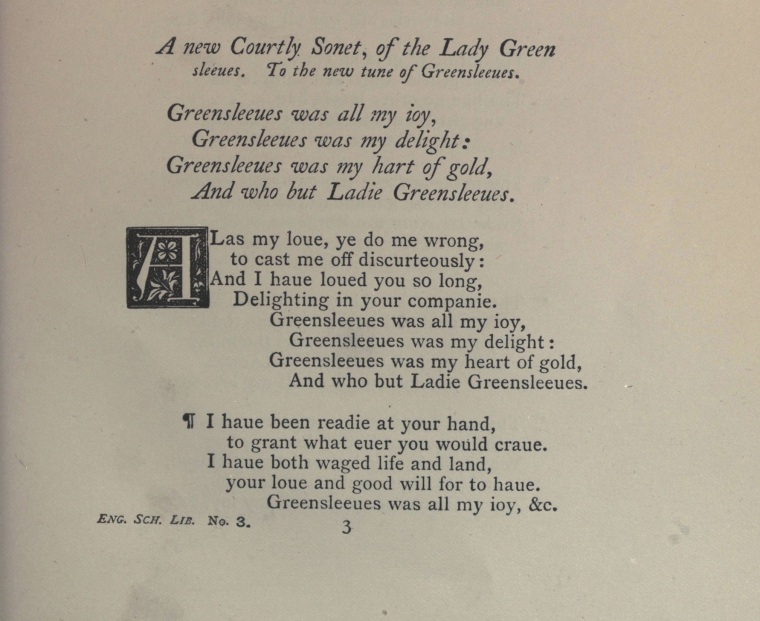
Deller’s interpretation gives us the opportunity to hear both the oldest known version of Greensleeves tune and some stanzas taken from the first known edition of the lyrics, a 1584 collection entitled A Handful of Pleasant Delites. Here is the full text (italicized stanzas are omitted by Deller):

Alas, my love, you do me wrong
To cast me off discourteously,
For I have loved you well and long,
Delighting in your company.

  Greensleeves was all my joy,
  Greensleeves was my delight,
  Greensleeves was my heart of gold,
  And who but my lady Greensleeves.

I have been ready at your hand,
To grant whatever you would crave;
I have both waged life and land,
Your love and good-will for to have.

I bought three kerchers to thy head,
That were wrought fine and gallantly;
I kept them both at board and bed,
Which cost my purse well-favour’dly.

I bought thee petticoats of the best,
The cloth so fine as fine might be:
I gave thee jewels for thy chest;
And all this cost I spent on thee.

Thy smock of silk both fair and white,
With gold embroidered gorgeously;
Thy petticoat of sendall right;
And this I bought thee gladly.

Thy girdle of gold so red,
With pearls bedecked sumptously,
The like no other lasses had;
And yet you do not love me!

Thy purse, and eke thy gay gilt knives,
Thy pin-case, gallant to the eye;
No better wore the burgess’ wives;
And yet thou wouldst not love me!

Thy gown was of the grassy green,
The sleeves of satin hanging by;
Which made thee be our harvest queen;
And yet thou wouldst not love me!

Thy garters fringed with the gold,
And silver aglets hanging by;
Which made thee blithe for to behold;
And yet thou wouldst not love me!

My gayest gelding thee I gave,
To ride wherever liked thee;
No lady ever was so brave;
And yet thou wouldst not love me!

My men were clothed all in green,
And they did ever wait on thee;
All this was gallant to be seen;
And yet thou wouldst not love me!

They set thee up, they took thee down,
They served thee with humility;
Thy foot might not once touch the ground;
And yet thou wouldst not love me!

For every morning, when thou rose,
I sent thee dainties, orderly,
To cheer thy stomach from all woes;
And yet thou wouldst not love me!

Thou couldst desire no earthly thing,
But still thou hadst it readily,
Thy music still to play and sing;
And yet thou wouldst not love me!

And who did pay for all this gear,
That thou didst spend when pleased thee?
Even I that am rejected here,
And thou disdainst to love me!

Well! I will pray to God on high,
That thou my constancy mayst see,
And that, yet once before I die,
Thou wilt vouchsafe to love me!

Greensleeves, now farewell! Adieu!
God I pray to prosper thee!

For I am still thy lover true;
Come once again and love me!

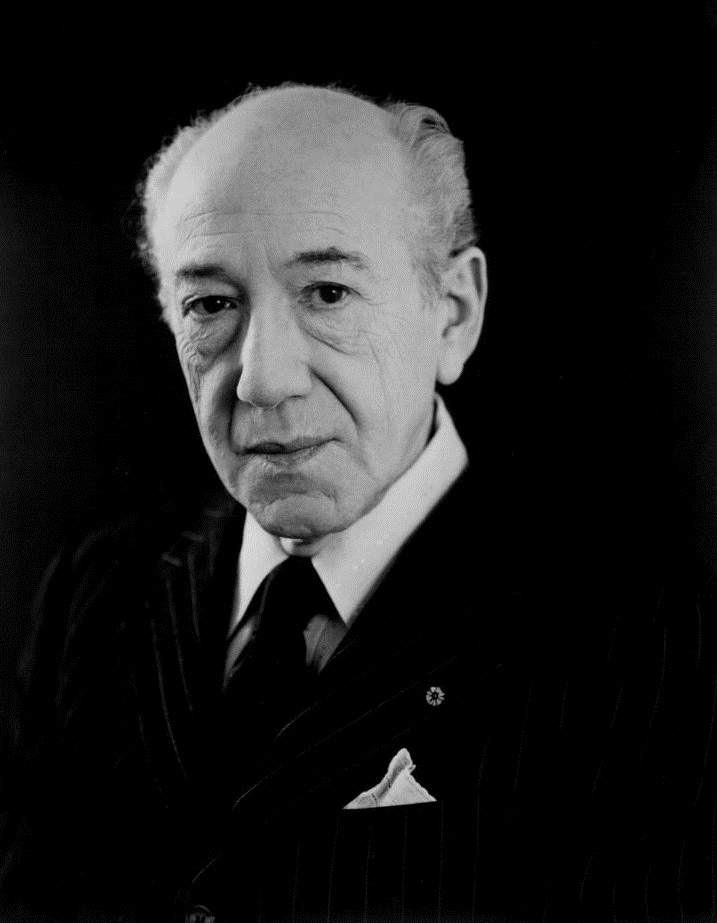
Incipit From a reprint, dated 1878, of A Handful of Pleasant Delites
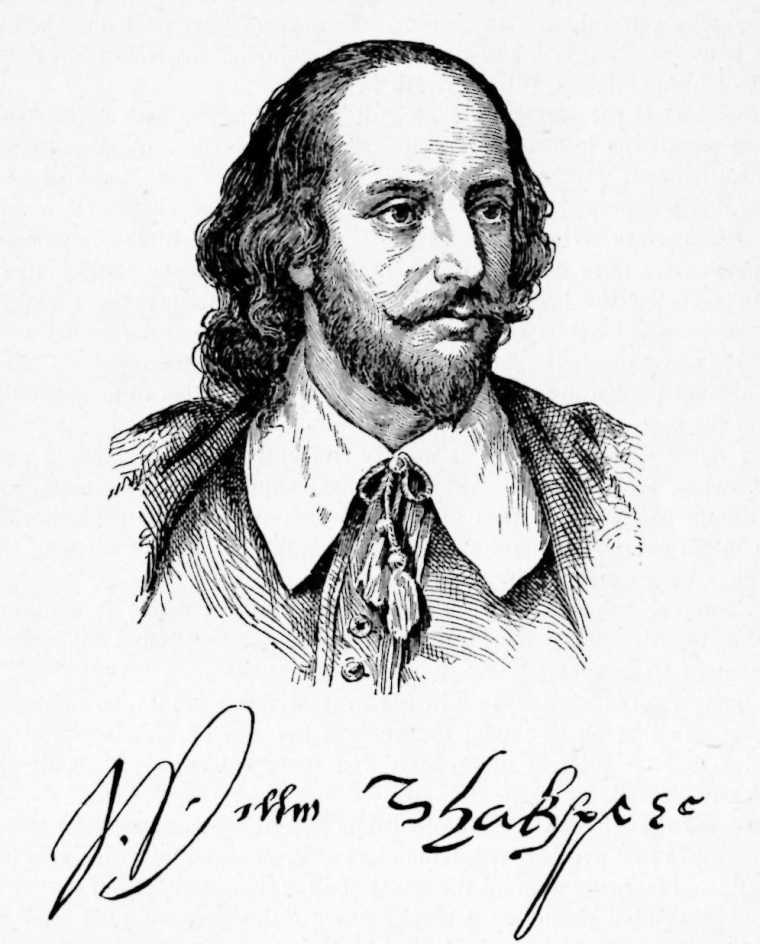

Greensleeves cannot be missing from an anthology of Shakespearean music: the ballad of the beautiful green-sleeved lady is in fact mentioned twice in the comedy The Merry Wives of Windsor (first published in 1602, though believed to have been written in or before 1597). Its plot is well known: the pot-bellied and cash-strapped knight John Falstaff awkwardly tries to seduce two ladies, Mistress Ford and Mistress Page, married to wealthy merchants living in Windsor (in Berkshire); by gaining their favour, Sir John hopes to fix his financial woe, but is quickly unmasked: the wives find he sent them identical love letters and take revenge by playing tricks on Falstaff.
When the hoax comes to light, Mistress Ford comments on the fact with these words (act 2, scene 1):

I shall think the worse of fat men, as long as I have an eye to make difference of men’s liking: and yet he would not swear; praised women’s modesty; and gave such orderly and well-behaved reproof to all uncomeliness, that I would have sworn his disposition would have gone to the truth of his words; but they do no more adhere and keep place together than the Hundredth Psalm to the tune of Green Sleeves.

It’s true: Psalm 100 does not adhere to Greensleeves; but it must be said that this is a purely metrical matter — the verses of the psalm («O be joyful in the Lord, all ye lands» according to the Great Bible, 1539) do not fit at all to the tune of the ballad — and not a sort of moral prohibition. Adapting a sacred text to a familiar secular melody (this is called contrafactum) has never been a problem, and we have already seen (click here) that Greensleeves itself has given its tune to a religious chant.

The last prank against Falstaff takes place in the forest of Windsor, where he is invited to go, dressed as a hunter, for a love rendezvous (act 5, scene 5). «Sir John!» says Mistress Ford, «Art thou there, my deer? my male deer?»; Falstaff replies by stating that «a tempest of provocation» will not be able to distract him from her, even if the sky thunders «to the tune of Green Sleeves»:

My doe with the black scut! Let the sky rain potatoes; let it thunder to the tune of Green Sleeves, hail kissing-comfits and snow eringoes; let there come a tempest of provocation, I will shelter me here.

(A few brief explanations:
potatoes: when the potato was introduced to Europe, precisely at the time of Shake­speare, it was considered an aphrodisiac;
kissing-comfits: perfumed sugar sweets, used to freshen the breath;
eringoes: does not refer to the herbaceous plants of this name, but to the pleurotus eryngii, called king trumpet or king oyster mushroom, considered an aphrodisiac since ancient times.)

Shakespeare

Shakespeariana – XXXVIII Greensleeves – XX 🇮🇹

Lady Greensleeves & Mistress Ford

Anonimo inglese della seconda metà del Cinquecento: Greensleeves. Alfred Deller, controtenore; Desmond Dupré, liuto.
L’interpretazione di Deller e Dupré ci dà modo di ascoltare la più antica versione conosciuta della melodia e, insieme, alcune strofe tratte dalla prima edizione nota del testo, una raccolta del 1584 intitolata A Handful of Pleasant Delites. Ecco il testo completo (le parti in corsivo sono omesse da Deller):

Alas, my love, you do me wrong
To cast me off discourteously,
For I have loved you well and long,
Delighting in your company.

  Greensleeves was all my joy,
  Greensleeves was my delight,
  Greensleeves was my heart of gold,
  And who but my lady Greensleeves.

I have been ready at your hand,
To grant whatever you would crave;
I have both waged life and land,
Your love and good-will for to have.

I bought three kerchers to thy head,
That were wrought fine and gallantly;
I kept them both at board and bed,
Which cost my purse well-favour’dly.

I bought thee petticoats of the best,
The cloth so fine as fine might be:
I gave thee jewels for thy chest;
And all this cost I spent on thee.

Thy smock of silk both fair and white,
With gold embroidered gorgeously;
Thy petticoat of sendall right;
And this I bought thee gladly.

Thy girdle of gold so red,
With pearls bedecked sumptously,
The like no other lasses had;
And yet you do not love me!

Thy purse, and eke thy gay gilt knives,
Thy pin-case, gallant to the eye;
No better wore the burgess’ wives;
And yet thou wouldst not love me!

Thy gown was of the grassy green,
The sleeves of satin hanging by;
Which made thee be our harvest queen;
And yet thou wouldst not love me!

Thy garters fringed with the gold,
And silver aglets hanging by;
Which made thee blithe for to behold;
And yet thou wouldst not love me!

My gayest gelding thee I gave,
To ride wherever liked thee;
No lady ever was so brave;
And yet thou wouldst not love me!

My men were clothed all in green,
And they did ever wait on thee;
All this was gallant to be seen;
And yet thou wouldst not love me!

They set thee up, they took thee down,
They served thee with humility;
Thy foot might not once touch the ground;
And yet thou wouldst not love me!

For every morning, when thou rose,
I sent thee dainties, orderly,
To cheer thy stomach from all woes;
And yet thou wouldst not love me!

Thou couldst desire no earthly thing,
But still thou hadst it readily,
Thy music still to play and sing;
And yet thou wouldst not love me!

And who did pay for all this gear,
That thou didst spend when pleased thee?
Even I that am rejected here,
And thou disdainst to love me!

Well! I will pray to God on high,
That thou my constancy mayst see,
And that, yet once before I die,
Thou wilt vouchsafe to love me!

Greensleeves, now farewell! Adieu!
God I pray to prosper thee!

For I am still thy lover true;
Come once again and love me!

Incipit Da una ristampa, datata 1878, di A Handful of Pleasant Delites


In una antologia di «musica scespiriana», Greensleeves non può mancare: la canzone della bella signora dalle maniche verdi è infatti menzionata nella commedia The Merry Wives of Windsor (pubblicata per la prima volta nel 1602, ma si ritiene sia stata scritta prima del 1597). La trama è nota: il panciuto e squattrinato cavaliere John Falstaff tenta maldestramente di sedurre due signore, Mistress Ford e Mistress Page, sposate a ricchi borghesi di Windsor (nel Berkshire); ottenendo i loro favori sir John spera di sistemare le proprie finanze, ma viene subito smascherato: le due donne si accorgono di aver ricevuto lettere d’amore identiche, perciò decidono di vendicarsi e ordiscono alcune perfide burle ai danni di Falstaff.
Quando l’imbroglio viene scoperto, questo è il commento di Mistress Ford (atto II, scena 1ª):

I shall think the worse of fat men, as long as I have an eye to make difference of men’s liking: and yet he would not swear; praised women’s modesty; and gave such orderly and well-behaved reproof to all uncomeliness, that I would have sworn his disposition would have gone to the truth of his words; but they do no more adhere and keep place together than the Hundredth Psalm to the tune of Green Sleeves.

È vero, Greensleeves non va d’accordo con il Salmo 100: ma è un impedimento di carattere puramente metrico – i versi («Acclamate il Signore, voi tutti della terra»; nella versione della Great Bible, 1539: «O be joyful in the Lord, all ye lands») non combaciano affatto con la melodia – e non una sorta di divieto morale. L’adattamento di un testo sacro a una melodia profana («travestimento spirituale») non ha mai costituito un problema, e del resto abbiamo già visto (qui) che, nel corso della sua storia pluricentenaria, la stessa Greensleeves ha prestato la propria melodia a un canto religioso.

L’ultima burla ai danni di Falstaff ha luogo nella foresta di Windsor, dove egli viene invitato a recarsi, vestito da cacciatore, per un incontro amoroso (atto V, scena 5ª). «Sir John!», lo apostrofa Mistress Ford, «Art thou there, my deer? my male deer?»; Falstaff risponde affermando che nemmeno una «tempesta di amorose provocazioni», fra le quali la melodia di Greensleeves, riuscirà a distoglierlo da lei:

My doe with the black scut! Let the sky rain potatoes; let it thunder to the tune of Green Sleeves, hail kissing-comfits and snow eringoes; let there come a tempest of provocation, I will shelter me here.

(Qualche breve spiegazione:
potatoes: quando la patata fu introdotta in Europa, appunto all’epoca di Shakespeare, era considerata afrodisiaca;
kissing-comfits: dolcetti di zucchero profumati, usati per rinfrescare l’alito;
eringoes: non si riferisce alle piante erbacee in Italia chiamate calcatreppole, bensì al fungo da noi comunemente noto come cardoncello, nome scientifico pleurotus eryngii, fin dall’Antichità considerato afrodisiaco.)

Shakespeare

Shakespeariana – XXXVII

Symphonie dramatique

Hector Berlioz (1803 - 1869): Roméo et Juliette, symphonie dramatique op. 17 (1839); libretto by Émile Deschamps, based on Shakespeare’s play Romeo and Juliet. Marianne Crebassa, mezzo-soprano; Paolo Fanale, tenor; Alex Esposito, bass; Choeur de Radio France directed by Howard Arman; Orchestre national de France; Daniele Gatti, conductor.

PREMIÈRE PARTIE

  1. Introduction: Combats – Tumulte – Intervention du Prince [1:45]

  2. Prologue:

    Récitatif choral: «D’anciennes haines endormies» [6:50]
    Strophes: «Premiers transports que nul n’oublie» [12:09]
    Récitatif et Scherzetto: «Bientôt de Roméo la pâle rêverie» [19:27]

DEUXIÈME PARTIE

  1. Roméo seul – Tristesse – Bruits lontains de concert et bal [23:13]
    Grande fête chez Capulet [30:50]

  2. Nuit sereine – Le Jardin de Capulet, silencieux et désert – Les jeunes Capulets, sortant de la fête, passent en chantant des réminiscences de la musique du bal – Scène d’amour [37:30]

  3. Scherzo: La reine Mab, ou la Fée des songes [59:33]

TROISIÈME PARTIE

  1. Convoi funèbre de Juliette: «Jetez des fleurs pour la vierge expirée» [1:07:59]

  2. Roméo au tombeau des Capulets [1:18:43]

  3. Finale:

    La foule accourt au cimetière – Rixe des Capulet et des Montagus [1:26:59]
    Récitatif et Air du Père Laurence: «Pauvres enfants que je pleure» [1:31:19]
    Serment de réconciliation: «Jurez donc par l’auguste symbole» [1:40:20]

Shakespeariana – XXXVI

Like a worm in the bud

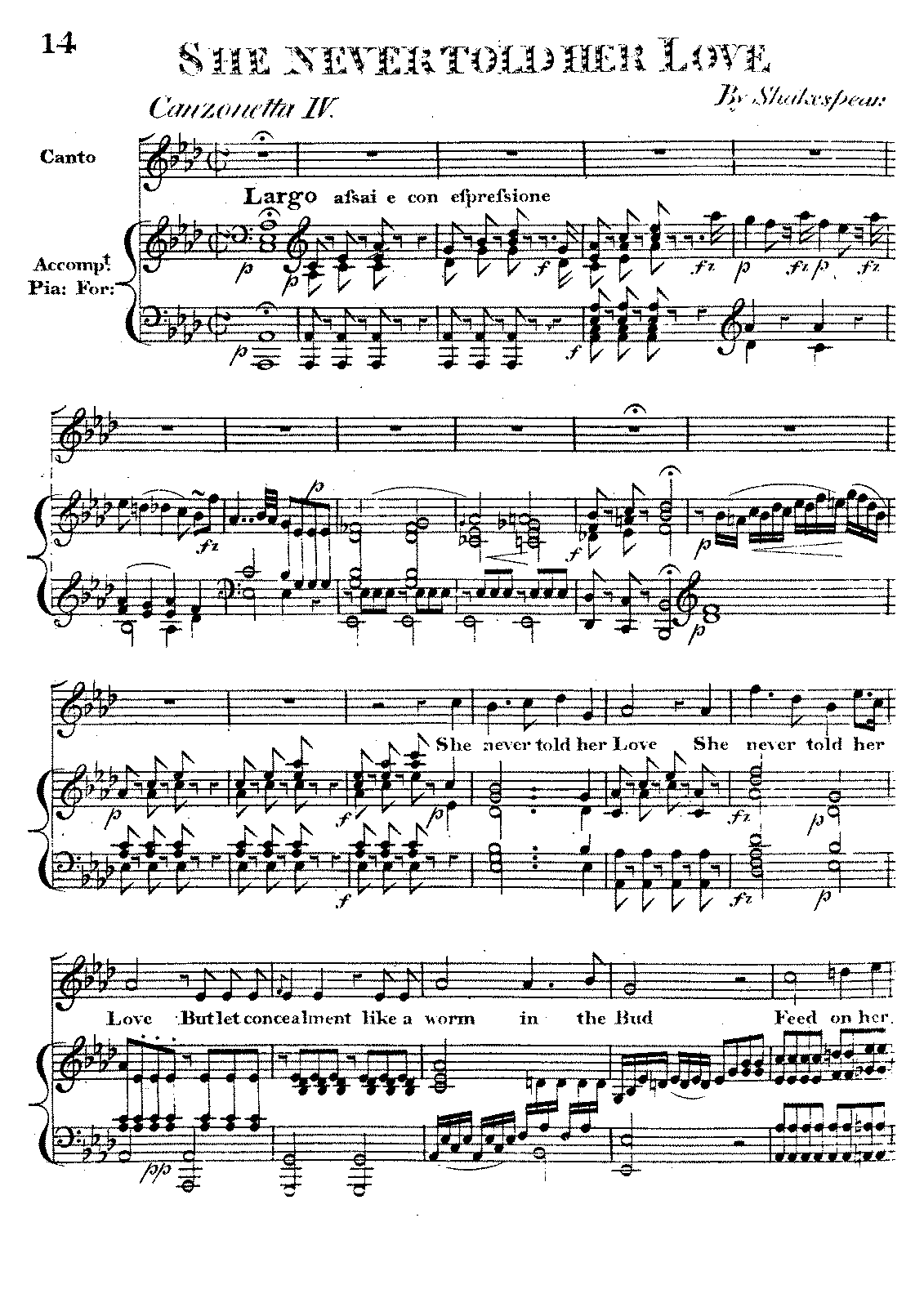
Franz Josef Haydn (1732 - 1809): She never told her love, canzonetta for voice and keyboard instrument Hob.XXVIa:34 (1794-95); lyrics by William Shakespeare (Twelfth Night, act 2, scene 4). Anne Sofie von Otter, mezzo-soprano; Melvyn Tan, fortepiano.

She never told her love,
but let concealment,
like a worm in the bud,
feed on her damask cheek,
she sat,
like patience on a monument,
smiling, smiling at grief.

Shakespeariana – XXXV

Beauty and kindness

Franz Schubert (1797 - 1828): An Silvia, Lied for voice and piano op. 106 n. 4, D 891 (1826); lyrics by William Shakespeare (from The Two Gentlemen of Verona, act 4, scene 2), German translation by Eduard von Bauernfeld. Fritz Wunderlich, tenor; Hubert Giesen, piano.

Was ist Silvia, saget an,
Dass sie die weite Flur preist?
Schön und zart seh’ ich sie nah’n,
Auf Himmels Gunst und Spur weist,
Dass ihr alles untertan.

Ist sie schön und gut dazu?
Reiz labt wie milde Kindheit;
Ihrem Aug’ eilt Amor zu,
Dort heilt er seine Blindheit,
Und verweilt in süsser Ruh’.

Darum Silvia, tön’, o Sang,
Der holden Silvia Ehren;
Jeden Reiz besiegt sie lang,
Den Erde kann gewähren:
Kränze ihr und Saitenklang!

Who is Silvia? what is she,
That all our swains commend her?
Holy, fair, and wise is she;
The heaven such grace did lend her,
That she might admirèd be.

Is she kind as she is fair?
For beauty lives with kindness.
Love doth to her eyes repair,
To help him of his blindness;
And, being helped, inhabits there.

Then to Silvia let us sing,
That Silvia is excelling;
She excels each mortal thing
Upon the dull earth dwelling;
To her let us garlands bring

Shakespeariana – XXXIV

Mendelssohn’s Dream

Felix Mendelssohn-Bartholdy (1809 - 1847): Ein Sommernachtstraum, ouverture op. 21 (1826) and incidental music op. 61 (1842) for William Shakespeare’s play A Midsummer Night’s Dream. Edith Mathis and Ursula Boese, sopranos; Chor des Bayerischen Rundfunks and Symphonieorchester des Bayerischen Rund­funks conducted by Rafael Kubelík.

(In published scores, Overture and Finale are usually not numbered.)
     Ouvertüre: Allegro vivace

  1. Scherzo: Allegro molto vivace [11:48]
  2. L’istesso tempo [16:33]
  3. Bunte Schlangen (Lied mit Chor): Allegro non troppo [17:49]

    ERSTER ELFE

    Bunte Schlangen, zweigezüngt!
    Igel, Molche, fort von hier!
    Dass ihr euren Gift nicht bringt
    In der Königin Revier!
    Fort von hier!

    ERSTER ELFE, ZWEITER ELFE UND CHOR

    Nachtigall, mit Melodei
    Sing in unser Eya popey!
    Eya popey! Eya popey!
    Dass kein Spruch,
    Kein Zauberfluch,
    Der holden Herrin schädlich sei.
    Nun gute Nacht mit Eya popey!

    ZWEITER ELFE

    Schwarze Käfer,
    Uns umgebt nicht mit Summen,
    Macht euch fort!
    Spinnen die ihr künstlich webt,
    Webt an einem andern Ort!

    ERSTER ELFE

    Alles gut! Nun auf und fort!
    Einer halte Wache dort!

  4. Intermezzo: Allegro appassionato [21:03]
  5. Notturno: Con moto tranquillo [24:26]
  6. Hochzeitmarsch (Wedding March): Allegro vivace [30:02]
  7. Marcia funebre (Funeral March): Allegro commodo [34:45]
  8. Ein Tanz von Rüpeln (A dance of clowns): Allegro molto [35:37]

    Finale mit Chor: Allegro vivace [37:15]

    CHOR DER ELFEN

    Bei des Feuers mattem Flimmern,
    Geister, Elfen, stellt euch ein!
    Tanzet in den bunten Zimmern
    Manchen leichten Ringelreihn!
    Singt nach seiner Lieder Weise!
    Singet! hüpfet lose, leise!

    ERSTER ELFE (Solo)

    Wirbelt mir mit zarter Kunst
    Eine Not auf jedes Wort,
    Hand in Hand, mit Feeengunst,
    Singt und segnet diesen Ort!

    CHOR DER ELFEN

    Bei des Feuers mattem Flimmern,
    Geister, Elfen, stellt euch ein!
    Tanzet in den bunten Zimmern
    Manchen leichten Ringelreihn!
    Singt nach seiner Lieder Weise!
    Singet! hüpfet lose, leise!
    Nun genung,
    Fort im Sprung,
    Trefft ihn in der Dämmerung!

Shakespeariana – XXXIII

English translation: please click here.

Il suon d’argento


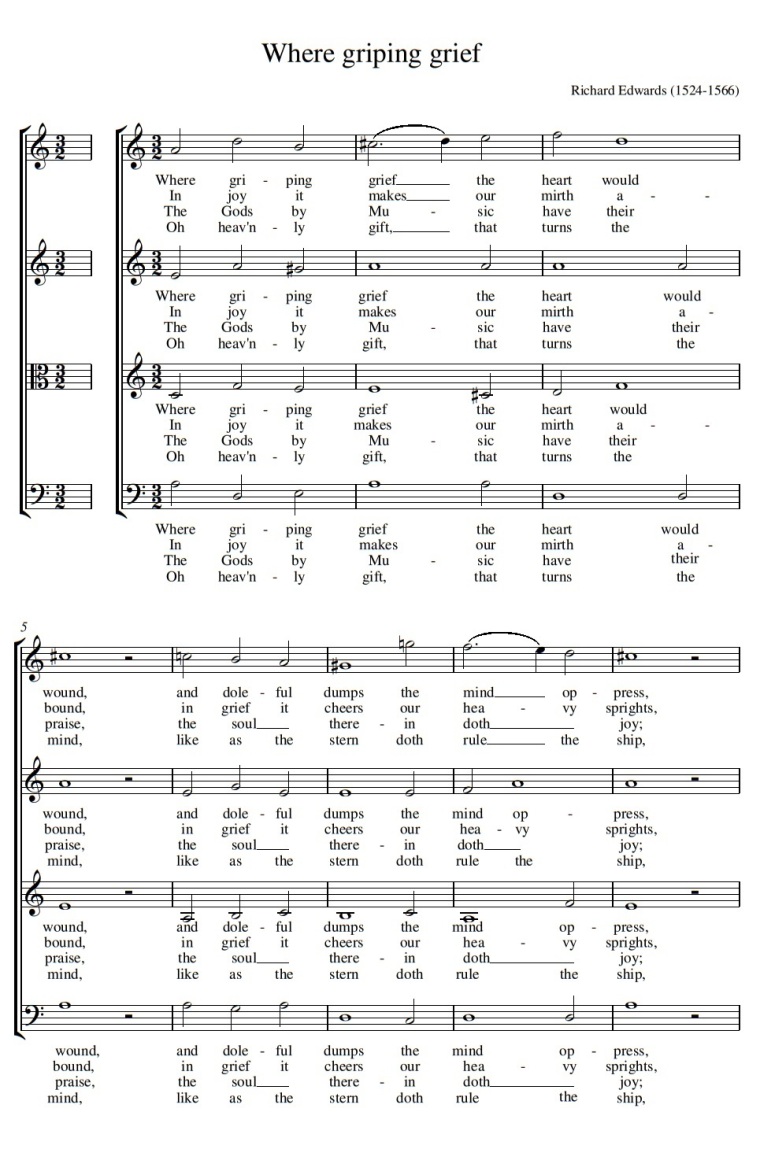
Anonimo (probabilmente Richard Edwardes, 1525 - 1566): Where griping grief. Versione per voce (soprano) e liuto: Emma Kirkby e Anthony Rooley. Versione a 4 voci: Deller Consort.

Where griping grief the heart would wound
 And doleful dumps the mind oppress,
There music with her silver sound
 Is wont with speed to give redress
Of troubled minds, for ev’ry sore,
 Sweet music hath a salve in store.

In joy it makes our mirth abound,
 In grief it cheers our heavy sprites,
The careful head relief hath found,
 By music’s pleasant sweet delights;
Our senses, what should I say more,
 Are subject unto Music’s law.

The gods by music have their praise,
 The soul therein doth joy;
For as the Roman poets say,
 In seas whom pirates would destroy,
A dolphin saved from death most sharp,
 Arion playing on his harp.

O heavenly gift, that turns the mind,
 Like as the stern doth rule the ship,
Of music whom the gods assigned,
 To comfort man whom cares would nip,
Since thou both man and beast doth move,
 What wise man then will thee reprove.


Forse figlio illegittimo di Enrico VIII, Richard Edwardes fu poeta, autore drammatico, gen­tiluo­mo della Chapel Royal e maestro del coro di voci bianche della medesima istituzione sotto le regine Maria e Elisabetta I. Nei suoi ultimi anni compilò un’ampia silloge di testi poetici di autori diversi, cui aggiunse, firmandoli, alcuni componimenti propri, e fra questi appunto Where gripyng grief, con il titolo In commendation of Musick. La raccolta, intitolata The Paradise of Dainty Devices, fu pubbli­cata postuma nel 1576, a cura di Henry Disle; dei molti volumi mi­scel­la­nei dati alle stampe in quel periodo fu il più fortunato, tant’è vero che fu ristampato nove volte nei successivi trent’anni.
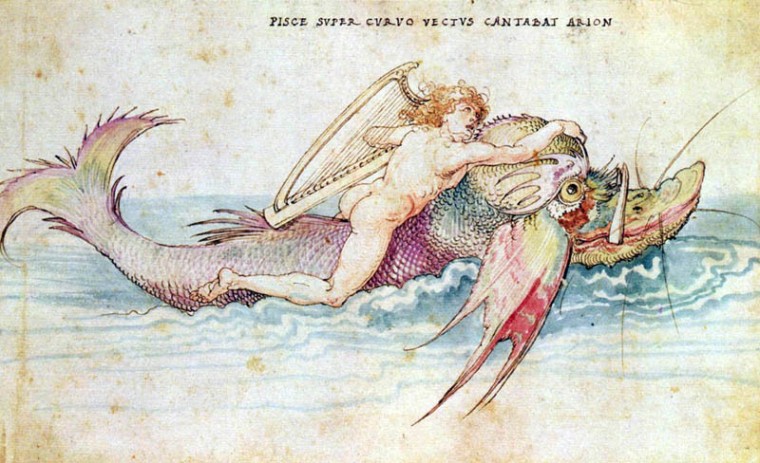
Del testo si trovano, anche nel web, numerose varianti, quasi tutte di poco conto, a cominciare da «When… Then…» invece di «Where… There…» nella prima strofa; ma è chiaramente un errore l’«Anon» che non di rado sostituisce «Arion» all’inizio dell’ultimo verso della terza strofa: Edwardes fa infatti riferimento a Arione di Métimna, l’antico citaredo che secondo Erodoto inventò il ditirambo e che, racconta il mito, si salvò da sicura morte in mare lasciandosi portare a riva da un delfino che aveva ammaliato con il canto.

Dürer: Arion (c1514)
Albrecht Dürer: Arion (c1514)

Le due fonti manoscritte che ci hanno tramandato la musica di Where griping grief (il Mulliner Book, raccolta di composizioni per strumento a tastiera databile fra il 1550 e il 1585 circa; e il Brogyntyn Lute Book, c1595) non riportano né il testo né il nome dell’autore: si ritiene probabile che anche la musica sia dello stesso Edwardes. La melodia è finemente cesellata; pur procedendo prevalentemente per gradi congiunti, presenta non pochi intervalli più ampi, fra cui un’insolita (per l’epoca) ottava diminuita — sulle parole «dumps the» nel secondo verso della prima strofa.

Il brano doveva essere abbastanza noto all’epoca di Shakespeare, perché questi lo cita in una scena di Romeo e Giulietta. Alla fine del IV atto, dopo che la Nutrice ha rinvenuto il corpo esanime della giovane Capuleti e un cupo inatteso dolore strazia i suoi familiari, alcuni musicisti, che erano stati convocati per allietare la festa delle nozze di Giulietta con il conte Paride, ripongono mestamente gli strumenti e stanno per andarsene quando sopraggiunge Pietro (servitore della Nutrice) e chiede ai musici di suonare per lui; gli altri rispondono che non è il momento adatto per far musica, sicché Pietro inizia a battibeccare con loro e infine, citando Where griping grief, trova il modo di insolentirli. La scena consiste in una lunga serie di giochi di parole a sfondo musicale, da alcuni critici considerati di bassa lega — tanto che qualche traduttore italiano ha pensato bene di omettere l’intero passo. Ma secondo me la scena non è affatto priva di interesse, ragion per cui la riporto qui di seguito: a sinistra l’originale inglese, a destra non esattamente una traduzione, ma piuttosto una reinterpretazione, con alcune esplicite allusioni a musiche famose ai tempi del Bardo e già note ai frequentatori di questo blog.

PETER
Musicians, O musicians, Heart’s Ease, Heart’s Ease. O, an you will have me live, play Heart’s Ease.
PIETRO
Musici, o musici, Chi passa, Chi passa. Se volete ch’io viva, suonate Chi passa.
FIRST MUSICIAN
Why Heart’s ease?
1° MUSICO
Perché Chi passa?
PETER
O musicians, because my heart itself plays My Heart is Full. O, play me some merry dump to comfort me.
PIETRO
O musici, perché il mio cuore sta danzando un passamezzo che non passa. Prego, suonate qualche allegro lamento per confortarmi.
FIRST MUSICIAN
Not a dump, we. ‘Tis no time to play now.
1° MUSICO
No, niente lamenti. Non è il momento di suonare.
PETER
You will not then?
PIETRO
Non volete suonare?
FIRST MUSICIAN
No.
1° MUSICO
No.
PETER
I will then give it you soundly.
PIETRO
Allora ve le suonerò io, sentirete.
FIRST MUSICIAN
What will you give us?
1° MUSICO
Che cosa sentiremo?
PETER
No money, on my faith, but the gleek. I will give you the minstrel.
PIETRO
Oh, non un tintinnar di monete, ve l’assicuro, ma piuttosto una canzon…atura. Ecco, vi tratterò da menestrelli.
FIRST MUSICIAN
Then I will give you the serving creature.
1° MUSICO
E allora noi ti tratteremo da giullare.
PETER
Then will I lay the serving creature’s dagger on your pate. I will carry no crotchets. I’ll re you, I’ll fa you. Do you note me?
PIETRO
E allora riceverete la sonagliera del giullare sulla zucca. Vi avevo chiesto lamenti e mi date capricci. Così ve le suonerò: prendete nota.
FIRST MUSICIAN
An you re us and fa us, you note us.
1° MUSICO
Se ce le suoni, prenderemo davvero le tue note.
SECOND MUSICIAN
Pray you, put up your dagger and put out your wit.
2° MUSICO
Per favore, riponi la tua sonagliera e va’ adagio.
PETER
Then have at you with my wit. I will dry-beat you with an iron wit and put up my iron dagger. Answer me like men.
(sings)
 When griping grief the heart doth wound
 And doleful dumps the mind oppress,
 Then Music with her silver sound—
Why «silver sound»? Why «Music with her silver sound»? What say you, Simon Catling?
PIETRO
Andrò a mio agio e vi metterò a disagio. I miei adagi non sono meno pesanti della sonagliera. Rispondete dunque, da uomini, ai miei colpi.
(canta)
 Quando ferisce il cuore arduo tormento
 E la mente grava penoso tedio,
 Allora Musica dal suon d’argento…
Perché «suon d’argento»? Perché dice «Musica dal suon d’argento»? Tu che ne dici, Simon Cantino?
FIRST MUSICIAN
Marry, sir, because silver hath a sweet sound.
1° MUSICO
Diamine, signore, perché l’argento ha un dolce suono.
PETER
Prates. What say you, Hugh Rebeck?
PIETRO
Ciance. E tu che dici, Ugo Ribeca?
SECOND MUSICIAN
I say, «silver sound» because musicians sound for silver.
2° MUSICO
Dico: «suon d’argento» perché i musicisti suonano per guadagnarsi dell’argento.
PETER
Prates too. What say you, James Soundpost?
PIETRO
Ciance anche queste. E tu, Giaco Bischero?
THIRD MUSICIAN
Faith, I know not what to say.
3° MUSICO
In fede mia, non so che dire.
PETER
Oh, I cry you mercy, you are the singer. I will say for you. It is «Music with her silver sound» because musicians have no gold for sounding.
(sings)
 Then Music with her silver sound
 With speedy help doth lend redress.
(exit)
PIETRO
Oh, ti chiedo scusa: tu sei quello che canta. Be’, risponderò io per te: dice «Musica col suon d’argento» perché i musicisti non hanno mai oro da far risonare.
(canta)
 Allora Musica dal suon d’argento
 Con lesto soccorso pone rimedio.
(esce)
FIRST MUSICIAN
What a pestilent knave is this same!
1° MUSICO
Che pestifero furfante è costui!
SECOND MUSICIAN
Hang him, Jack! Come, we’ll in here, tarry for the mourners and stay dinner.
(exeunt)
2° MUSICO
Lascialo perdere! Venite, entriamo: aspette­remo quelli che verranno per il funerale e ci fermeremo a pranzo.
(escono)

Shakespeariana – XXXIII

Her silver sound


Anonymous (probably Richard Edwardes, 1525 - 1566): Where griping grief. Two versions:
– as a song for 1 voice (soprano) and lute: Emma Kirkby and Anthony Rooley.
– as a partsong for 4 voices: the Deller Consort.

Where griping grief the heart would wound
 And doleful dumps the mind oppress,
There music with her silver sound
 Is wont with speed to give redress
Of troubled minds, for ev’ry sore,
 Sweet music hath a salve in store.

In joy it makes our mirth abound,
 In grief it cheers our heavy sprites,
The careful head relief hath found,
 By music’s pleasant sweet delights;
Our senses, what should I say more,
 Are subject unto Music’s law.

The gods by music have their praise,
 The soul therein doth joy;
For as the Roman poets say,
 In seas whom pirates would destroy,
A dolphin saved from death most sharp,
 Arion playing on his harp.

O heavenly gift, that turns the mind,
 Like as the stern doth rule the ship,
Of music whom the gods assigned,
 To comfort man whom cares would nip,
Since thou both man and beast doth move,
 What wise man then will thee reprove.


Richard Edwardes, possibly an illegitimate son of Henry VIII, was a poet, playwright, gentleman of the Chapel Royal and choirmaster of the same institution in the reigns of Mary and Elizabeth I. In his later years he compiled an extensive anthology of poems by various authors, adding his own, including Where griping grief (under the title In commendation of Musick). The anthology, titled The Paradise of Dainty Devices, appeared posthumously in 1576, edited by Henry Disle; it was the most successful of the numerous miscellaneous books printed at the end of the sixteenth century: it was in fact reprinted nine times in the following thirty years.

There are, even on the Internet, many variants of Where griping grief, almost all of little importance, such as for example «When… Then…» instead of «Where… There…» in the first line; but the «Anon» which often replaces «Arion» at the beginning of the last line of the third stanza is clearly a mistake: Edwardes in fact refers to Arion of Methymna, a kitharode in ancient Greece credited with inventing the dithyramb: according to the myth, Arion was saved from certain death at sea by being carried ashore by a dolphin that he had enchanted with his own singing.

Dürer: Arion (c1514)
Albrecht Dürer: Arion (c1514)

The two manuscript sources that have handed down the music of Where griping grief (the Mulliner Book, a collection of pieces for keyboard instrument dating between about 1550 and 1585; and the Brogyntyn Lute Book, c1595) do not bear neither the text nor the name of the composer: the music is thought to be probably by Edwardes himself. Where griping grief has a finely chiseled tune; though proceeding mainly in joint degrees, it has several larger intervals, including an unusual (at that time) diminished octave — to the words «dumps the» in the second line of the first stanza.

Where griping grief must have been quite well known in Shakespeare’s time, so much so that its first stanza is quoted in a scene from Romeo and Juliet, at the end of the fourth act, after the Nurse has found the lifeless body of the young Capulet and a gloomy unexpected pain torments his relatives; the news also saddens some musicians, who had been summoned to cheer Juliet’s wedding party: they are putting away their instruments before leaving when Peter (the Nurse’s servant) asks them to play for him; since the musicians have no intention of pleasing him, Peter begins to argue with them and finally, quoting Where griping grief, finds a way to insult them.

PETER

Answer me like men.
(sings)
 When griping grief the heart doth wound
 And doleful dumps the mind oppress,
 Then Music with her silver sound—
Why «silver sound»? Why «Music with her silver sound»? What say you, Simon Catling?

FIRST MUSICIAN

Marry, sir, because silver hath a sweet sound.

PETER

Prates. What say you, Hugh Rebeck?

SECOND MUSICIAN

I say, «silver sound» because musicians sound for silver.

PETER

Prates too. What say you, James Soundpost?

THIRD MUSICIAN

Faith, I know not what to say.

PETER

Oh, I cry you mercy, you are the singer. I will say for you. It is «Music with her silver sound» because musicians have no gold for sounding.
(sings)
 Then Music with her silver sound
 With speedy help doth lend redress.
(exit)

Shakespeariana – XXXII

MacBallet

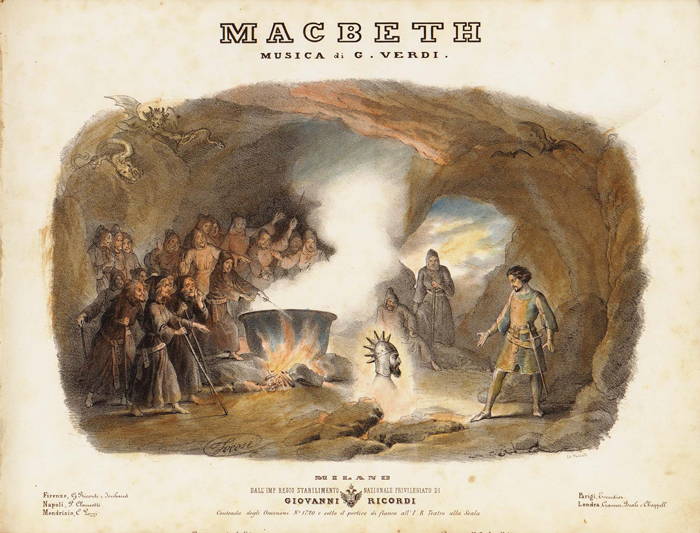
Giuseppe Verdi (1813 - 1901): Ballet music from Macbeth (1865). WDR Rundfunk­or­chester, dir. Massimo Zanetti.

Based on Shakespeare’s play of the same name, Verdi’s Macbeth was premiered on March 14th, 1847. The ballet scene was added to Verdi’s special Paris debut: the new version of the opera was first performed on April 21st, 1865.

Greensleeves – XVI

Diego Ortiz (c1510 - c1570): Recercada quinta sobre el passamezzo antiguo: Zarabanda, dal Tratado de glosas (trattato sulle variazioni, 1553). Hespèrion XXI, dir. e viola da gamba Jordi Savall.


Diego Ortiz: Recercada VII sobre la romanesca. Stessi interpreti.

Forse, ascoltando queste recercadas vi sarà venuta in mente Greensleeves: una ragione c’è, ora vedremo di che si tratta.
Passamezzo e romanesca sono danze in voga nel Cinquecento e nei primi anni del secolo successivo. Il passamezzo, di origine italiana, ha andamento lievemente mosso e ritmo binario; sotto il profilo coreutico è molto affine alla pavana, tanto che non di rado, all’epoca, viene con questa identificato: nell’Orchésographie (1588), Thoinot Arbeau scrive che il passamezzo è «une pavane moins pesamment et d’une mesure plus légière». La musica del passamezzo si fonda sopra uno schema armonico caratteristico, non molto dissimile da quello della follia; i musicisti europei tardorinascimentali se ne innamorano e l’impiegano quale base di serie di variazioni e di composizioni vocali: fra gli esempi più celebri vi sono The Oak and the Ash e, appunto, Greensleeves.
Intorno alla metà del Cinquecento, lo schema armonico del passamezzo dà origine a una variante destinata a avere altrettanta fortuna: viene chiamata passamezzo moderno per distinguerla dall’altra, detta conseguentemente passamezzo antico. Nella seconda parte del secolo, a fianco di passamezzo antico e passamezzo moderno entrano nell’uso altre formule armoniche stilizzate, come per esempio quella detta romanesca, dal nome di una danza affine alla gagliarda, di origine forse italiana o forse spagnola. Lo schema della romanesca è quasi identico a quello del passamezzo antico, da cui differisce solo per l’accordo iniziale.
La più antica versione nota di Greensleeves, che risale agli anni ’80 del XVI secolo, si fonda sul passamezzo antico, ma nel volgere di breve tempo viene soppiantata da una variante che adotta il basso della romanesca. Quasi certamente è quest’ultima la ver­sione conosciuta da Shakespeare, il quale per due volte fa riferimento alla «melodia di Greensleeves» nella commedia Le allegre comari di Windsor (ce ne occuperemo presto). La versione originale, identificata nell’Ottocento dal musicografo inglese William Chappell (cui si deve la raccolta Popular Music of the Olden Time, 1855-59), è oggi la più nota e diffusa.

Listening to these recercadas, perhaps Greensleeves will have come to your mind: there’s a reason, now we’ll see what it’s about.
Passamezzo and romanesca were popular dances in the sixteenth and early seventeenth centuries. The passamezzo has Italian origins, slightly fast movement and binary rhythm; the dance is very similar to the pavana, so that in 16th century it was often identified with it: in his treatise Orchésographie (1588) Thoinot Arbeau asserts that the passamezzo is «une pavane moins pesamment et d’une mesure plus légière». The music of the passamezzo is based on a characteristic harmonic pattern, similar to that of the follia; late Renaissance European musicians fell in love with it and used it as a ground for sets of variations and for singing poetry: among the most famous examples are The Oak and the Ash and, precisely, Greensleeves.
Around the middle of the sixteenth century, the harmonic formula of the passamezzo gave rise to a variant that was equally successful: it was called passamezzo moderno to distinguish it from the other, consequently called passamezzo antico. During the second half of the century, alongside the passamezzo antico and moderno, other stylized harmonic formulas came into use, such as for example the romanesca, which took its name from a dance similar to the gagliarda, of Italian or perhaps Spanish origin. The pattern of the romanesca is almost identical to that of the passamezzo antico, from which it differs only in the first chord.
The earliest known version of Greensleeves, dating from about 1580, is based on the passamezzo antico ground, but was soon superseded by a variant adopting the harmonic formula of the romanesca. The latter is almost certainly the version known from Shakespeare, who refers twice to «the tune of Greensleeves» in the play The Merry Wives of Windsor (which we will deal with soon). The original version, identified in the 19th century by the English musicographer William Chappell (who published the collection Popular Music of the Olden Time, 1855-59), is today the best known and most widespread.

Shakespeariana – XXX

When my love swears

Oscar van Hemel (1892 - 1981): Four Shakespeare sonnets for mixed choir (1961). Vocaal Ensemble PANiek.

  1. Music to hear (Sonnet 8)

    Music to hear, why hear’st thou music sadly?
    Sweets with sweets war not, joy delights in joy.
    Why lovest thou that which thou receivest not gladly,
    Or else receivest with pleasure thine annoy?
    If the true concord of well-tunèd sounds,
    By unions married, do offend thine ear,
    They do but sweetly chide thee, who confounds
    In singleness the parts that thou shouldst bear.
    Mark how one string, sweet husband to another,
    Strikes each in each by mutual ordering,
    Resembling sire and child and happy mother,
    Who, all in one, one pleasing note do sing.
     Whose speechless song, being many, seeming one,
     Sings this to thee: «Thou single wilt prove none».

  2. No longer mourn (Sonnet 71) [1:32]

    No longer mourn for me when I am dead
    Than you shall hear the surly sullen bell
    Give warning to the world that I am fled
    From this vile world with vilest worms to dwell;
    Nay, if you read this line, remember not
    The hand that writ it; for I love you so,
    That I in your sweet thoughts would be forgot,
    If thinking on me then should make you woe.
    O, if (I say) you look upon this verse,
    When I (perhaps) compounded am with clay,
    Do not so much as my poor name rehearse,
    But let your love even with my life decay,
     Lest the wise world should look into your moan,
     And mock you with me after I am gone.

  3. The little love-god (Sonnet 154) [3:34]

    The little Love-god lying once asleep,
    Laid by his side his heart-inflaming brand,
    Whilst many nymphs that vowed chaste life to keep
    Came tripping by; but in her maiden hand
    The fairest votary took up that fire
    Which many legions of true hearts had warmed;
    And so the General of hot desire
    Was, sleeping, by a virgin hand disarmed.
    This brand she quenched in a cool well by,
    Which from Love’s fire took heat perpetual,
    Growing a bath and healthful remedy,
    For men diseased; but I, my mistress’ thrall,
     Came there for cure and this by that I prove,
     Love’s fire heats water, water cools not love.

  4. When my love swears (Sonnet 138) [5:09]

    When my love swears that she is made of truth,
    I do believe her, though I know she lies,
    That she might think me some untutored youth,
    Unlearnèd in the world’s false subtleties.
    Thus vainly thinking that she thinks me young,
    Although she knows my days are past the best,
    Simply I credit her false-speaking tongue:
    On both sides thus is simple truth suppressed.
    But wherefore says she not she is unjust?
    And wherefore say not I that I am old?
    Oh, love’s best habit is in seeming trust,
    And age in love loves not to have years told.
     Therefore I lie with her and she with me,
     And in our faults by lies we flattered be.

Oscar van Hemel

Shakespeariana – XXIX

Ivresse de jeunesse

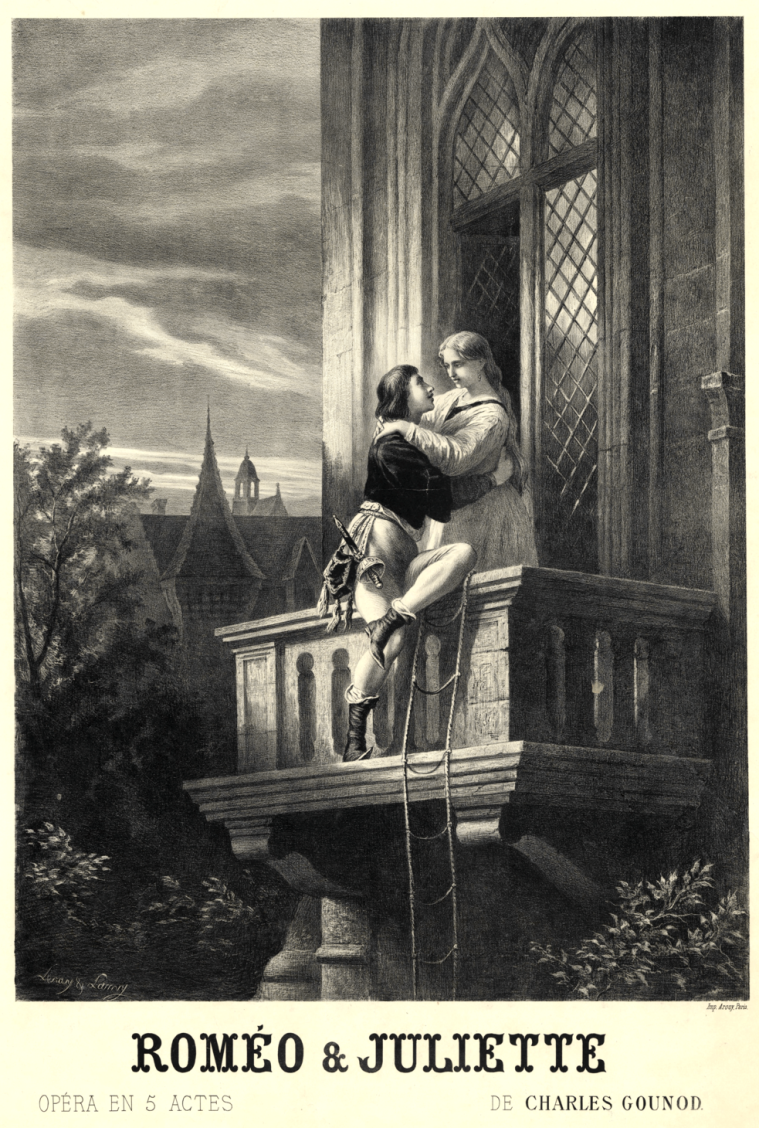
Charles Gounod (1818 - 1893): «Je veux vivre», Juliette’s valse-ariette (waltz song) from the 1st act of the opera Roméo et Juliette (1867), libretto by Jules Barbier and Michel Carré, based on Romeo and Juliet by William Shakespeare. Natalie Dessay, soprano; Orchestre du Capitole de Toulouse conducted by Michel Plasson.

Ah!
Je veux vivre
Dans ce rêve qui m’enivre
Ce jour encore!
Douce flamme,
Je te garde dans mon âme
Comme un trésor!

Cette ivresse de jeunesse
Ne dure, hélas, qu’un jour!
Puis vient l’heure
Où l’on pleure,
Le cœur cède à l’amour
Et le bonheur fuit sans retour!

Loin de l’hiver morose
Laisse-moi sommeiller
Et respirer la rose
Avant de l’effeuiller.

Shakespeariana – XXVIII

Ophelia sings

Anonymous (16th century): How should I your true love know, song of Ophelia from Shakespeare’s play Hamlet, act 4, scene 5. Alfred Deller, countertenor; Desmond Dupré, lute.

How should I your true-love know
From another one?
By his cockle bat and staff
And his sandal shoon.

He is dead and gone, lady,
He is dead and gone;
At his head a grass-green turf,
At his heels a stone.

White his shroud as the mountain snow,
Larded with sweet flowers.
Which bewept to the grave did go
With true-love showers.

Cabanel, Ophelia (1883)
Alexandre Cabanel (1823-1889): Ophelia (1883)

Shakespeariana – XXVII

Romeo and Juliet, a piano suite

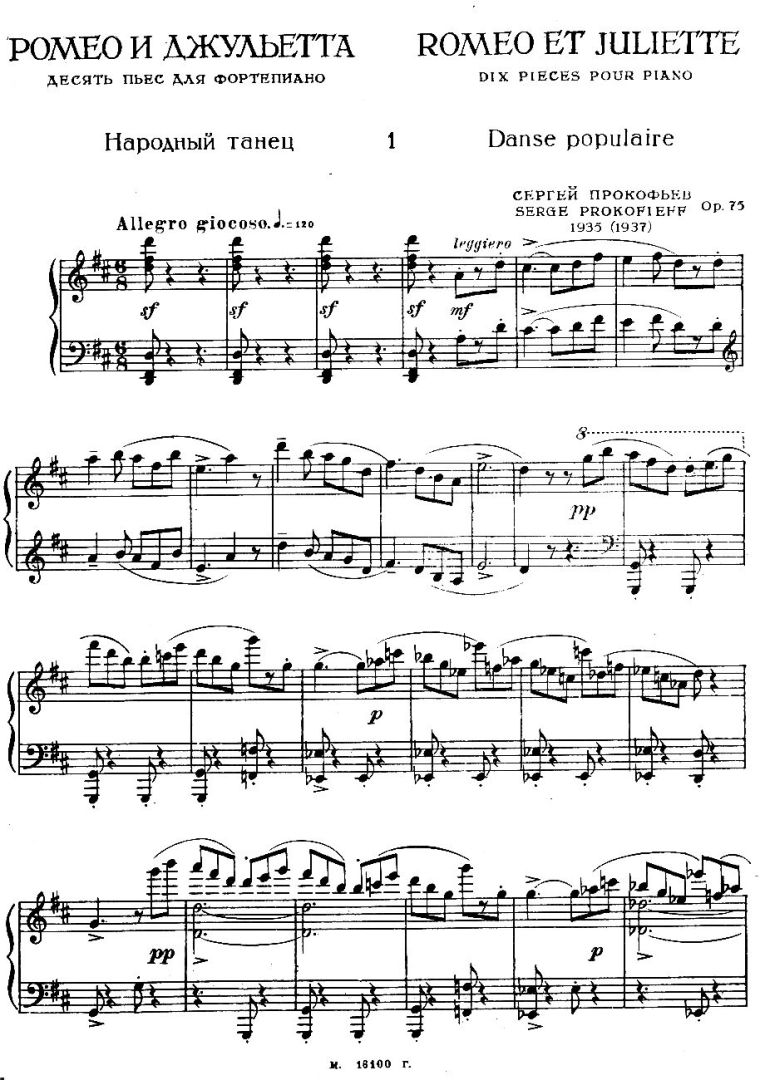
Sergei Prokofiev (Sergej Sergeevič Prokof’ev; 1891 - 1953): 10 Pieces for piano from the ballet Romeo and Juliet / Десять пьес для фортепиано из балета Ромео и Джульетта op. 75 (1937). Igor Roma, piano.

  1. Folk Dance (Народный танец)
  2. Scene (Сцена) [3:53]
  3. Minuet (Менуэт) [5:20]
  4. Young Juliet (Джульетта-девочка) [8:33]
  5. Masks (Маски) [12:23]
  6. Montagues and Capulets (Монтекки и Капулетти) [14:37]
  7. Friar Laurence (Патер Лоренцо) [18:01]
  8. Mercutio (Меркуцио) [21:15]
  9. Dance of the Girls With Lilies (Танец антильских девушек) [23:15]
  10. Romeo and Juliet Before Parting (Ромео и Джульетта перел разлукой) [25:41]

Shakespeariana – XXVI

Calleno custure me

Anonymous (16th century): Calleno custure me, song. Alfred Deller, countertenor; Desmond Dupré, lute.

When as I view your comely grace
  Calleno custure me,
Your golden hairs, your angel’s face,
  Calleno custure me.

Your azure veins much like the skies
Your silver teeth, your crystal eyes.

Your coral lips, your crimson cheeks
That gods and men both love and leeks.

My soul with silence moving sense
Doth wish of God with reverence.

Long life and virtue you possess
To match the gifts of worthiness.


The recurring line (chorus) which gives the song its title is probably an adaptation to the English pronunciation of the Irish Cailín ó chois tSiúre mé, i.e. « I am a girl from the Suir-side » (Suir is a river in Ireland that flows into the Atlantic Ocean near Waterford): a harp composition with this title is mentioned in a seventeenth-century Irish poetic text.
The earliest known source for the tune (no text) is William Ballet’s Lute Book, a composite volume containing lute tablature dating back to the late 16th century and owned by the Library of Trinity College, Dublin. Here the piece is performed by Dorothy Linell:


On this tune William Byrd (c1540 - 1623) composed a short but flavorful set of variations for keyboard instrument, preserved in the Fitzwilliam Virginal Book under the title Callino Casturame (n. [CLVIII]). YouTube offers various performances: I chose those of David Clark Little on the virginal and Lorenzo Cipriani on the organ.


Calleno custure me often appears in anthologies of Shakespearean music: it is in fact mentioned in Henry V (act 4, scene 4) within a pun that sounds a bit silly today, but which bears witness to the song’s popularity in Shakespeare’s time.
The scene takes place before the battle of Azincourt: Pistol, the king’s old party companion, surprises a French soldier, Le Fer, who has infiltrated the English lines. Fearing that Pistol wants to kill him, the Frenchman tries to cajole him, however speaking to him in his own language:
« Je pense que vous êtes gentilhomme de bonne qualité. »
Unable to understand even a syllable, Pistol replies by mimicking Le Fer’s speech, the sound of whose words evidently reminds him of our song:
« Qualtitie calmie custure me!  »
In short, he mimics it with a kind of “meh, meh, meh” but more elegant 🙂
Then Le Fer agrees with Pistol, who frees him for the price of two hundred crowns.

Shakespeariana – XXVI

English translation: please click here.

Calleno custure me

Anonimo del XVI secolo: Calleno custure me. Alfred Deller, controtenore; Desmond Dupré, liuto.

When as I view your comely grace
  Calleno custure me,
Your golden hairs, your angel’s face,
  Calleno custure me.

Your azure veins much like the skies
Your silver teeth, your crystal eyes.

Your coral lips, your crimson cheeks
That gods and men both love and leeks.

My soul with silence moving sense
Doth wish of God with reverence.

Long life and virtue you possess
To match the gifts of worthiness.


Il verso ricorrente che dà titolo alla composizione è probabilmente un adattamento alla pronuncia inglese della frase in gaelico irlandese Cailín ó chois tSiúre mé, ossia « Sono una ragazza delle rive del Suir » (fiume che sfocia nell’Atlantico in prossimità di Waterford): la frase compare quale titolo di una composizione per arpa in un testo poetico irlandese del XVII secolo.
La più antica fonte nota della melodia (priva di testo) è il William Ballet’s Lute Book, una raccolta manoscritta di composizioni intavolate per liuto, risalente al tardo Cinquecento e conservata nella Biblioteca del Trinity College di Dublino. Qui il brano è interpretato da Dorothy Linell:


La melodia è stata rielaborata da William Byrd (c1540 - 4 luglio 1623) in una breve ma saporita serie di variazioni per strumento a tastiera, tramandataci dal Fitzwilliam Virginal Book con il titolo Callino Casturame (n. [CLVIII]). YouTube ne offre numerose interpretazioni: ho scelto quelle di David Clark Little al virginale e Lorenzo Cipriani all’organo.


Resta da segnalare che Caleno custure me figura spesso nelle antologie di musiche scespiriane: è infatti citata nell’Enrico V (atto IV, scena 4a) in un gioco di parole che oggi suona alquanto insulso, ma che testimonia la popolarità della canzone all’epoca del Bardo.
La scena si svolge prima della battaglia di Azincourt: Pistol, vecchio compagno di bagordi del re, sorprende un soldato francese, Le Fer, infiltratosi fra le linee inglesi. Temendo che l’altro voglia ammazzarlo, il francese tenta di blandirlo, parlandogli però nella propria lingua:
« Je pense que vous êtes gentilhomme de bonne qualité. »
Non riuscendo a comprendere nemmeno una sillaba, Pistol risponde scimmiottando la parlata di Le Fer, il suono delle cui parole evidentemente gli rammenta il titolo della nostra canzone:
« Qualtitie calmie custure me!  »
Gli fa insomma il verso, una specie di “gnegnegné” ma più raffinato 🙂
Le Fer poi si accorda con Pistol, che in cambio di duecento scudi lo lascia libero.

Shakespeariana – XXIV

At heaven’s gate

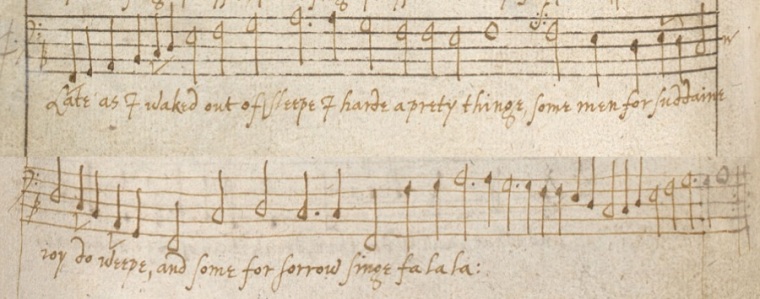
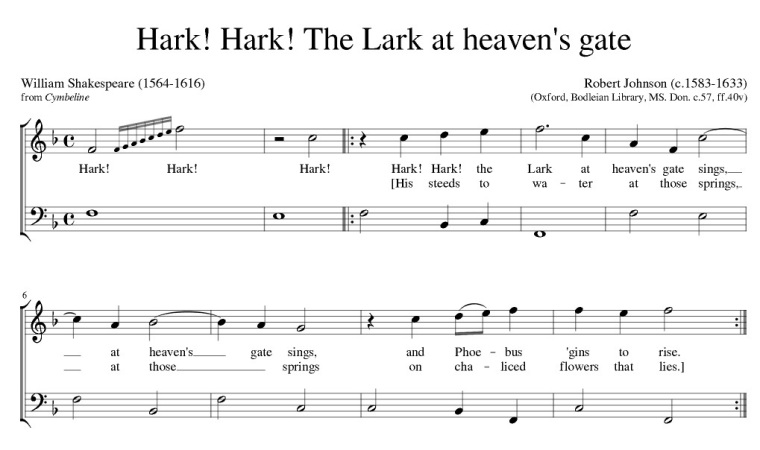
Hark! hark! the lark, Cloten’s song in Shakespeare’s play Cymbeline, King of Britain (c1609), act 2, scene 3. Emma Kirkby, soprano; Anthony Rooley, lute.

Hark! hark! the lark at heaven’s gate sings,
And Phoebus ’gins arise,
His steeds to water at those springs
On chalic’d flowers that lies;
And winking Mary-buds begin
To ope their golden eyes;
With everything that pretty is,
My lady sweet, arise:
Arise, arise!

This setting of Hark! hark! the lark survives in a music manuscript owned by the Bodleian Library, University of Oxford (MS Don. c.57, f. 40v), and has been attributed to Robert Johnson (c1583 - 1633). Johnson became lutenist to king James I in 1604 and was closely associated with Shakespeare’s company, to which he provided songs for various plays including The Winter’s Tale (1610) and The Tempest (1611).

Shakespeariana – XXIII

Romeo & Juliet & Romeo & Juliet

Pyotr Ilyich Tchaikovsky (1840 - 1893): Romeo and Juliet, overture-fantasy in B minor for orchestra, after Shakespeare’s tragedy, 1st version (1869). London Symphony Orchestra; Geoffrey Simon, conductor.


Tchaikovsky: Romeo and Juliet, definitive version (1880). London Symphony Orchestra; Valerij Gergiev, conductor.

This piece has no opus number: the reason is that Tchaikovsky honestly did not want to claim full authorship, since main themes and some elements of the structure were suggested to him by Mily Balakirev.

Shakespeariana – XXII

Musick to heare

Igor Stravinsky (Igor’ Fëdorovič Stravinskij; 1882 - 1971): Three Songs from William Shakespeare for mezzo-soprano, flute, clarinet and viola (1953). Anna Molnár, mezzo-soprano; Annamária Bán, flute; Csaba Pálfi, clarinet; Péter Tornyai, viola.

  1. Musick to heare (Sonnet 8)

    Musick to heare, why hear’st thou musick sadly?
    Sweets with sweets warre not, ioy delights in ioy:
    Why lou’st thou that which thou receaust not gladly,
    Or else receau’st with pleasure thine annoy?
    If the true concord of well tuned sounds,
    By vnions married, do offend thine eare,
    They do but sweetly chide thee, who confounds
    In singlenesse the parts that thou should’st beare:
    Marke how one string sweet husband to an other,
    Strikes each in each by mutuall ordering;
    Resembling sier, and child, and happy mother,
    Who all in one, one pleasing note do sing:
      Whose speechlesse song being many, seeming one,
      Sings this to thee, thou single wilt proue none.

  2. Full fadom five (Ariel’s song from The Tempest) [3:07]

    Full fadom five thy Father lies,
     Of his bones are Corrall made:
    Those are pearles that were his eies,
     Nothing of him that doth fade,
    But doth suffer a Sea-change
    Into something rich, & strange:
    Sea-Nimphs hourly ring his knell.
      Ding dong ding dong.
    Harke now I heare them; ding dong bell.

  3. Spring (cuckoo’s song from Love’s Labour’s Lost) [4:43]

    When Daisies pied, and Violets blew,
    And Cuckow-buds of yellow hew,
    And Ladie-smockes all silver white,
    Do paint the Medowes with delight,
    The Cuckow then on everie tree
    Mockes married men; for thus sings he,
    Cuckow! Cuckow, Cuckow! O worde of feare,
    Unpleasing to a married eare.

Shakespeariana – XXI

…und Julia

Heinrich Sutermeister (1910 - 1995): Symphonic Suite from the opera Romeo und Julia (1940). Royal Philharmonic Orchestra; Rainer Held, conductor.

  1. Fanfares Summon the Guests to a Feast at the Capulets: Presto vivace
  2. Music of the Feast: Più mosso
  3. Juliet Dances with Paris: Andante con grazia
  4. Climax of the Masked Ball: Allegro molto
  5. Sarabande: Andante molto sostenuto
  6. Fairy Mab: Presto grazioso
  7. Finale: Adagio

Shakespeariana – XX

Symphonic Hamlet

Franz Liszt (1811 - 1886): Hamlet, symphonic poem no. 10 (1858). London Philharmonic Orchestra; conductor: Bernard Haitink.


Pëtr Il’ič Čajkovskij (1840 - 1893): Hamlet, ouverture op. 67a (1889). London Symphony Orchestra; conductor: Valerij Gergiev.


Heinz Tiessen (1887 - 1971): Hamlet-Suite op.30 (1922). Rundfunk-Sinfonieorchester Berlin; conductor: Israel Yinon.

  1. Vorspiel
  2. Ophelias Tod [7:12]
  3. Totenmarsch [11:34]

Delacroix, Hamlet Eugène Delacroix: Hamlet et Horatio au cimetière (1839), Paris, Louvre
Shakespeariana – XIX Greensleeves – X

Falstaff in Love

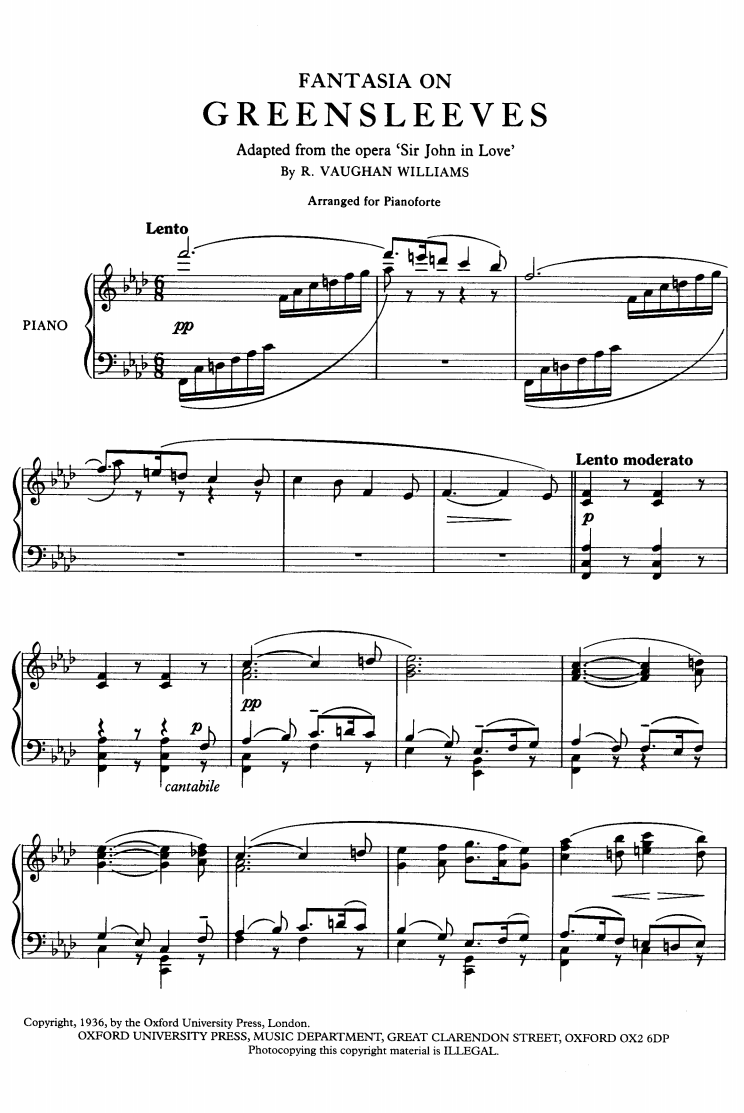
Ralph Vaughan Williams (1872 - 1958): Fantasia on Greensleeves for flute, harp and strings. Philadelphia Orchestra; conductor: Eugene Ormandy.

La Fantasia on Greensleeves è in realtà un arrangiamento, realizzato nel 1934 da Ralph Greaves con l’approvazione di Vaughan Williams, di un brano dell’opera Sir John in Love (1929), basata sulla commedia di Shakespeare Le allegre comari di Windsor. Utilizza non solo il ballad cui si allude nel titolo, ma anche una melodia tradizionale intitolata Lovely Joan, che Vaughan Williams aveva ascoltato nel Suffolk.

The Fantasia on Greensleeves is actually an arrangement, made in 1934 by Ralph Greaves with the approval of Vaughan Williams, of a piece from the opera Sir John in Love (1929), based on Shakespeare’s play The Merry Wives of Windsor. It uses not only the ballad alluded to in the title, but also a traditional tune called Lovely Joan, which Vaughan Williams heard in Suffolk.

Shakespeariana – XVIII

Prospero’s incantations

Egon Wellesz (1885 - 1974): Prosperos Beschwörungen, 5 symphonische Stücke nach Shake­speares „Der Sturm“ op. 53 (1934-36). Wiener Philharmoniker, dir. Bernard Haitink.

  1. Prosperos Beschwörung: Molto sostenuto
  2. Ariel und der Sturm: Leicht bewegt [5:13]
  3. Ariels Gesang: Tranquillo [10:30]
  4. Caliban: Unruhig [16:15]
  5. Ferdinand und Miranda: Sehr breit und ruhevoll – Prosperos Epilog. Misterioso [21:44]

Shakespeariana – XVII

Sing all a green willow – Shakespeare’s cut

Anonimo (sec. XVI-XVII): The Willow Song. Duo Mignarda: Donna Stewart, voce; Ron Andrico, liuto.

The poor soul sat sighing by a sycamore tree,
 Sing willow, willow, willow,
With his hand in his bosom and his head upon his knee,
 O willow, willow, willow shall be my garland.

  Sing all a green willow, willow, willow, willow;
  Aye me, the green willow must be my garland!

He sighed to his singing, and made a great moan:
I am dead to all pleasure, my true love she is gone.

The mute bird sat by him was made tame by his moans,
The true tears fell from him would have melted the stones.

Come all you forsaken and mourn you with me.
Who speaks of a false love, mine’s falser than she.

Let love no more boast her in palace nor bower.
It buds, but it blasteth ere it be a flower.

Though fair and more false, I die with thy wound.
Thou hast lost the truest lover that goes upon the ground.

Let nobody chide her, her scorns I approve.
She was born to be false, and I to die for her love.

Take this for my farewell and latest adieu,
Write this on my tomb, that in love I was true.


Dopo aver ascoltato la versione di Rossini e quella di Verdi, ecco la Canzone del salice « originale », ossia il ballad cantato da Desdemona nella 3a scena dell’atto IV dell’Otello scespiriano, come ci è stato tramandato da un manoscritto conservato nella British Library (Add. 15117, databile intorno al 1615). È una bella canzone triste, nello stile malinconico che era di moda nell’Inghilterra elisabettiana. Nei primi versi è ben descritta una persona af­flitta da profonda malinconia, in una postura non molto dis­si­mile da quella dell’angelo in una celebre incisione di Dürer (Melencolia I, 1514).
Da sottolineare che il comportamento di Desdemona contrav­viene alle consuetudini teatrali dell’epoca: era infatti consi­de­ra­to disdicevole che un personaggio di rango elevato si producesse in esibizioni canore sulla scena. Ma Desdemona è in preda a una forte agitazione, teme per la propria vita e teme ancora di più che Otello possa considerarla infedele: per questo motivo il suo canto — come del resto quello di Ofelia impazzita (Amleto IV:5) — poteva essere tollerato.
Con la Canzone del salice Shakespeare ha trovato il modo più efficace di rappresentare il turbamento di Desdemona, pervasa da presentimenti di morte ma ancora profondamente innamorata di Otello: nell’armonia, il continuo alternarsi di modo minore e maggiore rende musicalmente il contrasto dei suoi sentimenti, mentre nel testo la ripetizione insistita della parola willow (il salice è da sempre simbolo della tristezza d’amore) dà l’idea del suo intimo tormento.

After listening to The Willow Song set to music by Rossini and by Verdi, here is now the « original » version, i.e. the ballad that Desdemona sings in Shakespeare’s Othello (act 4, scene 3): this piece has come down to us through a manuscript which is preserved in the British Library (Add. 15117, datable around 1615). It’s a beautiful sad song, in the melancholy style that was popular in Elizabethan England. The first stanza well describes a person afflicted by a profound melancholy, in a posture not unlike that took by the angel in a Dürer’s famous engraving (Melencolia I, 1514).
It should be noted that Desdemona’s behavior contravenes the theatrical customs of the time: it was in fact considered unbecoming for a high-ranking character to perform singing on stage. But Desdemona is in the throes of a strong agitation, she is in fear for her own life, and fears even more that Othello might believe her unfaithful: for this reason her singing — like that of Ophelia gone mad (Hamlet, act 4, scene 5) — can be tolerated.
With The Willow Song Shakespeare finds the most effective way of representing Desdemona’s turmoil, pervaded by forebodings of death but still deeply in love with Othello: the continuous alternation of minor and major modes musically renders the contrast of her feelings, while the insistent repetition of the word willow (a tree which has always been a symbol of love sadness) illustrates her inner torment.

Shakespeariana – XVI

Sing all a green willow – II

Giuseppe Verdi (1813 - 1901): «Mi parea… Piangea cantando – Ave Maria», Canzone del salice dall’atto IV di Otello, dramma lirico in 4 atti su libretto di Arrigo Boito (1887). Maria Callas, soprano; Orchestre de la Societe des Concerts du Conservatoire, dir. Nicola Rescigno.
(La parte di Emilia è espunta.)

DESDEMONA:

Mi parea. M’ingiunse
di coricarmi e d’attenderlo. Emilia,
te ne prego, distendi sul mio letto
la mia candida veste nuzïale.
M’odi. Se pria di te morir dovessi
mi seppellisci con un di quei veli.
[…]
Son mesta tanto.
Mia madre aveva una povera ancella,
innamorata e bella;
era il suo nome
Barbara. Amava
un uom che poi l’abbandonò, cantava
un canzone: «La canzon del salice».
(ad Emilia.)
Mi disciogli le chiome…
Io questa sera ho la memoria piena
di quella cantilena.

 Piangea cantando
  nell’erma landa,
  piangea la mesta…
  O salce! salce! salce!
  Sedea chinando
  sul sen la testa!
  O salce! salce! salce!
  Cantiamo! il salce funebre
  sarà la mia ghirlanda.

(ad Emilia.)
Affrettati; fra poco giunge Otello.

 Scorreano i rivi fra le zolle in fior,
  gemea quel core affranto,
  e dalle ciglia le sgorgava il cor
  l’amara onda del pianto.
  O salce! salce! salce!
 Cantiam la nenia blanda.
  Cantiamo! Il salce funebre
  sarà la mia ghirlanda.
  Scendean augelli a vol dai rami cupi
  verso quel dolce canto.
  E gli occhi suoi piangevan tanto, tanto,
  da impietosir le rupi.

(a Emilia, levandosi un anello dal dito.)
Riponi quest’anello.
(alzandosi.)
Povera Barbara! Solea la storia
con questo semplice suono finir:
  Egli era nato per la sua gloria,
  io per amarlo…
(ad Emilia interrompendo.)
Ascolta.
(Emilia fa qualche passo.)
Odo un lamento.
Taci. Chi batte a quella porta?
  Io per amarlo e per morir.
Emilia, addio. Come m’ardon le ciglia!
È presagio di pianto.
(abbraccia Emilia che esce.)
Buona notte.
(va all’inginocchiatoio.)
 Ave Maria, piena di grazia, eletta
  fra le spose e le vergini sei tu,
  sia benedetto il frutto, o benedetta,
  di tue materne viscere, Gesù.
 Prega per chi adorando a te si prostra,
  prega nel peccator, per l’innocente,
  e pe ‘l debole oppresso e pe ‘l possente,
  misero anch’esso, tua pietà dimostra.
 Prega per chi sotto l’oltraggio piega
  la fronte e sotto la malvagia sorte;
  per noi tu prega,
  sempre e nell’ora della morte nostra.
(resta ancora inginocchiata ed appoggia la fronte
sull’inginocchiatoio come chi ripeta mentalmente
una orazione. Non s’odono che le prime e le ultime
parole della preghiera
.)
 Ave Maria… nell’ora della morte.
  Amen!
(si alza e va a coricarsi.)

Shakespeariana – XV

Sing all a green willow – I

Gioachino Rossini (1792 - 1868): «Assisa a pie’ d’un salice – Deh calma, o ciel, nel sonno», Canzone del salice e Preghiera dall’atto III di Otello, ossia Il moro di Venezia, dramma tragico in 3 atti su libretto di Francesco Berio di Salsa (1816). Montserrat Caballé, soprano (Desdemona); Corinna Vozza, mezzosoprano (Emilia); Orchestra della RCA Italiana, dir. Carlo Felice Cillario.

DESDEMONA:
 Assisa a pie’ d’un salice,
 immersa nel dolore,
 gemea trafitta Isaura
 dal più crudele amore:
 l’aura tra i rami flebile
 ne ripeteva il suon.
 I ruscelletti limpidi
 a’ caldi suoi sospiri,
 il mormorio mesceano
 de’ lor diversi giri:
 l’aura fra i rami flebile
 ne ripeteva il suon.
 Salce, d’amor delizia!
 Ombra pietosa appresta,
 (di mie sciagure immemore)
 all’urna mia funesta;
 né più ripeta l’aura
 de’ miei lamenti il suon.
 Che dissi!… Ah m’ingannai!… Non è del canto
 questo il lugubre fine. M’ascolta… Oh dio!
(un colpo di vento spezza alcuni vetri della finestra.)

EMILIA:
 Non paventar; rimira:
 impetuoso vento è quel che spira.

DESDEMONA:
 Io credeva che alcuno… Oh come il cielo
 s’unisce a’ miei lamenti!…
 Ascolta il fin de’ dolorosi accenti.
 Ma stanca alfin di spargere
 mesti sospiri, e pianto,
 morì l’afflitta vergine
 ahi! di quel salce accanto.
 Morì… che duol! l’ingrato…
 Poté… ma il pianto oh Dio!
 proseguir non mi fa. Parti, ricevi
 da’ labbri dell’amica il bacio estremo.

EMILIA:
 Oh che dici!… Ubbidisco… oh come io tremo!

DESDEMONA:
 Deh calma, o ciel, nel sonno
 per poco le mie pene,
 fa, che l’amato bene
 mi venga a consolar.
 Se poi son vani i prieghi,
 di mia breve urna in seno
 venga di pianto almeno
 il cenere a bagnar.
(ella cala la tendina e si getta sul letto.)

Shakespeariana – XIV

Take those lips away

Take, O take those lips away,
That so sweetly were forsworn;
And those eyes, the break of day,
Lights that do mislead the morn:
But my kisses bring again
Seals of love, though seal’d in vain.

Hide, O hide those hills of snow
That thy frozen bosom bears,
On whose tops the pinks that grow
Are yet of those that April wears,
But first set my poor heart free,
Bound in those icy chains by thee.

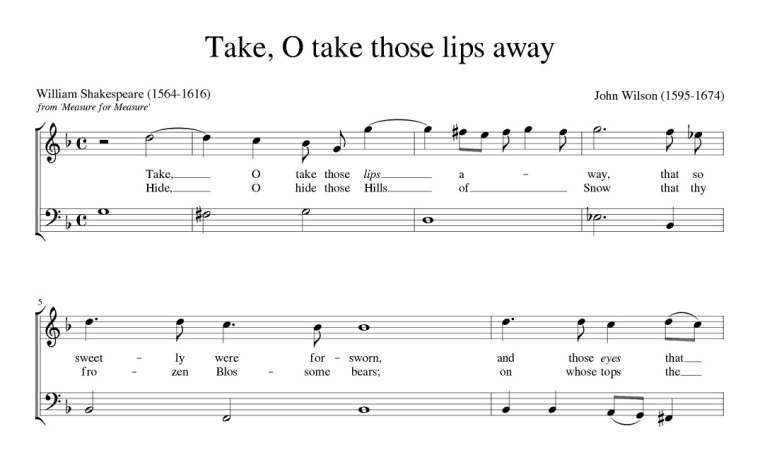
La prima strofa si trova nella commedia di Shakespeare Misura per misura (atto IV, scena 1a), rappresentata per la prima volta nel 1604; non sappiamo su quale melodia fosse cantata. Prima e seconda strofa sono nel dramma Rollo Duke of Normandy, or The Bloody Brother, scritto in collaborazione da John Fletcher, Philip Massinger, Ben Jonson e George Chapman in data imprecisabile (comunque non prima del 1612). Non è dato di sapere se la seconda strofe sia un’aggiunta di Fletcher oppure se tanto Shakespeare quanto Fletcher si siano rifatti a una canzone popolare in voga ai loro tempi.
Il testo è stato musicato da diversi autori. Il primo in ordine cronologico fu John Wilson (1595 - 1674), il quale nel 1614 succedette a Robert Johnson quale primo compositore dei King’s Men, la compagnia teatrale cui apparteneva Shakespeare. Ascoltiamo il suo lavoro in… versione shake­speariana (ossia limitata alla sola prima strofa) interpretata da Alfred Deller (voce) e Desmond Dupré (liuto); e poi nella versione integrale cantata dal soprano Anna Dennis, accompagnata da Hanneke van Proosdij al clavicembalo, Elisabeth Reed alla viola da gamba e David Tayler all’arciliuto.

The first stanza is featured in Shakespeare’s play Measure for Measure (act 4, scene 1), first represented in 1604; we do not know to what tune it was sung. Both the stanzas feature in the play Rollo Duke of Normandy, or The Bloody Brother, co-written by John Fletcher, Philip Massinger, Ben Jonson and George Chapman and performed at an unspecified date (though not earlier than 1612). It is not known whether the second stanza is an addition by Fletcher or whether both Shakespeare and Fletcher drew on a popular song in vogue in their time.
These verses have been set to music by various composers. The first in chronological order was John Wilson (1595 - 1674), who in 1614 succeeded Robert Johnson as principal composer for the King’s Men, the theater company to which Shakespeare belonged. Let’s listen to his work in… a Shakespearean version (i.e. the first stanza only) performed by Alfred Deller (voice) and Desmond Dupré (lute); and then in the complete version sung by soprano Anna Dennis, accompanied by Hanneke van Proosdij on harpsichord, Elisabeth Reed on viola da gamba and David Tayler on archlute.


John Weldon (1676 - 1736): Take, O take those lips away per voce e continuo (c1707). Emma Kirkby, soprano; Anthony Rooley, liuto.


Robert Lucas de Pearsall (1795 - 1856), Take, O take those lips away per coro a 5 voci a cappella op. 6 (1830). Cantores Musicæ Antiquæ, dir. Jeffery Kite-Powell.


Mrs H. H. A. Beach (Amy Marcy Cheney Beach, 1867 - 1944): Take, O take those lips away per voce e pianoforte, n. 2 dei Three Shakespeare Songs op. 37 (1897). Virginia Mims, soprano.


Peter Warlock (pseudonimo di Philip Heseltine, 1894 - 1930): Take, O take those lips away per voce e pianoforte (1916-17). Benjamin Luxon, baritono; David Willison, pianoforte.


Roger Quilter (1877 - 1953): Take, O take those lips away per voce e pianoforte, n. 4 dei Five Shakespeare Songs op. 23 (1921). Philippe Sly, basso-baritono; Michael McMahon, pianoforte.


Madeleine Dring (1923 - 1977): Take, O take those lips away per voce e pianoforte (c1950). Michael Hancock-Child, tenore; Ro Hancock-Child, pianoforte.


Emma Lou Diemer (1927): Take, O take those lips away, da Three Madrigals per coro e pianoforte (1960). The Colorado Chorale, dir. Frank Eychaner.

Shakespeariana – XIII

Something rich and strange

Due brani cantati da Ariele nella Tempesta (1610-11) di William Shakespeare:
Full fathom five (atto I, scena 2a)
Where the bee sucks (atto V, scena 1a)
La musica è di Robert Johnson (c1583 - 1633), il quale collaborò con Shakespeare scri­vendo brani per i suoi ultimi drammi. Canta Alfred Deller, accom­pa­gnato al liuto da Desmond Dupré.

Two pieces sung by Ariel in Shakespeare’s The Tempest (1610-11):
Full fathom five (act I, 2nd scene)
Where the bee sucks (act V, 1st scene)
Music is by Robert Johnson (c1583-1633), who worked with Shakespeare providing music for his later plays. Alfred Deller, haute-contre; Desmond Dupré, lute.


Full fathom five thy father lies,
Of his bones are coral made,
Those are pearls that were his eyes:
Nothing of him that doth fade,
But doth suffer a sea-change
Into something rich and strange.
Sea-nymphs hourly ring his knell:
Hark! now I hear them:
Ding-dong, bell.


Where the bee sucks, there suck I,
In a cowslip’s bell I lie,
There I couch when owls do cry,
On the bat’s back I do fly
After summer merrily.
  Merrily, merrily shall I live now
  Under the blossom that hangs on the bough.