Ferdinando Paër (1° luglio 1771 - 1839): Sonata per pianoforte n. 3 in mi bemolle maggiore. Andrea Di Renzo, fortepiano.
- Allegro
- Larghetto [9:37]
- Tempo di polacca: Allegro [16:05]

Ferdinando Paër (1° luglio 1771 - 1839): Sonata per pianoforte n. 3 in mi bemolle maggiore. Andrea Di Renzo, fortepiano.

Tu-whit
Thomas Augustine Arne (1710 - 1778): When icicles hang by the wall, song of winter from Shakespeare’s play Love’s Labour’s Lost, act 5, scene 2. Julia Gooding, soprano; ensemble Passacaglia.
When icicles hang by the wall
And Dick the shepherd blows his nail
And Tom bears logs into the hall
And milk comes frozen home in pail,
When blood is nipp’d and ways be foul,
Then nightly sings the staring owl,
Tu-whit;
Tu-who, a merry note,
While greasy Joan doth keel the pot.
When all aloud the wind doth blow
And coughing drowns the parson’s saw
And birds sit brooding in the snow
And Marian’s nose looks red and raw,
When roasted crabs hiss in the bowl,
Then nightly sings the staring owl,
Tu-whit;
Tu-who, a merry note,
While greasy Joan doth keel the pot.

Esa-Pekka Salonen (30 giugno 1958): Gemini per orchestra (2019). NDR Elbphilharmonie Orchester diretta dall’autore.

Johann Sebastian Bach (1685 - 1750): Chromatische Fantasie und Fuge in re minore BWV 903 (c1717-23). Chiara Massini, clavicembalo, e Andrea Bacchetti, pianoforte.
La Fuga ha inizio rispettivamente a [6:09] e a [7:00]

At heaven’s gate
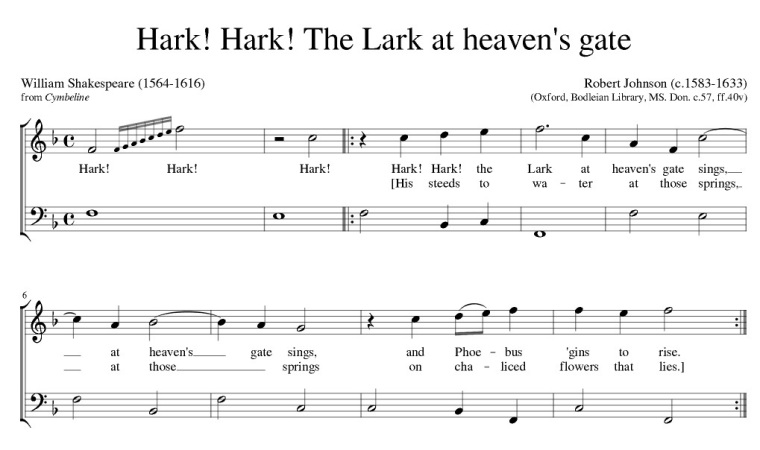
Hark! hark! the lark, Cloten’s song in Shakespeare’s play Cymbeline, King of Britain (c1609), act 2, scene 3. Emma Kirkby, soprano; Anthony Rooley, lute.
Hark! hark! the lark at heaven’s gate sings,
And Phoebus ’gins arise,
His steeds to water at those springs
On chalic’d flowers that lies;
And winking Mary-buds begin
To ope their golden eyes;
With everything that pretty is,
My lady sweet, arise:
Arise, arise!
This setting of Hark! hark! the lark survives in a music manuscript owned by the Bodleian Library, University of Oxford (MS Don. c.57, f. 40v), and has been attributed to Robert Johnson (c1583 - 1633). Johnson became lutenist to king James I in 1604 and was closely associated with Shakespeare’s company, to which he provided songs for various plays including The Winter’s Tale (1610) and The Tempest (1611).

Antonio Martín y Coll (? - c1734): Diferencias sobre las folias. Jordi Savall e Hespèrion XXI.
Giovanni Girolamo Kapsberger (c1580 - 1651): 19 Partite sopra la Folia. Sandro Volta, chitarrone.
Don Gregorio Paniagua Rodríguez: Fons vitae. Dementia praecox angelorum. Supra solfamireut (1982). Gregorio Paniagua e Atrium Musicae de Madrid.
Vangelis (Evangelos Odysseas Papathanassiou; 1943 - 2022): «Conquest of Paradise», dalla colonna sonora del film 1492 – La conquista del paradiso (1492: Conquest of Paradise) diretto nel 1992 da Ridley Scott.
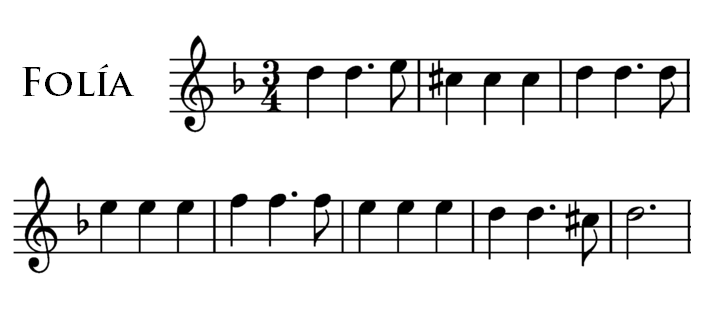
Anche il brano da Vangelis, come le altre composizioni di cui propongo l’ascolto in questa pagina, si fonda sulla Follia, un antico tema musicale (si ritiene che abbia origini portoghesi risalenti al XVI secolo) che nel corso del periodo barocco fu rielaborato da numerosi compositori europei, da Frescobaldi a Corelli, da Lully a Marais, da Alessandro Scarlatti a Vivaldi, da Johann Sebastian Bach (nella Bauernkantate BWV 212) al figlio di questi Carl Philipp Emanuel.

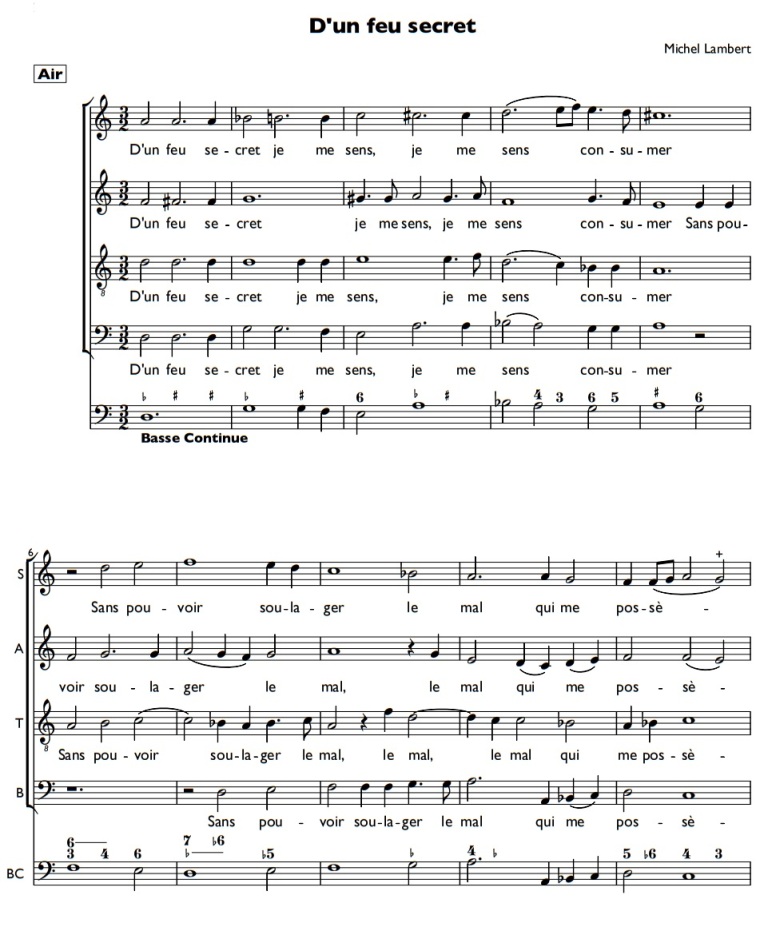
Michel Lambert (1610 - 29 giugno 1696): D’un feu secret je me sens consommer, air de cour (pubblicato in Airs à une, II. III. et IV. parties avec la basse-continue, 1689, p. 53). Les Arts Florissants, dir. William Christie.
D’un feu secret je me sens consommer
Sans pouvoir soulager le mal qui me possède;
Je pourrois bien guérir si je cessois d’aymer,
Mais j’ayme mieux le mal que le remède.
Quand je mourrois, pourroit-on me blasmer?
Qui commence d’ayme, ne doit-il pas poursuivre?
Quand on sçaura, Philis, que j’ay cessé d’aymer,
On sçaura bien que j’ay cessé de vivre.

The Beggar’s Opera, Air XXVII: Greensleeves. Roger Daltrey as Macheath.
Since Laws were made for ev’ry Degree,
To curb Vice in others, as well as me,
I wonder we han’t better Company,
Upon Tyburn Tree!
But Gold from Law can take out the Sting;
And if rich Men like us were to swing,
’Twould thin out the Land, such Numbers to string
Upon Tyburn Tree!
Nell’Opera del mendicante (The Beggar’s Opera, 1728), scritta da John Gay, con musiche tratte perlopiù dal repertorio popolare e adattate da Johann Christoph Pepusch, trova posto anche la melodia di Greensleeves. Il brano è intonato con rabbia e frustrazione da Macheath subito dopo aver appreso di essere stato condannato a morte. Per «Tyburn Tree» si intende la forca: Tyburn era il villaggio del Middlesex in cui si eseguivano le sentenze capitali.
In The Beggar’s Opera (1728), written by John Gay, with music drawn mostly from traditional repertoire and arranged by Johann Christoph Pepusch, the tune of Greensleeves also finds its place. This piece is sung in anger and frustration by Macheath soon after learning that he was sentenced to death. «Tyburn Tree» means the gallows: Tyburn was the Middlesex village where capital punishment was carried out.
![]()
Cesare Ciardi (28 giugno 1818 – 1877): Gran Concerto in re maggiore per flauto e pianoforte op. 129 (1859). Maurizio Bignardelli, flauto; Paola Quattrone, pianoforte.

Jean-Jacques Beauvarlet-Charpentier (28 giugno 1734 - 1794): Pange lingua, «hymne pour la Fête-Dieu au Très-Saint-Sacrement», dal Journal d’orgue… n. 7 (c1785). Jean-Luc Perrot all’organo Callinet (1837) della Chiesa di Notre-Dame in Saint-Étienne.

Romeo & Juliet & Romeo & Juliet
Pyotr Ilyich Tchaikovsky (1840 - 1893): Romeo and Juliet, overture-fantasy in B minor for orchestra, after Shakespeare’s tragedy, 1st version (1869). London Symphony Orchestra; Geoffrey Simon, conductor.
Tchaikovsky: Romeo and Juliet, definitive version (1880). London Symphony Orchestra; Valerij Gergiev, conductor.
This piece has no opus number: the reason is that Tchaikovsky honestly did not want to claim full authorship, since main themes and some elements of the structure were suggested to him by Mily Balakirev.

Magnus Lindberg (27 giugno 1958): Secondo Concerto per pianoforte orchestra (2012). Yefim Bronfman, pianoforte; New York Philharmonic Orchestra, dir. Alan Gilbert.

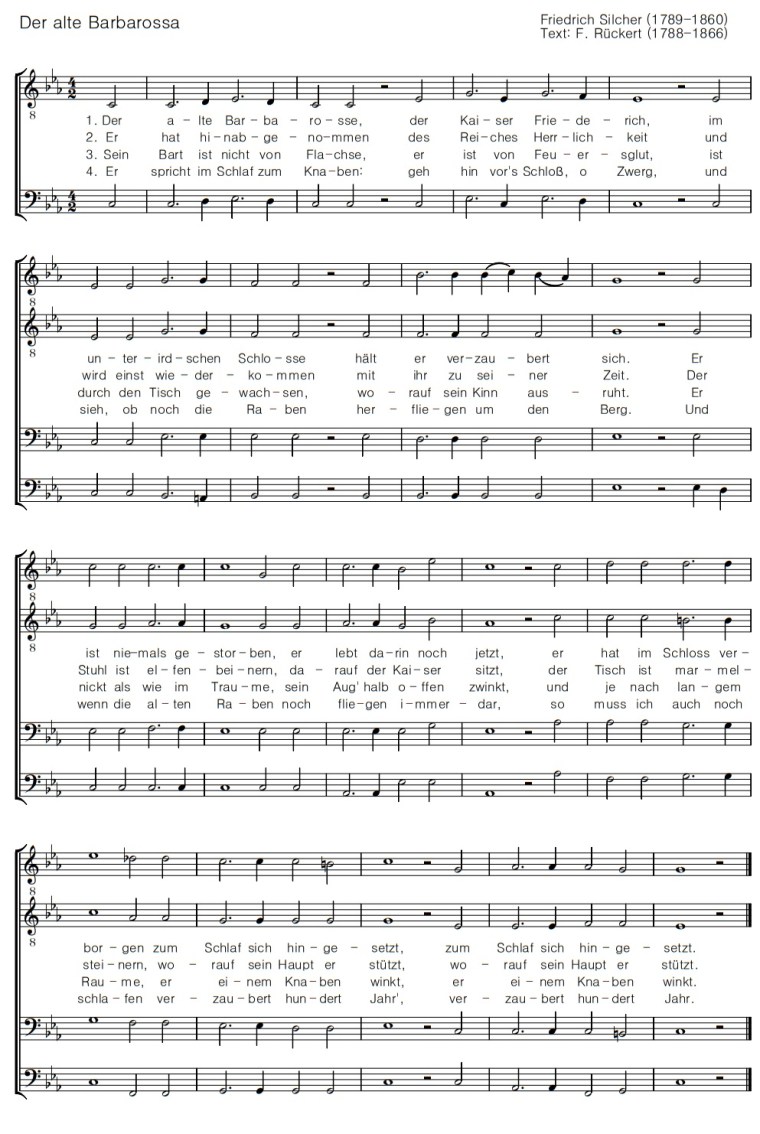
Friedrich Silcher (27 giugno 1789 - 1860): Der alte Barbarossa per coro maschile a 4 voci su testo di Friedrich Rückert. Psycho-Chor der Uni Jena.
Der alte Barbarossa,
Der Kaiser Friederich,
Im unterirdschen Schlosse
Hält er verzaubert sich.
Er ist niemals gestorben,
Er lebt darin noch jetzt,
Er hat im Schloß verborgen
Zum Schlaf sich hingesetzt.
Er hat hinabgenommen
Des Reiches Herrlichkeit
Und wird einst wiederkommen
Mit ihr, zu seiner Zeit.
Der Stuhl ist elfenbeinern,
Darauf der Kaiser sitzt;
Der Tisch ist marmelsteinern,
Worauf sein Haupt er stützt.
Sein Bart ist nicht von Flachse,
Er ist von Feuersglut,
Ist durch den Tisch gewachsen,
Worauf sein Kinn ausruht.
Er nickt als wie im Traume,
Sein Aug halb offen zwinkt,
Und je nach langem Raume
Er einem Knaben winkt.
Er spricht im Schlaf zum Knaben:
Geh hin vors Schloß, o Zwerg,
Und sieh, ob noch die Raben
herfliegen um den Berg.
Und wenn die alten Raben
Noch fliegen immerdar,
So muß ich auch noch schlafen,
Verzaubert hundert Jahr.

Musick to heare
Igor Stravinsky (Igor’ Fëdorovič Stravinskij; 1882 - 1971): Three Songs from William Shakespeare for mezzo-soprano, flute, clarinet and viola (1953). Anna Molnár, mezzo-soprano; Annamária Bán, flute; Csaba Pálfi, clarinet; Péter Tornyai, viola.
Musick to heare, why hear’st thou musick sadly?
Sweets with sweets warre not, ioy delights in ioy:
Why lou’st thou that which thou receaust not gladly,
Or else receau’st with pleasure thine annoy?
If the true concord of well tuned sounds,
By vnions married, do offend thine eare,
They do but sweetly chide thee, who confounds
In singlenesse the parts that thou should’st beare:
Marke how one string sweet husband to an other,
Strikes each in each by mutuall ordering;
Resembling sier, and child, and happy mother,
Who all in one, one pleasing note do sing:
Whose speechlesse song being many, seeming one,
Sings this to thee, thou single wilt proue none.
Full fadom five thy Father lies,
Of his bones are Corrall made:
Those are pearles that were his eies,
Nothing of him that doth fade,
But doth suffer a Sea-change
Into something rich, & strange:
Sea-Nimphs hourly ring his knell.
Ding dong ding dong.
Harke now I heare them; ding dong bell.
When Daisies pied, and Violets blew,
And Cuckow-buds of yellow hew,
And Ladie-smockes all silver white,
Do paint the Medowes with delight,
The Cuckow then on everie tree
Mockes married men; for thus sings he,
Cuckow! Cuckow, Cuckow! O worde of feare,
Unpleasing to a married eare.

Ernest Guiraud (26 giugno 1837 - 1892): La Chasse fantastique, poema sinfonico (1887) ispirato dalla Légende du beau Pécopin et de la belle Bauldour (1842) di Victor Hugo. Louisville Orchestra, dir. Jorge Mester.
La composizione segue fedelmente la descrizione della caccia nel racconto di Hugo, un passo del quale è citato da Guiraud in esergo sulla partitura:
« Al suono del corno, la foresta s’illumina, nei recessi più remoti, di mille luci straordinarie, di ombre che passano nella boscaglia, di voci lontane che gridano: a caccia! La muta abbaia, i cavalli nitriscono, gli alberi fremono come scossi dal vento. »

Vincenzo Albrici (26 giugno 1631 - 1695): Sonata (Sinfonia) in re minore a due violini e basso continuo. Collegium Marianum.

Alberto Ginastera (1916 - 25 giugno 1983): Suite de danzas criollas per pianoforte op. 15 (1946). Dmytro Choni.

Endre Szervánszky (1911 - 25 giugno 1977): Trio per flauto, violino e viola (1953). Uri Shoham, flauto; Rafael Frankel, violino; Robert Mozes, viola.

Pablo Bruna (1611 - 25 giugno 1679): Tiento de dos tiples, 6° tono. José Suárez, organo.

Leone Leoni (c1560 - 24 giugno 1627): Cor mio, deh, non languire, madrigale a 5 voci (pubblicato in Bell’Alba: quinto libro de madrigali a cinque voci, 1602, n. 9) su testo di Battista Guarini. The Consort of Musicke, dir. Anthony Rooley.
Cor mio, deh, non languire,
Che fai teco languir l’anima mia.
Odi i caldi sospiri: a te gl’invia,
La pietate e’l desire.
S’i’ ti potessi dar morendo aita,
Morrei per darti vita.
Ma vivi ohimé, ch’ingiustamente more,
Chi vivo tien ne l’altrui petto il core.

Louis Brassin (24 giugno 1836 o 1840 - 1884): Feuerzauber (Incantesimo del fuoco), scena finale di Die Walküre di Richard Wagner (1870) liberamente trascritta per pianoforte. Aleksandra Beljakovič.

Valéry Sauvage interpreta la più antica versione conosciuta di Greensleeves (anonima, riportata dal manoscritto noto come William Ballet’s Lute Book, c1590-1603) insieme con le variazioni composte da Francis Cutting (c1550 - 1595/96).
Valéry Sauvage performs the earliest known version of Greensleeves (anonymous, found in a manuscript known as the William Ballet’s Lute Book, c1590-1603) and the variations by Francis Cutting (c1550 - 1595/96).

Armas Järnefelt (1869 - 23 giugno 1958): Korsholma, poema sinfonico (1894). Gävle Symfoniorkester, dir. Hannu Koivula.

Tobias Michael (23 giugno 1592 - 1657): Das ist ein kostlich Ding per voce, flauto e basso continuo (pubblicato in Musikalische Seelenlust, vol. II, 1636). Ensemble Circa 1500, dir. Nancy Hadden.
Das ist ein köstlich Ding, dem Herren danken
und lobsingen deinem Namen, du Höchster.
Des Morgens deine Gnade und des Nachts deine Wahrheit verkündigen.
Auff den zehen Seiten und Psalter mit Spielen auff der Harffen.
Denn, Herr, du lässest mich frölich singen von deinen Wercken,
und ich rühme die Geschäffte deiner Hände.

…und Julia
Heinrich Sutermeister (1910 - 1995): Symphonic Suite from the opera Romeo und Julia (1940). Royal Philharmonic Orchestra; Rainer Held, conductor.

Ruth Zechlin (22 giugno 1926 - 2007): Polyphonie, da Musik zu Bach per orchestra (1983). Orchester der Komischen Oper Berlin, dir. Rolf Reuter.

Francesco Manfredini (22 giugno 1684 - 1762): Concerto quinto in re minore per violino, archi e basso continuo. Ensemble Barocco sempre giovane.

Philippe Hersant (21 giugno 1948): Concerto per violoncello e orchestra da camera (Prix «Arthur Honegger» 1994). Olivia Gay, violoncello; Orchestre Pasdeloup, dir. Wolfgang Doerner.

Symphonic Hamlet
Franz Liszt (1811 - 1886): Hamlet, symphonic poem no. 10 (1858). London Philharmonic Orchestra; conductor: Bernard Haitink.
Pëtr Il’ič Čajkovskij (1840 - 1893): Hamlet, ouverture op. 67a (1889). London Symphony Orchestra; conductor: Valerij Gergiev.
Heinz Tiessen (1887 - 1971): Hamlet-Suite op.30 (1922). Rundfunk-Sinfonieorchester Berlin; conductor: Israel Yinon.
Eugène Delacroix: Hamlet et Horatio au cimetière (1839), Paris, Louvre
Hugo Staehle (21 giugno 1826 - 1848): Sinfonia n. 1 in do minore (1844). Orchester des Staatstheaters Kassel, dir. Marc Piollet.