In the Upper Room

 
Philip Glass (1937): cinque danze (nn. 1, 2, 5, 8 e 9) dal balletto In the Upper Room (1986). Philip Glass Ensemble, dir. Michael Riesman.
Il balletto, coreografato da Twyla Tharp, fu presentato al pubblico il 26 agosto 1986 come Untitled. In seguito Tharp ebbe l’idea di ribattezzarlo con il titolo attuale prendendo spunto da un inno cristiano per la Pentecoste, In the upper room at Jerusalem ovvero Prayer for the Power: il testo, del rev. James Bruce Mackay, fa riferimento a un passo degli Atti degli apostoli (1:13) in cui si dice che i discepoli di Gesù erano soliti riunirsi « in una stanza al piano superiore » dove ricevettero poi lo Spirito Santo, il quale si manifestò loro, annunciato da un vento impetuoso, sotto forma di « lingue di fuoco che si dividevano e si posarono su ciascuno » (Atti 2:2-3). Il titolo del balletto non allude però a esperienze mistico-religiose: la Upper Room è in realtà la mente dell’artista, visitata dal vento e dal fuoco dell’ispirazione.

Musica di sua maestà: il principe consorte

 
Alberto di Sassonia-Coburgo-Gotha (26 agosto 1819 - 1861): Melodia per violino e pianoforte. Iona Brown, violino; Jennifer Partridge, pianoforte.


Alberto di Sassonia-Coburgo-Gotha: Gruss an den Bruder, testo di Ernesto I di Sassonia-Coburgo-Gotha (padre del compositore). Toby Spence, tenore; Ronald Brautigam, pianoforte.

Hat so lang mein Leid geschwiegen,
soll es heute auf erstehn
und aus süssen Schlaf dich wiegen,
durch der Klänge zartes Weh’n.

Ist auch noch so weit die Reise
trägt’s ein Zephir hin zu Dir!
Und es flüstert dann ganz leise,
Denkst des Bruders Du auch hier

von der Heimath von dem Norden
von der Jugend stillem Glück,
spricht es schwebend in Accorden:
leitet hieher deinen Blick.

(A lungo il mio soffrire è stato silente, ma oggi sorgerà e ti desterà dolcemente dal tuo sonno con il lieve respiro dei suoni.
Il viaggio è lungo, ma te lo porterà il vento! E con lieve alito ti farà pensare al tuo fratello,
alla casa, al Nord, alla serena felicità della gioventù, librandosi parlerà per accordi: qui attirerà il tuo sguardo.)


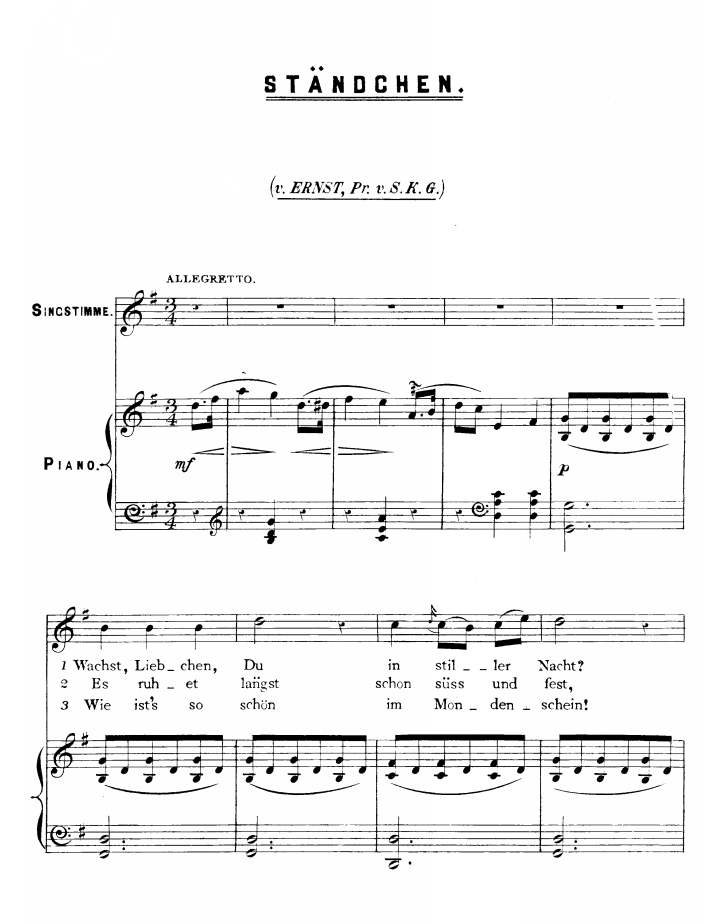
Alberto di Sassonia-Coburgo-Gotha: Ständchen (Serenata) per voce e pianoforte su testo di Ernesto I di Sassonia-Coburgo-Gotha. Ian Partridge, tenore; Jennifer Partridge, pianoforte.

Wachst, Liebchen, Du in stiller Nacht?
Kennest Liebchen auch der Sehnsucht Macht?
O lass bey meinem heissen Fleh’n
das Fenster heut noch offen stehn.

Es ruhet längst schon süss und fest,
was Lieb’ und Sehnsucht ruhen lässt.
O Liebchen komm an’s Fenster Dein,
lass schauen Deine Äugelein!

Wie ist’s so schön im Mondenschein!
Es weht die Luft so kühl und rein.
Horch wie die Leier sehnend klingt!
Das Vöglein selbst im Traum noch singt!

Da that sich auf das Fensterlein,
es sahn heraus im Mondenschein
die schönsten schönsten Äugelein:
wie freundlich waren sie und rein.

(Vegli ancora, amor mio, nella notte silente? Anche tu, amore, avverti il morso del desiderio? Oh, ascolta il mio appello appassionato e lascia aperta, ora, la tua finestra.
È un riposo assai dolce e profondo quello di chi dà requie all’amore e al desiderio. Oh, amore, vieni alla finestra e fa’ che possa vedere i tuoi begli occhi!
Com’è bello stare al chiaro di luna! L’aria è così fresca e pura. Ascolta il bramoso suono della cetra! Il passerotto canta anche quando sogna!
Ed ecco, la finestra si spalancò e nel chiaro di luna brillarono quegli occhi stupendi: e quanto erano amichevoli e puri.)

Staendchen
Alberto di Sassonia-Coburgo-Gotha

Tigeroo!

Irving Fine (1914 - 23 agosto 1962): Tigeroo per voce e pianoforte, da Childhood Fables for Grownups su testi di Gertrude Norman (1955). William Parker, baritono; Dalton Baldwin, pianoforte.

There once was a Tiger named Tigeroo,
The hungriest tiger in the zoo:
All day long he liked to eat
Not cake, not cookies, but only meat.

The keeper said, «Now, Tigeroo,
You eat too much, you know you do!
If you eat any more and you get sick,
I’ll call the tiger doctor quick!»

«I’ll eat all I like», said Tigeroo,
«I’m the hungriest tiger in the zoo.
You tell that doctor, I said POOH!
If he comes in my cage, I’ll eat him too!»

Rio Grande

Constant Lambert (23 agosto 1905 - 21 agosto 1951): The Rio Grande, cantata per voce solista, coro, pianoforte, ottoni, archi e percussione (1927) su testo di Sacheverell Sitwell. Jean Temperley, mezzosoprano; London Madrigal Singers, dir. Christopher Bishop; London Symphony Orchestra, dir. André Previn.

By the Rio Grande
They dance no sarabande
On level banks like lawns above the glassy, lolling tide;
Nor sing they forlorn madrigals
Whose sad note stirs the sleeping gales
Till they wake among the trees and shake the boughs,
And fright the nightingales;
But they dance in the city, down the public squares,
On the marble pavers with each colour laid in shares,
At the open church doors loud with light within.
At the bell’s huge tolling,
By the river music, gurgling, thin
Through the soft Brazilian air.
The Comendador and Alguacil are there
On horseback, hid with feathers, loud and shrill
Blowing orders on their trumpets like a bird’s sharp bill
Through boughs, like a bitter wind, calling
They shine like steady starlight while those other sparks are failing
In burnished armour, with their plumes of fire,
Tireless while all others tire.
The noisy streets are empty and hushed is the town
To where, in the square, they dance and the band is playing;
Such a space of silence through the town to the river
That the water murmurs loud –
Above the band and crowd together;
And the strains of the sarabande,
More lively than a madrigal,
Go hand in hand
Like the river and its waterfall
As the great Rio Grande rolls down to the sea.
Loud is the marimba’s note
Above these half -salt waves,
And louder still the tympanum,
The plectrum, and the kettle-drum,
Sullen and menacing
Do these brazen voices ring.
They ride outside,
Above the salt-sea’s tide.
Till the ships at anchor there
Hear this enchantment,
Of the soft Brazilian air,
By those Southern winds wafted,
Slow and gentle,
Their fierceness tempered
By the air that flows between.

Dans la forêt des lilas blancs

 
Claude Debussy (22 agosto 1862 - 1918): La Belle au bois dormant, mélodie L 81 (1890) su testo di Vincent Hyspa. Véronique Gens, soprano; Roger Vignoles, pianoforte.

Des trous à son pourpoint vermeil,
Un chevalier va par la brune,
Les cheveux tout pleins de soleil,
Sous un casque couleur de lune.
Dormez toujours, dormez au bois,
L’anneau, la Belle, à votre doigt.

Dans la poussière des batailles,
Il a tué loyal et droit,
En frappant d’estoc et de taille,
Ainsi que frapperait un roi.
Dormez au bois, où la verveine,
Fleurit avec la marjolaine.

Et par les monts et par la plaine,
Monté sur son grand destrier,
Il court, il court à perdre haleine,
Et tout droit sur ses étriers.
Dormez la Belle au Bois, rêvez
Q’un prince vous épouserez.

Dans la forêt des lilas blancs,
Sous l’éperon d’or qui l’excite,
Son destrier perle de sang
Les lilas blancs, et va plus vite.
Dormez au bois, dormez, la Belle
Sous vos courtines de dentelle.

Mais il a pris l’anneau vermeil,
Le chevalier qui par la brune,
A des cheveux pleins de soleil,
Sous un casque couleur de lune.
Ne dormez plus, La Belle au Bois,
L’anneau n’est plus à votre doigt.

L 81

Je vous attend dedans l’Enfer

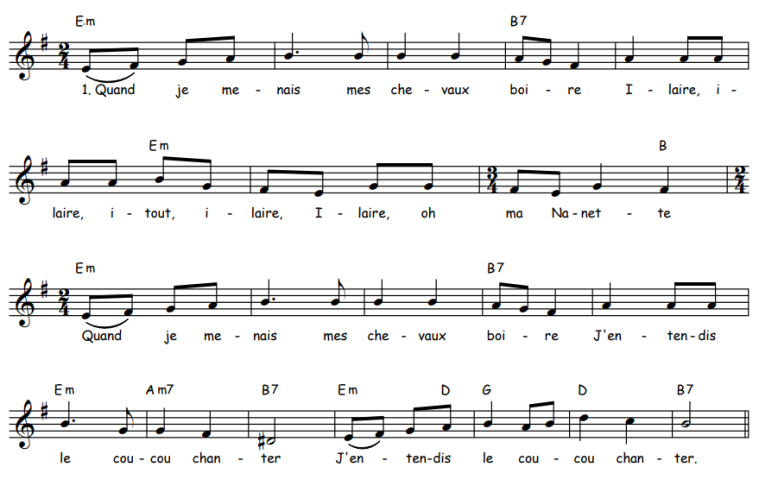
Anonimo (regione francese, sec. XVII): Quand je menai mes chevaux boire, chanson tradizionale francese (bretone o normanna). Claire Lefilliâtre, soprano; Le Poème Harmonique, dir. Vincent Dumestre.

Quand je menai mes chevaux boire,
  ilaire, ilaire, itou, ilaire,
  ilaire, oh, ma Nanette,
Quand je menai mes chevaux boire
j’entendis le coucou chanter.

Il me disait dans son language:
Ta bien aimée vont l’enterrer.

Ah! que dis-tu, méchante bête,
j’étais près d’elle hier au soir.

Mais quand je fus dedans la lande
j’entendis les cloches sonner.

Mais quand je fus dedans l’église
j’entendis les prêtres chanter.

Donnai du pied dedans la chasse.
Réveillez-vous si vous dormez.

Non je ne dors ni ne sommeille:
je vous attend dedans l’Enfer.

Vois: ma bouche est pleine de terre
et la tienne est pleine d’amour.

Auprès de moi reste une place
et c’est pour toi qu’on l’a gardée.

Quand je menais

Fra vaghi risi, e cari

Jacopo Peri detto Zazzerino (20 agosto 1561 - 12 agosto 1633): Un dì soletto, madrigale a 1 voce e basso continuo (pubblicato nella raccolta Le varie musiche del Sig. Jacopo Peri, 1609, n. 17) su testo di Gabriello Chiabrera. Marc Mauillon, voce; Angélique Mauillon, arpa.

Un dì soletto
vidi il diletto,
ond’ho tanto martire;
e sospirando,
tutto tremando
così le presi a dire:

«O tu, che m’ardi
co’ dolci sguardi,
come sì bella appari!»
Ella veloce
sciolse la voce
fra vaghi risi, e cari:

«Sul volto rose
l’alba mi pose,
lume su’ crini il sole,
ne gli occhi Amore
il suo splendore,
suo mel ne le parole.»

Così disse ella;
poscia, più bella
che giamai m’apparisse,
piena il bel viso
di bel sorriso,
lieta soggiunse, e disse:

«O tu, che t’ardi
a’ dolci sguardi,
come sì tristo appari!»
ed io veloce
sciolsi la voce
fra caldi pianti amari:

«D’empio veneno
mi sparge il seno,
oimé, tua gran beltade;
e la mia vita
quasi è finita
per troppa feritade».

Ella per gioco
sorise un poco,
indi mi si nascose;
ed io dolente
pregava ardente,
ma più non mi rispose.

Non gli dir di chi

Vincenzo Righini (1756 - 19 agosto 1812): Placido zeffiretto, arietta per voce e strumento a tastiera su testo di Pietro Metastasio (con alcune varianti). Patrice Michaels Bedi, soprano; David Schrader, fortepiano.

Placido zeffiretto,
Se trovi il caro oggetto
Digli che sei sospiro;
Ma non gli dir di chi.

Limpido ruscelletto,
Se trovi il caro oggetto
Digli che pianto sei,
Ma non le dir qual ciglio
Crescer ti fè cosi.


Antonio Vivaldi (1678 - 1741) : «Placido zeffiretto», aria (n. 3) dalla cantata T’intendo, si mio cor per soprano e basso continuo RV 668 sul medesimo testo del Metastasio. Rossana Bertini, soprano; Modo Antiquo, dir. Federico Maria Sardelli.

Placido zeffiretto,
Se trovi il caro oggetto/bene
Dille che sei sospiro;
Ma non le dir di chi.

Limpido ruscelletto,
Se mai t’ incontri in lei,
Dille che pianto sei,
Ma non le dir qual ciglio
Crescer ti fè cosi.


Vincenzo Righini

Musica di sua maestà: la principessa Kurakina

 
Natal’ja Ivanovna Kurakina (16 agosto 1766 - 1831): Je vais donc quitter pour jamais, romanza su testo di Jean-Pierre Claris de Florian (dal romanzo pastorale Estelle). Anne Harley, soprano; Oleg Timofeev, chitarra; Étienne Abelin, violino.

Je vais donc quitter pour jamais
mon beau pays, ma douce amie!
Loin d’eux je vais traîner ma vie,
dans les pleurs et dans les regrets.
Vallon charmant, où notre enfance
goûta ces plaisirs purs et vrais
que donne la seule innocence,
je vais vous quitter pour jamais.

Champs que j’ai dépouillés de fleurs,
pour orner les cheveux d’Estelle;
roses qui perdiez auprès d’elle
et votre éclat et vos couleurs;
fleuve dont j’ai vu l’ eau limpide,
pour réfléchir ses doux attraits,
suspendre sa course rapide,
je vais vous quitter pour jamais.

Prairie où dès nos premiers ans
nous parlions déjà de tendresse,
où, bien avant notre jeunesse,
nous passions pour de vieux amans;
beaux arbres où nous allions lire
le nom que toujours j’y traçois,
le seul qu’alors je susse écrire,
je vais vous quitter pour jamais.


Ludwig-Wilhelm Tepper de Ferguson (1768 - 1838): Variazioni sopra una romanza della principessa Kurakina. Irina Rees, clavicembalo.


Kurakina, Vigée-Lebrun

Psallit laudes, canit hymnos

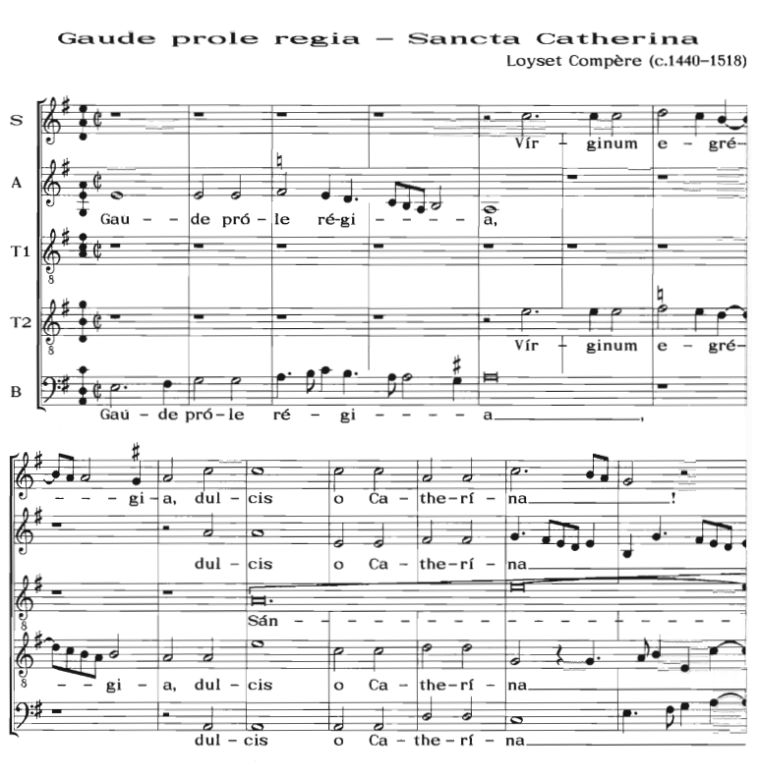
Loyset Compère (c1445 - 16 agosto 1518): Gaude prole regia, mottetto a 5 voci in lode di santa Caterina d’Alessandria. Capella Sancti Michaelis.

Gaude prole regia,
Virginum egregia,
dulcis o Catherina!

Congaudet exercitus
Cherub te divinitus
ferens in montem Sinai.

Costo regi Cypri nata,
moxque Christo desponsata
passa Alexandria.

Te clamat sanctam in caelis
omnis natio fidelis,
Francia cum Flandria.

Symphonisant dulce melos
cives qui habitant caelos
tam digno consortio.

Sponso tuo occurristi,
laureata quae fuisti,
digna caeli portio.

Psallit laudes, canit hymnos,
cantus personat divinos
fidelis ecclesia.

Laudes erumpit annuas,
colens passiones tUas
duraque supplicia.

o quam dulcis, quam formosa
quamque Christo gratiosa
est haec regis filia!

Quae spreta mundanitate
amplexaque castitate
nitet super filia.

Da captivis libertatem,
aegrotis incolumitatem,
sis spes te deprecantium.

Confer quaeso peregrinis
sanitatem in divinis,
sis via errantium.

Tandem pia Virgo cave,
ne quid in cor nostrum pravae
infundat diabolus.

Sed reice si quid assit
ut post mortem aeterna sit
mansio nostra polus.

Sancta Catherina, ora pro nobis.
Amen.

L’usignolo

Aleksandr Aleksandrovič Aljab’ev (15 agosto 1787 - 1851): L’usignolo (Соловей, 1826), romanza su testo di Anton Del’vig; trascrizione per voce e orchestra di Michail Ivanovič Glinka (1804 - 1857). Natalie Dessay, soprano; Berliner Sinfonie-Orchester, dir. Michael Schoenwandt.

Соловей мой, соловей,
Голосистый соловей!
Ты куда, куда летишь,
Где всю ночку пропоешь?
    Соловей мой, соловей,
    Голосистый соловей!

[Кто-то бедная, как я,
Ночь прослушает тебя,
Не смыкаючи очей,
Утопаючи в слезах?
    Соловей мой, соловей,
    Голосистый соловей!]

Ты лети, мой соловей,
Хоть за тридевять земель,
Хоть за синие моря,
На чужие берега;
    Соловей мой, соловей,
    Голосистый соловей!

Побывай во всех странах,
В деревнях и в городах:
Не найти тебе нигде
Горемышнее меня.
    Соловей мой, соловей,
    Голосистый соловей!

(Usignolo, mio usignolo, chiassoso usignolo! Dove sei, dove voli, dove canterai tutta la notte?
    Usignolo, mio usignolo, chiassoso usignolo!
[Ti ascolterà, questa notte, un’altra infelice come me, senza poter chiudere occhi che annegano nelle lacrime?]
Vola, mio usignolo, sopra terre lontane, sopra il blu del mare, sopra rive straniere.
Viaggia attraverso ogni landa, sui villaggi, sulle città: non troverai nessuno più infelice di me.)


Michail Ivanovič Glinka (1804 - 1857): Variazioni in mi minore sulla romanza L’usignolo di A. A. Aljab’ev (1833). Anna Petrova-Forster, pianoforte.


Franz Liszt (1811 - 1886): Le Rossignol, air russe d’Alabieff S 250/1 (1842). France Clidat, pianoforte.


Il brano di Liszt trascritto per arpa da Henriette Renié (1875 - 1956) e interpretato da Anneleen Lenaerts.

Ita factum est

Lorenzo Ratti (c1589 - 10 agosto 1630): Si bona suscepimus, mottetto a voci e strumenti; testo da Giobbe 2:10 e 1:21. Ensemble Concerto romano e Li sacri cornetti, dir. Alessandro Quarta.

Si bona suscepimus de manu Dei,
mala autem quare non sustineamus?

Dominus dedit, Dominus abstulit; sicut Domino placuit, ita factum est:
sit nomen Domini benedictum.
Nudus egressus sum de utero matris meae, et nudus revertar illuc.

Zitti zitti

Gioachino Rossini (1792 - 1868): «Zitti zitti, piano piano», terzetto dal II atto dell’opera Il barbiere di Siviglia, o sia L’inutil precauzione (1816). Joyce DiDonato (Rosina), William Browning (Figaro), Patrick Greene (Almaviva).


Nicolas Bochsa (9 agosto 1789 - 1856): Rondo sur le trio «Zitti, zitti» du Barbier de Seville. Joel von Lerber, arpa.

Quartetto per soprano e archi

 
Betsy Jolas (5 agosto 1926): Quatuor II per soprano, violino, viola e violoncello (1966). Mady Mesplé, soprano; Trio À Cordes Français: Gérard Jarry, violino; Serge Collot, viola; Michel Tournus, violoncello.
 

Una pastorella, un’oca e il trifoglio

Oswald von Wolkenstein (c1377 - 2 agosto 1445): Ain graserin durch kúlen tau. Ensemble für frühe Musik Augsburg.

Ain graserin durch kúlen tau
mit weissen, blossen fússlin zart
hat mich erfreut in grúner au;
das macht ir sichel brawn gehart,
do ich ir half den gattern rucken,
smucken fúr die schrencken,
lencken, sencken in die seul,
wolbewart, damit das freul
hinfúr an sorg nicht fliesen möcht ir gensel.

Als ich die schön her zeunen sach,
ain kurze weil ward mir ze lanck,
bis das ich ir den ungemach
tett wenden zwischen zwaier schranck.
mein häcklin klein hett ich ir vor
embor zu dienst gewetzet,
gehetzet, netzet; wie dem was,
schúbren half ich ir das gras.
«Zuck nicht, mein schatz!»
«Simm nain ich, lieber Jensel.»

Als ich den kle hett abgemät
und all ir lucken wolverzeunt,
dannocht gert si, das ich jät
noch ainmal inn der nidern peunt;
ze lon wolt si von rosen winden,
binden mir ain krenzel.
«Swenzel, renzel mir den flachs!»
«Treut in, wiltu, das er wachs!
herz liebe gans, wie schön ist dir dein grensel.»

Folk songs: 20. Barbara Allen

Anonimo (sec. XVII): Barbara Allen, ballad di origine scozzese. Alfred Deller, controtenore; Desmond Dupré, liuto.

In Scarlet town where I was born
There was a fair maid dwellin’,
Made ev’ry youth cry «Well-a-day.»
Her name was Barbara Allen.

All in the merry month of may,
When green buds they were swellin’,
Young Jemmy Grove on his death-bed lay
For love of Barbara Allen.

So slowly, slowly she came up,
And slowly she came nigh him,
And all she said when there she came:
«Young man, I think you’re dyin’.»

When he was dead, and laid in grave,
Her heart was struck with sorrow.
«Oh mother, mother, make my bed:
For I shall die tomorrow.»

Farewell, she said, ye virgins all,
And shun the fault I fell in:
Henceforth take warning by the fall
Of cruel Barbara Allen.

Folk songs: 19. Yonder comes a courteous knight

 
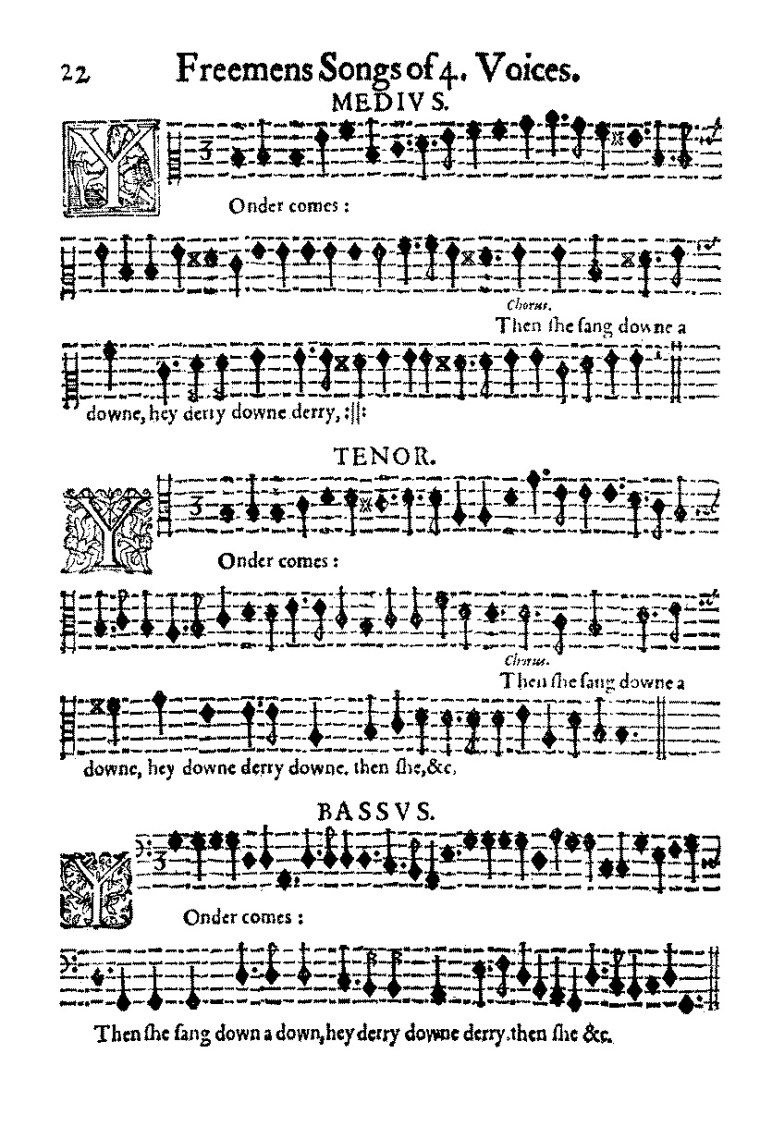
Thomas Ravenscroft (c1582 - c1633): Yonder comes a courteous knight, partsong a 4 (pubblicato in Deuteromelia, 1609, n. 22). Pro Cantione Antiqua.

Notevoli il testo, che presenta alla fine una «morale» davvero curiosa 🙂 , e l’armonizzazione, severa e moderna allo stesso tempo, nonché l’interpretazione dell’ensemble Pro Cantione Antiqua.

Yonder comes a courteous knight,
Lustely raking over the lay;
He was well ware of a bonny lasse,
As she came wand’ring over the way.
  Then she sang downe a downe, hey downe derry.

Jove you speed, fayre ladye, he said,
Among the leaves that be so greene;
If I were a king, and wore a crowne,
Full soone, fair lady, shouldst thou be a queen.

Also Jove save you, faire lady,
Among the roses that be so red;
If I have not my will of you,
Full soone, faire lady, shall I be dead.

[Then he lookt east, then hee lookt west,
He lookt north, so did he south;
He could not finde a privy place,
For all lay in the divel’s mouth.
]

If you will carry me, gentle sir,
A mayde unto my father’s hall,
Then shall you have your will of me,
Under purple and under paule.

[He set her up upon a steed,
And him selfe upon another,
And all the day he rode her by,
As though they had been sister and brother.
]

When she came to her father’s hall,
It was well walled round about;
She rode in at the wicket-gate,
And shut the foure-ear’d foole without.

You had me, quoth she, abroad in the field,
Among the corne, amidst the hay,
Where you might had your will of mee,
For, in good faith, sir, I never said nay.

[Ye had me also amid the field,
Among the rushes that were so browne,
Where you might had your will of me,
But you had not the face to lay me downe.
]

He pulled out his nut-browne sword,
And wipt the rust off with his sleeve,
And said: Jove’s curse come to his heart,
That any woman would beleeve!

When you have your owne true-love
A mile or twaine out of the towne,
Spare not for her gay clothing,
But lay her body flat on the ground.

Corteccia

Francesco Corteccia (27 luglio 1502 - 1571): Vientene, almo riposo, madrigale a 5 voci (pubblicato nel Libro primo de madrigali a cinque & a sei voci, 1547). John Elwes, tenore; Les Sacque­boutiers de Toulouse.

Vientene, almo riposo, ecco ch’io torno
e ne discaccio il giorno,
posate erbette e fronde,
e spogliatevi piagge e arboscelli,
entrate o pastorelli,
entrate o ninfe bionde,
entro al bel nido adorno
ognun s’adagi, e dorma al mio ritorno.


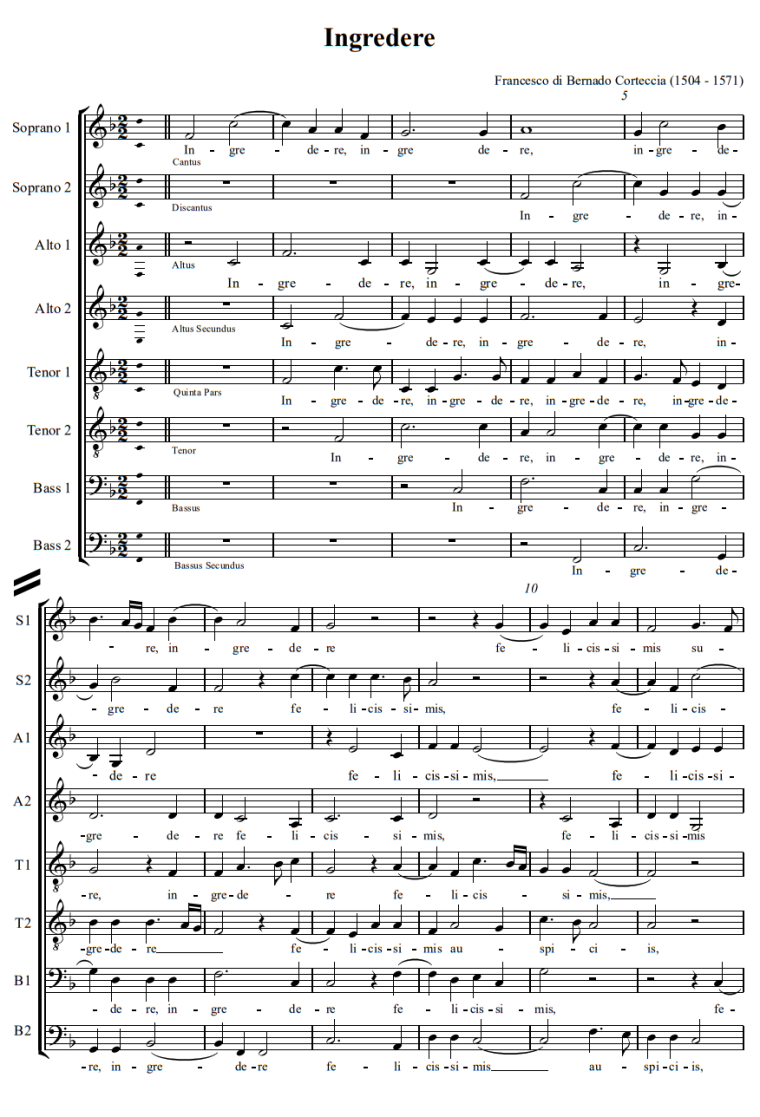
Corteccia: Ingredere, mottetto a 8 voci in 2 cori (pubblicato in Musiche fatte nelle nozze dello illustrissimo Duca di Firenze, il signor Cosimo de’ Medici, et della illustrissima consorte sua, madonna Leonora da Tolletto, 1539, n. 2). Nel primo video, il mottetto è eseguito dall’ensemble del Centre de Musique Ancienne di Ginevra, dallo Studio di Musica Rinascimentale di Palermo e dalla Schola «Jacopo da Bologna» diretti da Gabriel Garrido; nel secondo, Eduardo Antonello esegue tutte le parti con i suoi cromorni.

Ingredere felicissimis, auspiciis urbem tuam Helionora ac optime
prolis fecunda, ita domi similem patri foris avo sobolem producas
ut Mediceo nomini eiusque devotissimis civibus securitatem prestes eternam.

Folk songs: 18. She Moved through the Fair

Anonimo: She Moved through the Fair, canzone tradizionale irlandese. Alfred Deller, controtenore; Desmond Dupré, liuto.

My young love said to me: My mother won’t mind,
And my father won’t slight you for your lack of kine.
And she stepped away from me and this she did say:
It will not be long, love, ‘til our wedding day.

She stepped away from me and she moved through the fair,
And fondly I watched her move here and move there,
And then she went homeward with one star awake,
As the swan in the evening moves over the lake.

Last night she came to me, she came softly in.
So softly she came that her feet made no din,
And she laid her hand on me, and this she did say:
It will not be long, love, ‘til our wedding day.

La melodia, diffusa in Irlanda e in Scozia, risale probabilmente al basso Medioevo. Il testo è stato pubblicato per la prima volta nella raccolta Irish Country Songs (1909), curata da Herbert Hughes.

Folk songs: 17. Tre in una

 
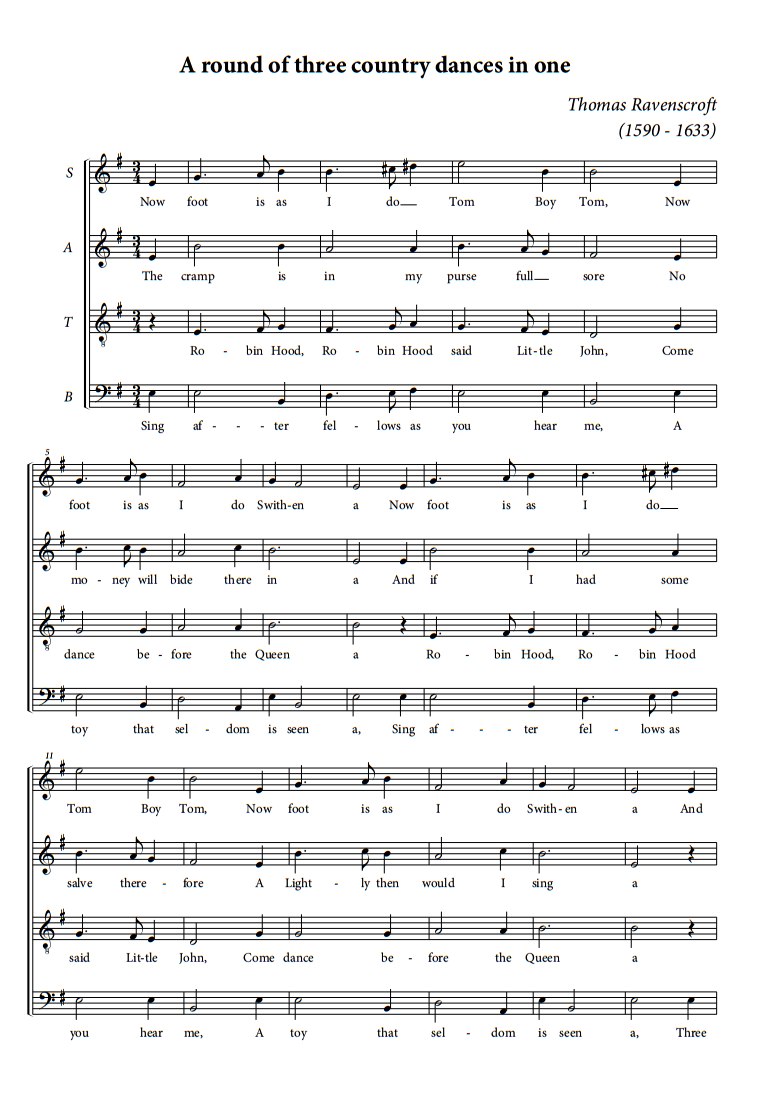
Thomas Ravenscroft (c1582 - c1633): A round of three country dances in one, da Pammelia (1609), eseguito da Donna Stewart e i suoi Doppelgänger 🙂

Ecco un esempio significativo della maestria di Ravenscroft, che costruisce un round (canone) innestando sopra un ground di sua invenzione, con questo testo:

Sing after fellows as you hear me,
A toy that seldom is seen-a:
Three country dances in one to be,
A pretty conceit as I ween-a.

tre diverse country dances, e cioè Robin Hood, The Cramp e Tom boy Tom:

  1. Robin Hood, Robin Hood, said Little John,
    Come dance before the Queen-a
    In a red petticoat and a green jacket,
    a white hose and a green-a.

  2. The cramp is in my purse full sore,
    No money will bide therein-a,
    And if I had some salve therefore,
    O lightly then would I sing-a.
    Hey, ho, the cramp-a.

  3. Now foot it as I do Tom boy Tom,
    Now foot it as I do Swithen-a,
    And Hick, thou must trick it all alone,
    Till Robin come leaping in between-a.

Folk songs: 16. Bushes and Briars

 
Anonimo: Bushes and Briars, canto tradizionale inglese. Alfred Deller, controtenore; Desmond Dupré, liuto.
La «scoperta» di questo brano si deve a Ralph Vaughan Williams, che l’udì cantare da un pastore nell’Essex e ne pubblicò un arrangiamento per coro maschile a 4 voci a cappella nel 1908.

Through bushes and through briars,
I lately took my way;
All for to hear the small birds sing,
And the lambs to skip and play.

I overheard my own true love,
Her voice it was so clear;
Long time I have been waiting
For the coming of my dear.

Sometimes I am uneasy
And troubled in my mind;
Sometimes I think I’ll go to my love
And tell to him my mind.

And if I should go to my love,
My love he will say «Nay»;
If I show to him my boldness,
He’ll ne’er love me again.


L’arrangiamento di Vaughan Williams eseguito da The Gentlemen of St. John’s.
 

Il soverchio dolor non fa morire

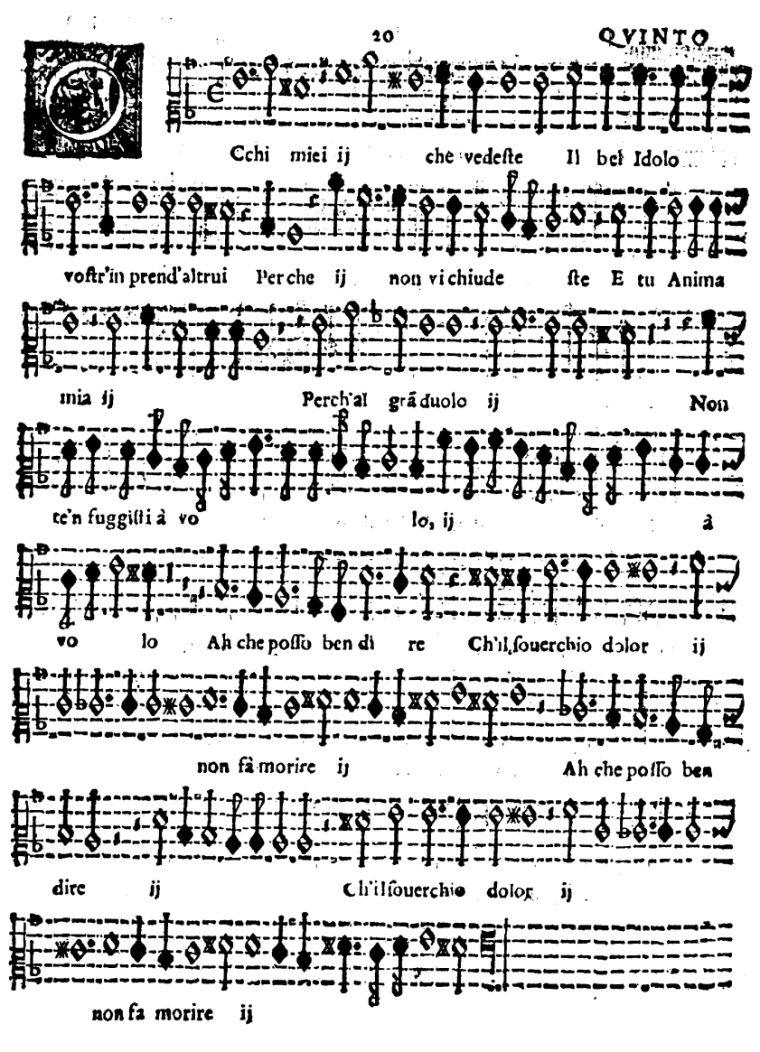
Pomponio Nenna (1556 - 25 luglio 1608): Occhi miei che vedeste, madrigale a 5 voci (pubblicato nel Quarto Libro de madrigali a cinque voci, 1609, n. 20); testo di Battista Guarini. Concerto Italiano, dir. Rinaldo Alessandrini.

Occhi miei che vedeste
Il bell’idolo vostro in preda altrui
Perché non vi chiudeste?
E tu, Anima mia,
Perché al gran duolo
Non t’en fuggisti a volo?
Ah, che posso ben dire
Che il soverchio dolor
Non fa morire.

Nenna - IV Libro

Folk songs: 15. Dulcina

 
Anonimo (sec. XVII): As at noon Dulcina rested, ballad su testo attribuito erroneamente a sir Walter Raleigh (1554? - 1618). Ellen Hargis, soprano; Paul O’Dette, cittern; The King’s Noyse, dir. David Douglass.

As att noone Dulcina rested
  In her sweete & shadie bower;
Came a sheppard, & requested
  In her lap to sleepe an houre.
    But from her looke
    A wound hee tooke
  Soe deepe, that for a farther boone
    The Nimphe hee pray’d,
    Whereto she say’d,
  Forgoe mee nowe, come to mee soone.

But in vaine shee did conjure him
  For to leave her presence soe,
Havinge a Thousand meanes t’alure him,
  & but one to lett him goe.
    Where lipps delighte,
    & eyes invite,
  & cheeks as fresh as rose in June,
    Persuade to staie,
    What boots to saye
  Forgoe mee nowe, come to mee soone.

Hee demaunds what time or leisure
  Can there be more fitt then nowe:
She saies, night gives love that pleasure,
  Which the day cannot alowe.
    The sunns clere light
    Shyneth more bright
  Quoth hee more fairer then the moone
    For her to praise
    Hee love, shee saies,
  Forgoe mee nowe, come to mee soone.

With greife of heart this shepheard hasted
  Up the mountaine to his flocks,
Then hee tooke a reed and piped
  Th’echo sounded through the rocks,
    Thus did hee plaie
    & wishe the day
  Were spent, & night were come ere noone,
    For silent night
    Is loves delight
  Ile goe to faire Dulcina soone.

Beauties Darling faire Dulcina
  Like to Venus for her love
Spent the day away in passion
  Mourninge like the Turtle Dove,
    Melodiouslie,
    Notes lowe & highe
  Shee farbled forth this dolefull tune,
    O come againe,
    Sweete sheppard swaine,
  Thou canst not be with mee to soone.

When as Thetis in her pallace
  Had receiv’d the prince of light
Came in Coridon the shepheard,
  To his love and hearts delight.
    The Pan did plaie
    The wood Nimphes they
  Did skip & daunce to heare the tune,
    Hymen did saie
    T’was holidaie,
  Forgoe mee nowe, come to mee soone.

Sweete, hee say’d, as I did promise
  I am nowe return’d againe,
Longe delaie you knowe breeds daunger
  & to lov’rs breedeth paine.
    The Nimph say’d then
    Above all men
  Still welcome shepheard morne & noone,
    The shepheard praies,
    Dulcina saies,
  Shepheard, I doubt y’are come to soone.

Come you nowe to overthrowe mee,
  Out alas I am betray’d,
Deare, is this the love you shewe mee
  To betraie a silly maide.
    Helpe, helpe, ay mee,
    I dare not speake
  I dare not crie, my heart will breake.
    What, all alone?
    Nay, then I finde
  Men are to stronge for woemen kinde.

O sillie foole, whie doubt I tellinge
  When I doubted not to truste.
If my bellie fall a swellinge
  There’s noe helpe but out it must.
    Ay mee, the greife,
    Ay mee, the shame,
  When I shall beare the common name.
    Yet att the worst
    Of my disgrace
  I am not first, nor shal be laste.

La prima menzione di As at noon Dulcina rested risale al 1690, mentre la prima pubblicazione nota è del 1707 e si deve a Thomas D’Urfey, che l’inserì nella sua monumentale silloge intitolata Wit and Mirth, or Pills to Purge Melancholy (1698-1720). La musica è caratterizzata da un brusco cambio di ritmo e andamento al 5° verso della strofe: a una prima parte fluente, in ritmo binario, fa seguito una seconda parte saltellante, in ritmo ternario. Questo particolare induce a pensare che la musica fosse in origine destinata alla danza e che il brano con molta probabilità facesse parte di un masque, un genere di rappresentazione teatrale che andava molto in voga in Inghilterra ai tempi di Giacomo I.
Ebbe vita propria come composizione soltanto strumentale, mantenendo perlopiù il titolo di Dulcina derivatole dal testo dello pseudo-Raleigh. Purtuttavia, in precedenza William Brade (un inglese attivo a Amburgo: l’abbiamo già incontrato, per esempio qui) l’aveva rielaborato a cinque parti strumentali e pubblicato con il titolo di Turkische Intrada; qui è interpretato dai Musicians of the Globe diretti da Philip Pickett:


Folk songs: 14. The Tailor and the Mouse

Anonimo: The Tailor and the Mouse. Alfred Deller, controtenore; Desmond Dupré, liuto.

There was a tailor had a mouse,
  Hi diddle um come feed-al,
They lived together in one house,
  Hi diddle um come feed-al.

Chorus :
  Hi diddle um come tarum tantrum,
  Through the town of Ramsey,
  Hi diddle um come over the lea,
  Hi diddle um come feed-al.

The tailor thought his mouse was ill,
He gave him part of a blue pill.

The tailor thought the mouse would die,
He baked him in an apple pie.

The pie was cut, the mouse ran out,
The tailor followed him all about.

The tailor found his mouse was dead,
So he bought another one in his stead.

Edward

Una famosa ballata tradizionale scozzese nella non meno famosa versione tedesca di Johann Gottfried Herder (1744 - 1803):

Dein Schwert, wie ist’s von Blut so rot?
Edward, Edward!
Dein Schwert, wie ist’s von Blut so rot?
Und gehst so traurig da? O!

Ich hab geschlagen meinen Geier tot,
Mutter, Mutter!
Ich hab geschlagen meinen Geier tot,
Und das, das geht mir nah. O!

Deines Geiers Blut ist nicht so rot,
Edward, Edward!
Deines Geiers Blut ist nicht so rot,
Mein Sohn, bekenn mir frei. O!

Ich hab geschlagen mein Rotroß tot,
Mutter, Mutter!
Ich hab geschlagen mein Rotroß tot,
Und’s war so stolz und treu. O!

Dein Roß war alt und hast’s nicht not,
Edward, Edward!
Dein Roß war alt und hast’s nicht not,
Dich drückt ein andrer Schmerz. O!

Ich hab geschlagen meinen Vater tot!
Mutter, Mutter!
Ich hab geschlagen meinen Vater tot,
Und das, das quält mein Herz! O!

Und was wirst du nun an dir tun,
Edward, Edward?
Und was wirst du nun an dir tun,
Mein Sohn, das sage mir! O!

Auf Erden soll mein Fuß nicht ruhn,
Mutter, Mutter!
Auf Erden soll mein Fuß nicht ruhn,
Will wandern übers Meer! O!

Und was soll werden dein Hof und Hall,
Edward, Edward?
Und was soll werden dein Hof und Hall,
So herrlich sonst, so schön? O!

Ach immer steh’s und sink und fall!
Mutter, Mutter!
Ach immer steh’s und sink und fall,
Ich werd es nimmer sehn! O!

Und was soll werden aus Weib und Kind,
Edward, Edward?
Und was soll werden aus Weib und Kind,
Wann du gehst übers Meer? O!

Die Welt ist groß, laß sie betteln drin,
Mutter, Mutter!
Die Welt ist groß, laß sie betteln drin,
Ich seh sie nimmermehr! O!

Und was soll deine Mutter tun,
Edward, Edward?
Und was soll deine Mutter tun,
Mein Sohn, das sage mir? O!

Der Fluch der Hölle soll auf euch ruhn,
Mutter, Mutter!
Der Fluch der Hölle soll auf euch ruhn,
Denn ihr, ihr rietet’s mir! O!

Perché la tua spada è così rossa di sangue,
Edward, Edward?
Perché la tua spada è così rossa di sangue
E perché te ne vai così triste? Oh!

Ho colpito il mio falco a morte,
Madre, madre!
Ho colpito il mio falco a morte,
E questo mi addolora. Oh!

Il sangue del tuo falco non è così rosso,
Edward, Edward!
Il sangue del tuo falco non è così rosso,
Dimmi la verità, figlio mio. Oh!

Ho ucciso il mio cavallo roano,
Madre, madre!
Ho ucciso il mio cavallo roano
Che era così fiero e fedele. Oh!

Il tuo cavallo era vecchio e non ne avevi bisogno,
Edward, Edward;
Il tuo cavallo era vecchio e non ne avevi bisogno,
Un’altra pena ti affligge. Oh!

Ho colpito a morte mio padre!
Madre, madre!
Ho colpito a morte mio padre,
Ed è questo che tormenta il mio cuore! Oh!

E quale pena ne vuoi portare,
Edward, Edward?
Quale pena ne vuoi portare,
Dimmi, figlio mio! Oh!

I miei piedi mai riposeranno sulla terra,
Madre, madre!
I miei piedi mai riposeranno sulla terra,
E me ne andrò sul mare. Oh!

E che ne sarà della tua casa,
Edward, Edward?
E che ne sarà della tua casa,
Così nobile e così bella? Oh!b

Andrà in rovina e infine crollerà,
Madre, madre!
Andrà in rovina e infine crollerà,
Non la rivedrò mai più. Oh!

E che sarà della tua donna e di tuo figlio,
Edward, Edward?
E che sarà della tua donna e di tuo figlio,
Quando tu te ne andrai per il mare? Oh!

Il mondo è grande, che vaghino mendichi,
Madre, madre!
Il mondo è grande, che vaghino mendichi,
Io non li rivedrò mai più. Oh!

E che sarà di tua madre,
Edward, Edward?
E che sarà di tua madre?
Dimmelo, figlio mio. Oh!

La maledizione dell’inferno cada su di te,
Madre, madre!
La maledizione dell’inferno cada su di te,
Perché sei stata tu a dirmi di farlo. Oh!

Carl Loewe (1796 - 1869): Edward, ballata op. 1 n. 1 (1818). Dietrich Fischer-Dieskau, baritono; Jörg Demus, pianoforte.

Loewe, Edward


Franz Schubert (1797 - 1828): Eine altschotthche Ballade, Lied, 2a versione, op. 165 n. 5 (posth.), D 923 (1827). Martha Guth, soprano; Penelope Crawford, pianoforte.

Schubert, D 923


Johannes Brahms (1833 - 1897): Edward, duetto op. 75 n. 1 (1878). Brigitte Fassbaender, mezzosoprano; Peter Schreier, tenore; Karl Engel, pianoforte.

Brahms, op. 75 n. 1