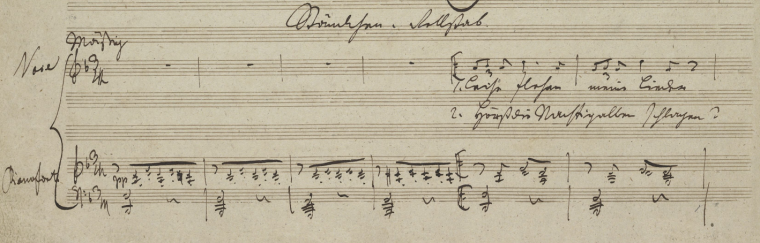
Franz Schubert (1797 - 19 novembre 1828): Ständchen, Lied D 957/4 (1828) su testo di Ludwig Rellstab. Peter Schreier, baritono; Walter Olbertz, pianoforte.
Leise flehen meine Lieder
Durch die Nacht zu Dir;
In den stillen Hain hernieder,
Liebchen, komm’ zu mir!
Flüsternd schlanke Wipfel rauschen
In des Mondes Licht;
Des Verräthers feindlich Lauschen
Fürchte, Holde, nicht.
Hörst die Nachtigallen schlagen?
Ach! sie flehen Dich,
Mit der Töne süßen Klagen
Flehen sie für mich.
Sie verstehn des Busens Sehnen,
Kennen Liebesschmerz,
Rühren mit den Silbertönen
Jedes weiche Herz.
Laß auch Dir das Herz bewegen,
Liebchen, höre mich!
Bebend harr’ ich Dir entgegen!
Komm’, beglücke mich!
Felice Blangini (18 novembre 1781 - 1841): La vielle, arietta buffa. Leonardo De Lisi, tenore; Orchestra della Compagnia dell’Opera Italiana, dir. Maurizio Benedetti.
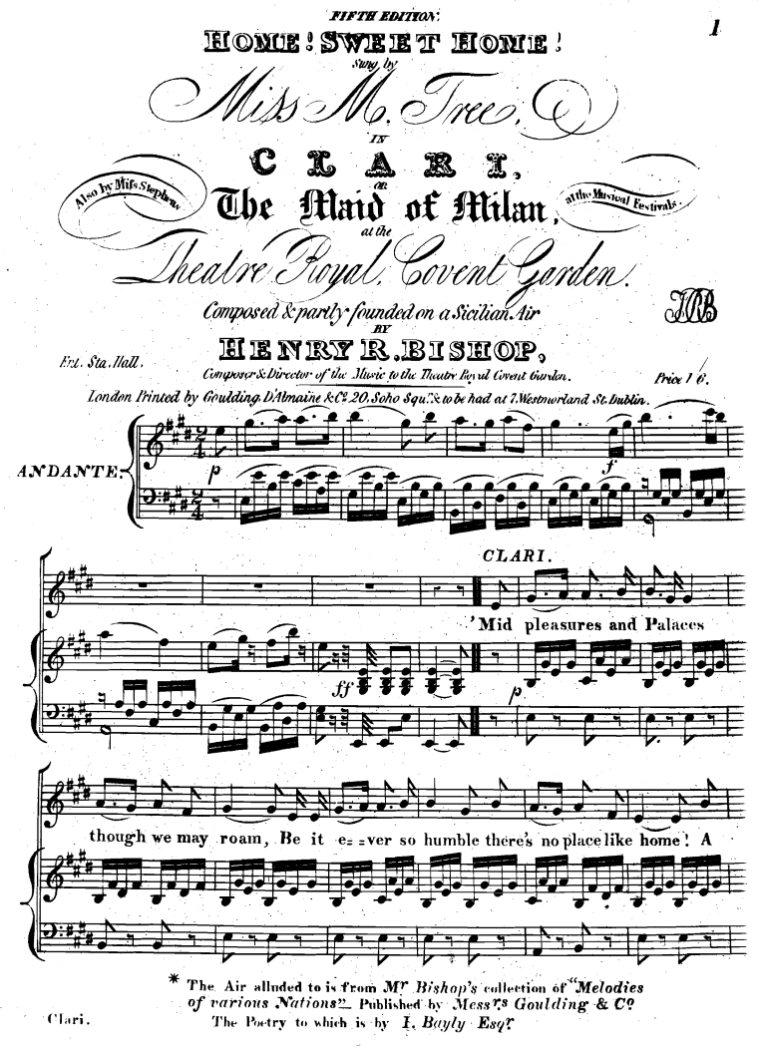
Quando, per pura curiosità, ho cercato “home sweet home” nel web, sono rimasto alquanto sorpreso: nei primi 150 risultati della ricerca eseguita tramite Google, non compare nemmeno una volta il nome di Henry Bishop.
“Musicista?” chiederete voi. Certo: sir Henry Rowley Bishop (18 novembre 1786 - 1855) scrisse un gran numero di cantate, balletti e opere liriche; fra queste ultime si annovera Clari, or The Maid of Milan (1823), composta su libretto dello statunitense John Howard Payne: fa parte dell’opera l’aria «Mid pleasures and palaces» nota, per via del refrain, appunto con il titolo Home! Sweet Home! Qui potete ascoltarla nell’interpretazione del soprano Greta Bradman accompagnata dall’arpista Suzanne Handel:
Mid pleasures and palaces though we may roam,
Be it ever so humble, there’s no place like home;
A charm from the skies seems to hallow us there,
Which seek thro’ the world, is ne’er met elsewhere.
Home! Home!
Sweet, sweet home!
There’s no place like home,
There’s no place like home!
An exile from home splendor dazzles in vain.
Oh, give me my lowly thatched cottage again,
The birds singing gaily that came at my call
And gave me the peace of mind, dearer than all.
Home! Home!
Sweet, sweet home!
There’s no place like home,
there’s no place like home!
Home! Sweet Home! venne pubblicato come brano a sé stante, in un primo tempo con la dicitura «composed and partly founded on a Sicilian Air» (in seguito Bishop ammise di aver inventato questo particolare a scopo promozionale). Divenne subito incredibilmente popolare: in breve tempo ne furono vendute oltre centomila copie. Nel 1852, curata dall’autore, ne uscì una nuova edizione a stampa come parlour ballad (cioè, in sostanza, una romanza da camera), e in questa veste ottenne ampio successo anche negli Stati Uniti: difatti, ancora oggi è spesso presente nelle antologie di musiche risalenti agli anni della guerra di secessione (1861-1865).
La vasta popolarità di cui Home! Sweet Home! godette nel corso dell’Ottocento è testimoniata dal fatto che la sua melodia è citata in varie composizioni dell’epoca. Già nel 1827 venne utilizzata dallo svedese Franz Berwald (1796 - 1868) nella sezione mediana, Andante con variazioni, del suo Konzertstück per fagotto e orchestra op. 2 — qui interpretato da Patrik Håkansson con l’Orchestra sinfonica di Gävle diretta da Petri Sakari:
[l’Andante con variazioni ha inizio a 5:43]
Altra citazione celebre si trova all’inizio della «scena della pazzia» (aria «Cielo, a’ miei lunghi spasimi», atto II, scena 3ª) nella tragedia lirica Anna Bolena, rappresentata nel 1830, di Donizetti (1797 - 1848) — ascoltate Maria Callas:
Risale al 1855 circa l’opus 72 di Sigismond Thalberg (1812 - 1871), Home! Sweet Home! Air Anglais varié per pianoforte; nel video qui sotto è eseguito da Dennis Hennig:
Un’altra breve serie di variazioni, per cornetta a pistoni sola, si deve a Jean-Baptiste Arban (1825 – 1889); per ascoltarla (o riascoltarla) — potete farlo leggendo (o rileggendo) allo stesso tempo uno spassoso racconto di Jerome K. Jerome — cliccate qui.
Voglio menzionare ancora, per finire, la Fantaisie sur deux mélodies anglaises per organo op. 43 di Alexandre Guilmant (1837 - 1911): in questa composizione, del 1887 circa, Home! Sweet Home! è associato a un altro famosissimo brano inglese, Rule, Britannia! di Thomas Arne (1710 - 1778). Ecco la Fantaisie di Guilmant eseguita da Bernhard Schneider all’organo Klais della Chiesa di Sankt Aegidien in Braunschweig:
Heitor Villa-Lobos (1887 - 17 novembre 1959): Bachianas brasileiras n. 5 per soprano e otto violoncelli (1938-45) su testi di Ruth Valladares Corrêa (1904 - c1963) e Manuel Bandeira (1886 - 1968). Renée Fleming, soprano; Kenneth Freudigman (solista), Sofia Zappi, Alexander East, Pamela Smits, Damon Coleman, Robert Vos, Brad Ritchie e Eran Meir, violoncelli; dir. Michael Tilson Thomas.
I. Ária (Cantilena); testo di Ruth Valadares Corrêa
Tarde uma nuvem rósea lenta e transparente.
Sobre o espaço, sonhadora e bela!
Surge no infinito a lua docemente,
Enfeitando a tarde, qual meiga donzela
Que se apresta e a linda sonhadoramente,
Em anseios d’alma para ficar bela
Grita ao céu e a terra toda a Natureza!
Cala a passarada aos seus tristes queixumes
E reflete o mar toda a Sua riqueza…
Suave a luz da lua desperta agora
A cruel saudade que ri e chora!
Tarde uma nuvem rósea lenta e transparente
Sobre o espaço, sonhadora e bela!
II. Dança (Martelo); testo di Manuel Bandeira [6:38]
Irerê, meu passarinho
Do sertão do cariri,
Irerê, meu companheiro,
Cadê viola?
Cadê meu bem?
Cadê maria?
Ai triste sorte a do violeiro cantadô!
Sem a viola em que cantava o seu amô,
Seu assobio é tua flauta de irerê:
Que tua flauta do sertão quando assobia,
A gente sofre sem querê!
Teu canto chega lá do fundo do sertão
Como uma brisa amolecendo o coração.
Irerê, solta teu canto!
Canta mais! Canta mais!
Pra alembrá o cariri!
Canta, cambaxirra!
Canta, juriti!
Canta, irerê!
Canta, canta, sofrê!
Patativa! Bem-te-vi!
Maria-acorda-que-é-dia!
Cantem, todos vocês,
Passarinhos do sertão!
Bem-te-vi!
Eh sabiá!
Lá! Liá! liá! liá! liá! liá!
Eh sabiá da mata cantadô!
Lá! Liá! liá! liá!
Lá! Liá! liá! liá! liá! liá!
Eh sabiá da mata sofredô!
O vosso canto vem do fundo do sertão
Como uma brisa amolecendo o coração.
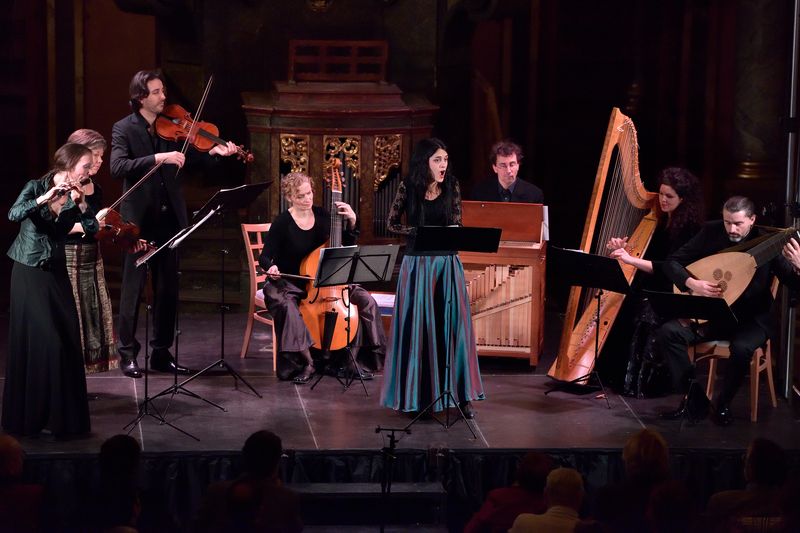
Thomas Ford (c1580 - sepolto il 17 novembre 1648): Faire, sweet, cruell, ayre (pubblicato in Musicke of Sundrie Kindes, 1607, vol. I, n. 7). Victoria Cassano, soprano; Javier Ovejero Mayoral, liuto.
Faire, sweet, cruell, why doest thou flie mee,
Goe not, oh goe not from thy deerest,
Though thou doest hasten I am nie thee,
When thou see’mst farre then am I neerest,
Tarrie then and take me with you.
Fie, fie, sweetest here is no danger,
Flie not, oh flie not loue pursues thee,
I am no foe, nor forraine stranger,
Thy scornes with fresher hope renewes me,
Tarrie then and take me with you.
Aaron Copland (14 novembre 1900 - 1990): Twelve Poems of Emily Dickinson (1950). Barbara Bonney, soprano; André Previn, pianoforte.
Nature, the gentlest mother
Nature, the gentlest mother
Impatient of no child,
The feeblest or the waywardest, —
Her admonition mild
In forest and the hill
By traveller is heard,
Restraining rampant squirrel
Or too impetuous bird.
How fair her conversation,
A summer afternoon, —
Her household, her assembly;
And when the sun goes down
Her voice among the aisles
Incites the timid prayer
Of the minutest cricket,
The most unworthy flower.
When all the children sleep
She turns as long away
As will suffice to light her lamps;
Then, bending from the sky,
With infinite affection
And infiniter care,
Her golden finger on her lip,
Wills silence everywhere.
There came a wind like a bugle [4:00]
There came a wind like a bugle;
It quivered through the grass,
And a green chill upon the heat
So ominous did pass
We barred the windows and the doors
As from an emerald ghost;
The doom’s electric moccasin
That very instant passed.
On a strange mob of panting trees,
And fences fled away,
And rivers where the houses ran
The living looked that day,
The bell within the steeple wild
The flying tidings whirled.
How much can come and much can go,
And yet abide the world!
Why do they shut me out of heaven? [5:29]
Why do they shut Me out of Heaven?
Did I sing too loud?
But I can say a little “Minor”
Timid as a Bird!
Wouldn’t the Angels try me
Just once more
Just see if I troubled them
But don’t shut the door!
Oh, if I were the Gentleman
In the “White Robe”
And they were the little Hand that knocked
Would I forbid?
[Why do they shut Me out of Heaven?
Did I sing too loud?]
The world feels dusty [7:35]
The World feels Dusty
When We stop to Die
We want the Dew then
Honors taste dry
Flags vex a Dying face
But the least Fan
Stirred by a friend’s Hand
Cools like the Rain
Mine be the Ministry
When they Thirst comes
Dews of Thyself to fetch
And Holy Balms
Heart, we will forget him [9:30]
Heart, we will forget him
You and I, tonight.
You may forget the warmth he gave,
I will forget the light.
When you have done, pray tell me,
That I my thoughts may dim;
Haste! lest while you’re lagging,
I may remember him!
Dear March, come in! [11:41]
Dear March, come in!
How glad I am!
I looked for you before.
Put down your hat –
You must have walked –
How out of breath you are!
Dear March, how are you?
And the rest?
Did you leave Nature well?
Oh, March, come right upstairs with me,
I have so much to tell!
I got your letter, and the bird’s;
The maples never knew
That you were coming, – I declare,
How red their faces grew!
But, March, forgive me –
And all those hills
You left for me to hue,
There was no purple suitable,
You took it all with you.
Who knocks? that April?
Lock the door!
I will not be pursued!
He stayed away a year, to call
When I am occupied.
But trifles look so trivial
As soon as you have come,
And blame is just as dear as praise
And praise as mere as blame.
Sleep is supposed to be [13:53]
Sleep is supposed to be,
By souls of sanity,
The shutting of the eye.
Sleep is the station grand
Down which on either hand
The hosts of witness stand!
Morn is supposed to be,
By people of degree,
The breaking of the day.
Morning has not occurred!
That shall aurora be
East of Eternity;
One with the banner gay,
One in the red array, –
That is the break of day.
When they come back [16:57]
When they come back if Blossoms do
I always feel a doubt
If Blossoms can be born again
When once the Art is out
When they begin, if Robins may,
I always had a fear
I did not tell, it was their last Experiment
Last Year,
When it is May, if May return,
Had nobody a pang
Lest in a Face so beautiful
He might not look again?
If I am there,
One does not know
What Party one may be
Tomorrow, but if I am there
I take back all I say
I felt a funeral in my brain [18:48]
I felt a funeral in my brain,
And mourners to and fro,
Kept treading, treading, till it seemed
That sense was breaking through.
And when they all were seated
A service like a drum
Kept beating, beating, till I thought
My mind was going numb.
And then I heard them lift a box,
And creak across my soul
With those same boots of lead, again.
Then space began to toll
As all the heavens were a bell,
And Being but an ear,
And I and silence some strange race,
Wrecked, solitary, here.
I’ve heard an organ talk sometimes [20:51]
I’ve heard an Organ talk, sometimes
In a Cathedral Aisle,
And understood no word it said
Yet held my breath, the while
And risen up and gone away,
A more Berdardine Girl
Yet know not what was done to me
In that old Hallowed Aisle.
Going to heaven! [22:54]
Going to Heaven!
I don’t know when,
Pray do not ask me how, –
Indeed I’m too astonished
To think of answering you!
Going to Heaven! –
How dim it sounds!
And yet it will be done
As sure as flocks go home at night
Unto the shepherd’s arm!
Perhaps you’re going too!
Who knows?
If you should get there first
Save just a little place for me
Close to the two I lost!
The smallest “robe” will fit me,
And just a bit of “crown”;
For you know we do not mind our dress
When we are going home.
Going to Heaven!
I’m glad I don’t believe it
For it would stop my breath,
And I’d like to look a little more
At such a curious earth!
I am glad they did believe it
Whom I have never found
Since the mighty autumn afternoon
I left them in the ground.
The Chariot [25:15]
Because I could not stop for Death —
He kindly stopped for me —
The carriage held but just ourselves —
and Immortality.
We slowly drove — he knew no haste,
And I had put away
My labour, and my leisure too
For His Civility —
We passed the school, where children played,
Their lessons scarcely done.
We passed the fields of gazing grain,
We passed the setting sun.
We paused before a house that seemed
a swelling of the ground;
The roof was scarcely visible,
The cornice but a mound.
Since then ’tis centuries; but each
Feels shorter than the day
I first surmised the horses’ heads
Were toward eternity.
Oscar Strasnoy (12 novembre 1970): Tourbillon per pianoforte, da Georges Delerue. Alexandre Tharaud, pianoforte.
Jeanne Moreau canta le Tourbillon de la vie di Georges Delerue in Jules et Jim di François Truffaut; il testo è di Cyrus Bassiak (pseudonimo di Serge Rezvani), che nel film suona la chitarra.
Elle avait des bagues à chaque doigt,
Des tas de bracelets autour des poignets,
Et puis elle chantait avec une voix
Qui, sitôt, m’enjôla.
Elle avait des yeux, des yeux d’opale,
Qui me fascinaient, qui me fascinaient.
Y avait l’ovale de son visage pâle
De femme fatale qui m’fut fatale.
On s’est connus, on s’est reconnus,
On s’est perdus de vue, on s’est r’perdus d’vue
On s’est retrouvés, on s’est réchauffés,
Puis on s’est séparés.
Chacun pour soi est reparti.
Dans l’tourbillon de la vie
Je l’ai revue un soir, aïe aïe aïe
Ça fait déjà un fameux bail.
Au son des banjos je l’ai reconnue.
Ce curieux sourire qui m’avait tant plu.
Sa voix si fatale, son beau visage pâle
M’émurent plus que jamais.
Je me suis soûlé en l’écoutant.
L’alcool fait oublier le temps.
Je me suis réveillé en sentant
Des baisers sur mon front brûlant.
On s’est connus, on s’est reconnus.
On s’est perdus de vue, on s’est r’perdus de vue
On s’est retrouvés, on s’est séparés.
Puis on s’est réchauffés.
Chacun pour soi est reparti.
Dans l’tourbillon de la vie.
Je l’ai revue un soir, ah là là
Elle est retombée dans mes bras.
Quand on s’est connus,
Quand on s’est reconnus,
Pourquoi se perdre de vue,
Se reperdre de vue?
Quand on s’est retrouvés,
Quand on s’est réchauffés,
Pourquoi se séparer?
Alors tous deux on est repartis
Dans le tourbillon de la vie
On a continué à tourner
Tous les deux enlacés.
Barbara Strozzi (1619 - 11 novembre 1677): Che si può fare?, aria per 1 voce e basso continuo (pubblicata nel volume Arie a voce sola op. 8, 1664); testo di Luigi Zorzisto (pseudonimo per anagramma di Giulio Strozzi, padre adottivo della compositrice). Céline Scheen, soprano; Ensemble Artaserse.
Che si può fare?
Le stelle rubelle
Non hanno pietà.
Che s’el cielo non dà
Un influsso di pace al mio penare,
Che si può fare?
Che si può dire?
Da gl’astri disastri
Mi piovano ogn’hor;
Che se perfido amor
Un respiro diniega al mio martire,
Che si può dire?
Così va rio destin forte tiranna,
Gl’innocenti condanna:
Così l’oro più fido
Di costanza e di fè, lasso conviene,
lo raffini d’ogn’hor fuoco di pene.
Sì, sì, penar deggio,
Sì, che darei sospiri,
Deggio trarne i respiri.
In aspri guai per eternarmi
Il ciel niega mia sorte
Al periodo vital
Punto di morte.
Voi spirti dannati
Ne sete beati
S’ogni eumenide ria
Sol’ è intenta a crucciar l’anima mia.
Se sono sparite
Le furie di Dite,
Voi ne gl’elisi eterni
I dì trahete io coverò gl’inferni.
Così avvien a chi tocca
Calcar l’orme d’un cieco,
Al fin trabbocca.
Ennio Morricone (10 novembre 1928 - 2020): due brani dalla colonna sonora del film Il buono, il brutto, il cattivo (1966) di Sergio Leone. Christine Nonbo Andersen, soprano; Tuva Semmingsen, mezzosoprano; DR SymfoniOrkestret, dir. Sarah Hicks.
David Monrad Johansen (8 novembre 1888 – 1974): Voluspaa, cantata per 3 voci soliste, coro e orchestra op. 15 (1926). Kari Frisell, soprano; Else Nedberg, contralto; Odd Wolstad, basso; Det Norske Solistkor, dir. Rolf Hovey; Filharmonisk Selskaps Orkester, dir. Øivin Fjeldstad. Registrazione del 1969.
Voluspaa o Vǫluspá (La profezia della veggente) è il primo e il più celebre dei ventinove canti che costituiscono l’Edda maggiore o Edda poetica, raccolta di poemi medievali in lingua norrena tramandati dal manoscritto islandese noto come Codex Regius ; quest’ultimo risale al Duecento, ma i testi in esso contenuti sono certamente assai più antichi.
Figura centrale della musica norvegese nel periodo compreso fra le due guerre mondiali, Johansen aderì al partito fascista Nasjonal Samling e durante l’occupazione tedesca della Norvegia appoggiò il governo collaborazionista di Vidkun Quisling; per questo motivo, dopo la guerra, nell’ambito del cosiddetto Norske landssvikoppgjøret (Purga dei traditori della patria), Johansen fu processato per tradimento e condannato a cinque anni di lavori forzati (poi ridotti a quattro).
Francisco Guerrero (1528 - 8 novembre 1599): Usquequo, Domine, mottetto a 6 voci (pubblicato nel Liber primus missarum, 1566, n. 11). The Tallis Scholars, dir. Peter Phillips.
Usquequo, Domine, oblivisceris me in finem?
Usquequo avertis faciem tuam a me?
Quamdiu ponam consilia in anima mea,
dolorem in corde meo per diem?
Usquequo exaltabitur inimicus meus super me?
Respice, et exaudi me, Domine Deus meus.
Heinrich Schütz (1585 - 6 novembre 1672): Die Himmel erzählen die Ehre Gottes, mottetto a 6 voci SWV 386 (pubblicato in Geistliche Chor-Music op. 11, 1648, n. 18); testo: Salmo 19:1-6 e dossologia. Collegium Vocale Gent, dir. Philippe Herreweghe.
Die Himmel erzählen die Ehre Gottes,
und die Feste verkündiget seiner Hande Werk.
Ein Tage sagt’s dem andern,
und eine Nacht tut’s kund der andern.
Es ist keine Sprache noch Rede,
da man nicht ihre Stimme höre.
Ihre Schnur gehet aus in alle Lande,
und ihre Rede an der Welt Ende.
Er hat der Sonne eine Hütte in derselben gemacht;
und die selbige gehet heraus
wie ein Bräutigam aus seiner Kammer,
und freuet sich, wie ein Held
zu laufen den Weg.
Sie gehet auf an einem Ende des Himmels
und läuft um bis wieder an dasselbige Ende,
und bleibt nichts vor ihrer Hitz’ verborgen.
Ehre sei dem Vater und dem Sohn
und auch dem Heil’gen Geiste,
wie es war im Anfang, jetzt und immerdar,
und von Ewigkeit zu Ewigkeit.
Amen.
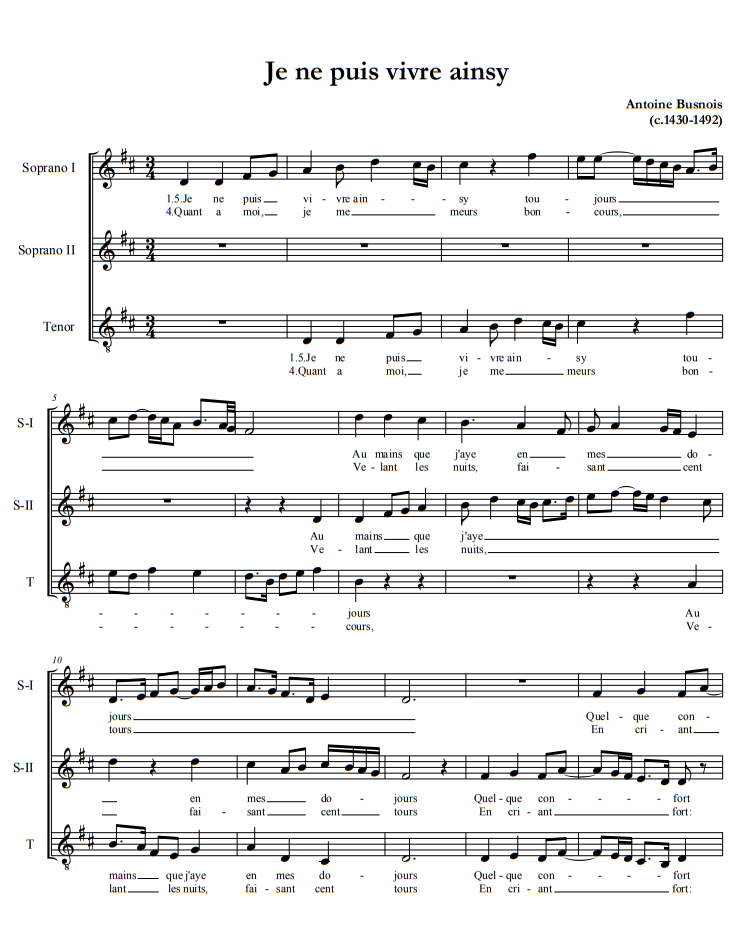
Antoine Busnois (c1430 - 6 novembre 1492): Je ne puis vivre ainsy, bergerette a 3 voci (c1460). Ensemble Pomerium, dir. Alexander Blachly.
La bergerette è un virelai provvisto di un’unica strofe; la sua struttura è dunque refrain – strofe – refrain.
A Busnois piaceva molto giocare con le note e con le parole. Il testo di questa composizione è un acrostico che rivela il nome della persona cui è dedicata.
Je ne puis vivre ainsy toujours Au main que j’aye en mes dolours Quelque confort Une seule heure ou mains ou fort Et tou les jours Leaument serviray amours Jusqu’a la mort. Noble femme de nom et d’armes, Escript vous ay ce dittier-cy.
Des ieux plourant a chauldes larmes Affin qu’ayes de moy merchy. Quant a moi, je me meurs boncours Velant les nuits, faisant cent tours En criant fort Vengence en a Dieu, car a grant tort Je noye en plours Lors qu’au besoin me fault secours Et Pitie dort.
Hugo Distler (1908 - 1° novembre 1942): Ritter Blaubart, musiche di scena (1940) per l’omonimo dramma fiabesco (1796) di Ludwig Tieck. Katharina Wingen, soprano; Stefan Livland, tenore; Neubrandenburger Philharmonie, dir. Stefan Malzew.
Ouvertüre zum 1. Akt
Agnes Lied [6:15]
Wie rauschen die Bäume
So winterlich schon;
Es fliegen die Träume
Der Liebe davon!
Und über Gefilde
Ziehn Wolkengebilde,
Die Berge stehn kahl.
Es schneidet ein Regen
Dem Wandrer entgegen,
Der Mond sieht ins Thal.
Ein Klagelied schallt
Aus Dämm’rung und Wald:
Es verwehten die Winde
Den treulosen Schwur,
Wie Blitze geschwinde
Verschüttet vom Glück sich die goldene Spur;
O dunkles Menschenleben,
Muß jeder Traum einst niederschweben?
Rosen und Nelken
Bekränzen das Haupt,
Und ach sie verwelken,
Der Baum steht entlaubt;
Der Frühling er scheidet,
Macht Winter zum Herrn,
Die Liebe vermeidet
Und fliehet so fern. –
Verworrenes Leben,
Was ist dir gegeben? –
Erinnern und Hoffen
Zur Qual und zur Lust. –
Ach! Ihnen bleibt offen
Die zitternde Brust.
Annes Lied [8:14]
Beglückt, wer an des Treuen Brust
In voller Liebe ruht,
Kein Kummer naht und stört die Lust,
Nur heller brennt die Glut.
Kein Wechsel, kein Wanken,
Zum ruhigen Glück
Fliehn alle Gedanken
Der Ferne zurück.
Und lieber und bänger
Drückt Mund sich an Mund,
So inn’ger, so länger;
Von Stunde zu Stund’
Beschränkter und enger
Der liebliche Bund.
Kriegsmusik [9:39]
Ouvertüre zum 2. Akt [11:55]
Ouvertüre zum 3. Akt [17:23]
Lied Leopold und Rezitativ Brigitte und Leopold [20:04]
LEOPOLD:
Wer klopft an die Tür? –
Ich, Liebste, bin hier.
Wo ist dein Gemach?
Erkennst du mein Ach?
Auf! Liebst du mich kühn,
So laß uns entfliehn;
Schnell schwindet die Zeit,
Und Zögern gereut.
Die Stunde vergeht,
Dann ist es zu spät.
BRIGITTE:
Lepold!
LEOPOLD:
Liebste Brigitte!
BRIGITTE:
Ich habe Euch schon lange an Eurer Stimme erkannt. – Was wollt Ihr hier?
LEOPOLD:
Ihr könnt noch fragen? – Folgt mir, wenn Ihr mich liebt. – Seht, sie schlafen alle, der Tag fängt schon an zu grauen, ich muß fort, Euer Vater kehrt zurück, dort auf dem Tisch liegen die Schlüssel der Burg.
BRIGITTE:
Ich sollte meinen alten Vater verlassen?
LEOPOLD:
Er soll nachher unsre Ehe segnen, aber erst müssen wir in Sicherheit sein. Ihr wißt ja, er ist gegen unsre Liebe.
Philippe de Vitry (31 ottobre 1291 - 1361): O canenda vulgo per compita / Rex quem metrorum / Rex regum, mottetto a 4 voci. Ensemble Sequentia.
Il brano celebra Roberto d’Angiò, detto il Saggio (1277 - 1343), re di Napoli dal 1309; il sovrano non è citato nel testo, ma le lettere iniziali dei versi del motetus (2a voce) ne formano il nome (acrostico). Secondo varie testimonianze dell’epoca, Roberto d’Angiò fu un munifico mecenate e protettore delle arti, e in particolare amava la musica, dilettandosi nel cantare e nel comporre.
Il testo del triplum è una feroce invettiva contro un denigratore del re. Chi fosse questo vituperevole personaggio non ci è dato di sapere.
Triplum
O canenda vulgo per compita
ab eterno belial dedita
seculorum nephanda rabies
et delira canum insanies.
quem cum nequis carpere dentibus
criminaris neque lactrattibus
damnum colens tu quid persequeris
virum iustum et tuo deseris
rege regi quem decor actuum
illuminat quem genus strenuum
et sanctorum multa affinitas
sibi facta lux splendor claritas
corruscantem reddit pre ceteris
quemadmodum nocturnis syderis
iubar phebus perventus abtulit
dei proth dolor lapsum pertulit
iherusalem dominum proprium
ihesum spernens habes in socium.
Motetus
Rex quem metrorum depingit prima figura Omne tenens in se quod dat natura beatis Basis iusticie troianus iulius ausu Ecclesie tuctor machabeus hector in arma Rura colens legum scrutator theologie Temperie superans augustum iulius hemo Virtutes cuius mores genus actaque nati Scribere non possem possint tuper ethera scribi.
Contratenor
[senza testo.]
Tenor
Rex regum.
(O indicibile follia dei nostri tempi, possa tu essere cantata a tutti su ogni strada, condannata all’inferno per l’eternità, delirio di cani pazzi! Perché perseguiti l’uomo giusto, colui che non puoi lacerare con i tuoi denti né accusare con i tuoi latrati, cercando la sua distruzione, e perché abbandoni il tuo re, che la bellezza delle opere reali illumina, che l’ascendenza nobilita e che le tante affinità con i santi, la luce che è sua, lo splendore, la limpidezza rendono più brillante di chiunque altro, allo stesso modo in cui Febo sorgendo sembra spegnere il bagliore delle stelle notturne? Tu hai come unico compagno lo stesso peccato contro Dio, miserabile a dirsi, che Gerusalemme ha commesso nel respingere il suo legittimo Signore, Gesù.
Il re che la prima lettera di questi versi raffigura racchiude in sé tutte le cose che la natura dona ai beati. È la base della giustizia, uno Iulo di Troia per il suo coraggio, un guardiano della Chiesa, un Maccabeo [cioè un guerriero valoroso, NdT], un Ettore in armi, che protegge il proprio Paese osservando allo stesso tempo le leggi della teologia, superando Giulio Augusto in temperanza. Poiché non saprei descrivere a parole le virtù, il carattere, la famiglia e le azioni di un uomo così ricco di qualità, possano queste cose essere scritte lassù nei cieli.
Jean Mouton (c1459 - 30 ottobre 1522): Nesciens mater, mottetto a 8 voci (pubblicato nell’antologia Motetti et carmina gallica, c1521, n. 1). The Monteverdi Choir, dir. John Eliot Gardiner.
Il mottetto consiste in un canone quadruplo in diapenthe, cioè alla quinta.
Nesciens mater virgo virum
peperit sine dolore
salvatorem saeculorum.
Ipsum regem angelorum
sola virgo lactabat,
ubere de caelo pleno.
Andreas Hammerschmidt (1611 - 29 ottobre 1675): Sonata super «Nun lob, mein’ Seel’, den Herren» a 7 voci (soprano, 2 trombe, 4 tromboni) e basso continuo (pubblicata in Kirchen- und Tafelmusik, darinnen 1. 2. 3. Vocal und 4. 5. 6. Instrumenta enthalten, 1662, n. 2). Greta de Reyghere, soprano; Ricercar Consort.
Nun lob, mein’ Seel’, den Herren,
Was in mir ist, den Namen sein!
Sein’ Wohltat tut er mehren,
Vergiß es nicht, o Herze mein!
Hat dir dein’ Sünd’ vergeben
Und heilt dein’ Schwachheit groß,
Errett’t dein armes Leben,
Nimmt dich in seinen Schoß,
Mit rechtem Trost beschüttet,
Verjüngt dem Adler gleich.
Der Kön’g schafft Recht, behütet,
Die leiden in sein’m Reich.
Er hat uns wissen lassen
Sein herrlich Recht und sein Gericht,
Dazu sein’ Güt’ ohn’ Maßen,
Es mangelt an Erbarmung nicht.
Sein’n Zorn läßt er wohl fahren,
Straft nicht nach unsrer Schuld,
Die Gnad’ tut er nicht sparen,
Den Blöden ist er hold.
Sein Güt’ ist hoch erhaben
Ob den’n, die fürchten ihn.
So fern der Ost vom Abend,
Ist unsre Sünd’ dahin.
(Salmo 103:1-2, traduzione tedesca di Johann Gramann, 1530)
Šimon Brixi (28 ottobre 1693 - 1735): Tu es Deus, graduale in la minore per la Domenica di Quinquagesima; testo: Salmo 77, versetti 15-16. Hana Blažiková, soprano; Collegium Marianum.
Tu es Deus, qui facis mirabilia solus: notam fecisti in gentibus virtutem tuam.
Liberasti in brachio tuo populum tuum, filios Israel et Ioseph.
Stefano Landi (1587 - 28 ottobre 1639): Augellin, aria a 1 voce e basso continuo (1620). Marco Beasley, tenore; ensemble L’Arpeggiata, dir. Christina Pluhar.
Augellin
Che ’l tuo amor
Segui ogn’hor
Dal faggio al pin
E formando i bei concenti
Vai temprando
Col tuo canto i miei lamenti.
Il mio Sol
Troppo fier,
Troppo altier,
Del mio gran duol,
Clori amata, Clori bella,
M’odia, ingrata,
A’ miei prieghi empia e rubella.
[Fa che si’
Crudo men
Quel bel sen
Che mi ferì,
E con l’aura del tuo canto,
Dolce e varia,
Fa ’l suo cor pietoso alquanto.]
Non sia più
Cruda, no,
Morirò
S’ella è qual fu;
Taci, taci, ché già pia
Porge i baci
Al mio labro l’alba mia.
Sol pietà
Spira il sen
Né ritien
Più crudeltà,
Lieti affanni, dolci pene,
Cari danni
Del mio Sole, del mio bene.
Segui, augel,
Né sdegnar
Di formar
Canto novel;
Fuor del seno amorosetto
Mostra a pieno
La tua gioia, il mio diletto.
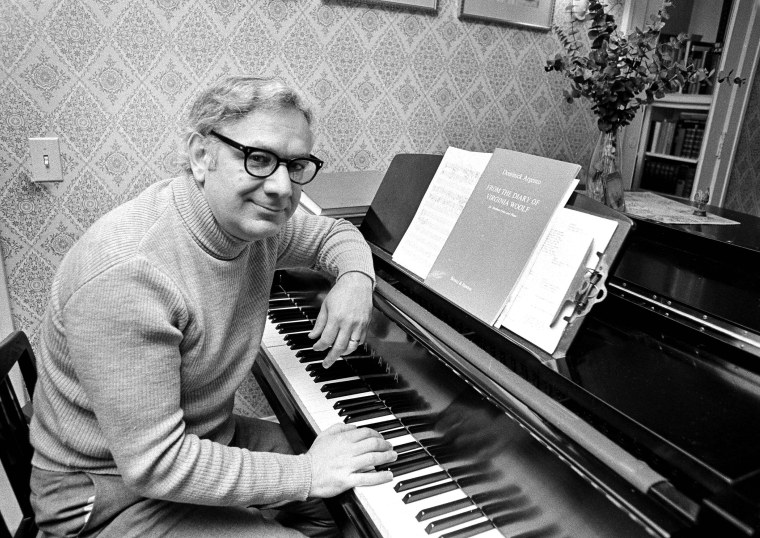
Dominick Argento (27 ottobre 1927 - 2019): Six Elizabethan Songs (1958). Barbara Bonney, soprano; André Previn, pianoforte.
Spring (Thomas Nashe, 1567-1601: da Summer’s Last Will and Testament, 1592)
Spring, the sweet Spring, is the year’s pleasant king;
Then blooms each thing, then maids dance in a ring,
Cold doth not sting, the pretty birds do sing,
Cuckoo, jug-jug, pu-we, to-witta-woo!
The palm and may make country houses gay,
Lambs frisk and play, the shepherd pipes all day,
And we hear aye birds tune this merry lay,
Cuckoo, jug-jug, pu-we, to-witta-woo!
The fields breathe sweet, the daisies kiss our feet,
Young lovers meet, old wives a-sunning sit,
In every street these tunes our ears do greet,
Cuckoo, jug-jug, pu-we, to-witta-woo!
Spring! The sweet Spring!
Sleep (Samuel Daniel, 1562-1619: da Delia, 1592)
Care-charmer Sleep, son of the sable Night,
Brother to Death, in silent darkness born,
Relieve my anguish and restore thy light,
With dark forgetting of my cares, return;
And let the day be time enough to mourn
The shipwreck of my ill-adventur’d youth:
Let waking eyes suffice to wail their scorn,
Without the torment of the night’s untruth.
Cease, dreams, th’ images of day-desires
To model forth the passions of the morrow;
Never let rising sun approve you liars,
To add more grief to aggravate my sorrow.
Still let me sleep, embracing clouds in vain;
And never wake to feel the day’s disdain.
Winter (William Shakespeare, 1564-1616: da Love’s Labour’s Lost V/2, 1597)
When icicles hang by the wall
And Dick the shepherd blows his nail,
And Tom bears logs into the hall,
And milk comes frozen home in pail;
When blood is nipt and ways be foul,
Then nightly sings the staring owl:
Tu-who!
Tu-whit! Tu-who! — A merry note!
While greasy Joan doth keel the pot.
When all aloud the wind doth blow,
And coughing drowns the parson’s saw,
And birds sit brooding in the snow,
And Marian’s nose looks red and raw;
When roasted crabs hiss in the bowl
Then nightly sings the staring owl:
Tu-who!
Tu-whit! Tu-who! — A merry note!
While greasy Joan doth keel the pot.
Dirge (Shakespeare: da Twelfth Night II/4, 1602)
Come away, come away, death,
And in sad cypress let me be laid;
Fly away, fly away, breath;
I am slain by a fair cruel maid.
My shroud of white, stuck all with yew,
O prepare it!
My part of death, no one so true
Did share it.
Not a flower, not a flower sweet,
On my black coffin let there be strown;
Not a friend, not a friend greet
My poor corpse, where my bones shall be thrown:
[A thousand, thousand sighs to save,]
Lay me, O where
Sad true lover never find my grave,
To weep there!
Diaphenia (Henry Constable, 1562-1613: Damelus’ Song to his Diaphenia, c1600)
Diaphenia, like the daffadowndilly,
White as the sun, fair as the lily,
Heigh ho, how I do love thee!
I do love thee as my lambs
Are belovèd of their dams:
How blest were I if thou would’st prove me.
Diaphenia, like the spreading roses,
That in thy sweets all sweets encloses,
Fair sweet, how I do love thee!
I do love thee as each flower
Loves the sun’s life-giving power;
For dead, thy breath to life might move me.
Diaphenia, like to all things blessèd,
When all thy praises are expressèd,
Dear joy, how I do love thee!
As the birds do love the spring,
Or the bees their careful king, —
Then in requite, sweet virgin, love me!
Hymn (Ben Jonson, 1572-1637: Hymn to Diana)
Queen and huntress, chaste and fair,
Now the sun is laid to sleep,
Seated in thy silver chair,
State in wonted manner keep:
Hesperus entreats thy light,
Goddess excellently bright.
Earth, let not thy envious shade
Dare itself to interpose;
Cynthia’s shining orb was made
Heav’n to clear when day did close;
Bless us then with wishèd sight,
Goddess excellently bright.
Lay thy bow of pearl apart,
And thy crystal shining quiver;
Give unto the flying hart
Space to breathe, how short so-ever:
Thou that mak’st a day of night,
Goddess excellently bright.
Carlo Filago (1589 - 23 ottobre 1644): Quam pulchra es, amica mea, mottetto «a doi canti» (pubblicato in Sacrarum cantionum Liber Tertius, 1619). Instrumenta Musica, dir. Ercole Nisini.
Quam pulchra es, amica mea,
columba mea, immaculata mea
et odor vestimentorum super omnia aromata.
Alleluia.
Michael William Balfe (1808 - 20 ottobre 1870): «I dreamt that I dwelt in marble halls», aria di Arline (soprano) dall’opera The Bohemian Girl (1843), atto II, scena 1a. Dame Joan Sutherland, soprano; London Symphony Orchestra, dir. Richard Bonynge (registrazione del 1962).
I dreamt that I dwelt in marble halls,
With vassals and serfs at my side,
And of all who assembled within those walls,
That I was the hope and the pride.
I had riches too great to count, could boast
Of a high ancestral name;
But I also dreamt, which pleas’d me most,
That you lov’d me still the same.
I dreamt that suitors sought my hand,
That knights upon bended knee,
And with vows no maiden heart could withstand,
They pledg’d their faith to me.
And I dreamt that one of that noble host
Came forth my hand to claim;
But I also dreamt, which charm’d me most,
That you lov’d me still the same.
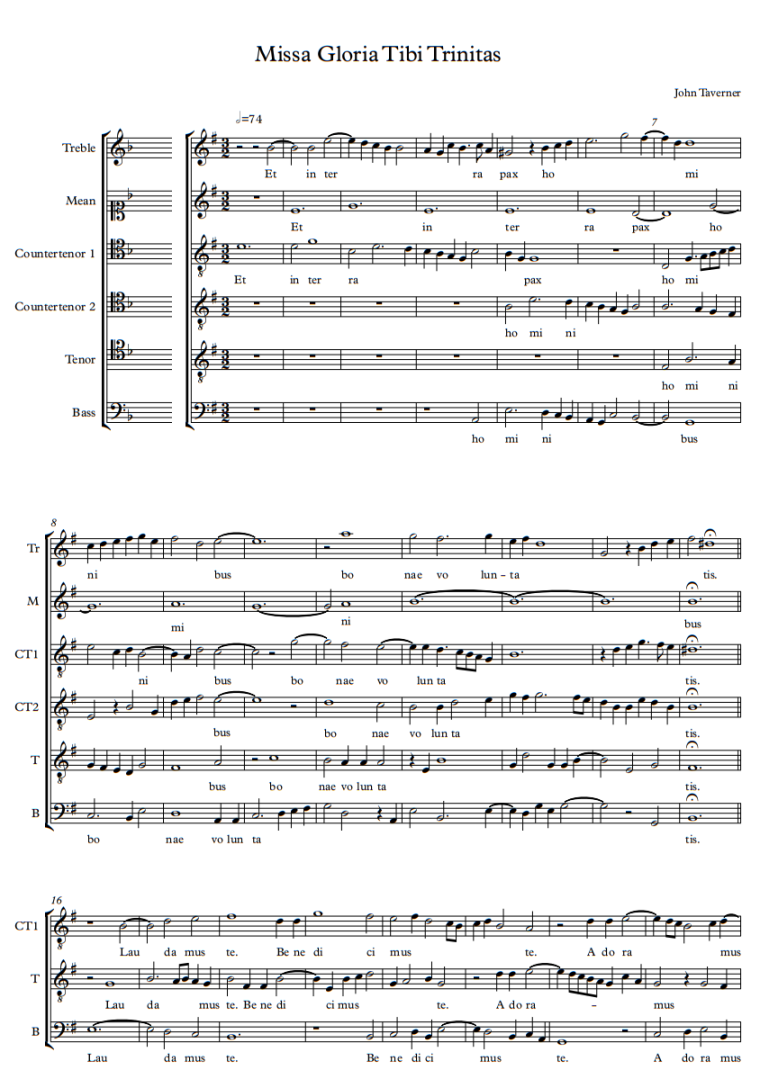
John Taverner (c1490 - 18 ottobre 1545): Missa « Gloria tibi Trinitas » a 6 voci, composta prima del 1530. Ars Nova Copenhagen, dir. Paul Hillier.
Come le altre messe composte da Taverner, manca del Kyrie : all’epoca era infatti consuetudine intonare Kyrie tropati (cioè ampliati mediante interpolazioni testuali e/o musicali), ciascuna chiesa o regione avendone un proprio repertorio. La Missa « Gloria tibi Trinitas » di Taverner comprende dunque:
Gloria
Credo
Sanctus
Benedictus
Agnus Dei
Questa splendida Messa ha un posto di rilievo nella storia della musica britannica in quanto diede origine a una forma polifonica a sé stante. La sezione del Benedictus che si svolge sulle parole « in nomine Domini » [0:42], a 4 voci, è caratterizzata da particolare eufonia e dolcezza, e per questo motivo fu assai apprezzata dai musicisti inglesi del XVI e del XVII secolo, numerosi dei quali rielaborarono il brano in composizioni contrappuntistiche, perlopiù strumentali, cui diedero appunto il titolo di In nomine. Sono circa 150 gli In nomine composti fra la metà del Cinquecento e la fine del secolo seguente; a questi se ne aggiungono altri creati in epoche successive, fino ai giorni nostri.
Luca Marenzio (18 ottobre 1553 o 1554 - 1599): Spuntavan già per far il mondo adorno, madrigale a 5 voci (dal Primo Libro de madrigali a cinque voci, 1580, n. 3). La Compagnia del Madrigale.
Prima parte :
Spuntavan già per far il mondo adorno
Vaghi fioretti, erbette verdi e belle,
Di color mille e ’n queste parti e ’n quelle
Ralegravan la terra e i colli intorno.
Gian gli augelletti all’apparir del giorno
D’amor cantando sin sovra le stelle,
E correvan le fiere ardite e snelle
Tra lor scherzando, a le campagne intorno.
Seconda parte :
Quando ’l mio vivo sol perch’io non pera
Godi or, mi disse con un dolce riso,
Amante fido il premio del tuo ardore.
Indi con molti baci sparse fuore
Quante grazie e dolcezze ha ’l Paradiso
E quant’ha odor nei fior la Primavera.
William Byrd (c1540 - 1623): Come to me, grief, for ever a 5 voci (pubblicato in Psalms, sonnets, and songs of sadness and piety to five parts, 1588, n. 34). Versione per canto e consort di viole: Emily van Evera, soprano; The Musicians of Swanne Alley.
Come to me, grief, for ever,
Come to me tears day and night,
Come to me plaint, ah helpless,
Just grief, heart tears, plaint worthy.
Go from me dread to die now
Go from me care to live more,
Go from me joys all on earth,
Sidney, O Sidney is dead.
He whom the Court adorned,
He whom the country courtesied,
He who made happy his friends,
He that did good to all men.
Sidney, the hope of lands strange,
Sidney, the flower of England,
Sidney, the spirit heroic,
Sidney id dead, O dead.
Dead? no, no, but renowed
With the anointed one,
Honour on earth at his feet,
Bliss everlasting his seat.
Come to grief for ever
Come to me tears day and night,
Come to me plaint, ah helpless,
Just grief, heart tears, plaint worthy.
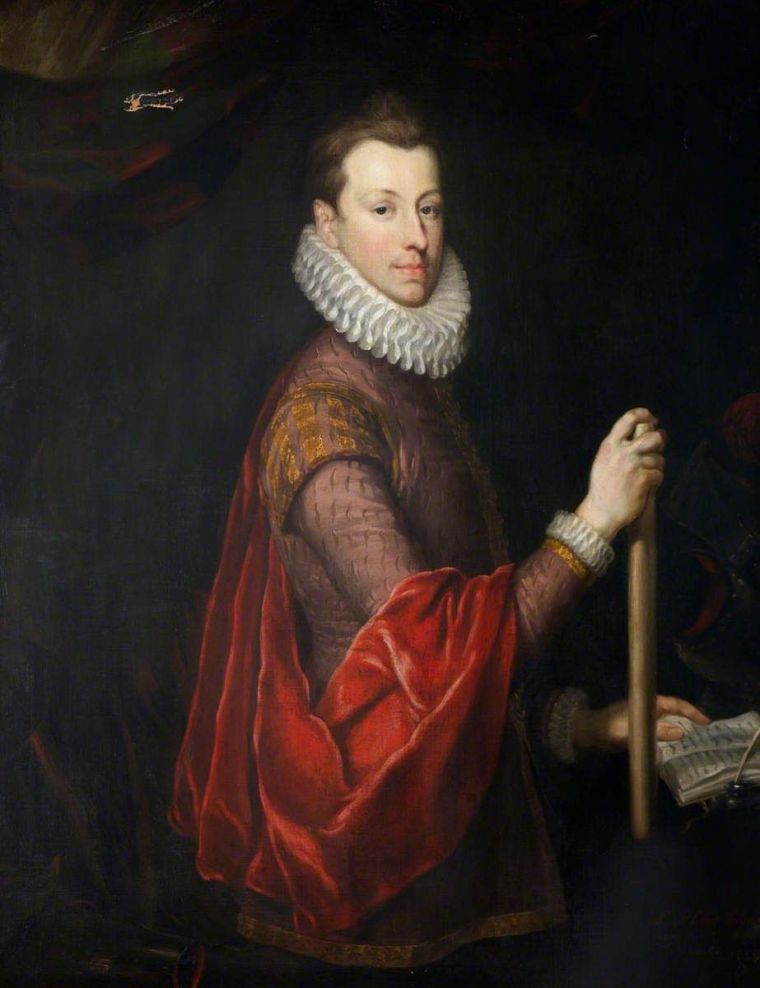
Avevamo già incontrato sir Philip Sidney (1554 - 17 ottobre 1586), una delle menti più brillanti dell’Inghilterra elisabettiana, ricordando la sua storia d’amore con Penelope Devereux e ascoltando le tre composizioni su altrettante sue poesie (tratte da Astrophel and Stella) pubblicate nell’antologia A Musicall Banquet (1610) curata da Robert Dowland. Per altre informazioni su Sidney vi rimando all’interessantissimo blog di Luisa Zambrotta.
George Knapton (1698 - 1778): ritratto di sir Philip Sidney, da Isaac Oliver
Nicolas Grenon (c1375 - 17 ottobre 1456): La plus belle et doulce figure, virelai (chanson) a 3 voci, tramandato dal Codex Reina (nouv. acq. fr. 6771 della Bibliothèque Nationale de France). Ensemble Amadis, dir. Catherine Joussellin.
La plus belle et doulce figure,
la plus noble, gente faiture,
c’est ma chiere dame et mestresse.
Bon an, bon jour, joye et liesse
li doinst dieux, et bone aventure.
C’est tout mon bien, c’est ma déesse,
celle par qui ma dolour cesse,
en qui je preing ma noreture,
qui servir vueil sans nul destresse
de cuer, tant que vogue me lesse,
n’en ce monde d’autre n’ay cure.
Former la sut dieus de nature:
blans, blond, tout par mesure;
playsanment y jouta jesnesse,
largesse, honour, toute noblesse
en fais, en dis et en parleure.
(Il più bello e dolce volto, l’aspetto più nobile e gentile è quello della mia cara signora e padrona. Un buon anno, una buona giornata, gioia e letizia le conceda il Signore, e buona sorte.
È tutto il mio bene, è la mia dea colei grazie alla quale ha fine ogni mia pena e dalla quale prendo sostentamento,
colei che desidero servire senza per questo provar disagio, di cuore, finché me lo concederà, perché non mi interessa altro in questo mondo.
Dio l’ha saputa formare secondo natura: di pelle chiara, bionda, ogni cosa nella giusta misura; piacevolmente vi ha aggiunto giovinezza, generosità, onore e ogni nobiltà nell’agire, nel parlare e nel pensare.)
Erkki-Sven Tüür (16 ottobre 1959): Ärkamine (Risveglio) per coro e orchestra (2011); testi di Juhan Liiv, Ernst Enno, Jaan Kaplinski, Doris Kareva e della liturgia ortodossa. Eesti Filharmoonia Kammerkoor; Sinfonietta Riga, dir. Daniel Reuss.
Claudin de Sermisy (c1490 - 13 ottobre 1562): Secourez moy, chanson a 4 voci (pubblicata nella raccolta Trente et sept chansons musicales a quatre parties, 1531); testo di Clément Marot. Ensemble «Clément Janequin».
Secourez-moi ma dame par amours
Ou autrement la mort me vient quérir.
Autre que vous ne peut donner secours
À mon las coeur lequel s’en va mourir.
Hélas, hélas, venez tôt secourir
Celui qui vit pour vous en grand tristesse,
Car de son coeur vous êtes la maîtresse.


 Heitor Villa-Lobos (1887 - 17 novembre 1959): Bachianas brasileiras n. 5 per soprano e otto violoncelli (1938-45) su testi di Ruth Valladares Corrêa (1904 - c1963) e Manuel Bandeira (1886 - 1968). Renée Fleming, soprano; Kenneth Freudigman (solista), Sofia Zappi, Alexander East, Pamela Smits, Damon Coleman, Robert Vos, Brad Ritchie e Eran Meir, violoncelli; dir. Michael Tilson Thomas.
  Thomas Ford (c1580 - sepolto il 17 novembre 1648): Faire, sweet, cruell, ayre (pubblicato in Musicke of Sundrie Kindes, 1607, vol. I, n. 7). Victoria Cassano, soprano; Javier Ovejero Mayoral, liuto.









 George Knapton (1698 - 1778): ritratto di sir Philip Sidney, da Isaac Oliver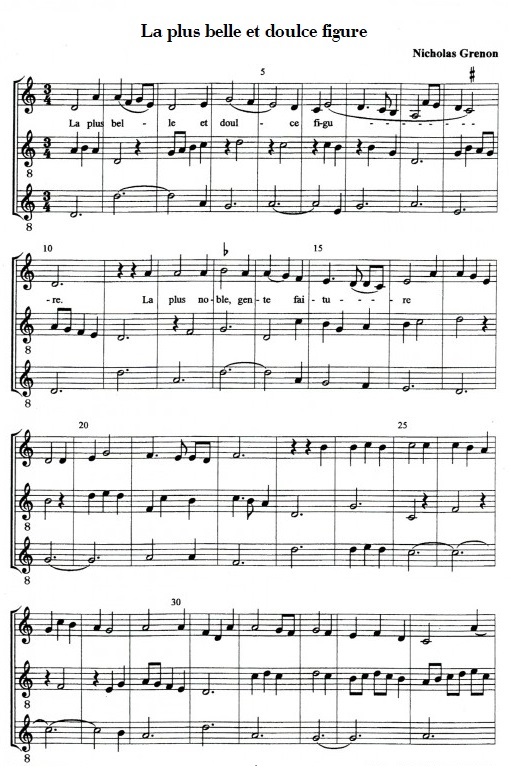

 la regina gioiosa