Pierre Guédron (c1565 - c1621): Vous que le bonheur rappelle, air de cour (pubblicato a cura di Robert Dowland in A Musicall Banquet, Londra 1610, n. XIII). The Consort of Musicke, dir. Anthony Rooley.
Vous que le bonheur rappelle
à un servage ancien,
mourez aux pieds de la belle
qui vous daigne faire sien.
Glorieuse en votre perte,
honorez votre vainqueur,
qui vous a la porte ouverte
de la prison de son coeur.
Heureux venez vous donc rendre
à celle qui vous a pris;
c’est honneur de se voir prendre
à qui tient tout à mépris.
L’honneur d’un brave adversaire
honore votre trépas,
heureux qu’en mourant peut faire
que son nom ne meure pas.
Pierre Guédron (c1565 - c1621): Si le parler et le silence, air de cour (pubblicato in Airs de différents auteurs mis en tablature de luth par Gabriel Bataille, Parigi 1608; poi a cura di Robert Dowland in A Musicall Banquet, Londra 1610, n. XII). Nigel Rogers, tenore; Anthony Bailes, liuto.
Ce penser qui sans fin tirannise ma vie
se montre tellement contre moi conjuré,
que tant plus jé m’efforce à dompter son ennuie
at tant moins à mon bien je le vois préparé.
J’ai quitté la beauté dont il a pris naissance,
espérant par l’oublie ses charmes décevoir
mais je trouve à la fin que la venue et l’absence
sont tous deux différents, et d’un même pouvoir.
J’ay maintefois juré du change faire espreuve
Pour faire qu’un dessein fust par l’autre deffait,
Mais à toutes les fois, aussi tost je me treuve
Infidelle en parole, & fidelle en effect.
J’ay des plus fiers dedains la puissance empruntée
Pour repousser le trait dont j’ay le coeur attaint,
Mais plus je recognois par par leur force domptée
Ma douleur veritable & mon remede feint.
Ainsi donc combatant le mal qui me possede
Sans voir par ces moyens ses tempestes calmer,
Je me vay consommant dans mon propre remede
Comme un Vaisseau qui brusle au milieu de la Mer.
Voilà comme en vivant en toute servitude
Je nourris un penser dont l’impiteux effort,
Se montre en mon endroit si plain d’ingratitude
Qu’en luy donnant la vie il me donne la mort.
Pierre Guédron (c1565 - c1621): Si le parler et le silence, air de cour. Catherine King, soprano; Jacob Heringman, liuto.
Si le parler et le silence
nuit à notre heur également,
parlons donc, ma chère espérance,
du coeur et des yeux seulement;
Amour ce petit dieu volage
nous apprend ce muet langage.
Que le regard vole et revole,
messager des nos passions,
et serve au lieu de la parole
pour dire nos intentions.
Amour ce petit dieu volage
nous apprend ce muet langage.
Mais si quelque âme est offencée
de nous voir discourir des yeux,
nous parlérons de la pensée,
comme les anges dans les cieux.
Amour ce petit dieu volage
nous apprend ce muet langage.
Ainsi par un doux artifice
nous trompérons les courtisans,
et nous rirons de la malice
de mille fâcheux médisans,
qui n’en sauront pas d’avantage
ignorant, ce muet langage.
Si le parler è il primo dei tre airs de cour di Pierre Guédron inclusi da Robert Dowland nella raccolta A Musicall Banquet (Londra 1610, n. XI).
Air de cour è in sostanza il nome dato alla chanson francese d’autore nel periodo compreso tra la fine del Cinquecento e il quarto decennio del secolo successivo (corrisponde dunque grosso modo all’età aurea dell’ayre inglese). Fra i principali esponenti di questo genere, oltre a Guédron spiccano Antoine Boësset e Étienne Moulinié: nomi che ricorreranno con una certa frequenza in questo blog.
John Dowland (1563 - 1626): In darkness let me dwell, ayre. Ellen Hargis, soprano; Jacob Heringman, liuto; Mary Springfels, viol.
In darkness let me dwell; the ground shall sorrow be,
The roof despair, to bar all cheerful light from me;
The walls of marble black, that moist’ned still shall weep;
My music, hellish jarring sounds, to banish friendly sleep.
Thus, wedded to my woes, and bedded in my tomb,
O let me living die, till death doth come, till death doth come.
Capolavoro di Dowland, il brano fu pubblicato dal figlio del compositore, Robert (1591 - 1641), nell’antologia A Musicall Banquet (Londra 1610, n. X). In darkness let me dwell è l’ultima delle composizioni vocali su testo inglese della raccolta: fanno seguito tre airs de cour francesi (tutti e tre di Pierre Guédron, il cui nome non è tuttavia menzionato nella pubblicazione), due romances spagnoli e cinque arie su testo italiano.
Giuseppe Persiani (11 settembre 1799 - 1869): «Cari giorni», dal II atto della tragedia lirica Inés de Castro (1835), libretto di Salvatore Cammarano. Cecilia Bartoli, mezzosoprano; orchestra La Scintilla, dir. Adam Fischer.
Cari giorni a me sereni
d’innocenza e di virtù,
foste brevi, siete spenti,
né a brillar tornate più.
Nel dolor è scorsa intera
la prim’ora dell’età,
mia giornata innanzi sera
nel dolor tramonterà.
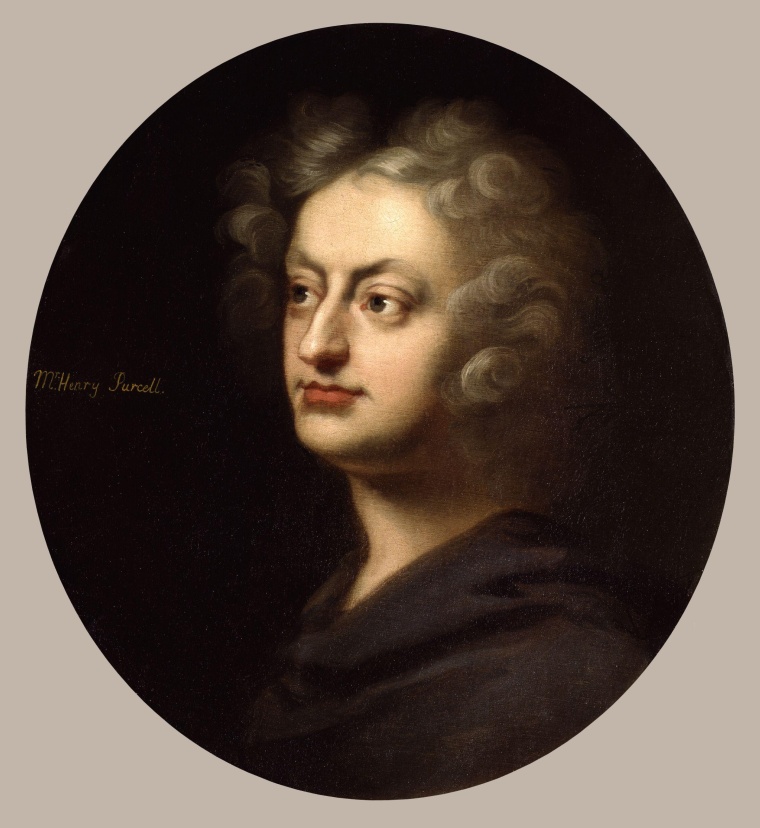
Alcuni catches (canoni) a 3 e a 4 voci di Henry Purcell (10 settembre 1659 - 1695) interpretati da Alfred Deller con il suo Consort.
Come, let us drink,
’Tis in vain to think
Like fools on grief or sadness:
Let our money fly,
And our sorrows dye,
All worldly care is madness.
But wine and good cheer
Will in spight of our fear
Inspire our hearts with mirth, boys;
The time we live
To wine let us give,
Since all must turn to Earth, boys.
Hand about the bowl
The delight of my soul,
And to my hand commend it;
A fig for chink
’Twas made to buy drink,
And before we go hence we’ll spend it.
Prithee hen’t so sad and serious,
Nothing’s got by grief or cares;
Melancholy’s too imperious,
When it comes, still domineers.
But if bus’ness, love or sorrow
That possesses thus thy mind,
Bid ’em come again tomorrow,
We are now to mirth inclin’d.
Let the glass run its round
And each good fellow keep his ground,
And if there be any flincher found
We’ll have his soul new coin’d.
I gave her cakes and I gave her ale,
I gave her sack and sherry;
I kiss’d her once and I kiss’d her twice,
And we were wondrous merry.
I gave her beads and bracelets fine,
I gave her dold down-derry;
I thought she was a-fear’d till she strok’d my beard,
And we were wondrous merry.
Merry my heart, merry my cocks,
Merry my sprites, hey down-derry;
I kiss’d her once and I kiss’d her twice,
And we were wondrous merry.
’Tis women makes us love,
’Tis love that makes us sad,
’Tis sadness makes us drink,
And drinking makes us mad.
Segnalo che anche Enzo Martinelli ha voluto ricordare Henry Purcell nel suo genetliaco 🙂
John Dowland (1563 - 1626): Lady if you so spight me, ayre. Martyn Hill, tenore; Anthony Rooley, liuto; Trevor Jones, viol.
Lady if you so spight me,
Wherfore do you so oft kisse and delight mee?
Sure that my hart opprest and overcloyed,
May breake thus overjoyde,
If you seeke to spill mee,
Come kisse me sweet and kill mee,
So shal your hart be eased,
And I shall rest content and dye well pleased.
Il brano fu pubblicato dal figlio del compositore, Robert (1591 - 1641), nella raccolta A Musicall Banquet (Londra 1610, n. IX).
John Dowland (1563 - 1626): Lady if you so spight me, ayre « for one voice only to sing » su testo di sir Henry Lee of Ditchley (1533 - 1611). Emma Kirkby, soprano; Anthony Rooley, liuto.
Far from triumphing Court and wonted glory
He dwelt in shady unfrequented places,
Time’s prisoner now, he made his pastime story;
Glady forgets Court’s erst-afforded graces.
That goddess whom he served to heaven is gone,
And he on earth in darkness left to moan.
But lo, a glorious light from his dark rest
Shone from the place where erst this goddess dwelt;
A light whose beams the world with fruit hath blest;
Blest was the knight while he that light beheld.
Since then a star fixed on his head hath shined,
And a saint’s image in his heart is shrined.
Ravished with joy, so graced by such a saint,
He quite forgat his cell and self denaid;
He thought it shame in thankfulness to faint,
Debts due to princes must be duly paid;
Nothing so hateful to a noble mind
As finding kindness for to prove unkind.
But ah! poor knight, though thus in dream he ranged,
Hoping to serve this saint in sort most meet,
Time with his golden locks to silver changed
Hath with age-fetters bound him hands and feet.
Ay me! he cries, goddess, my limbs grow faint,
Though I Time’s prisoner be, be you my saint.
Il brano fu pubblicato dal figlio del compositore, Robert (1591 - 1641), nella raccolta A Musicall Banquet (Londra 1610, n. VIII).
Giuseppe Balzano (9 settembre 1616 - 1700): Adiuro vos, cantata per 3 voci soliste, coro e archi; testo tratto dal Cantico dei cantici (8:4-5). Dir. Joseph Vella.
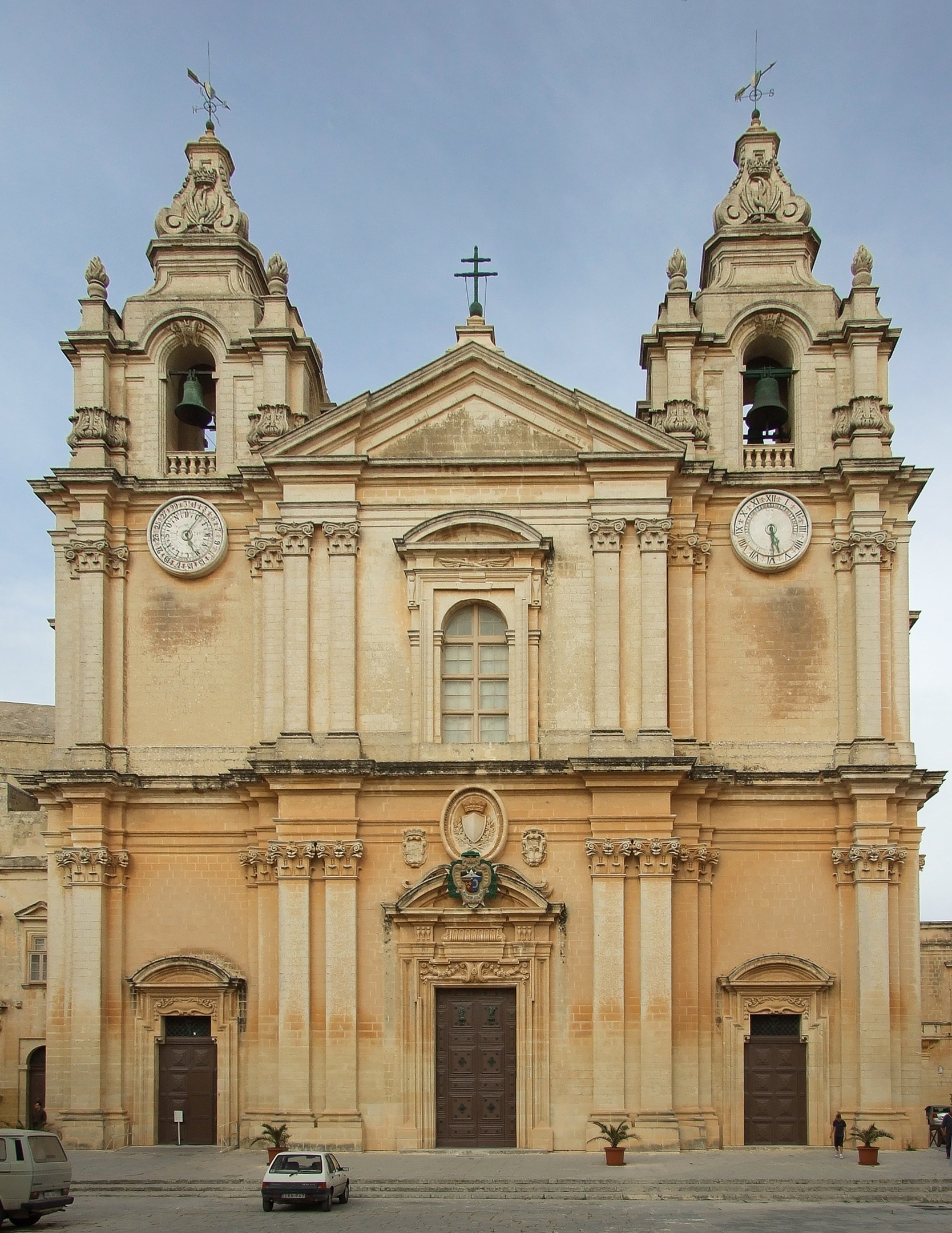
La Cattedrale di San Paolo in Medina (Malta), ove Balzano fu maestro di cappella dal 1661 al 1699.
Guillaume Tessier (sec. XVI): In a grove most rich of shade, ayre su testo di Philip Sidney (da Astrophel and Stella). Versione per 1 voce e liuto: Emily van Evera e Paul O’Dette; versione per 2 voci e liuto: Emma Kirkby, soprano; David Thomas, basso; Anthony Rooley, liuto.
In a grove most rich of shade
where birds wanton music made,
May then in his pied weeds showing,
new perfumes with flowers fresh growing.
Astrophel with Stella sweet
did for mutual comfort meet
both within themselves oppressed,
but each in the other blessed.
Him great harms had taught much care,
Her fair neck a foul yoke bare;
But her sight his cares did banish,
In his sight her yoke did vanish.
Wept they had, alas the while,
But now tears themselves did smile,
While their eyes, by love directed,
Interchangeably reflected.
Sigh they did, but now betwixt
Sighs of woe were glad sighs mixt;
With arms crossed, yet testifying
Restless rest, and living dying.
Their ears hungry of each word
Which the dear tongue would afford;
But their tongues restrained from walking,
Till their hearts had ended talking.
But when their tongues could not speak,
Love itself did silence break:
Love did set his lips asunder,
Thus to speak in love and wonder.
Therewithal away she went,
Leaving him so passion, rent
With what she had done and spoken,
That therewith my song is broken.
In a grove most rich of shade è l’ottava canzone di Astrophel and Stella: il testo è stato adattato a una composizione che il francese Guillaume Tessier aveva inserito nel proprio Premier Livre d’Airs tant en François, Italien qu’Espaignol…, edito a Parigi nel 1582 con una dedica (in italiano) «alla Sereniss. e Sacratiss. Regina d’Inghilterra»; è probabile che Sidney conoscesse personalmente Tessier.
Il brano venne poi ripubblicato da Robert Dowland (1591 - 1641) nella raccolta A Musicall Banquet (Londra 1610, n. VII), antologia dedicata a sir Robert Sidney, fratello di Philip e padrino del curatore.
Daniel Bacheler (1572 - 1618 o 1619): Change thy mind since she doth change, ayre su testo di Robert Devereux, II conte di Essex (1567 - 1601). Nigel Rogers, tenore; Anthony Bailes, liuto.
To plead my faith, where faith hath no reward;
to move remorse, where favour is not borne;
to heap complaints, where she doth not regard,
were fruitless, bootless, vain and yield but scorn.
I loved her whom all the world admir’d.
I was refus’d of her that can love none;
and my vain hope, which far too high aspir’d,
is dead and buried and for ever gone.
Forget my name, since you have scorn’d my love,
and womanlike do not too late lament;
since for your sake I do all mischief prove,
I none accuse nor nothing do repent.
I was as fond as ever she was fair,
yet lov’d I not more than I now despair.
Nella raccolta A Musicall Banquet, pubblicata a Londra nel 1610 a cura di Robert Dowland, il secondo brano composto su testo di Robert Devereux è opera di Daniel Bacheler, liutista e compositore che fu dapprima al servizio di sir Francis Walsingham, potente ministro di Elisabetta I; in seguito attivo presso lo stesso conte di Essex. venne infine nominato groom of the privy chamber della regina consorte Anna di Danimarca.
Anonimo (XVI-XVII secolo): O dear life, when shall it be, ayre su testo di Philip Sidney (1554 - 1586) tratto da Astrophel and Stella (Tenth Song). Emma Kirkby, soprano; David Thomas, basso; The Consort of Musicke, dir. Anthony Rooley.
O dear life, when shall it be
That mine eyes thine eyes may see;
And in them thy mind discover,
Whether absence hath had force,
Thy remembrance to divorce
From the image of thy lover?
Or if I myself find not,
After [Though my] parting aught forgot:
Nor debarr’d from Beauty’s treasure,
Let no tongue aspire to tell
In what high joys I shall dwell,
Only Thought aims at the pleasure.
Thought, therefore, I will send thee
To take up the place for me:
Long I will not after tarry:
There, unseen, thou may’st be bold,
Those fair wonders to behold,
Which in them my hopes do carry.
Thought, see thou no place forbear,
Enter bravely everywhere;
Seize on all to her belonging:
But, if thou wouldst guarded be,
Fearing her beams, take with thee
Strength of liking, rage of longing.
O my thought! my thoughts surcease,
Thy delights my woes increase;
My life fleets with too much thinking:
Think no more, but die in me,
Till thou shalt revived be,
At her lips my nectar drinking.
È di autore ignoto anche il secondo brano su testo di Philip Sydney inserito da Robert Dowland nella raccolta A Musicall Banquet (Londra 1610, n. V).
la 10ª canzone di Astrophel and Stella ispirò anche William Byrd (c1540 - 1623), che sui versi di Sidney compose un partsong a 5 voci (pubblicato in Songs of sundrie natures, 1589, n. 33). L’ascoltiamo qui nella interpretazione a voce sola con accompagnamento strumentale dei Musicians of Swanne Alley, solista il soprano Emily van Evera:
Isabella Leonarda (Isabella Calegari) detta la Musa novarese (6 settembre 1620 - 1704): Sonata in re minore per violino e basso continuo (ultima delle 12 Sonate a 1, 2, 3, e 4 istromenti op. 16, 1693). Ensemble Bizzarrie Armoniche.
Adagio
Allegro e presto [1:51]
Vivace e largo [3:05]
Aria: Allegro [7:53]
Veloce [9:21]
Isabella Leonarda: Magnificat. Gruppo vocale Musica Laudantes, dir. Riccardo Doni; Cappella strumentale del Duomo di Novara, dir. Paolo Monticelli.
Anonimo (sec. XVI-XVII): Go, my flock, go get you hence, ayre su testo di Philip Sidney (1554 - 1586) tratto da Astrophel and Stella. Nigel Rogers, tenore; Anthony Bailes, liuto.
Go, my flock, go get you hence,
Seek some other place of feeding;
Where you may have some defence
From the storms in my breast breeding
And showers from mine eyes proceeding.
Leave a wretch in whom all woe
Can abide to keep no measure:
Merry flock! such one forego,
Unto whom mirth is displeasure:
Only rich in mischief’s treasure.
Stella! fayrest shepherdess!
Fayrest but yet cruelst ever! Stella! whom the heav’ns still bless!
Though against me she persever;
Though I bliss inherit never.
Stella hath refusèd me! Astrophel that so well servèd,
In this pleasant spring, must see,
While in pride flowers be preservèd
Himself only winter-starvèd.
Why, alas, then doth she swear
That she loveth me so dearly?
Seeing me so long to bear
Coals of love that burn so clearly:
And yet leave me hopeless merely?
No, she hates me, well away!
Fayning love, somewhat to please me:
Knowing, if she should display
All her hate, Death would soon seize me,
And of hideous torments ease me.
Then my dear flock now adieu!
But, alas, if in your straying,
Heavenly Stella meet with you,
Tell her, in your piteous blaying,
Her poor slave’s unjust decaying.
Personalità di spicco nell’Inghilterra elisabettiana, sir Philip Sidney è noto fra l’altro quale autore di una raccolta di versi (108 sonetti e 11 canzoni) in stile petrarchesco, pubblicata postuma nel 1591 con il titolo Astrophel and Stella: vi si celebra l’amore del poeta per Penelope Devereux (1563 - 1607).
Sorella maggiore del più noto Robert, 2° conte di Essex e favorito di Elisabetta I, quando aveva 13 anni Penelope fu promessa in sposa a Sidney; per ragioni non del tutto chiarite, il progetto andò a monte e, all’inizio del 1581, Penelope sposò controvoglia Robert Rich, in seguito 1° conte di Warwick (1559 - 1619), dal quale ebbe sette figli; nei versi di Sidney ricorre sovente il termine rich, evidente allusione al nome assunto dall’amata con questo matrimonio. Nel 1595 Penelope divenne amante di Charles Blount, 8° barone Mountjoy (1563 - 1606), il quale le diede altri tre figli; ottenuto il divorzio nel 1605, alla fine di quell’anno Penelope sposò Blount.
L’ayre composto da autore ignoto sul testo di Go, my flock, nona canzone di Astrophel and Stella, venne pubblicato da Robert Dowland nella raccolta A Musicall Banquet (Londra 1610, n. IIII) — questa antologia è dedicata a sir Robert Sidney, fratello di Philip e padrino del curatore.
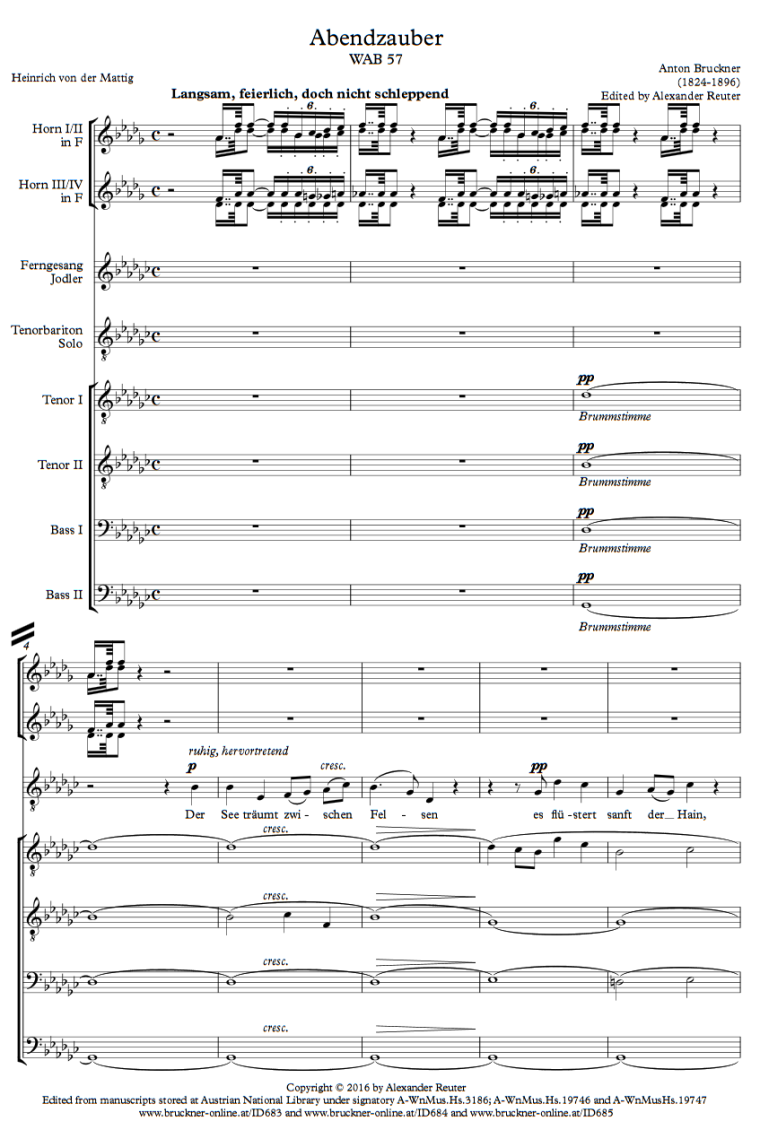
Anton Bruckner (4 settembre 1824 - 1896): Abendzauber per tenore o baritono, coro maschile (TTBB), 3 Jodler (SSA) e 4 corni (a mo’ di corni delle Alpi), WAB 57 (1878); testo di Heinrich von der Mattig, ossia il medico militare Heinrich Wallmann (1827-1898). Christoph Prégardien, tenore; Camerata Musica Limburg, dir. Jan Schumacher.
Der See träumt zwischen Felsen,
Es flüstert sanft der Hain.
Den Bergeshang beleuchtet
Des Mondes Silberschein.
Und aus dem Waldesdunkel
Hallt Nachtigallensang,
Und von dem See weh’n Lieder
Mit zauberhaftem Klang.
Ich saß am Seegestade,
Vertieft in süßen Traum;
Da träumte ich zu schweben
Empor zum Himmelsraum.
Wer könnte je vergessen
Den wonnevollen Ort!
Noch tief im Herzen klingen
Die Zaubertöne fort.
(Il lago sogna fra le rocce, il bosco mormora dolcemente. La luce argentea della luna rischiara il pendio della montagna.
Dal buio della foresta risuona il canto dell’usignolo, il lago sussurra magiche melodie.
Seduto in riva al lago, assorto in dorate fantasie, sognavo di salire in paradiso.
Chi potrebbe mai dimenticare un luogo così delizioso! Suoni fatati riecheggiano ancora nel profondo del cuore.)
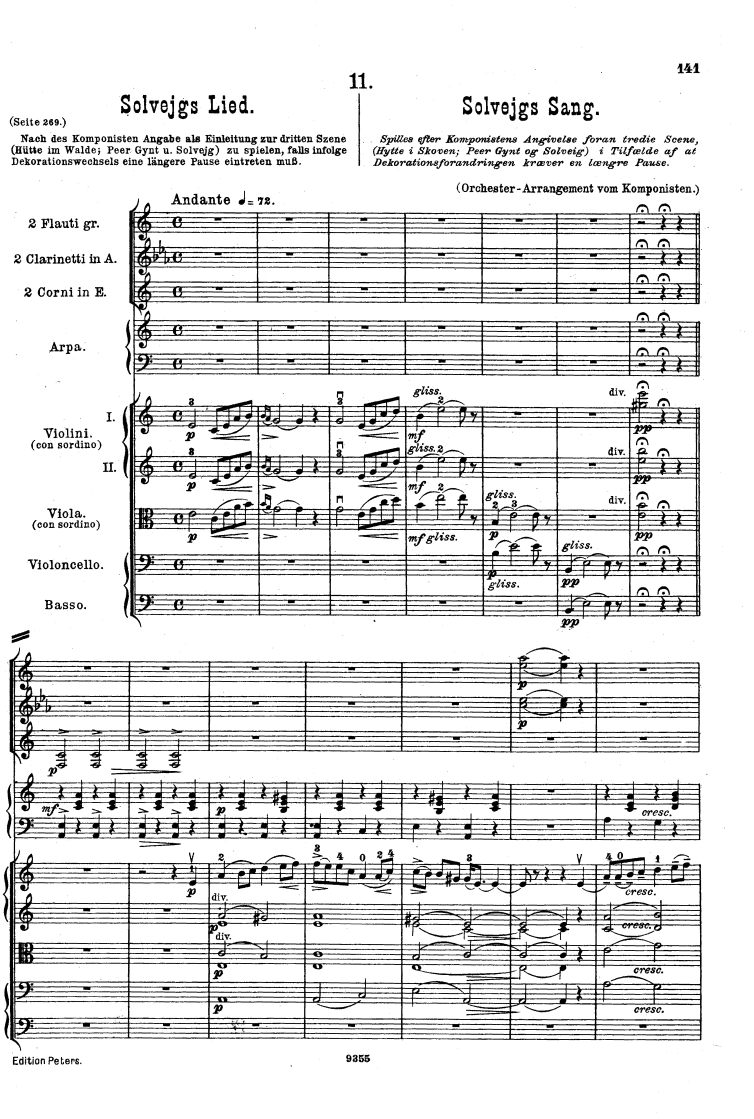
Edvard Grieg (1843 - 4 settembre 1907): «Solvejgs sang / Solvejgs Lied», dalle musiche di scena (1875) per il dramma Peer Gynt di Henrik Ibsen (atto III, n. 19); traduzione tedesca di Christian Morgenstern. Lucia Popp, soprano; Academy of St Martin in the Fields, dir. Neville Marriner.
Der Winter mag scheiden, der Frühling vergehn,
der Sommer mag verwelken, das Jahr verwehn,
Du kehrst mir zurück, gewiß, du wirst mein,
ich hab es versprochen, ich harre treulich dein.
Gott helfe dir, wenn du die Sonne noch siehst.
Gott segne dich, wenn du zu Füßen ihm kniest.
Ich will deiner harren, bis du mir nah,
und harrest du dort oben, so treffen wir uns da!
(Forse l’inverno passerà, la primavera se ne andrà, l’estate appassirà e l’anno intero svanirà, ma un giorno tornerai, lo so. E io fedelmente ti aspetterò, te l’ho promesso. Che Dio ti aiuti, se ancora vedi il sole. Che Dio ti benedica, se ti inginocchi davanti a Lui. Io ti aspetterò, fino a quando arriverai da me. E se rimarrai lassù, lassù ci incontreremo!)
Conosco molte interpretazioni di questa composizione, diverse sono disponibili online grazie a YouTube, ma nessuna mi commuove come quella di Lucia Popp.
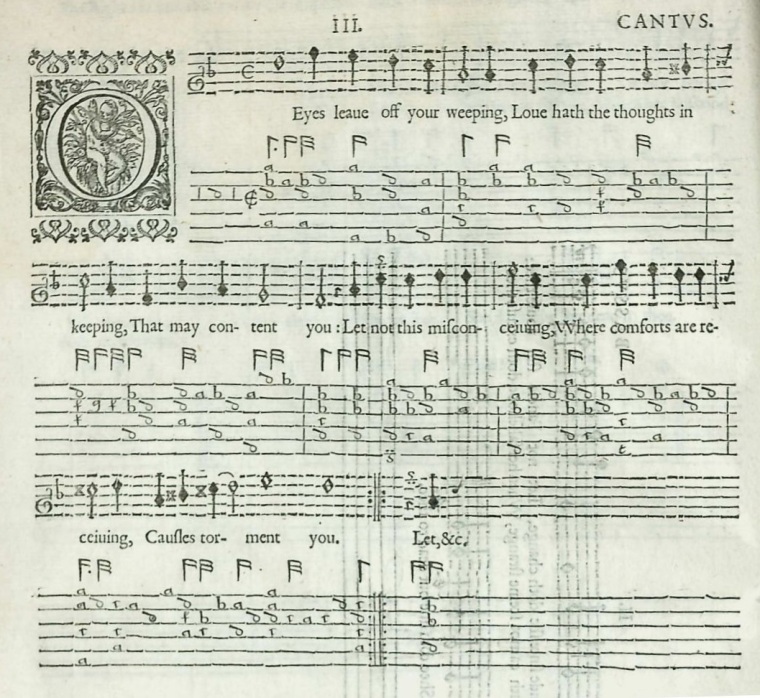
Robert Hales (attivo 1583 - 1616): O eyes, leave off your weeping, ayre su testo di autore anonimo (talvolta erroneamente attribuito a Nicholas Breton, 1542 - 1626). Emma Kirkby, soprano; Anthony Rooley, liuto.
O eyes, leave off your weeping,
love hath the thoughts in keeping
that may content you.
Let not this misconceiving,
where comforts are receiving,
causeless torment you.
Clouds threaten but a shower;
hope hath his happy hour,
though long in lasting.
Time needs must be attended
Love must not be offended
with too much hasting.
But O the painful pleasure,
where Love attends the leisure
of life’s wretchedness:
where Hope is but illusion,
and Fear is but confusion
of Love’s happiness.
But happy Hope, that seeth
how Hope and Hap agreeth,
of life deprive me;
or let me be assured
when life hath death endured
Love will revive me.
Di Robert Hales sappiamo che fu al servizio di Elisabetta I, apprezzato dalla sovrana in particolare quale cantante, e poi di Anna di Danimarca, consorte di Giacomo I; O eyes, leave off your weeping, pubblicato da Robert Dowland nella raccolta A Musicall Banquet (Londra 1610, n. 4), è l’unica sua composizione nota.
Richard Martin (XVI-XVII secolo): Change thy mind since she doth change, ayre su testo (risalente al 1597) di Robert Devereux, II conte di Essex (1567 - 1601). Nigel Rogers, tenore; Anthony Bailes, liuto.
Change thy mind since she doth change,
Let not fancy still abuse thee.
Thy untruth cannot seem strange
When her falsehood doth excuse thee.
Love is dead and thou art free;
She doth live, but dead to thee.
Whilst she lov’d thee best awhile,
See how she hath still delay’d thee,
Using shows for to beguile
Those vain hopes that have deceiv’d thee.
Now, thou see’st although too late
Love loves truth, which women hate.
Love no more since she is gone;
She is gone and loves another.
Being once deceiv’d by one,
Leave her love, but love none other.
She was false, bid her adieu;
She was best, but yet; untrue.
Love, farewell, more dear to me
Than my life which thou preservest.
Life, all joys are gone from thee,
Others have what thou deservest.
O my death doth spring from hence;
I must die for her offence.
[Die, but yet before thou die,
Make her know what she hath gotten.
She in whom my hopes did lie
Now is chang’d, I quite forgotten.
She is chang’d, but changed base,
Baser in so vile a place.]
Presente nella raccolta A Musicall Banquet, pubblicata a Londra nel 1610 a cura di Robert Dowland, Change thy mind è l’unica composizione pervenutaci di Richard Martin, musicista del quale si ignora pressoché tutto.
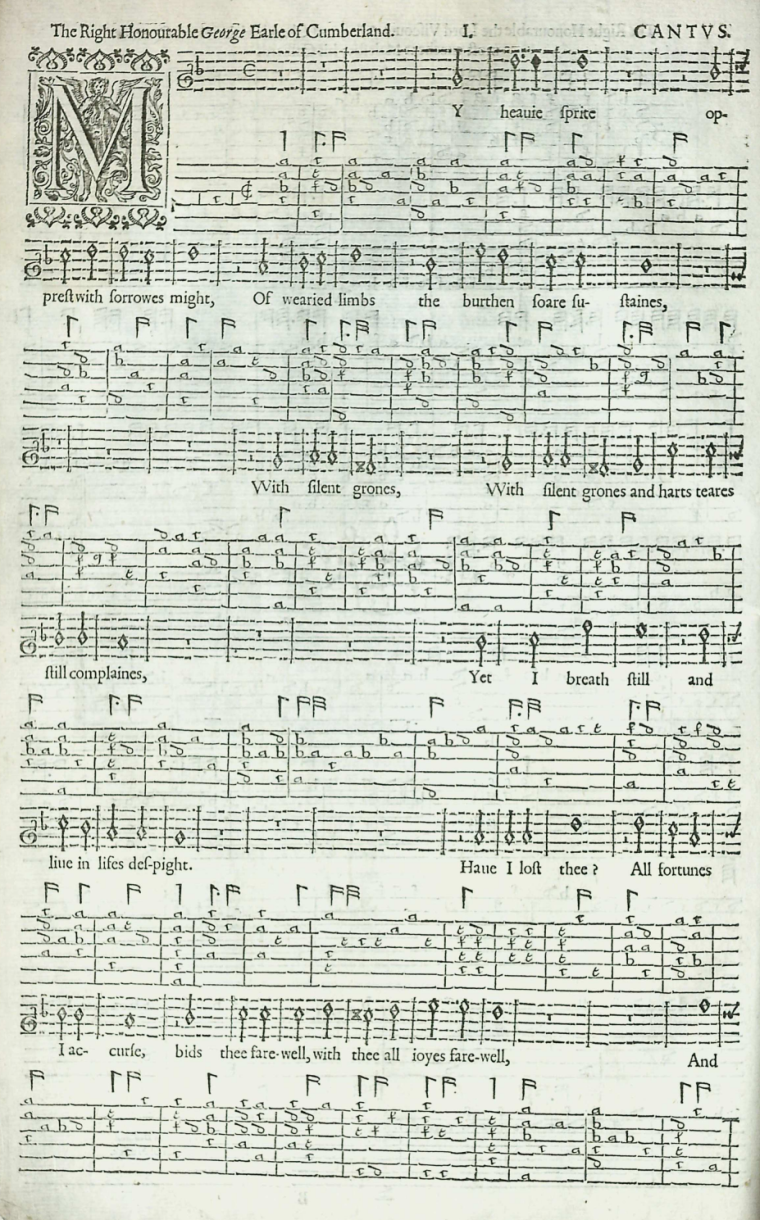
Anthony Holborne (c1545 - 1602): My heavy sprite, oppress’d with sorrow’s might, ayre su testo di George Clifford, III conte di Cumberland (1558 - 1606). Emma Kirkby, soprano; Anthony Rooley, liuto.
My heavy sprite, oppress’d with sorrow’s might,
of wearied limbs the burden sore sustains,
with silent groans and heart’s tears still complains,
yet I breathe still and live in life’s despite.
Have I lost thee? All fortunes I accurse
bids, thee farewell, with thee all joys farewell,
and for thy sake this world becomes my hell.
My heavy sprite di Anthony Holborne è il primo brano vocale della raccolta A Musicall Banquet, pubblicata a Londra nel 1610 a cura di Robert Dowland (1591 - 1641).
Alphons Diepenbrock (2 settembre 1862 - 1921): Die Nacht, elegia per contralto e orchestra (1910-11) su testo di Friedrich Hölderlin. Janet Baker, mezzosoprano; Koninklijk Concertgebouworkest, dir. Bernard Haitink.
Rings um ruhet die Stadt; still wird die erleuchtete Gasse,
Und, mit Fackeln geschmückt, rauschen die Wagen hinweg.
Satt gehn heim von Freuden des Tags zu ruhen die Menschen,
Und Gewinn und Verlust wäget ein sinniges Haupt
Wohlzufrieden zu Haus; leer steht von Trauben und Blumen,
Und von Werken der Hand ruht der geschäftige Markt.
Aber das Saitenspiel tönt fern aus Gärten; vielleicht, daß
Dort ein Liebendes spielt oder ein einsamer Mann
Ferner Freunde gedenkt und der Jugendzeit; und die Brunnen
Immerquillend und frisch rauschen an duftendem Beet.
Still in dämmriger Luft ertönen geläutete Glocken,
Und der Stunden gedenk rufet ein Wächter die Zahl.
Jetzt auch kommet ein Wehn und regt die Gipfel des Hains auf,
Sieh! und das Schattenbild unserer Erde, der Mond,
Kommet geheim nun auch; die Schwärmerische, die Nacht, kommt,
Voll mit Sternen und wohl wenig bekümmert um uns,
Glänzt die Erstaunende dort, die Fremdlingin unter den Menschen,
Über Gebirgeshöhn traurig und prächtig herauf.
(Friedrich Hölderlin, Brod und Wein I)
Riposa la città, il vicolo acceso azzittisce;
strepitano carrozze adorne di fiaccole,
la gente rincasa, sazia delle gioie del giorno,
un capo accorto calcola entrata e uscita
in pace e a casa, il mercato industrioso
spoglio di grappoli fiori e opere s’acquieta.
– Un violino lontano, da un giardino. Forse
qualcuno che ama o un solitario che pensa
gioie perdute, la sua giovinezza; perenni
fresche fontane scrosciano su aiuole odorose.
Erano nella penembra dell’aria rintocchi lenti,
qualcuno annuncia chiaro il conto delle ore.
Un soffio di vento muove le cime del bosco,
e il simulacro della terra, la luna,
viene in segreto: e la fantastica notte
che è ricca di stelle e di noi non si cura,
splende stupita, estraniata tra gli uomini
sopra le cime dei colli, triste e sfarzosa.
(traduzione di Enzo Mandruzzato)
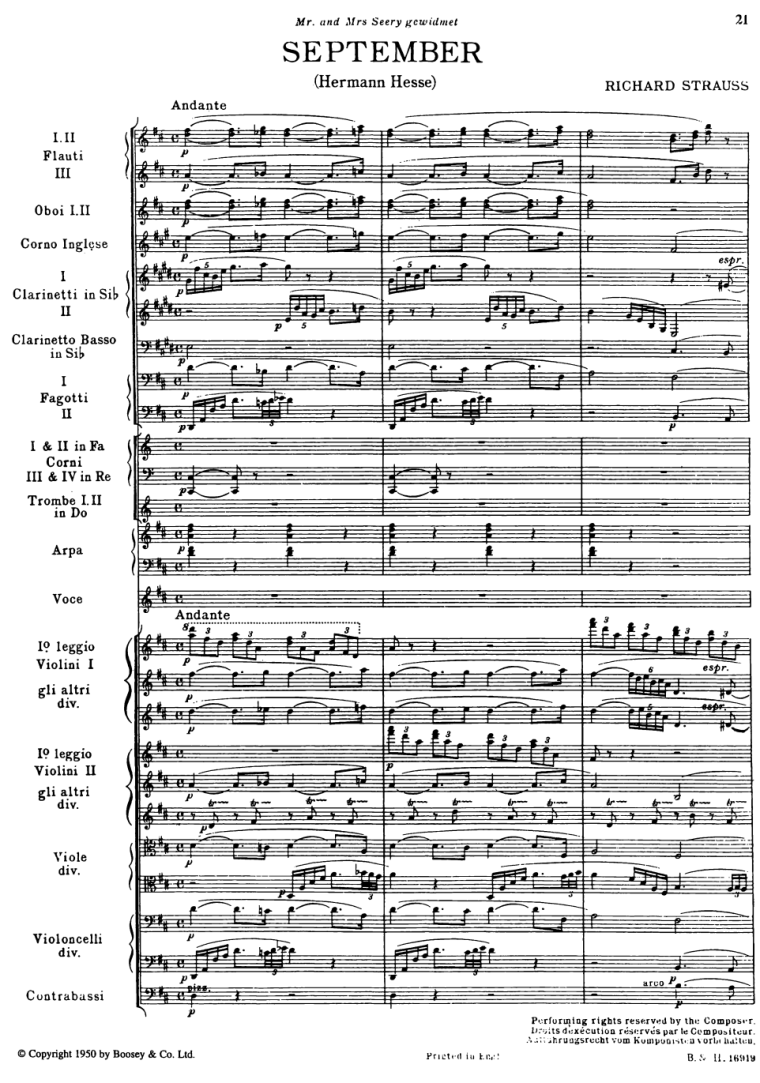
Richard Strauss (1864 - 1949): September, Lied per voce e orchestra (Vier letzte Lieder, n. 2; 1948) su testo di Hermann Hesse. Lucia Popp, soprano; London Symphony Orchestra, dir. Michael Tilson Thomas.
Der Garten trauert,
kühl sinkt in die Blumen der Regen.
Der Sommer schauert
still seinem Ende entgegen.
Golden tropft Blatt um Blatt
nieder vom hohen Akazienbaum.
Sommer lächelt erstaunt und matt
in den sterbenden Gartentraum.
Lange noch bei den Rosen
bleibt er stehn, sehnt sich nach Ruh.
Langsam tut er die [großen]
müdgeword’nen Augen zu.
(Il giardino è in lutto, fredda scivola tra i fiori la pioggia. Rabbrividendo l’estate si avvia silente verso la fine.
A foglia a foglia l’oro cade a terra dall’alto albero d’acacia. L’estate sorride, stupita e languida, nel sogno del giardino morente.
A lungo ancora vicino alle rose sembra sopravvivere, ma anela al riposo. Lentamente chiude i [grandi] suoi occhi ormai stanchi.)
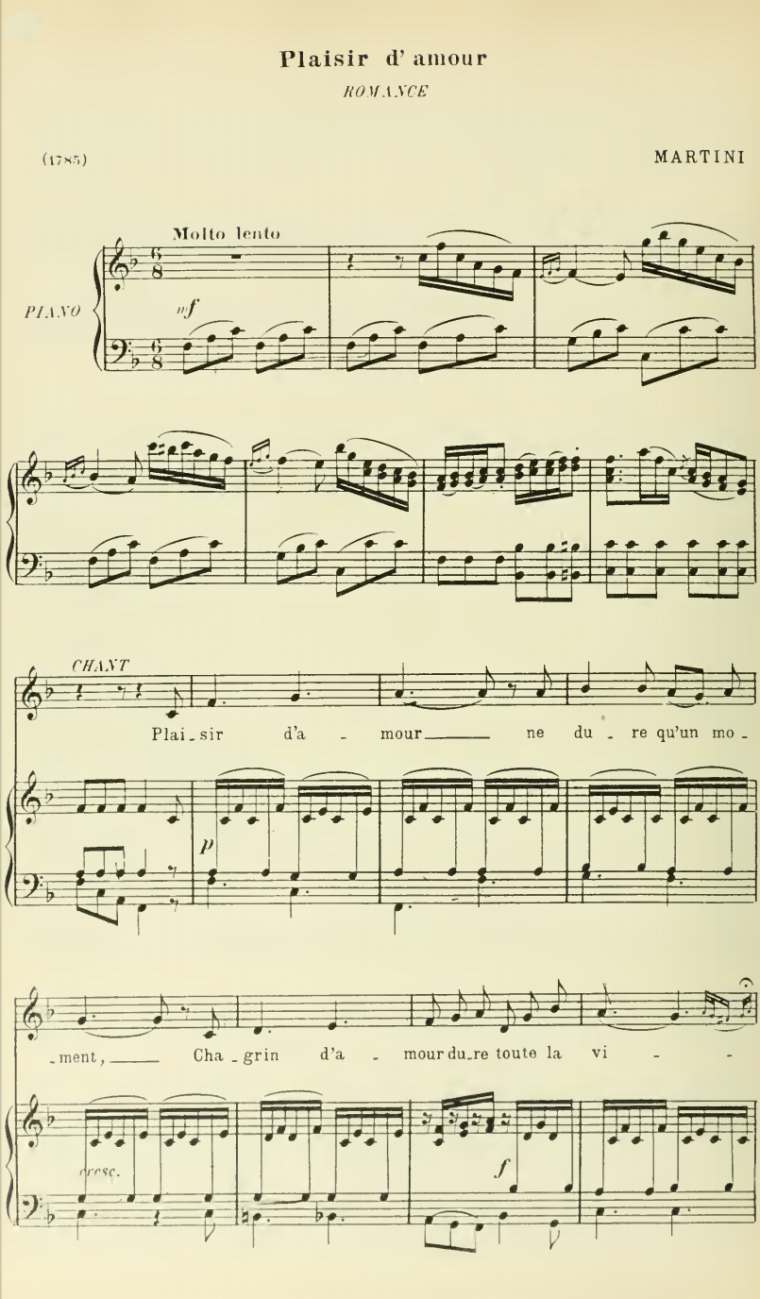
Jean-Paul Égide Martini (ovvero Johann Paul Aegidius Schwarzendorf detto Martini il Tedesco, 31 agosto 1746 - 1816): Plaisir d’amour, romanza per voce e pianoforte (c1784) su testo di Jean-Pierre Claris de Florian. Claire Lefilliâtre, soprano; Arthur Schoonderwoerd, fortepiano.
Plaisir d’amour ne dure qu’un moment, chagrin d’amour dure toute la vie.
J’ai tout quitté pour l’ingrate Sylvie.
Elle me quitte et prend un autre amant.
Plaisir d’amour ne dure qu’un moment, chagrin d’amour dure toute la vie.
«Tant que cette eau coulera doucement
vers ce ruisseau qui borde la prairie
Je t’aimerai», me répétait Sylvie.
L’eau coule encore. Elle a changé pourtant.
Plaisir d’amour ne dure qu’un moment, chagrin d’amour dure toute la vie.
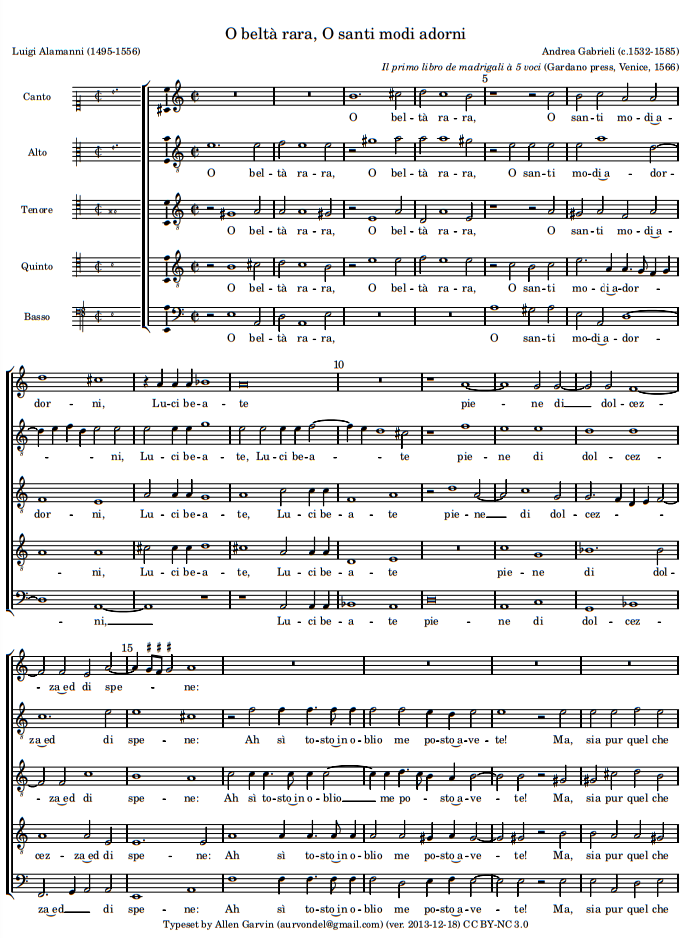
Andrea Gabrieli (c1533 - 30 agosto 1585): O beltà rara, madrigale a 5 voci (pubblicato nel Primo Libro de madrigali a 5 voci, 1566, n. 11) su testo di Luigi Alamanni. I Fagiolini, dir. Robert Hollingworth.
O beltà rara, o santi modi adorni,
Luci beate piene
Di dolcezza e di spene:
Ah sì tosto in oblio me posto avete!
Ma, sia pur quel che può, voi non farete
Ch’io non sia quel che’l primo giorno volli;
Fin che questi occhi molli
Finiran per mai sempre il longo pianto.
Simon Bainbridge (30 agosto 1952 - 2021): Herbsttag / Autumn Day per doppio coro a cappella (1993) su testo di Rainer Maria Rilke nella traduzione inglese di James Blair Leishman. The Ionian Singers, dir. Timothy Salter.
Herr: es ist Zeit. Der Sommer war sehr groß
Leg deinen Schatten auf die Sonnenuhren,
und auf den Fluren laß die Winde los.
Befiehl den letzten Früchten voll zu sein;
gieb ihnen noch zwei südlichere Tage,
dränge sie zur Vollendung hin und jage
die letzte Süße in den schweren Wein.
Wer jetzt kein Haus hat, baut sich keines mehr.
Wer jetzt allein ist, wird es lange bleiben,
wird wachen, lesen, lange Briefe schreiben
und wird in den Alleen hin und her
unruhig wandern, wenn die Blätter treiben.
Lord, it is time. The summer was so great.
Impose upon the sundials now your shadows
and round the meadows let the winds rotate.
Command the last fruits to incarnadine;
vouchsafe, to urge them on into completeness,
yet two more south-like days; and that last sweetness,
inveigle it into the heavy vine.
He’ll not build now, who has no house awaiting.
Who’s now alone, for long will so remain:
sit late, read, write long letters, and again
return to restlessly perambulating
the avenues of parks when leaves downrain.
Giovanni Paisiello (1740 - 1816): «Nel cor più non mi sento», duetto, dal II atto dell’opera L’amor contrastato, ossia La molinarella (libretto di Giuseppe Palomba, 1788; ripresa nel 1790 con il titolo La molinara). Renata Tebaldi, soprano (esegue soltanto la 1a strofe); New Philharmonia Orchestra, dir. Richard Bonynge.
Nel cor più non mi sento
brillar la gioventù.
Cagion del mio tormento,
Amor, sei colpa tu.
Mi pizzichi, mi stuzzichi,
mi pungichi, mi mastichi;
Che cosa è questa, ohimè?
Pietà, pietà, pietà!
Amore è un certo che,
che disperar mi fa!
Bonifazio Asioli (30 agosto 1769 - 1832): Sonata in sol maggiore per pianoforte op. 8 n. 1. Vladimir Plešakov.
Presto
Adagio [6:22]
Tema («Nel cor più non mi sento» di Paisiello), 10 variazioni e Epilogo [11:18]
Ludwig van Beethoven (1770 - 1827): 6 Variazioni per pianoforte su «Nel cor più non mi sento» WoO 70 (1795). Wilhelm Kempff.
Sulla genesi di questa composizione si racconta il seguente aneddoto. Una sera Beethoven si trovava a teatro per assistere a una rappresentazione della Molinara; quando fu eseguito il noto duetto «Nel cor più non mi sento», una dama gli disse: «Avevo alcune variazioni su questo tema, ma le ho perdute». Durante la notte Beethoven compose sei variazioni sul tema di Paisiello e il mattino successivo le inviò alla signora con questa intitolazione: Variazioni ecc. perdute per la — ritrovate per Luigi van Beethoven. Sie sind so leicht, daß die Dame sie wohl a vista sollte spielen können (sono così facili che la signora dovrebbe essere in grado di eseguirle a prima vista).
Niccolò Paganini (1782 - 1840): Introduzione e variazioni sul tema «Nel cor più non mi sento» per violino solo (1821). Leonid Kogan.
Giovanni Bottesini (1821 - 1889): Variazioni su «Nel cor più non mi sento» per contrabbasso e pianoforte op. 23. Gabriele Ragghianti, contrabbasso; Pier Narciso Masi, pianoforte.
Félicien David (1810 - 29 agosto 1876): Le désert, ode-symphonie in 3 parti per voce recitante, tenore, coro maschile e orchestra, testo poetico di Auguste Colin (1844). Olivier Pascalin, recitante; Bruno Lazzaretti, tenore; Chor der St.-Hedwigs-Kathedrale Berlin; Rundfunk-Sinfonieorchester Berlin, dir. Guido Maria Guida.
Questa composizione è il frutto (maturato oltre dieci anni dopo) del viaggio in Egitto e in Medio Oriente compiuto da David nel 1833, all’epoca della sua adesione al sansimonismo. Il testo narra il percorso di una carovana attraverso il deserto del Sahara: affronta una tempesta di sabbia, fa sosta per la notte, riprende il cammino al levar del giorno rendendo omaggio a Allah. L’ode è articolata in 3 parti a loro volta suddivise in scene fra loro indipendenti:
PARTE I, L’entrée au désert. L’orchestra evoca l’immensità silente del deserto; si ode la preghiera di un coro di pellegrini che rende omaggio a Allah; dopo, in lontananza, si avverte il rumore della carovana (Marche de la caravane), dapprima sommesso, poi sempre più forte man mano che questa si avvicina. Si leva una forte tempesta di sabbia (Le simoun), amplificata dalla disperata supplica del coro che invoca Allah affinché abbia pietà dei credenti. Tornata la calma, la carovana può riprendere il cammino.
PARTE II, La nuit [22:26]. Il coro intona un cantico alla notte; seguono due brani strumentali, la Fantaisie arabe («air syrien») e la Danse des almées, che richiamano remote atmosfere orientali. Si celebra la vita libera del deserto in contrapposizione a quella civilizzata (La liberté au désert); l’episodio si conclude con una Rêverie du soir fondata sopra una melodia orientale udita da David al tempo del suo soggiorno in Egitto. Il silenzio, immobile, si distende nuovamente sul deserto.
PARTE III, Le lever du soleil [35:09]. Il sole si alza sul deserto e lo inonda di luce e di amore; solo il canto del muezzin (Chant du muezzin) increspa l’atmosfera immobile del Sahara. La carovana si rimette in cammino (Le départ de la caravane). L’ode si conclude con un omaggio corale a Allah.
Ivor Gurney (28 agosto 1890 - 1937): The Cloths of Heaven, testo di William Butler Yeats. Ian Partridge, tenore; Jennifer Partridge, pianoforte.
Had I the heavens’ embroidered cloths,
Enwrought with golden and silver light
The blue and the dim and the dark cloths
Of night and light and the half-light,
I would spread the cloths under your feet:
But I, being poor, have only my dreams.
I have spread my dreams under your feet;
Tread softly because you tread on my dreams.
Josquin des Prez (c1450 - 27 agosto 1521): Alma redemptoris mater, antifona (mottetto) a 4 voci (1518). Ensemble De Labyrinto.
Alma Redemptoris Mater, quae pervia coeli porta manes,
et stella maris, succurre cadenti, surgere qui curat, populo:
tu quae genuisti, natura mirante, tuum sanctum Genitorem,
Virgo prius ac posterius, Gabrielis ab ore sumens illud Ave, peccatorum miserere.
Tomás Luis de Victoria (1548 - 27 agosto 1611): Alma redemptoris mater, antifona a 8 voci (pubblicata in Cantica B. Virginis, 1581, n. 18). Ensemble Plus Ultra, dir. Michael Noone.
Tomás Luis de Victoria (1548 - 27 agosto 1611): Nigra sum, sed formosa, antifona (mottetto) a 6 voci (pubblicato in Motecta festorum totius anni cum Communi Sanctorum, quae partim senis, partim quinis, partim quaternis, alia octonis vocibus concinuntur, 1585, n. 3); testo tratto dal Canticum canticorum (I:5, II:10-12) in parte modificato.
Alcune interpretazioni del mio mottetto preferito. Nell’ordine:
– The Tallis Scholars, dir. Peter Phillips
– Chanticleer
– The Song Company
– Ensemble Plus Ultra, dir. Michael Noone
Nigra sum sed formosa filia Jerusalem
Ideo dilexit me Dominus et introduxit me in cubiculum suum et dixit mihi:
surge amica mea et veni.
Jam hiems transiit, imber abiit et recessit,
Flores apparuerunt in terra nostra, tempus putationis advenit.
Victoria è uno dei più straordinari compositori di ogni tempo. Ogni volta che ho l’occasione di ascoltare la sua musica mi sorprende la maestria con cui riesce a creare architetture polifoniche di complesse senza mai rinunciare all’intelligibilità del testo e alla piacevolezza dell’insieme. Questo brano è un esempio significativo della sua arte formidabile.
Josquin des Prez (c1450 - 27 agosto 1521): Tu solus qui facis mirabilia, mottetto a 4 voci (pubblicato in Motetti de Passione de Cruce de Sacramento de Beata Virgine – B, Venezia 1503). Gloriana Ensemble: Noar Lee Naggan, controtenore; Hillel Sherman, tenore; Yoram Bar Akiva, baritono; Joel Sivan, basso.
I. Tu solus qui facis mirabilia,
Tu solus Creator, qui creasti nos,
Tu solus Redemptor, qui redemisti nos
sanguine tuo pretiosissimo.
Ad te solum confugimus,
in te solum confidimus
nec alium adoramus,
Jesu Christe.
Ad te preces effundimus
exaudi quod supplicamus,
et concede quod petimus,
Rex benigne .
II. D’ung aultre amer,
Nobis esset fallacia:
D’ung aultre amer,
Magna esset stultitia et peccatum.
Audi nostra suspiria,
Replenos tua gratia,
O rex regum,
Ut ad tua servitia
Sistamus cum laetitia
in aeternum.














 la regina gioiosa