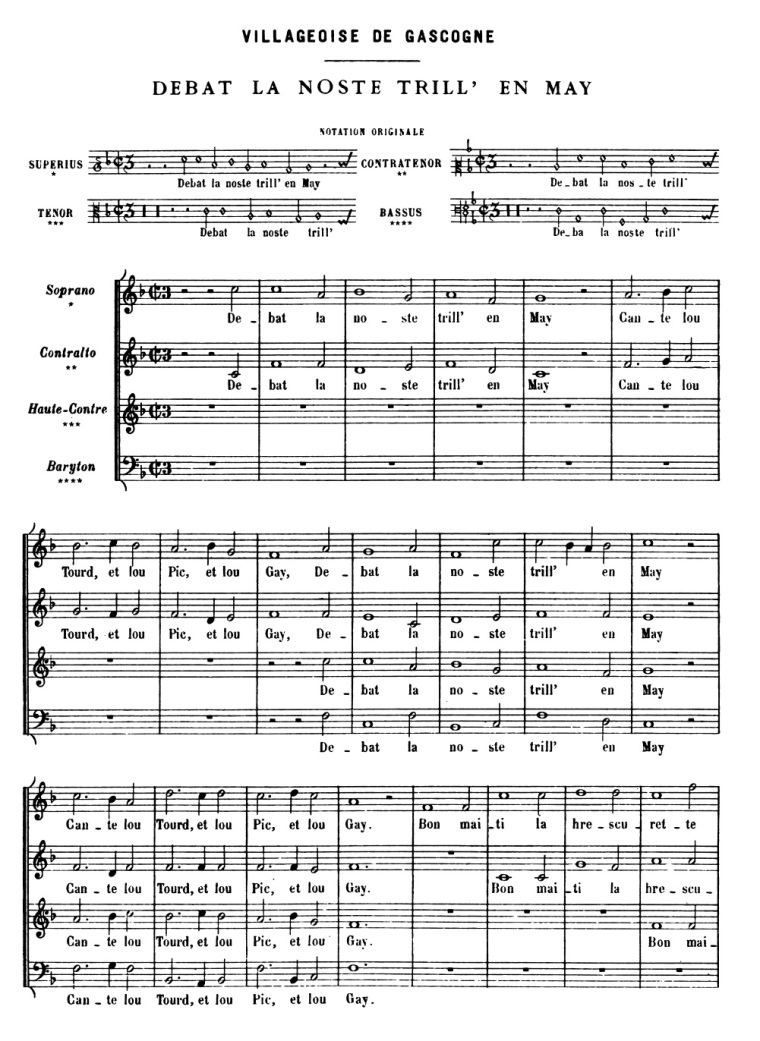
Claude Le Jeune (c1530 - 1600): Debat la noste trill’ en may, chanson a 4 voci e 4 viole (1585). Ensemble «Clément Janequin», Ensemble Les Eléments.
Testo originale in dialetto guascone
Traduzione in francese moderno
Debat la noste trill’ en May
Cante lou Tourd, et lou Pic, et lou Gay.
Bon maiti la hrescurette jou m’leué
Jou troubé la mi’ amourette sueu graüe,
Aqui n’agoum’ quauques moutetz,
Et puchens dus ou trés poutétz.
Debat la noste trill’ en May
Cante lou Tourd, et lou Pic, et lou Gay.
La betzere courroussa de Deü baisa,
Dichouc se ce hous pensa de bet temps a.
Non m’a gousse muchat jamès
Qu’ere de ta hrem com’ames.
Debat la noste trill’ en May
Cante lou Tourd, et lou Pic, et lou Gay,
Com’ duchouc jou la mia bere
Vist que lou ceü non capere tau beautat
Que m’bouilles ta reguerguement
Ma peiche de péne et torment
Debat la noste trill’ en May
Cante lou Tourd, et lou Pic, et lou Gay.
Sous notre treille en mai
Chantent la grive et le pic et le geai.
De bon matin, à la fraîche je me levai
Je rencontrai mon amoureuse sur la grève,
Là nous eûmes quelques mots doux,
Et ensuite deux ou trois baisers.
Sous notre treille en mai
Chantent la grive et le pic et le geai.
Alors elle, courroucée de ces baisers,
Dit que si elle avait pris garde, autrefois,
Elle ne m’aurait jamais montré
Que son amour pour moi était aussi fort.
Sous notre treille en mai
Chantent la grive et le pic et le geai.
Où, lui dis-je, ma belle, a-t-on vu
Que le ciel n’abrite pas de beauté qui te vaille,
Pour que tu me veuilles avec tant de rudesse
Repaître de peine et de tourment!
Sous notre treille en mai
Chantent la grive et le pic et le geai.
Vicente Martín y Soler (2 maggio 1754 - 1806): La costanza, canzonetta (pubblicata in XII Canzonette italiane accompagnate col cembalo o arpa o chitarra, c1788, n. 7). Teresa Berganza, mezzosoprano; José Miguel Moreno, chitarra.
No che lasciar non posso
il caro mio tesoro,
per lui languisco e moro,
fedel ognor sarò.
L’idolo mio diletto
che m’ha ferito il petto
lasciar d’amar non so.
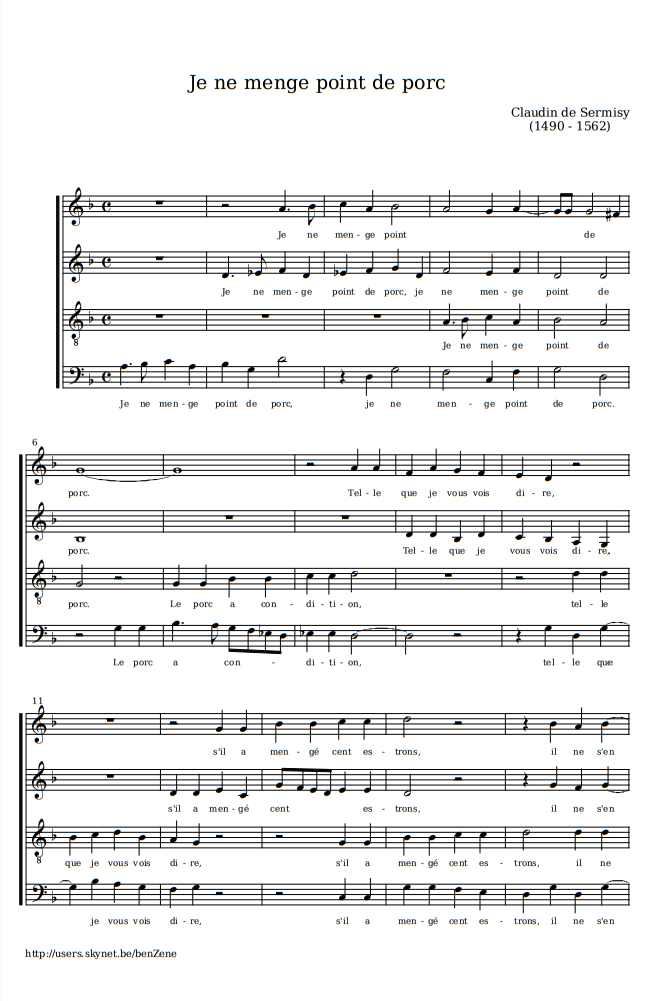
Claudin de Sermisy (c1490 - 1562): Je ne menge point de porc, chanson a 4 voci (1538). Molto bravo Simone Lo Castro, il quale canta tutte e quattro le parti.
Sermisy non mangia carne di maiale e ci spiega perché:
Je ne menge point de porc,
telle que je vois dire:
s’il a mengé cent estrons,
il ne s’en fera que rire.
Il les tourne, il les vire,
il leur rit et puis les mort.
Je ne menge point de porc.
Le porc s’en alloit jouant
tout au long d’une rivière;
il veit ung estron nouant,
il luy print a faire chere
disant en ceste maniere:
« Estron nouant en riviere,
rend toy ou tu es mort. »
Je ne menge point de porc.
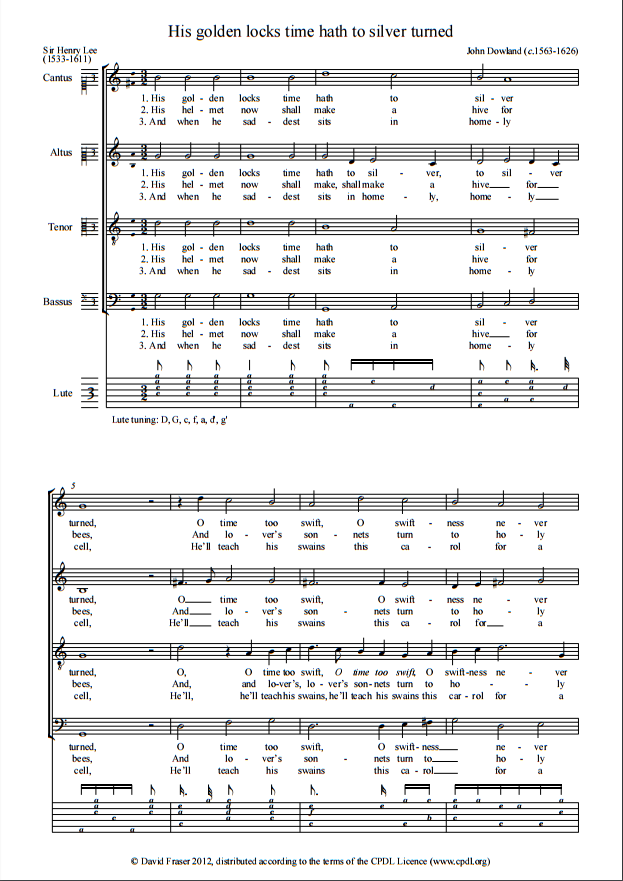
John Dowland (1563 - 1626): His golden locks, dal First Booke of Songes (1597), n. 18. Emma Kirkby, soprano; Anthony Rooley, liuto.
His golden locks Time hath to silver turned.
O Time too swift, O swiftness never ceasing:
His youth ‘gainst Time and Age hath ever spurned,
But spurned in vain; youth waneth by increasing.
Beauty, strength, youth are flowers but fading seen;
Duty, faith, love are roots, and ever green.
His helmet now shall make a hive for bees,
And lovers’ sonnets turn to holy psalms.
A man at arms must now serve on his knees,
And feed on prayers which are Age’s alms.
But though from Court to cottage he depart,
His Saint is sure of his unspotted heart.
And when he saddest sits in homely cell,
He’ll teach his swains this carol for a song:
Blest be the hearts that wish my Sov’reign well.
Curst be the soul that think her [him] any wrong.
Goddess [Ye gods], allow this aged man his right
To be your beadsman now, that was your knight.
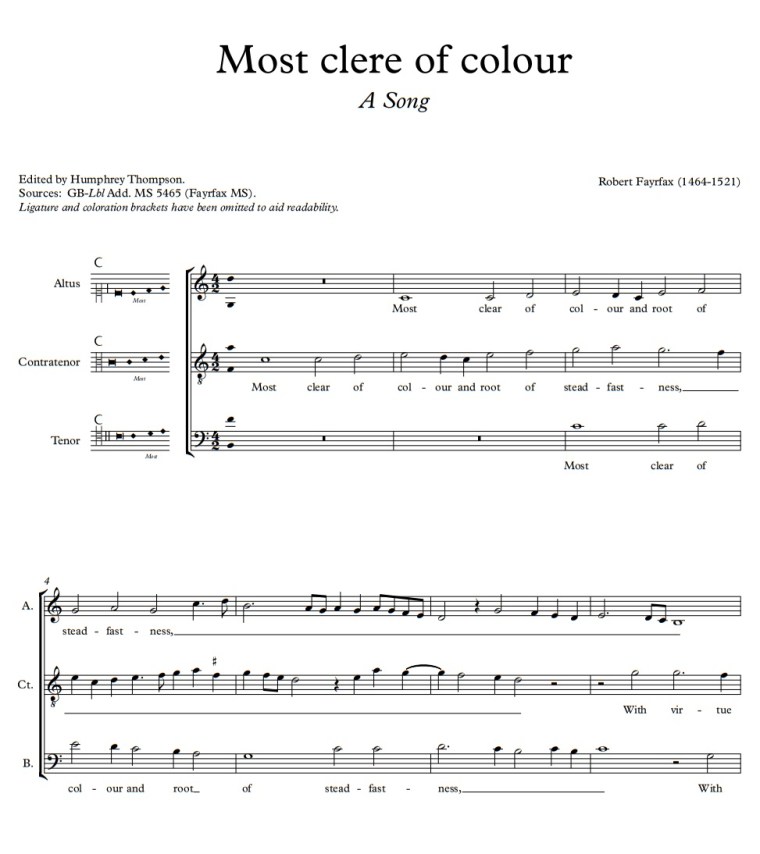
Robert Fayrfax (23 aprile 1464 - 1521): Most clere of colour per 3 voci a cappella. The Hilliard Ensemble.
Most clere of colour and rote of stedfastness,
With vertu connyng her maner is lede,
Which that passyth my mynde for to express
Of her bounte, beaute and womanhode;
The bryghtest myrrour and floure of goodlyhed,
Which that all men knowith, both more and less;
Thes vertues byn pryntyd in her doutless.
Johann Sebastian Bach (1685 - 1750): Weinen, Klagen, Sorgen, Zagen, cantata BWV 12 su testo di Salomo Franck (forse) e Samuel Rodigast (n. 7); eseguita per la prima volta a Weimar il 22 aprile 1714. Paul Esswood, contraltista; Kurt Equiluz, tenore; Max van Egmond, basso; Tölzer Knabenchor, dir. Gerhard Schmidt-Gaden; King’s College Choir Cambridge, dir. David Willcocks; Leonhardt-Consort, dir. Gustav Leonhardt.
Sinfonia: Adagio assai
Coro: Weinen, Klagen, Sorgen, Zagen [2:20]
Récitativo: Wir müssen durch viel Trübsal [8:21]
Aria: Kreuz und Krone sind verbunden [9:19]
Aria: Ich folge Christo nach [15:45]
Aria: Sei getreu, alle Pein [18:33]
Corale: Was Gott tut, das ist wohlgetan [22:50]
Il basso ostinato del coro (n. 2) della cantata bachiana è costituito da una successione cromatica discendente di quattro note (passus duriusculus : secondo le convenzioni della retorica musicale, i cromatismi ascendenti o discendenti esprimono dolore). Su questo basso ostinato Franz Liszt compose un Präludium per pianoforte (R 23, 1859; dedicato a Anton Grigor’evič Rubinštejn) che qui possiamo ascoltare nell’interpretazione di Vladimir Horowitz:
In seguito, Liszt scrisse una serie di Variationen über den Basso continuo von J. S. Bachs Kantate «Weinen, Klagen, Sorgen, Zagen» (R 24, anch’esse dedicate a A. G. Rubinštejn), composte sotto l’impressione della morte di Blandine Ollivier, la figlia che il musicista ungherese aveva avuto da Catherine-Adelaide Méran e che era defunta a Saint-Tropez l’11 settembre 1862. L’esecuzione che vi propongo è di Artur Aksenov:
Liszt rielaborò poi le variazioni in una versione organistica (R 382, dedicata a Alexander Wilhelm Gottschalg, organista e Kantor di Tiefurt), qui eseguita da Thibaut Duret all’organo Michel-Merklin-Kuyhn di Saint Louis de la Guillotière, a Lione:
Sigismondo d’India (c1582 - 19 aprile 1629): Ha di serpe il velen, madrigale a 5 voci (dal Primo Libro de madrigali a 5 voci, 1606, n. 5) su testo di Giovanni Battista Strozzi. La Venexiana, dir. Claudio Cavina.
Ha di Serpe il velen,
Di Tigre il morso,
E di lieve Cervetta
Quest’acerbetta fugitiva ha ‘l corso.
Ben sembr’ell’Angioletta,
Di dolcezza e di gratia à le parole,
À le guancie l’Aurora,
À gl’occhi il Sole.
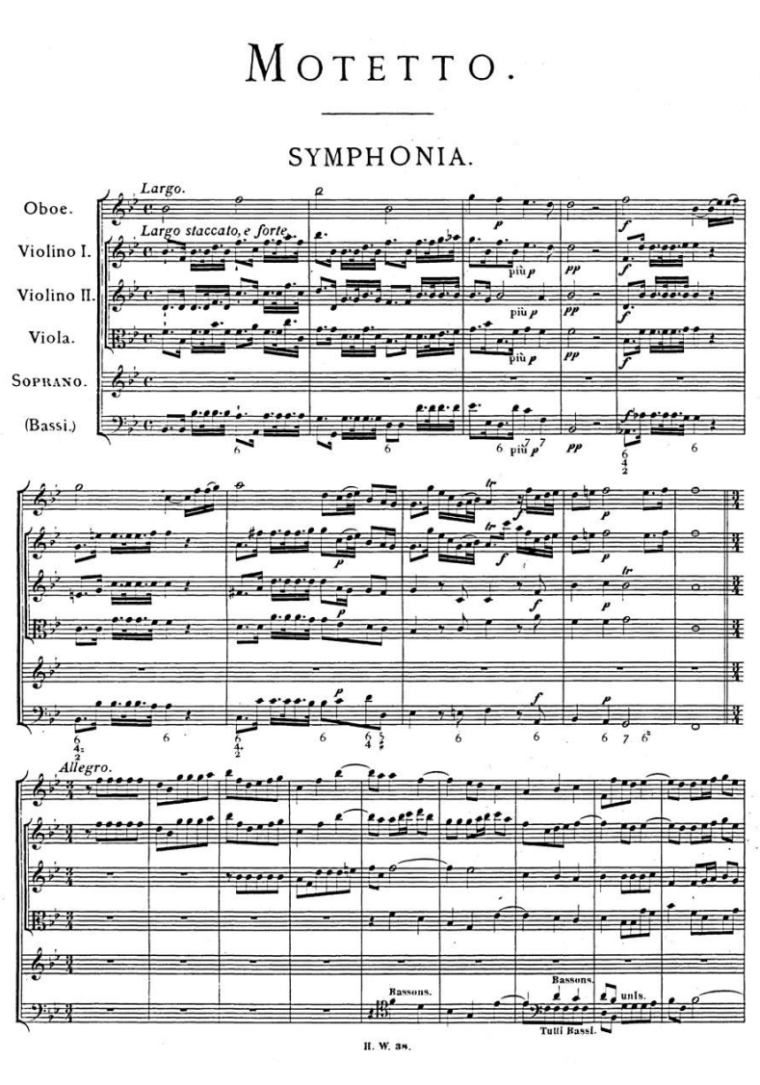
Georg Friedrich Händel (1685 - 14 aprile 1759): Silete, venti, mottetto per soprano e orchestra HWV 242 (c1724). Karina Gauvin, soprano; Les Violons du Roy, dir. Bernard Ladabie.
Symphonia: Largo – Allegro
Recitativo accompagnato: Larghetto [2:14]
Silete venti, nolite murmurare frondes,
quia anima mea dulcedine requiescit.
Aria: Andante ma larghetto [5:35]
Dulcis amor, Jesu care,
quis non cupit te amare?
Veni, transfige me!
Si tu feris, non sunt clades:
tuae plagae sunt suaves,
quia totus vivo in te.
Accompagnato [12:43]
O fortunata anima!
O jucundissimus triumphus!
O felicissima laetitia!
Aria: Andante – Allegro – Da capo: Andante [13:15]
Date serta, date flores;
me coronent vestri honores;
date palmas nobiles.
Surgant venti
Et beatae spirent almae fortunatae
Auras coeli fulgidas.
Arthur Benjamin (1893 - 10 aprile 1960): Storm Clouds Cantata per soprano, coro e orchestra su testo di Dominic Bevan Wyndham Lewis (1934); versione rimaneggiata da Bernard Herrmann (1956). Barbara Howitt, soprano; Covent Garden Opera Chorus e London Symphony Orchestra, dir. B. Herrmann.
La cantata fu composta appositamente per la celeberrima «scena dello sparo», che si svolge nella Royal Albert Hall di Londra, nel film L’uomo che sapeva troppo (The Man Who Knew Too Much, 1934) di Alfred Hitchcock; per il rifacimento del 1956 fu ancora utilizzata la musica di Benjamin, ma apportando alcune modifiche al testo e, curate da Herrmann, alla partitura.
Testo
(versione del 1956)
Soprano:
There came a whispered terror on the breeze.
And the dark forest shook.
Coro:
And on the trembling trees came nameless fear.
And panic overtook each flying creature of the wild.
Soprano:
All save the child.
Around whose head screaming,
The night-birds wheeled and shot away.
Coro:
Finding release from that which drove them onward like their prey.
Finding release the storm-clouds broke.
And drowned the dying moon.
The storm-clouds broke.
Finding release!
Johann Crüger (9 aprile 1598 - 1662): Jesu, meine Freude, inno su testo di Johann Franck (pubblicato nella 5ª edizione dell’innario protestante Praxis pietatis melica, 1653). Cappella Vocale Berlin, dir. Carsten Albrecht.
Jesu, meine Freude,
Meines Herzens Weide,
Jesu, meine Zier,
Ach wie lang, ach lange
Ist dem Herzen bange
Und verlangt nach dir!
Gottes Lamm, mein Bräutigam,
Außer dir soll mir auf Erden
Nichts sonst Liebers werden.
[Unter deinem Schirmen
Bin ich vor den Stürmen
Aller Feinde frei.
Laß den Satan wittern,
Laß den Feind erbittern,
Mir steht Jesus bei.
Ob es itzt gleich kracht und blitzt,
Ob gleich Sünd und Hölle schrecken:
Jesus will mich decken.]
Trotz dem alten Drachen,
Trotz des Todes Rachen,
Trotz der Furcht darzu!
Tobe, Welt, und springe,
Ich steh hier und singe
In gar sichrer Ruh.
Gottes Macht hält mich in acht;
Erd und Abgrund muss verstummen,
Ob sie noch so brummen.
Weg mit allen Schätzen!
Du bist mein Ergötzen,
Jesu, meine Lust !
Weg ihr eitlen Ehren,
Ich mag euch nicht hören,
Bleibt mir unbewusst!
Elend, Not, Kreuz, Schmach und Tod
Soll mich, ob ich viel muss leiden,
Nicht von Jesu scheiden.
Gute Nacht, o Wesen,
Das die Welt erlesen,
Mir gefällst du nicht.
Gute Nacht, ihr Sünden,
Bleibet weit dahinten,
Kommt nicht mehr ans Licht!
Gute Nacht, du Stolz und Pracht!
Dir sei ganz, du Lasterleben,
Gute Nacht gegeben.
Weicht, ihr Trauergeister,
Denn mein Freudenmeister,
Jesus, tritt herein.
Denen, die Gott lieben,
Muß auch ihr Betrüben
Lauter Zucker sein.
Duld ich schon hier Spott und Hohn,
Dennoch bleibst du auch im Leide,
Jesu, meine Freude.
Johann Sebastian Bach (1685 - 1750): Jesu, meine Freude, mottetto funebre a 5 voci e basso continuo BWV 227 (1723). Agnès Mellon e Greta de Reyghere, soprani; Vincent Darras, controtenore; Howard Crook, tenore; Peter Kooy, basso. La Chapelle Royale, dir. Philippe Herreweghe.
Le strofe di Franck sono alternate a passi della Lettera ai Romani :
Jesu, meine Freude
Es ist nun nichts Verdammliches (Romani 8:1,4)
Unter deinem Schirmen
Denn das Gesetz (Romani 8:2)
Trotz dem alten Drachen
Ihr aber seid nicht fleischlich (Romani 8:9)
Weg mit allen Schätzen
So aber Christus in euch ist (Romani 8:10)
Gute Nacht, o Wesen
So nun der Geist (Romani 8:11)
Weicht, ihr Trauergeister
Johann Sebastian Bach: Jesu, meine Freude, preludio corale BWV 610 (c1713-15). Gilberto Guarino, organo.
Bianca Maria Meda (c1665 - c1700): Cari musici, mottetto per soprano, 2 violini e basso continuo (da Mottetti a 1, 2, 3 e 4 voci con violini e senza, 1691, n. 1). Roberta Invernizzi, soprano; ensemble Bizzarrie Armoniche, dir. e violoncello Elena Russo.
Cari musici, cum grato silentio
Voces comprimite,
Suspendite sonos,
Cantare cessate,
Et contemplate dilecte
Jesu amores.
Non me turbate, no, amante,
Armonici chori
Cantare, cessate.
Quantae deliciae
Quantae fortunata beant me,
Rapit meum cor ad se
Jesus solus voce amante.
Quanta laetitia
Quanta me divina replet lux
In amore verus dux
Mihi donat gaudia tanta.
Ah! Quid dico! Anima ingrata,
in silentio taciturno
Amores sponsi audio sepelire,
Ah non tacete, no,
O voces canorae,
Non tacete.
Amare et silere, cor,
Tentas impossibile,
Plus tormentum sit terribile
Quando curat reticere.
Tacere et ardere, no,
Non potes tam firmissime,
Tuae pene sunt durissimae,
Si tacendo vis languere.
Francisco de Peñalosa (c1470 - 1° aprile 1528): Ave, verum corpus, mottetto a 4 voci. Ensemble Absalon.
Ave, verum corpus natum
de Maria Virgine;
vere passum, immolatum
in cruce pro homine;
cuius latus perforatum
vere fluxit sanguine.
O clemens, o pie,
o Iesu Fili Mariae,
miserere nobis.
Johann Sebastian Bach (31 marzo 1685 - 1750): «Kommt, ihr angefochtnen Sünder», aria (n. 5) dalla cantata Freue dich, erlöste Schar BWV 30 (c1738). Magdalena Kožená, mezzosoprano; Musica Florea, dir. Marek Stryncl.
Kommt, ihr angefochtnen Sünder,
Eilt und lauft, ihr Adamskinder,
Euer Heiland ruft und schreit!
Kommet, ihr verirrten Schafe,
Stehet auf vom Sündenschlafe,
Denn itzt ist die Gnadenzeit!
(Venite, peccatori, accorrete, figli d’Adamo. Il vostro Salvatore grida e vi chiama! Venite, gregge disperso, svegliatevi dal sonno del peccato, poiché ora è il tempo del perdono!)
Nicolaus Bruhns (1665 - 29 marzo 1697): Die Zeit meines Abschieds ist vorhanden, cantata per coro a 4 voci, archi e continuo. Ricercar Consort.
Testo: II Lettera a Timoteo IV:6-8
[6] Quanto a me, il mio sangue sta per essere sparso in libagione ed è giunto il momento di sciogliere le vele. [7] Ho combattuto la buona battaglia, ho terminato la mia corsa, ho conservato la fede. [8] Ora mi resta solo la corona di giustizia che il Signore, giusto giudice, mi consegnerà in quel giorno; e non solo a me, ma anche a tutti coloro che attendono con amore la sua manifestazione.
Constantijn Huygens (1596 - 28 marzo 1687): Dilataverunt super me os suum, mottetto a 1 voce e basso continuo (pubblicato in Pathodia sacra et profana, 1647, n. 6). Anne Grimm, soprano; Peter Kooij, basso di viola; Leo van Doeselaar, organo.
Et dilataverunt super me os suum; dixerunt: Euge, euge! viderunt oculi nostri.
Vidisti, Domine: ne sileas; Domine, ne discedas a me.
(Salmo 35:21-22)
Jacob Obrecht (1457/58 - 1505): Missa Fortuna desperata a 4 voci. Ensemble vocale The Sound and The Fury.
Obrecht compose questa messa non su una delle rielaborazioni d’autore della chanson omonima (se ne conoscono una a 3 voci di Heinrich Isaac, una a 6 di Alexander Agricola e una a 3 parti strumentali, forse di Josquin des Prez), bensì sulla versione originale, quella riportata dai quattro manoscritti di cui s’è detto ieri. Il fatto che Obrecht abbia lavorato sul testo originale dà maggior consistenza all’attribuzione di Fortuna desperata a Antoine Busnois: è infatti molto probabile che i due musicisti si conoscessero di persona, essendo stati attivi a Bruges nello stesso periodo, Busnois — nell’ultimo anno della sua vita — presso la Cattedrale di San Salvatore, Obrecht in San Donaziano.
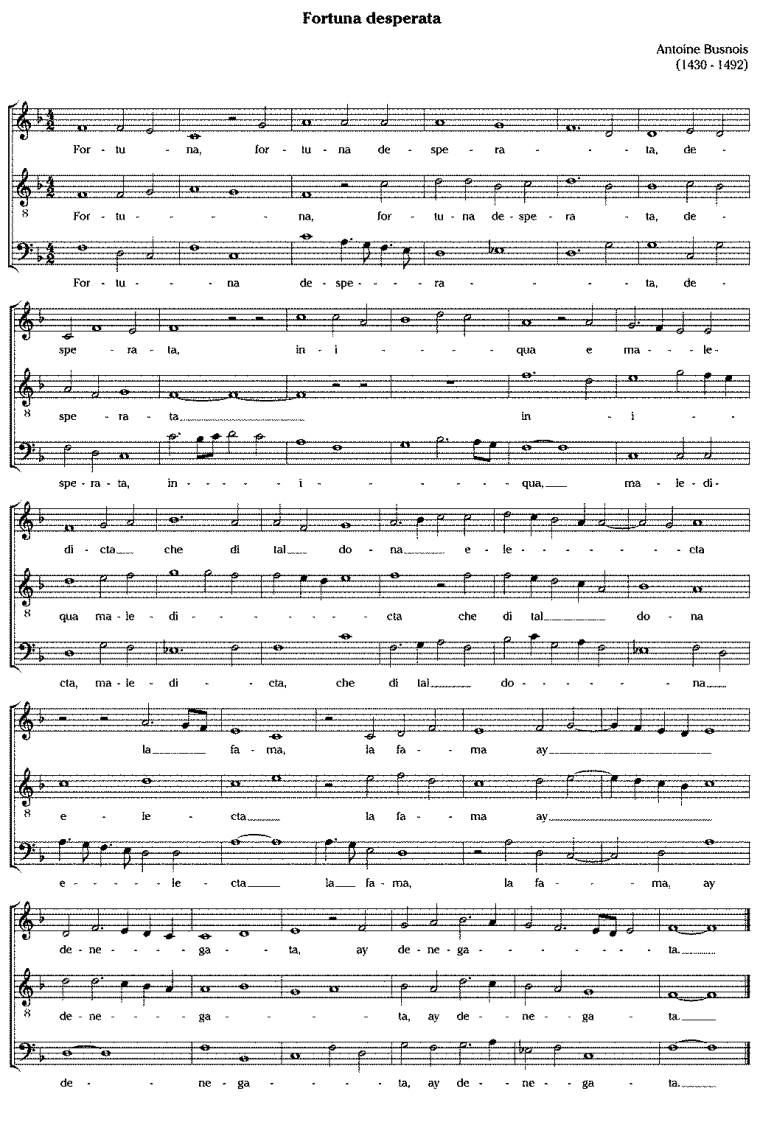
Antoine Busnois? (1430 - 1492): Fortuna desperata, chanson a 3 voci. The Clerks’ Group, dir. Edward Wickham.
Fortuna desperata
Iniqua e maledecta
Che de tal dona electa
La fama ay denigrata.
O morte dispietata,
Inimica e crudele,
Che d’alto più che stelle
L’hai così abbassata.
Meschina e despietata,
Ben piangere posso may
Et desiro finire,
Finire i miei guay.
Questa chanson è stata tramandata da quattro manoscritti, tre dei quali non indicano il nome dell’autore; nel quarto codice è attribuita a Busnois. Secondo alcuni studiosi, potrebbe invece essere opera di un musicista fiorentino, Felice di Giovanni Martini († 1478).
Jean-Baptiste Lully (1632 - 22 marzo 1687): Plaude laetare Gallia, mottetto a 5 voci, coro, orchestra e basso continuo su testo di Pierre Perrin, composto in occasione del battesimo di Luigi di Francia, detto il Gran Delfino, figlio primogenito del Re Sole (24 marzo 1668). Le Concert Spirituel, dir. Hervé Niquet.
Simphonie
Plaude laetare Gallia
Rore caelesti rigantur lilia,
Sacro Delphinus fonte lavatur
Et christianus Christo dicatur.
O Jesu vita precantium [2:44]
O Jesu vita precantium
O Jesu vita credentium
Exaudi vota precantium.
Vivat regnet princeps fidelis [5:24]
Vivat regnet princeps fidelis
Semper justus, semper victor, semper augustus
Triumphet in caelis
Et sempiterna luceat corona.
Robert Lucas de Pearsall (14 marzo 1795 - 1856): Lay a garland, madrigale a 8 voci (1840) su testo di Beaumont & Fletcher (da The Maid’s Tragedy, 1608-11: atto II, scena 1ª) modificato da Pearsall. Ensemble Voces8.
Lay a garland on her hearse
of dismal yew.
Maidens, willow branches wear,
say she died true.
Her love was false, but she was firm
Upon her buried body lie
lightly, thou gentle earth.
Pearsall: Tu es Petrus, mottetto a 8 voci (1854): travestimento spirituale del brano precedente. Coral Reyes Bartlet.
Thomas Augustine Arne (12 marzo 1710 - 1778): The Morning, cantata (1755). Anastasia Terranova, soprano; Emile ter Schegget, flauto dolce; Schola Cantorum Basiliensis.
The glittering sun begins to rise
On yonder hill, and paints the skies.
The lark his warbling matin sings,
Each flower in all its beauty springs.
The village up, the shepherd tries
His pipe, and to the woodland hies.
Oh! that on th¹enamelled green
My Delia, lovely maide, were seen,
Fresher than the roses bloom,
Sweeter than the mead¹s perfume.
Go, gentle gales, and bear my sighs away,
To Delia¹s ear the tender notes convey.
As some lonely turtle his lost love deplores,
And with shrill echoes fills the sounding shores.
So I like him, abandoned and forlorn,
With ceaseless plaints my absent Delia mourn.
Go, gentle gales, and bear my sighs along;
The birds shall cease to tune their evening song,
The winds to blow, the waving woods to move,
And streams to murmer e¹er I cease to love.
Not bubbling fountains to the thirsty swain,
Nor balmy sleep to labourers spent with pain,
Nor showers to larks, nor sunshine to the bee,
Are half so pleasing as thy sight to me.
Carlo Gesualdo da Venosa (8 marzo 1566 - 1613): Se la mia morte brami, madrigale a 5 voci (da Madrigali a cinque voci libro sesto, 1611, n. 1) su testo di Torquato Tasso. Ensemble Métamorphoses, dir. Maurice Bourbon.
Se la mia morte brami, crudel, lieto ne moro.
E dopo morte ancor te solo adoro.
Ma se vuoi che non t’ami, ahi, che a pensarlo solo
il duol m’ancide e l’alma fugge a volo.
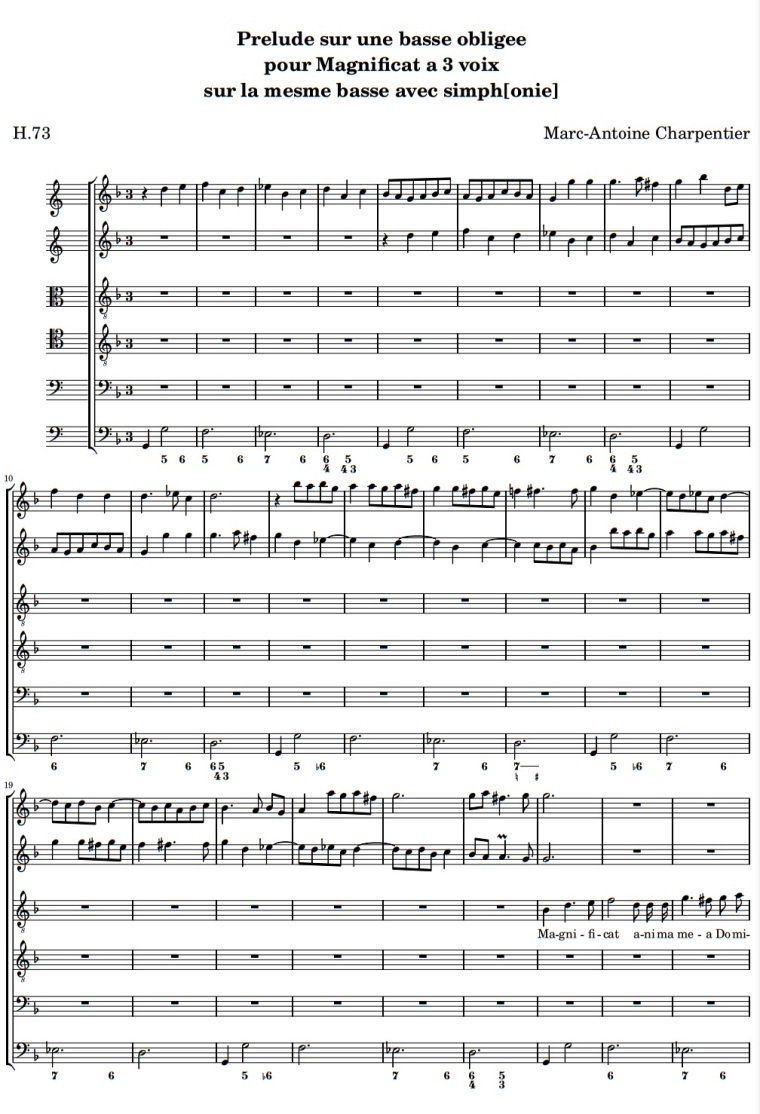
Marc-Antoine Charpentier (1643 - 24 febbraio 1704): Magnificat a 3 voci e basso continuo H. 73 (1670-71). Les Arts Florissants, dir. William Christie.
John Dowland (1563 - 20 febbraio 1626): Lasso vita mia (da A Pilgrimes Solace, 1612, n. 11). Michael Chance, controtenore; Monica Huggett, violino; Bruce Dickey, cornetto; Paul Beyer, liuto e direzione.
Lasso vita mia, mi fa morire,
Crudel amor mio cor consume,
Da mille ferite, che mi fa morir.
Ahi me, deh, che non mi fa morire.
Crudel amor mi fa sofrir mille martire.
Anonimo (Spagna, sec. XIV): Ad mortem festinamus. La Capella Reial de Catalunya, Hespèrion XXI e Jordi Savall.
Anche questo brano, una delle più celebri danze macabre medievali, ha la forma di un virelai.
Ad mortem festinamus
peccare desistamus.
Scribere proposui
de contemptu mundano
ut degentes seculi
non mulcentur in vano;
iam est hora surgere
a sompno mortis pravo.
Ad mortem festinamus
peccare desistamus.
Vita brevis breviter
in brevi finietur,
mors venit velociter
quae neminem veretur.
Omnia mors perimit
et nulli miseretur.
Ad mortem festinamus
peccare desistamus.
Ni conversus fueris
et sicut puer factus
et vitam mutaveris
in meliores actus,
intrare non poteris
regnum Dei beatus.
Ad mortem festinamus
peccare desistamus.
Tuba cum sonuerit
dies erit extrema
et iudex advenerit
vocabit sempiterna
electos in patria
prescitos ad inferna.
Ad mortem festinamus
peccare desistamus.
Quam felices fuerint
qui cum Christo regnabunt
facie ad faciem
sic eum adspectabunt.
Sanctus, Sanctus, Dominus
Sabaoth conclamabunt.
Ad mortem festinamus
peccare desistamus.
Et quam tristes fuerint
qui eterne peribunt,
pene non deficient,
non propter has obibunt,
heu, heu, heu, miserrimi,
nunquam inde exibunt.
Ad mortem festinamus
peccare desistamus.
Cuncti reges seculi
et in mundo magnates
adventant et clerici
omnesque potestates,
fiant velut parvuli,
dimittant vanitates.
Ad mortem festinamus
peccare desistamus.
Heu, fratres karissimi,
si digne contemplemus
passionem Domini
amara et si flemus,
ut pupillam oculi
servabit, ne peccemus.
Ad mortem festinamus
peccare desistamus.
Alma Virgo virginum,
in celis coronata,
apud tuum filium
sis nobis advocata
et post hoc exilium
occurrens mediata.
Ad mortem festinamus
peccare desistamus.
Vile cadaver eris:
cur non peccare vereris?
cur intumescere queris?
ut quid pecuniam queris?
quid vestes pomposas geris?
ut quid honores queris?
cur non penitens confiteris?
contra proximum non leteris?
Ad mortem festinamus
peccare desistamus.
Le puntate precedenti (per accedervi, cliccare sul titolo):
Thomas Ravenscroft (c1582 - c1633): Martin said to his man, partsong a 4 voci (da Deuteromelia, 1609, n. 16). Pro Cantione Antiqua.
Martin said to his man
(fie, man, fie!),
Martin said to his man
(who’s the foole, now?),
Martin said to his man:
Fill thou the cup and I the can.
Thou hast well drunken, man!
Who’s the foole, now?
I see a sheep shearing corn
And a couckold blow his horn.
I see a man in the Moone,
Clowting of Saint Peters shoone.
I see a hare chase a hound,
Twenty mile aboue the ground.
I see a goose ring a hog.
And a snayle that did bite a dog.
I see a mouse catch the cat,
And the cheese to eate the rat.
Quando la musica è puro spasso: un partsong fra i meglio riusciti di Ravenscroft magistralmente interpretato dal complesso vocale diretto da Mark Brown. Alcuni allegri ubriaconi, fra un boccale e l’altro, si divertono a spararle sempre più grosse, fino a quando uno non eccede; da ammirarsi l’arte con cui gli interpreti variano continuamente l’intonazione del testo. L’ultima fanfaronata è totalmente inverosimile: il suo autore lo sa benissimo, perciò è un po’ imbarazzato e parla/canta sottovoce: segue un attimo di silenzio che ben rappresenta lo sconcerto generale, poi l’allegra e rapida conclusione. Bravissimi tutti.
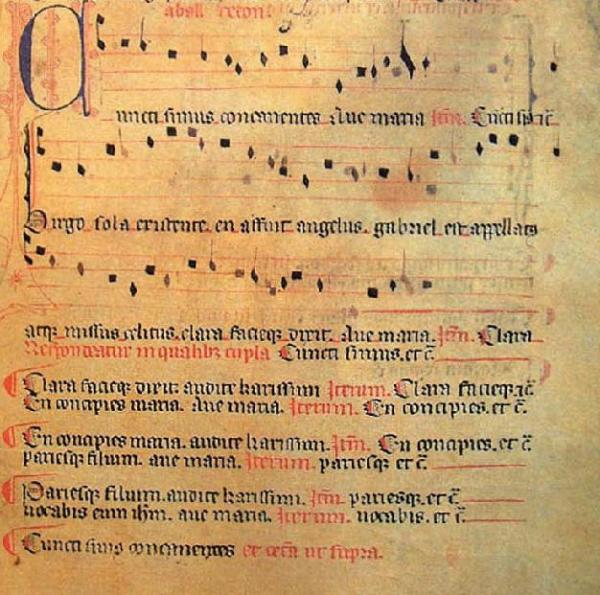
Anonimo (Spagna, sec. XIV): Cuncti simus concanentes. New London Consort, dir. Philip Pickett.
Cuncti simus concanentes: Ave Maria.
Virgo sola existente
en affuit angelus,
Gabriel est appellatus
atque missus celitus.
Clara facieque dixit: Ave Maria.
Clara facieque dixit,
audite karissimi:
En concipies, Maria,
pariesque filium,
audite karissimi,
bocabis eum Jhesum.
Alfred Bachelet (26 febbraio 1864 - 10 febbraio 1944): Chère nuit, mélodie (1897) su testo di Eugène Adénis-Colombeau. Barbara Hendricks, soprano; Michel Dalberto, pianoforte.
Voici l’heure bientôt.
Derrière la colline
je vois le soleil qui décline
Et cache ses rayons jaloux…
J’entends chanter l’âme des choses
Et les narcisses et les roses
M’apportent des parfums plus doux!
Chére nuit aux clartés sereines
Toi que ramènes le tendre amant
Ah! descends et voile la terre
De ton mystère calme et charmant.
Mon bonheur renaît sous ton aile
O nuit plus belle que les beaux jours:
Ah! lève-toi pour faire encore
Briller l’aurore de mes amours.













 la regina gioiosa