Valses tristes
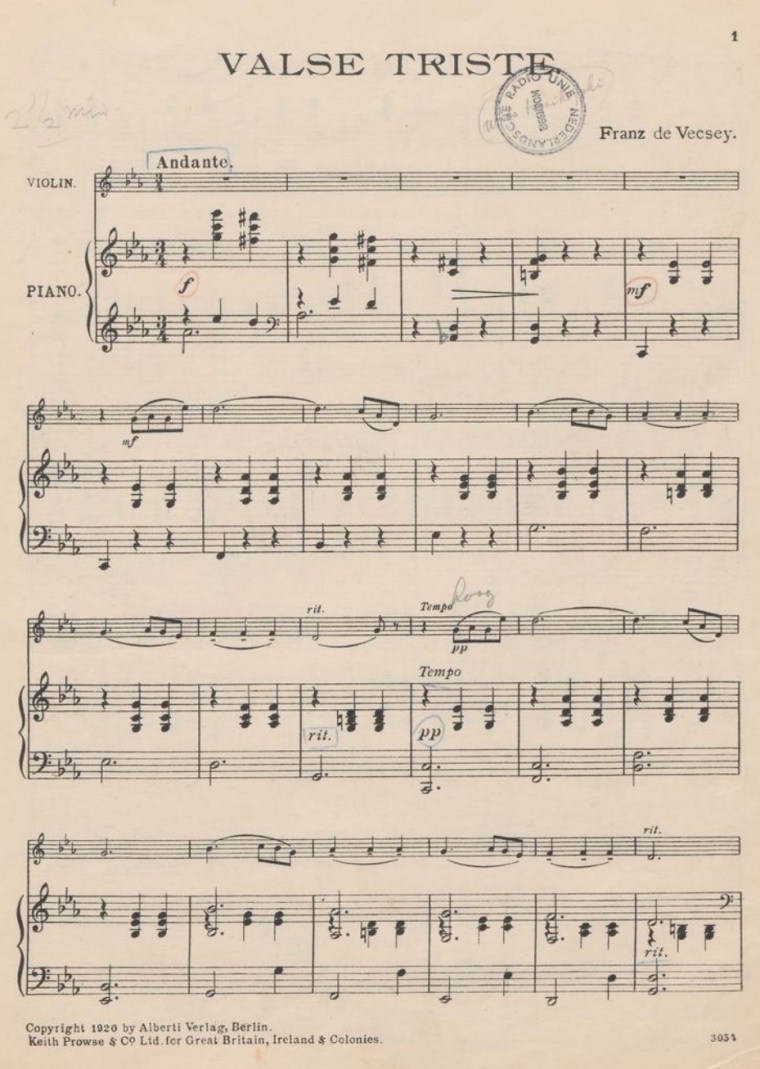
Franz von Vecsey (1893 - 1935): Valse triste in do minore per violino e pianoforte (1913). Svetlin Roussev, violino; Yeol Eum Son, pianoforte.

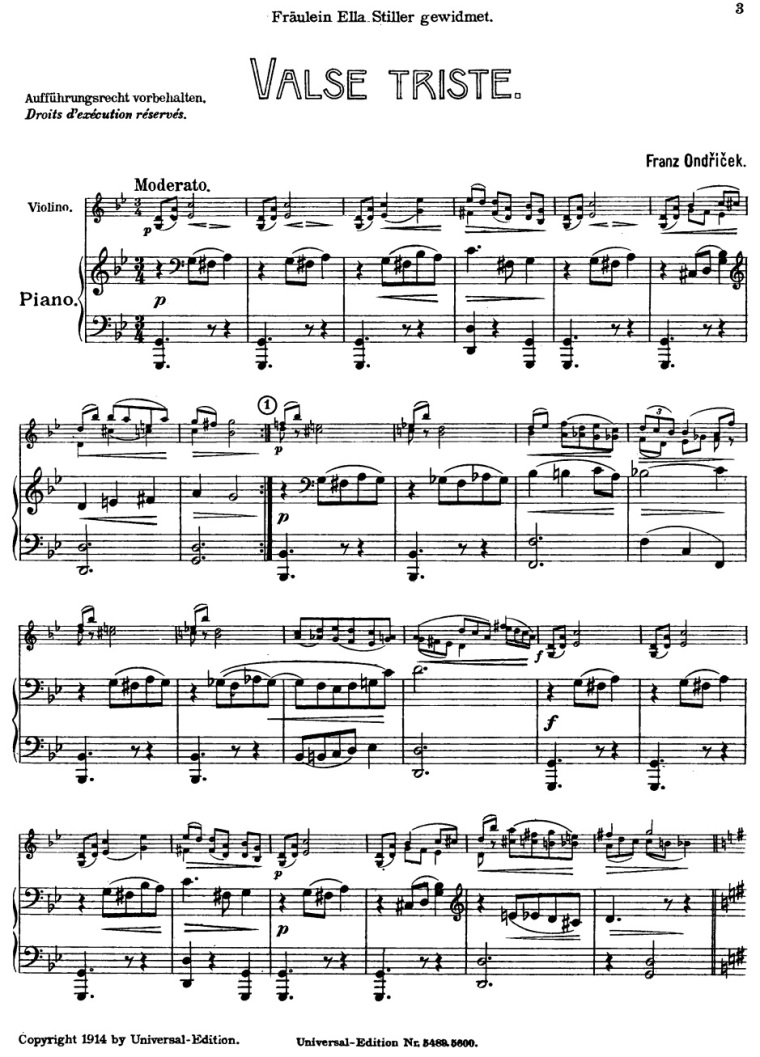
František Ondříček (29 aprile 1857 - 1922): Valse triste in sol minore per violino e pianoforte (1914). Václav Snítil, violino; Josef Hála, pianoforte.

Via dalla pazza folla
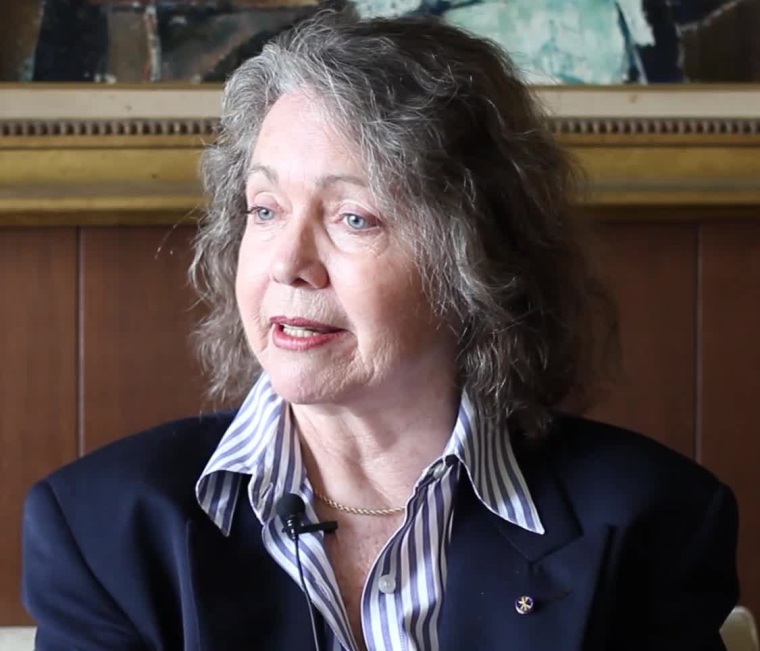
Craig Armstrong (29 aprile 1959) e altri: Far from the Madding Crowd, musiche per il film diretto nel 2015 da Thomas Vinterberg, 4° adattamento cinematografico dell’omonimo romanzo di Thomas Hardy.
- Opening
- Alexander Ewing (1830-1895): Jerusalem the Golden. The Dorset Singers
- Corn Exchange
- The Great Misunderstanding
- Spring Sheep Dip
- Oak Returns
- Tradizionale: Let No Man Steal Your Thyme, arrangiamento di Neil MacColl e Kate St John. Cantato da Carey Mulligan e Michael Sheen
- Never Been Kissed
- Hollow in the Ferns
- Bathsheba and Troy Wedding
- Tradizionale: Dribbles of Brandy, arrangiamento di Eliza Carthy e altri
- Tradizionale: Swiss Boy, arrangiamento di Eliza Carthy e altri
- Fanny and Troy
- Troy Swims Out
- Tradizionale: O come, O come, Emmanuel. The Dorset Singers
- Boldwood Variation
- Tradizionale: Michael Turner’s Waltz, arrangiamento di Eliza Carthy e altri
- Tradizionale: Jenny Lind Polka, arrangiamento di Eliza Carthy e altri
- Time Moves On
- Oak Leaves
- Bathsheba and Oak Unite
- End Credits
- Tradizionale: Let No Man Steal Your Thyme (c.s.)
- Far from the Madding Crowd Love Theme

Saltarello
Anonimo (sec. XIV): Saltarello. Studio der frühen Musik, dir. Thomas Binkley.
Nato a Cleveland il 26 dicembre 1931, Thomas Binkley studiò musica e musicologia presso le Università dell’Illinois e di Monaco; nel capoluogo bavarese si stabilì nel 1959, e l’anno seguente vi fondò lo «Studio der frühen Musik», destinato a diventare uno dei più famosi ensemble di musica medievale e rinascimentale. Docente alla Schola Cantorum Basiliensis dal 1973 al ’77, Binkley rientrò poi negli Stati Uniti: insegnò per due anni alla Stanford University e nel 1979 fondò l’Early Music Institute presso l’Università dell’Indiana, a Bloomington; in questa città morì il 28 aprile 1995.
Assai cospicua è la produzione discografica dello «Studio der frühen Musik». Il brano che sottopongo alla vostra attenzione fu originariamente pubblicato in un disco del 1970 (etichetta Telefunken) interamente dedicato alla musica dei trovatori; è costituito dall’accostamento di due danze diverse ma affini, la prima in ritmo binario, la seconda in ritmo ternario: si tratta di due dei quattro saltarelli trascritti in un manoscritto trecentesco di origine toscana, oggi conservato nella British Library con la segnatura Add. 29987, la più antica fonte pervenutaci per quanto riguarda le danze di questo genere.

Sinfonia a fumetti
Michael Daugherty (28 aprile 1954): Metropolis Symphony (1988–93). Nashville Symphony Orchestra, dir. Giancarlo Guerrero.
- Lex (1991)
- Krypton (1993) [10:03]
- MXYZPTLK (1988) [16:53]
- Oh, Lois! (1989) [23:55]
- Red Cape Tango (1993) [29:03]
I began composing my Metropolis Symphony in 1988, inspired by the celebration in Cleveland of the fiftieth anniversary of Superman’s first appearance in the comics. When I completed the score in 1993, I dedicated it to the conductor David Zinman, who had encouraged me to compose the work, and to the Baltimore Symphony Orchestra. The Metropolis Symphony evokes an American mythology that I discovered as an avid reader of comic books in the fifties and sixties. Each movement of the symphony — which may be performed separately — is a musical response to the myth of Superman. I have used Superman as a compositional metaphor in order to create an independent musical world that appeals to the imagination. The symphony is a rigorously structured, non-programmatic work, expressing the energies, ambiguities, paradoxes, and wit of American popular culture. Like Charles Ives, whose music recalls small-town America early in our century, I draw on my eclectic musical background to reflect on late-twentieth-century urban America. Through complex orchestration, timbral exploration, and rhythmic polyphony, I combine the idioms of jazz, rock, and funk with symphonic and avant-garde composition.
I. Lex
« Lex » derives its title from one of Superman’s most vexing foes, the supervillain and business tycoon Lex Luthor. Marked “Diabolical” in the score, this movement features a virtuoso violin soloist (Lex) who plays a fiendishly difficult fast triplet motive in perpetual motion, pursued by the orchestration and a percussion section that includes four referee whistles placed quadraphonically on stage.
II. Krypton
« Krypton » refers to the exploding planet from which the infant Superman escaped. A dark, microtonal soundworld is created by glissandi in the strings, trombone, and siren. Two percussionists play antiphonal fire bells throughout the movement, as it evolves from a recurring solo motive in the cellos into ominous calls from the brass section. Gradually the movement builds toward an apocalyptic conclusion.
III. Mxyzptlk
« Mxyzptlk » is named after a mischievous imp from the fifth dimension who regularly wreaks havoc on Metropolis. This brightly orchestrated movement is the scherzo of the symphony, emphasizing the upper register of the orchestra. It features two dueling flute soloists who are positioned stereophonically on either side of the conductor. Rapidly descending and ascending flute runs are echoed throughout the orchestra, while open-stringed pizzicato patterns, moving strobe-like throughout the orchestra, are precisely choreographed to create a spatial effect.
IV. Oh, Lois!
« Oh, Lois! » invokes Lois Lane, news reporter at the Daily Planet alongside Clark Kent (alias Superman). Marked with the tempo “faster than a speeding bullet,” this five-minute concerto for the orchestra uses flexatone and whip to provide a lively polyrhythmic counterpoint that suggests a cartoon history of mishaps, screams, dialogue, crashes, and disasters, all in rapid motion.
V. Red Cape Tango
« Red Cape Tango » was composed after Superman’s fight to the death with Doomsday, and is my final musical work based on the Superman mythology. The principal melody, first heard in the bassoon, is derived from the medieval Latin death chant “Dies irae.” This dance of death is conceived as a tango, presented at times like a concertino comprising string quintet, brass trio, bassoon, chimes, and castanets. The tango rhythm, introduced by the castanets and heard later in the finger cymbals, undergoes a gradual timbral transformation, concluding dramatically with crash cymbals, brake drum, and timpani. The orchestra alternates between legato and staccato sections to suggest a musical bullfight.
Michael Daugherty

Un Quartetto di Hyacinthe Jadin
Hyacinthe Jadin (27 aprile 1776 - 1800): Quartetto per archi in la maggiore op. 1 n. 2 (1795). Quatuor Franz Joseph.
- Allegro
- Menuet [5:35]
- Pastoral: Andante [8:58]
- Finale: Presto [12:58]
![]()
Andante grazioso
Andreas Jakob Romberg (27 aprile 1767 - 1821): Quintetto in fa maggiore per flauto, violino, 2 viole e violoncello op. 41 n. 3 (1811). Vladislav Brunner, flauto; Viktor Šimčisko, violino; Milan Telecký e Ján Cút, viole; Juraj Alexander, violoncello.
- Allegro
- Adagio – Andante grazioso [8:46]
- Minuetto: Allegretto
- Vivace [5:16]

Riccioli d’argento
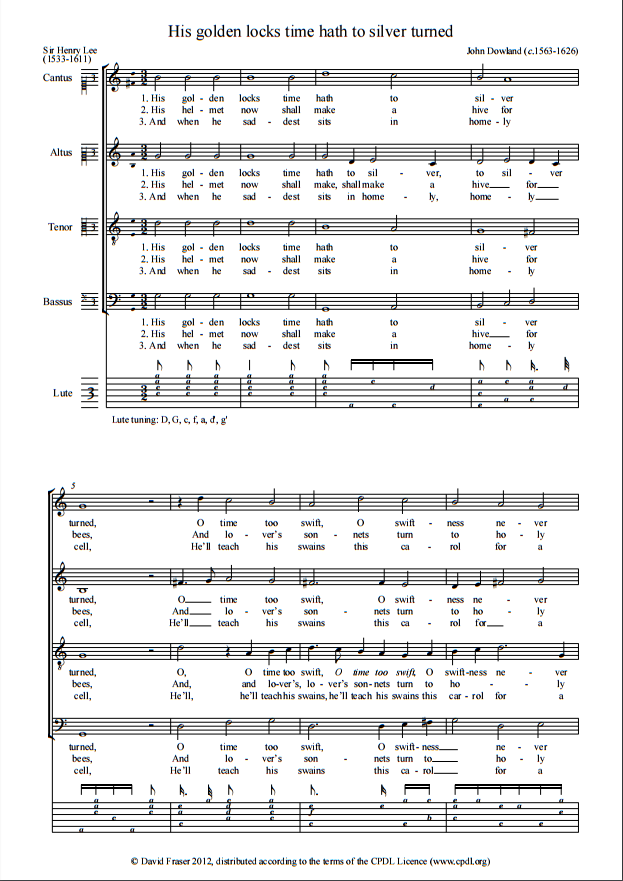
John Dowland (1563 - 1626): His golden locks, dal First Booke of Songes (1597), n. 18. Emma Kirkby, soprano; Anthony Rooley, liuto.
His golden locks Time hath to silver turned.
O Time too swift, O swiftness never ceasing:
His youth ‘gainst Time and Age hath ever spurned,
But spurned in vain; youth waneth by increasing.
Beauty, strength, youth are flowers but fading seen;
Duty, faith, love are roots, and ever green.
His helmet now shall make a hive for bees,
And lovers’ sonnets turn to holy psalms.
A man at arms must now serve on his knees,
And feed on prayers which are Age’s alms.
But though from Court to cottage he depart,
His Saint is sure of his unspotted heart.
And when he saddest sits in homely cell,
He’ll teach his swains this carol for a song:
Blest be the hearts that wish my Sov’reign well.
Curst be the soul that think her [him] any wrong.
Goddess [Ye gods], allow this aged man his right
To be your beadsman now, that was your knight.

Per corno e pianoforte
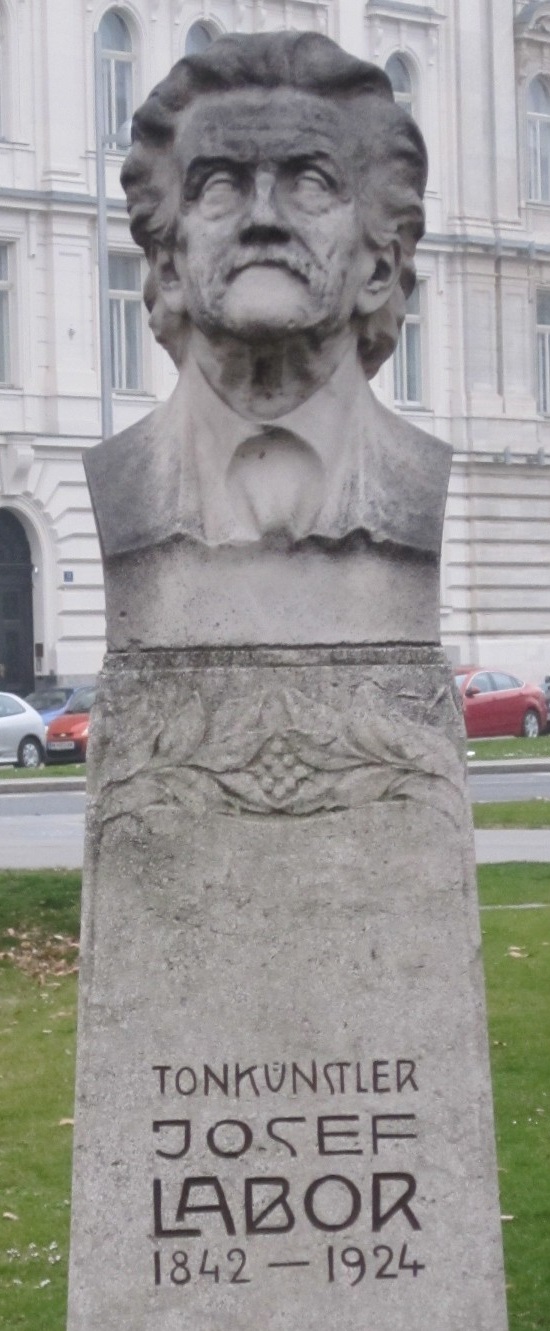
Josef Labor (1842 - 26 aprile 1924): Tema e variazioni per corno e pianoforte op. 10 (c1899). Přemysl Vojta, corno; Oliver Triendl, pianoforte.

Rondò mobile
Ernst Widmer (25 aprile 1927 - 1990): Rondo mobile per pianoforte op. 145 (1984). Carol Murta Ribeiro.
Andante mosso e appassionato
Franco Mannino (25 aprile 1924 - 2005): Concerto per violino e orchestra n. 2 op. 447 (1993). Francesco Manara, violino; Orchestra da camera Gli Armonici, dir. Umberto Bruno.
- Andante mosso e appassionato
- Ode
- Presto

Divertimento in cui si esprime una uccellaja
Alessandro Speranza (24 aprile 1724 - 1797): Divertimento per cembalo in cui si esprime una uccellaja in sol maggiore. Falerno Ducande alias Fernando De Luca.


Try to stay calm
Augusta Read Thomas (24 aprile 1964): Capricious; toccata-like da Two Thoughts About The Piano (2017). Daniel Pesca, pianoforte.

Pop Suite
Arthur Frackenpohl (23 aprile 1924 - 2019): Pop Suite per ottoni (1974); adattamento per 4 tube. The British Tuba Quartet.
- Rock
- Refrain [1:39]
- Rag [4:26]

The bryghtest myrrour
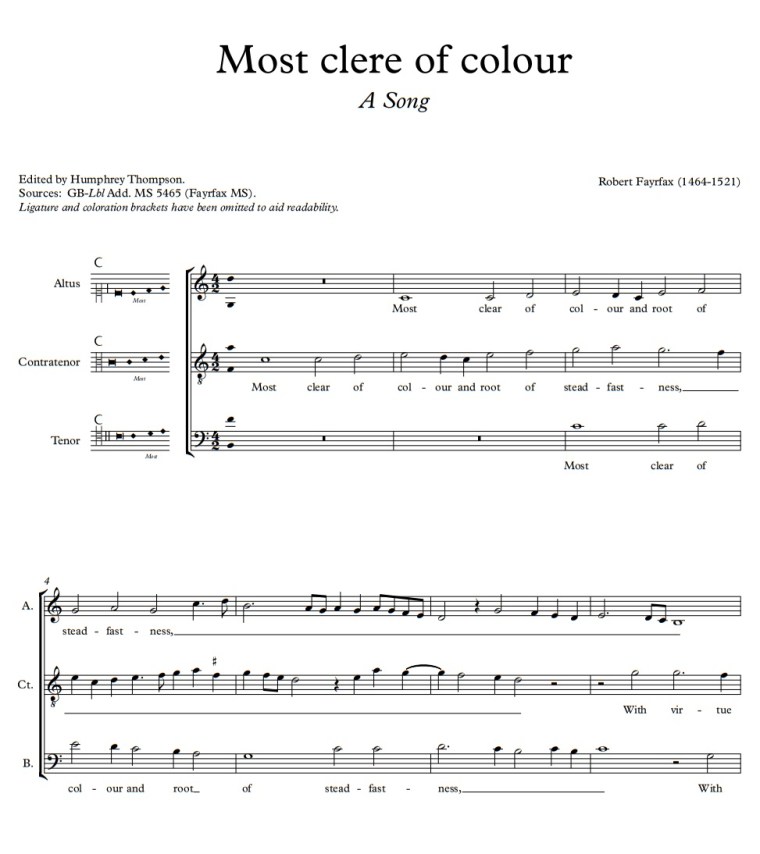
Robert Fayrfax (23 aprile 1464 - 1521): Most clere of colour per 3 voci a cappella. The Hilliard Ensemble.
Most clere of colour and rote of stedfastness,
With vertu connyng her maner is lede,
Which that passyth my mynde for to express
Of her bounte, beaute and womanhode;
The bryghtest myrrour and floure of goodlyhed,
Which that all men knowith, both more and less;
Thes vertues byn pryntyd in her doutless.

Passus duriusculus
Johann Sebastian Bach (1685 - 1750): Weinen, Klagen, Sorgen, Zagen, cantata BWV 12 su testo di Salomo Franck (forse) e Samuel Rodigast (n. 7); eseguita per la prima volta a Weimar il 22 aprile 1714. Paul Esswood, contraltista; Kurt Equiluz, tenore; Max van Egmond, basso; Tölzer Knabenchor, dir. Gerhard Schmidt-Gaden; King’s College Choir Cambridge, dir. David Willcocks; Leonhardt-Consort, dir. Gustav Leonhardt.
- Sinfonia: Adagio assai
- Coro: Weinen, Klagen, Sorgen, Zagen [2:20]
- Récitativo: Wir müssen durch viel Trübsal [8:21]
- Aria: Kreuz und Krone sind verbunden [9:19]
- Aria: Ich folge Christo nach [15:45]
- Aria: Sei getreu, alle Pein [18:33]
- Corale: Was Gott tut, das ist wohlgetan [22:50]
Il basso ostinato del coro (n. 2) della cantata bachiana è costituito da una successione cromatica discendente di quattro note (passus duriusculus : secondo le convenzioni della retorica musicale, i cromatismi ascendenti o discendenti esprimono dolore). Su questo basso ostinato Franz Liszt compose un Präludium per pianoforte (R 23, 1859; dedicato a Anton Grigor’evič Rubinštejn) che qui possiamo ascoltare nell’interpretazione di Vladimir Horowitz:
In seguito, Liszt scrisse una serie di Variationen über den Basso continuo von J. S. Bachs Kantate «Weinen, Klagen, Sorgen, Zagen» (R 24, anch’esse dedicate a A. G. Rubinštejn), composte sotto l’impressione della morte di Blandine Ollivier, la figlia che il musicista ungherese aveva avuto da Catherine-Adelaide Méran e che era defunta a Saint-Tropez l’11 settembre 1862. L’esecuzione che vi propongo è di Artur Aksenov:
Liszt rielaborò poi le variazioni in una versione organistica (R 382, dedicata a Alexander Wilhelm Gottschalg, organista e Kantor di Tiefurt), qui eseguita da Thibaut Duret all’organo Michel-Merklin-Kuyhn di Saint Louis de la Guillotière, a Lione:

Scherzo in re minore – II
Édouard Lalo (1823 - 22 aprile 1892): Trio n. 3 in la minore per violino, violoncello e pianoforte op. 26 (1880). Trio Parnassus.
- Allegro appassionato
- Presto [9:48]
- Très lent [14:17]
- Allegro molto [25:10]
Édouard Lalo: Scherzo in re minore per orchestra (1884); trascrizione del II movimento dell’op. 26. Orchestre de la Suisse Romande, dir. Ernest Ansermet.

Metamorfosi – VI
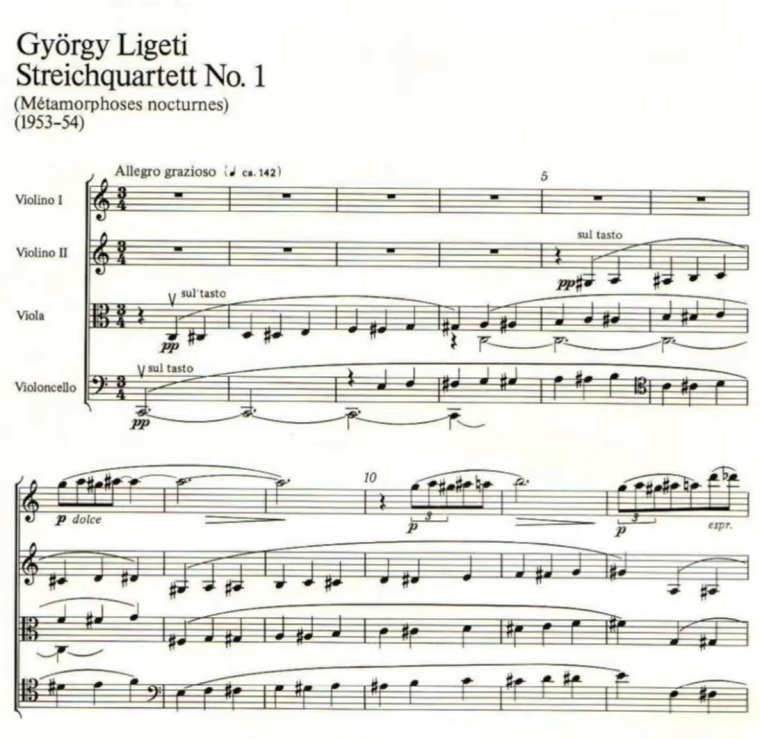
György Ligeti (1923 - 2006): Quartetto per archi n. 1, Metamorphoses nocturnes (1953-54). Kodak String Quartet.

Concerto romantico – III
Clément d’Hooghe (21 aprile 1899 - 1951): Concerto per pianoforte e orchestra, Romantisch Concerto (1949). Jozef de Beenhouwer, pianoforte; BRT filharmonisch orkest, dir. Sylveer van den Broeck.
- Lento espressivo – Allegro
- Moderato sostenuto [13:54]
- Vivo e molto leggiero [20:44]

Metamorfosi – V
Paul Hindemith (1895 - 1963): Symphonic Metamorphosis of Themes by Carl Maria von Weber (1943). SWR Symphonieorchester, dir. Dima Slobodeniouk.
- Allegro (Weber: Allegro, tutto ben marcato op. 60 n. 4)
- Scherzo (Turandot): Moderato (Weber: Turandot, musiche di scena op. 37) [4:25]
- Andantino (Weber: Andantino con moto op. 10 n. 2) [12:27]
- Marsch (Weber: Marcia. Maestoso op. 60 n. 7) [16:50]
Un’accurata guida all’ascolto delle Symphonic Metamorphosis, firmata da Sergio Sablich, si trova nel sito l’Orchestra Virtuale del Flaminio.
Di questa composizione avevamo già incontrato il II movimento nell’ambito della ricerca sulle «melodie itineranti», nella fattispecie quando ci siamo occupati dell’air chinois citato nel Dictionnaire de musique di Jean-Jacques Rousseau.

Dansflitsen
Sem Dresden (20 aprile 1881 – 1957): Dansflitsen, suite per orchestra (1951). Residentie Orkest, dir. Willem van Otterloo.
- Intrada: Alla polacca. Allegro ma non troppo
- Siciliana: Poco moderato [1:04]
- Tempo di valse: Molto allegro [3:11]
- Passamezzo: Moderato [5:03]
- Menuetto vivo: Allegro con grazia [7:10]
- Marcia funebre: Molto moderato [9:49]
- Alla Tarantella: Molto allegro [11:32]

Metamorfosi – IV
Fumio Hayasaka (1914 - 1955): Metamorfosi per orchestra (1953). Orchestra filarmonica del Giappone, dir. Tetsuji Honna.

Acerbetta fugitiva
Sigismondo d’India (c1582 - 19 aprile 1629): Ha di serpe il velen, madrigale a 5 voci (dal Primo Libro de madrigali a 5 voci, 1606, n. 5) su testo di Giovanni Battista Strozzi. La Venexiana, dir. Claudio Cavina.
Ha di Serpe il velen,
Di Tigre il morso,
E di lieve Cervetta
Quest’acerbetta fugitiva ha ‘l corso.
Ben sembr’ell’Angioletta,
Di dolcezza e di gratia à le parole,
À le guancie l’Aurora,
À gl’occhi il Sole.

Metamorfosi – III
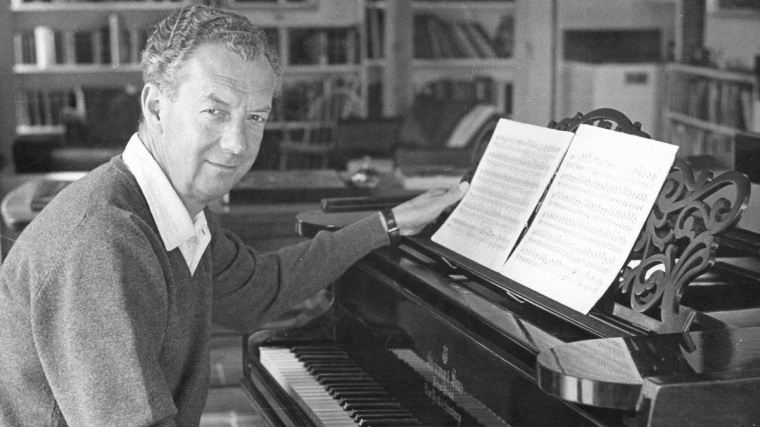
Benjamin Britten (1913 - 1976): Six Metamorphoses after Ovid per oboe solo op. 49 (1951). Heinz Holliger.
-
Pan, who played upon the reed pipe which was Syrinx, his beloved
-
Phaeton, who rode upon the chariot of the sun for one day and was hurled into the river Padus by a thunderbolt [2:10]
-
Niobe, who, lamenting the death of her fourteen children, was turned into a mountain [3:30]
-
Bacchus, at whose feasts is heard the noise of gaggling women’s tattling tongues and shouting out of boys [6:11]
-
Narcissus, who fell in love with his own image and became a flower [8:05]
-
Arethusa, who, flying from the love of Alpheus the river god, was turned into a fountain [12:07]

Gli elementi
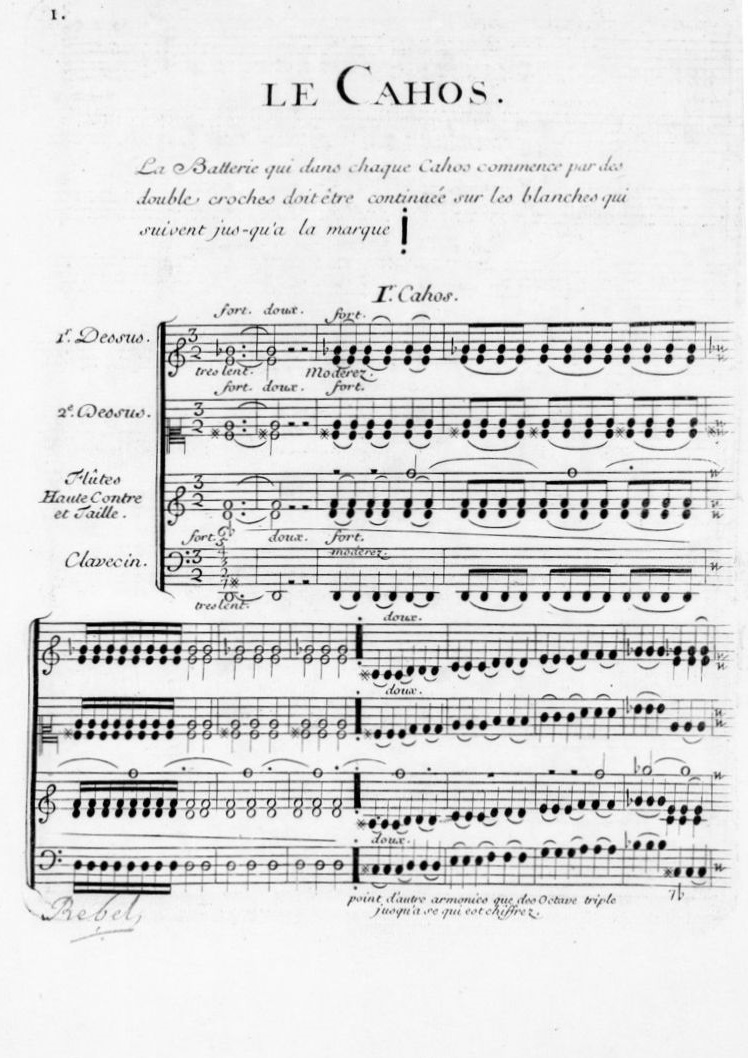
Jean-Féry Rebel (18 aprile 1666 - 1747): Les Élémens, «simphonie nouvelle» (1737). Le Concert des Nations, dir. Jordi Savall.
Ispirata dall’omonimo balletto di Michel-Richard Delalande e André-Cardinal Destouches, che Rebel aveva diretto alle Tuileries di Parigi il 3 dicembre 1721, fu eseguita la prima volta come azione coreografica — interpreti, fra gli altri, Françoise Prévost (futura consuocera di Rebel), Marie Sallé, David Dumoulin e Louis Dupré — dopo una rappresentazione della tragédie en musique di Lully Cadmus et Hermione (1673).
È una sinfonia a programma ante litteram. La parte introduttiva, intitolata Le cahos, descrive musicalmente il caos degli elementi naturali (acqua, aria, terra, fuoco) prima che essi trovassero ciascuno il proprio posto nell’ordine cosmico. L’identificazione tra caos primordiale e caos armonico (illustrata da Rebel nell’Avertissement anteposto alla partitura nella 1a edizione) fa sì che nelle prime sette battute gli strumenti eseguano simultaneamente tutti i suoni della scala: la dissonanza risolve nell’accordo perfetto coincidente con il momento in cui gli elementi, dopo l’iniziale resistenza, docilmente si conformano all’ordine cosmico. Seguono sette parti che corrispondono ai sette stadi del processo di separazione degli elementi, ognuno dei quali è rappresentato musicalmente da una sezione dell’orchestra (il basso simboleggia l’immobilità della terra, i flauti la fluidità dell’acqua e la leggerezza dell’aria, gli archi l’irrequietezza del fuoco) ed è caratterizzato da un proprio tema musicale.
- Le Cahos: L’Eau – L’Air – La Terre – Le Feu
- [Loure I:] La Terre [6:59]
- Chaconne: Le Feu [8:43]
- Ramage: L’Air [11:11]
- Rossignols [12:30]
- Rondeau: Air pour l’Amour [13:45]
- Loure [II] [14:50]
- Sicillienne [16:38]
- Caprice [17:51]
- Premier Tambourin: L’Eau [20:46]
- Second Tambourin: L’Eau [21:43]
- Premier Tambourin: L’Eau [22:35]

Metamorfosi – II
Philip Glass (1937): Metamorphosis I-III (1988). Floraleda Sacchi, arpa.

Toccata-Carillon
Ulisse Matthey (17 aprile 1876 - 1947): Toccata-Carillon. Marco Limone all’organo della Cattedrale di Chambéry.

Metamorfosi – I
Richard Strauss (1864 - 1949): Metamorphosen per 23 archi solisti (1946). Staatskapelle Weimar, dir. Antoni Wit.

Clarinetto all’ungherese
Leó Weiner (16 aprile 1885 - 1960): Ballata per clarinetto e pianoforte op. 8 (1911). Márton Egri, clarinetto; Boglárka Orgován, pianoforte.

Concerto slavo
Borys Ljatošyns’kyj (Boris Ljatošinskij; 1895 - 15 aprile 1968): Concerto slavo per pianoforte e orchestra op. 54 (1953). Evgenij Ržanov, pianoforte; Orchestra sinfonica della Radiotelevisione di Kiev, dir. Vadim Gnedaš.
- Allegro
- Lento [11:00]
- Allegro risoluto [20:43]